Leningrad & the Orchestra that Defied Hitler
Similar Content
Browse content similar to Leningrad & the Orchestra that Defied Hitler. Check below for episodes and series from the same categories and more!
Transcript
| Line | From | To | |
|---|---|---|---|
BELLS CHIME | 0:00:02 | 0:00:04 | |
WATER LAPS | 0:00:05 | 0:00:06 | |
Just over 70 years ago, all of this was threatened with destruction in | 0:00:14 | 0:00:20 | |
the war of annihilation Adolf Hitler was waging against the Soviet Union. | 0:00:20 | 0:00:26 | |
But the defenders of Leningrad would find the strength to resist | 0:00:27 | 0:00:31 | |
in unexpected places, including a concert hall. | 0:00:31 | 0:00:36 | |
We're about to listen to one of the most extraordinary | 0:00:38 | 0:00:40 | |
pieces of orchestral music ever written. | 0:00:40 | 0:00:43 | |
Extraordinary not just because of the music | 0:00:43 | 0:00:46 | |
but because of the circumstances in which it was conceived. | 0:00:46 | 0:00:49 | |
It's the work of Soviet composer Dmitri Shostakovich, | 0:00:49 | 0:00:54 | |
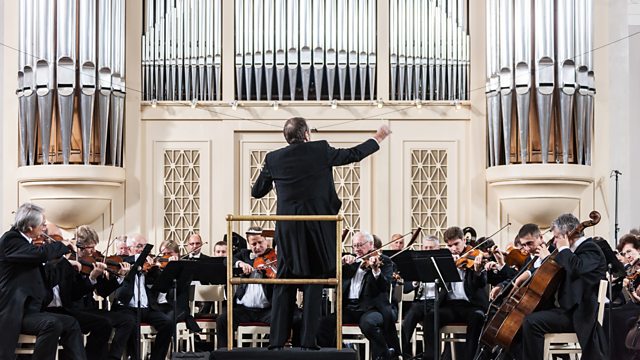
and it was performed here in the Philharmonic Hall in Leningrad, | 0:00:54 | 0:00:57 | |
a city under siege that Hitler had vowed to destroy by bombs | 0:00:57 | 0:01:02 | |
and shells, but principally by starvation. | 0:01:02 | 0:01:06 | |
MUSIC: Symphony No 7 in C Major, Op. 60 'Leningrad': IV Allegro Non Troppo composed by Dmitri Shostakovich | 0:01:06 | 0:01:12 | |
Here's another wrapped corpse being hauled by two men to be buried. | 0:01:35 | 0:01:40 | |
But alongside is the body of a woman, just abandoned. | 0:01:40 | 0:01:46 | |
But while Leningrad starved, | 0:01:48 | 0:01:50 | |
Shostakovich's symphony crossed continents and oceans, uniting | 0:01:50 | 0:01:54 | |
audiences around the world in their struggle against a common enemy. | 0:01:54 | 0:01:59 | |
'This is the BBC Home Service. | 0:02:00 | 0:02:02 | |
'It is fitting that this work should receive its first | 0:02:02 | 0:02:05 | |
'performance in this country on the anniversary of Germany's | 0:02:05 | 0:02:09 | |
'treacherous attack on Russia.' | 0:02:09 | 0:02:10 | |
And, then, against the odds, the symphony returned | 0:02:11 | 0:02:15 | |
to the besieged city, and musicians, | 0:02:15 | 0:02:17 | |
some of them literally brought back from the dead, | 0:02:17 | 0:02:20 | |
defied Hitler by giving the performance of a lifetime. | 0:02:20 | 0:02:24 | |
This is a piece that makes superhuman demands on any orchestra. | 0:02:25 | 0:02:29 | |
But a symphony written for half-starved musicians to play, | 0:02:29 | 0:02:32 | |
it ain't. | 0:02:32 | 0:02:33 | |
The symphony is going to be performed now in the same hall | 0:02:35 | 0:02:39 | |
where was played at the height of the siege. | 0:02:39 | 0:02:41 | |
The conductor is Maxim Shostakovich, the son of the composer. | 0:02:43 | 0:02:48 | |
As a three-year-old, he was evacuated from the besieged city. | 0:02:48 | 0:02:51 | |
And alongside us are a precious handful of siege survivors, | 0:02:52 | 0:02:56 | |
and eyewitnesses to the birth of the symphony | 0:02:56 | 0:03:00 | |
and to that historic performance just over 70 years ago. | 0:03:00 | 0:03:04 | |
MUSIC: Symphony No 7 in C Major, Op. 60 'Leningrad': I Allegretto composed by Dmitri Shostakovich | 0:03:06 | 0:03:11 | |
The Leningrad Symphony is a microcosm of the city in those desperate times, | 0:03:13 | 0:03:19 | |
a monument to its suffering, heroism and survival. | 0:03:19 | 0:03:23 | |
It's a work that shows that when death is on the march and | 0:03:24 | 0:03:27 | |
destruction is all around, art can be a weapon, a shield, a lifeline. | 0:03:27 | 0:03:33 | |
It's not surprisingly that a piece of music that made history should | 0:04:02 | 0:04:07 | |
have come from this place, St Petersburg, | 0:04:07 | 0:04:10 | |
or Leningrad, as it was called in the days of the Soviet Union. | 0:04:10 | 0:04:15 | |
It was built as a showcase of Russian culture, | 0:04:15 | 0:04:18 | |
with museums and concert halls, cathedrals and theatres. | 0:04:18 | 0:04:22 | |
But when war came, these very same landmarks would be used | 0:04:22 | 0:04:27 | |
by German artillery to range their guns and pinpoint targets | 0:04:27 | 0:04:32 | |
in a city that stood for everything that Adolf Hitler hated. | 0:04:32 | 0:04:37 | |
And, yet, somehow, in the midst of all the destruction, | 0:04:38 | 0:04:41 | |
the cultural heart of the city continued to beat. | 0:04:41 | 0:04:46 | |
To understand how that happened, | 0:04:47 | 0:04:49 | |
you have to understand something about the city itself. | 0:04:49 | 0:04:53 | |
Most great cities evolve over centuries, | 0:04:57 | 0:05:00 | |
but St Petersburg was willed into existence in a single generation, | 0:05:00 | 0:05:06 | |
at the behest of one man, Peter the Great, | 0:05:06 | 0:05:09 | |
to make an epic political, economic, and cultural statement. | 0:05:09 | 0:05:13 | |
Resounding statements have issued from this city ever since. | 0:05:13 | 0:05:17 | |
MUSIC: Symphony No 5 in D Minor, Op 47: Allegro Non Troppo composed by Eugene Ormandy | 0:05:17 | 0:05:22 | |
300 years ago, this was a stretch of empty marshland | 0:05:43 | 0:05:47 | |
on the north-western edge of Russia | 0:05:47 | 0:05:49 | |
between Lake Ladoga and the Gulf of Finland. | 0:05:49 | 0:05:53 | |
It was here that Peter the Great sketched his symphony of a city | 0:05:53 | 0:05:58 | |
which his successors - Catherine the Great and the tsars | 0:05:58 | 0:06:01 | |
of the Romanov dynasty - orchestrated with colonnaded palaces, | 0:06:01 | 0:06:06 | |
classical statuary, golden-spired churches, and arched bridges. | 0:06:06 | 0:06:11 | |
Peter the Great famously said he wanted his new capital city | 0:06:12 | 0:06:17 | |
to be a window on the West, | 0:06:17 | 0:06:19 | |
flooding benighted Russia with the illumination of Western modernity. | 0:06:19 | 0:06:25 | |
But a window looks both ways. | 0:06:25 | 0:06:28 | |
St Petersburg offered the West a vista on the cultural riches | 0:06:28 | 0:06:32 | |
of mother Russia, from Crime And Punishment, to Swan Lake. | 0:06:32 | 0:06:37 | |
But always alongside the culture were the politics - | 0:06:39 | 0:06:43 | |
politics of a particularly lethal kind. | 0:06:43 | 0:06:46 | |
This was a city of the proletariat as well as the intelligentsia - | 0:06:46 | 0:06:51 | |
an industrial city of docklands and factories, slums and dives, | 0:06:51 | 0:06:55 | |
poverty and unrest, which would ultimately explode into revolution. | 0:06:55 | 0:07:00 | |
Following a succession of defeats on Eastern Front | 0:07:03 | 0:07:06 | |
during the First World War, Tsar Nicholas was deposed in 1917, | 0:07:06 | 0:07:10 | |
and, in the chaos that ensued, the Bolsheviks, led by Lenin, | 0:07:10 | 0:07:14 | |
seized power in a coup d'etat. | 0:07:14 | 0:07:17 | |
Civil war, famine, | 0:07:18 | 0:07:19 | |
and the painful birth of the new Soviet system followed, | 0:07:19 | 0:07:23 | |
during which, by some estimates, as many as 15 million perished. | 0:07:23 | 0:07:28 | |
When Lenin died in 1924, Moscow got his embalmed corpse. | 0:07:32 | 0:07:38 | |
This place was left with his name, becoming Leningrad, the same year. | 0:07:38 | 0:07:43 | |
It proved to be a bad bargain. | 0:07:43 | 0:07:45 | |
Lenin's successor was Joseph Stalin. | 0:07:47 | 0:07:50 | |
He mistrusted Leningrad. | 0:07:50 | 0:07:53 | |
Ethnically diverse, culturally self-confident, | 0:07:53 | 0:07:56 | |
and politically independent, | 0:07:56 | 0:07:58 | |
the city was a challenge to his autocratic instincts. | 0:07:58 | 0:08:02 | |
And, so, once Stalin had consolidated his grip on power, | 0:08:03 | 0:08:07 | |
Leningrad got it in the neck. | 0:08:07 | 0:08:10 | |
The back of the neck. | 0:08:11 | 0:08:12 | |
MUSIC: Piano Trio No 2 in E Minor, Op 67: IV Allegretto composed by Dmitri Shostakovich | 0:08:12 | 0:08:17 | |
In 1936, Stalin unleashed his Great Terror. | 0:08:25 | 0:08:29 | |
Violent political repression had been a constant in Russian history, | 0:08:29 | 0:08:34 | |
but in intensity and scale, | 0:08:34 | 0:08:36 | |
there had been nothing to match the mass arrests, | 0:08:36 | 0:08:40 | |
show trials and mass executions of Stalin's terror, | 0:08:40 | 0:08:43 | |
inflicted across the Soviet Union. | 0:08:43 | 0:08:47 | |
In Leningrad, Black Marias would fan out from the secret police | 0:09:00 | 0:09:04 | |
headquarters, the Bolshoi Dom - the Big House - night after night, | 0:09:04 | 0:09:09 | |
to harvest fresh crops of victims. | 0:09:09 | 0:09:12 | |
Tens of thousands were sent to the labour camps of the Gulag. | 0:09:12 | 0:09:16 | |
The rest ended up here. | 0:09:21 | 0:09:23 | |
This small forest 18 miles north of Leningrad is known as | 0:09:25 | 0:09:29 | |
the Levashovo Wasteland. | 0:09:29 | 0:09:32 | |
This is where the bodies | 0:09:32 | 0:09:34 | |
of those shot by the secret police were dumped. | 0:09:34 | 0:09:37 | |
Today, family members mark the memory of loved ones by placing | 0:09:42 | 0:09:46 | |
photographs on the trees that share the ground with their bodies. | 0:09:46 | 0:09:50 | |
Between the autumn of 1936 and the summer of 1938, | 0:09:52 | 0:09:56 | |
around 68,000 Leningraders were murdered in this way, | 0:09:56 | 0:10:01 | |
their names recorded in 13 volumes of the Leningrad martyrology. | 0:10:01 | 0:10:07 | |
Across the Soviet Union, there were, by the most conservative estimates, | 0:10:07 | 0:10:12 | |
1.5 million arrests, | 0:10:12 | 0:10:14 | |
and at least 700,000 executions. | 0:10:14 | 0:10:18 | |
Death on such a scale is almost impossible to comprehend. | 0:10:19 | 0:10:24 | |
But, as Stalin remarked, | 0:10:24 | 0:10:27 | |
"One death? That's a tragedy. | 0:10:27 | 0:10:30 | |
"A million deaths? It's a statistic." | 0:10:30 | 0:10:34 | |
MUSIC: Counterplan composed by Dmitri Shostakovich | 0:10:34 | 0:10:37 | |
During the Great Terror, the composer Dmitri Shostakovich, | 0:11:05 | 0:11:10 | |
like everyone else, walked a tightrope. | 0:11:10 | 0:11:13 | |
A native of Leningrad, | 0:11:13 | 0:11:15 | |
he was a prodigy of the city's celebrated conservatory. | 0:11:15 | 0:11:18 | |
And whilst still a teenager, | 0:11:18 | 0:11:20 | |
he won international fame with his first symphony, | 0:11:20 | 0:11:23 | |
and established his claim to be the leading composer of the Soviet era. | 0:11:23 | 0:11:27 | |
But status brought no immunity | 0:11:27 | 0:11:30 | |
from Stalin's terror. | 0:11:30 | 0:11:32 | |
Far more helpful to Shostakovich | 0:11:32 | 0:11:35 | |
was the song of the Counterplan, | 0:11:35 | 0:11:37 | |
which he'd written for a hit movie in 1932, | 0:11:37 | 0:11:40 | |
and which was said to be one of Stalin's favourites. | 0:11:40 | 0:11:43 | |
In Stalin's Russia, that kind of popularity could save your life. | 0:11:43 | 0:11:48 | |
With its refrain like a fixed grin, the song of the Counterplan | 0:11:55 | 0:11:58 | |
expresses the profound optimism now demanded of Soviet composers. | 0:11:58 | 0:12:03 | |
As Stalin himself said, "Life is getting better, comrades. | 0:12:03 | 0:12:06 | |
"Life is becoming more joyous." | 0:12:06 | 0:12:09 | |
FACTORY WHISTLE BLOWS | 0:12:27 | 0:12:28 | |
The Soviet system was totalitarian. | 0:12:31 | 0:12:34 | |
It concerned itself with everything a citizen did. | 0:12:34 | 0:12:38 | |
From mining coal to writing poetry, | 0:12:38 | 0:12:40 | |
everything was the business of the state. | 0:12:40 | 0:12:42 | |
But when it came to music, | 0:12:50 | 0:12:52 | |
the Cultural Commissars were conflicted. | 0:12:52 | 0:12:55 | |
They sensed that music could be a useful tool, | 0:12:55 | 0:12:59 | |
but could it be trusted to toe the party line? | 0:12:59 | 0:13:03 | |
Vladimir Ilyich Lenin loved Beethoven, | 0:13:03 | 0:13:07 | |
but that very passion troubled him because what if his love | 0:13:07 | 0:13:11 | |
for the Appassionata Sonata were to sap his revolutionary zeal? | 0:13:11 | 0:13:15 | |
MUSIC: Piano Sonata No. 23 in F Minor, Op. 57: Appassionata composed by Ludwig van Beethoven | 0:13:15 | 0:13:20 | |
"I can't listen to music very often. | 0:13:20 | 0:13:22 | |
"It affects my nerves," Lenin complained. | 0:13:22 | 0:13:25 | |
"It makes one want to say silly things | 0:13:25 | 0:13:27 | |
"and to pat people on their little heads, | 0:13:27 | 0:13:29 | |
"people who can create such beauty living in a filthy hell. | 0:13:29 | 0:13:33 | |
"But one shouldn't pat anyone on their little heads nowadays. | 0:13:33 | 0:13:38 | |
"One should beat them. Beat them mercilessly." | 0:13:38 | 0:13:41 | |
"Not that we want to use that kind of violence against anyone, ideally. | 0:13:45 | 0:13:49 | |
"Ah, but our duty is infernally hard." | 0:13:49 | 0:13:53 | |
Under Stalin, the machinery of totalitarianism had fallen | 0:14:07 | 0:14:11 | |
into the hands of a tyrant. | 0:14:11 | 0:14:13 | |
Now everything was his business. | 0:14:13 | 0:14:16 | |
Like Lenin, Stalin was a music buff, | 0:14:16 | 0:14:19 | |
scribbling terse judgments on the sleeves of his record collection. | 0:14:19 | 0:14:23 | |
Good. Bad. So-so. | 0:14:23 | 0:14:26 | |
And when the secret police delivered long lists of names to his desk, | 0:14:27 | 0:14:32 | |
he annotated them in the same brusque style. | 0:14:32 | 0:14:35 | |
Beat, beat, and beat again. | 0:14:35 | 0:14:38 | |
Shoot them all. | 0:14:38 | 0:14:40 | |
But at a time when the pressure to conform weighed like a mountain | 0:14:51 | 0:14:56 | |
on the artistic life of the Soviet Union, | 0:14:56 | 0:14:59 | |
Shostakovich dared to break free. | 0:14:59 | 0:15:01 | |
Two years after the Song of the Counterplan, | 0:15:48 | 0:15:51 | |
Shostakovich premiered a new opera, | 0:15:51 | 0:15:52 | |
Lady Macbeth of the Mtsensk District, | 0:15:52 | 0:15:55 | |
a grisly tale of greed, lust and murder, | 0:15:55 | 0:15:58 | |
with sexually-charged music that combined | 0:15:58 | 0:16:00 | |
extremes of expressionism with radical dissonance. | 0:16:00 | 0:16:05 | |
By choosing a story set in the bad old days of the tsars, | 0:16:34 | 0:16:38 | |
Shostakovich must have felt that he'd done enough to be | 0:16:38 | 0:16:41 | |
politically correct. | 0:16:41 | 0:16:43 | |
But when Stalin finally caught up with the opera | 0:16:43 | 0:16:45 | |
two years after its premiere, | 0:16:45 | 0:16:48 | |
the composer's high-flying career came crashing down to earth. | 0:16:48 | 0:16:53 | |
At a performance at the Bolshoi Theatre in Moscow | 0:16:53 | 0:16:56 | |
on 26th January 1936, Stalin walked out after the first act. | 0:16:56 | 0:17:01 | |
This is an article that no Soviet composer in the days of Stalin | 0:17:04 | 0:17:08 | |
wanted to read, especially when it was rumoured to be | 0:17:08 | 0:17:11 | |
written by the great record collector himself. | 0:17:11 | 0:17:14 | |
It was published in Pravda two days after Stalin's dramatic walk out, | 0:17:14 | 0:17:19 | |
and its title, "Muddle Instead Of Music", | 0:17:19 | 0:17:24 | |
sets the tone for what follows. | 0:17:24 | 0:17:27 | |
"From the first minute, the listener is shocked by deliberate dissonance, | 0:17:27 | 0:17:32 | |
"by a confused stream of sound. | 0:17:32 | 0:17:35 | |
"Snatches of melody, the beginnings of a musical phrase are drowned, | 0:17:35 | 0:17:38 | |
"emerge again and disappear in a grinding and squealing roar." | 0:17:38 | 0:17:43 | |
And it gets worse. | 0:17:43 | 0:17:45 | |
"To follow this music is most difficult. | 0:17:45 | 0:17:47 | |
"To remember it, impossible. | 0:17:47 | 0:17:49 | |
"It is a game of clever ingenuity that may end very badly." | 0:17:49 | 0:17:54 | |
Maxim Shostakovich, who, as a conductor, | 0:17:57 | 0:18:00 | |
would work closely with his father, saw, as a child, | 0:18:00 | 0:18:03 | |
the crushing effects of Stalin's disfavour. | 0:18:03 | 0:18:07 | |
HE SPEAKS RUSSIAN | 0:18:07 | 0:18:08 | |
The following year, 1937, things took an even more sinister turn. | 0:18:54 | 0:19:00 | |
Marshal Tukhachevsky, a friend and supporter of Shostakovich, | 0:19:00 | 0:19:04 | |
fell foul of Stalin's paranoid suspicions. | 0:19:04 | 0:19:08 | |
The composer was ordered to report to | 0:19:08 | 0:19:10 | |
the Bolshoi Dom confession factory, | 0:19:10 | 0:19:12 | |
where he was questioned about a plot to assassinate Stalin, | 0:19:12 | 0:19:16 | |
supposedly hatched at Tukhachevsky's dacha. | 0:19:16 | 0:19:19 | |
When he failed to supply the answers required, his interrogator asked | 0:19:19 | 0:19:22 | |
him to think carefully about it overnight | 0:19:22 | 0:19:25 | |
and to return the next day with something more incriminating. | 0:19:25 | 0:19:29 | |
THUNDER RUMBLES | 0:20:27 | 0:20:29 | |
And then war came to Leningrad | 0:20:31 | 0:20:34 | |
and a new kind of terror gripped the city. | 0:20:34 | 0:20:37 | |
For the Soviet Union, the German invasion on 22nd June, 1941, | 0:20:44 | 0:20:50 | |
was swift and shocking. | 0:20:50 | 0:20:52 | |
Less than two years earlier, the Nazis and the Soviets | 0:20:52 | 0:20:56 | |
had alarmed the world by signing a non-aggression pact, | 0:20:56 | 0:21:00 | |
and, at first, Stalin simply refused to believe that Hitler had broken it. | 0:21:00 | 0:21:05 | |
The scale of the onslaught soon became clear, | 0:21:06 | 0:21:09 | |
with German Panzer divisions storming across an 1,800-mile front, | 0:21:09 | 0:21:14 | |
deep into Soviet territory. | 0:21:14 | 0:21:17 | |
East towards Moscow, south-east into the Ukraine | 0:21:17 | 0:21:20 | |
and north-east through the Baltic States towards Leningrad. | 0:21:20 | 0:21:25 | |
Perched on the north-western edge of Soviet territory, | 0:21:25 | 0:21:28 | |
Leningrad was especially vulnerable to the German advance, | 0:21:28 | 0:21:32 | |
coupled with a blocking move from the Soviet's old enemy, the Finns. | 0:21:32 | 0:21:37 | |
As the Red Army fell back, | 0:21:37 | 0:21:38 | |
the city on its neck of land between the Gulf of Finland | 0:21:38 | 0:21:42 | |
and Lake Ladoga was very soon in danger of being | 0:21:42 | 0:21:45 | |
cut off from the rest of the Soviet Union. | 0:21:45 | 0:21:47 | |
On 8th September, 1941, the encirclement was complete. | 0:21:49 | 0:21:54 | |
Hitler ordered his generals to halt their advance, | 0:21:54 | 0:21:57 | |
to hold their positions and to starve the city to death. | 0:21:57 | 0:22:01 | |
Hitler loathed Leningrad. | 0:22:04 | 0:22:07 | |
When Paris fell in the summer of 1940, he came to gloat, | 0:22:07 | 0:22:11 | |
but the sight of the French capital inspired a grudging respect. | 0:22:11 | 0:22:16 | |
For Leningrad, he had no respect. | 0:22:16 | 0:22:19 | |
To him, it was a city of subhuman "Untermensch" - | 0:22:19 | 0:22:23 | |
Slavs, Bolsheviks, Jews. | 0:22:23 | 0:22:26 | |
Their city could be destroyed, and in the cruellest way imaginable - | 0:22:26 | 0:22:31 | |
deliberate slow starvation. | 0:22:31 | 0:22:34 | |
Rationing had been introduced in Leningrad in July. | 0:22:38 | 0:22:42 | |
To begin with, the ration levels were generous - | 0:22:42 | 0:22:45 | |
workers receiving double the amount given to so-called dependents, | 0:22:45 | 0:22:49 | |
women, children, the elderly. | 0:22:49 | 0:22:51 | |
But once the siege began in earnest, the ration quickly fell | 0:22:51 | 0:22:55 | |
and for dependents, the fall was acute, | 0:22:55 | 0:22:59 | |
from 400 grams a day in July 1941, | 0:22:59 | 0:23:02 | |
to just 125 in November - | 0:23:02 | 0:23:05 | |
less than 20% of the calories needed to survive. | 0:23:05 | 0:23:09 | |
This is what 125 grams of bread would have looked like. | 0:23:11 | 0:23:16 | |
It's pitiful, but this was the daily ration for dependents | 0:23:16 | 0:23:21 | |
during one of the coldest winters even known. | 0:23:21 | 0:23:24 | |
This is good quality bread made from lovely fragrant flour. | 0:23:26 | 0:23:31 | |
During the siege, bread was adulterated with all sorts. | 0:23:33 | 0:23:37 | |
Pine shavings, animal fodder, the sweepings off the bakery floor. | 0:23:37 | 0:23:42 | |
It came out looking and tasting like a lump of damp clay. | 0:23:42 | 0:23:49 | |
Yet, to a city ravaged by hunger, | 0:23:49 | 0:23:52 | |
this was the most precious thing on earth. | 0:23:52 | 0:23:55 | |
The Soviet ration system was based on principles originally | 0:23:58 | 0:24:02 | |
developed in the Gulag, where food was distributed, | 0:24:02 | 0:24:06 | |
not according to need, but according to your capacity for work. | 0:24:06 | 0:24:11 | |
But keeping a family alive did not count as work. | 0:24:11 | 0:24:14 | |
The work of sheer survival fell mostly to mothers. | 0:24:16 | 0:24:20 | |
Getting up at dawn, cold and famished, | 0:24:22 | 0:24:25 | |
summoning the energy to get out and join a bread queue, and then | 0:24:25 | 0:24:30 | |
to stand there for hours in bitter cold, exposed to artillery and bombs, | 0:24:30 | 0:24:36 | |
and all for a meagre ration of adulterated bread. | 0:24:36 | 0:24:40 | |
So what use is a composer to a city under siege? | 0:24:43 | 0:24:47 | |
What kind of work should he do? | 0:24:47 | 0:24:49 | |
Turned down for active service, | 0:24:51 | 0:24:53 | |
Shostakovich dug trenches before being assigned to | 0:24:53 | 0:24:56 | |
fire-watching duties on the roof of the Conservatory. | 0:24:56 | 0:24:59 | |
A perfect photo opportunity that produced an image that would | 0:24:59 | 0:25:02 | |
later come to define the siege. | 0:25:02 | 0:25:05 | |
Firefighter Shostakovich composing, despite the bombs and the shells. | 0:25:05 | 0:25:09 | |
And, like all the best propaganda, it was true. | 0:25:11 | 0:25:15 | |
On 19th July, just a few days after the fall of the Russian city | 0:25:15 | 0:25:19 | |
of Smolensk, he began work on a new composition - | 0:25:19 | 0:25:23 | |
a symphony, his seventh, in four movements. | 0:25:23 | 0:25:26 | |
Composers have often attempted to capture or commemorate | 0:25:33 | 0:25:36 | |
moments of war. | 0:25:36 | 0:25:38 | |
Beethoven's Eroica Symphony, Tchaikovsky's 1812 Overture, | 0:25:38 | 0:25:42 | |
but, as musicologist Marina Frolova-Walker explains, | 0:25:42 | 0:25:45 | |
none have done that in the heat of battle. | 0:25:45 | 0:25:49 | |
This is what is so unique about it because when the war started | 0:25:49 | 0:25:53 | |
Shostakovich was the only one | 0:25:53 | 0:25:55 | |
who actually started writing a symphony pretty soon after that. | 0:25:55 | 0:26:00 | |
Usually we say that time needs to pass for thoughts to be | 0:26:00 | 0:26:05 | |
packaged in symphonic form, but Shostakovich managed to do | 0:26:05 | 0:26:09 | |
it at that time and I don't know anyone else who managed to do that. | 0:26:09 | 0:26:14 | |
The most obvious place where that happens, | 0:26:14 | 0:26:16 | |
most famously in the first movement, is what has become called | 0:26:16 | 0:26:20 | |
"The Invasion Theme", | 0:26:20 | 0:26:21 | |
which starts with a side drum, takes over the whole orchestra | 0:26:21 | 0:26:24 | |
and seems almost to kind of destroy everything in its path, | 0:26:24 | 0:26:27 | |
musically speaking. | 0:26:27 | 0:26:29 | |
Look, here it is here, starting with the side drums. | 0:26:29 | 0:26:33 | |
I might give this a go. | 0:26:33 | 0:26:35 | |
And so it goes on. | 0:27:00 | 0:27:02 | |
The same inane little tune repeating and repeating a dozen times, | 0:27:02 | 0:27:06 | |
building and building, pianissimo to fortissimo, for more than 340 bars. | 0:27:06 | 0:27:12 | |
I think what he does is very original | 0:27:18 | 0:27:20 | |
and I know lots of critics say it is not. | 0:27:20 | 0:27:23 | |
You know, they said this is like Ravel's Bolero... | 0:27:23 | 0:27:26 | |
-Because of the repetition? -..because of the repetition. | 0:27:26 | 0:27:29 | |
And yet, what I think is absolutely unique about this is that war | 0:27:29 | 0:27:33 | |
has never been portrayed in this way, in this grotesque way. | 0:27:33 | 0:27:36 | |
So what Shostakovich seems to say, that any banal, ordinary thing | 0:27:36 | 0:27:42 | |
can become so terrifying and so evil. | 0:27:42 | 0:27:45 | |
Neither Hitler nor Stalin, nor anyone else, | 0:27:45 | 0:27:49 | |
they were not particularly evil geniuses. | 0:27:49 | 0:27:52 | |
They were ordinary people. One was a mediocre painter. | 0:27:52 | 0:27:56 | |
The other one, a mediocre poet, and look what happens. | 0:27:56 | 0:28:00 | |
Shostakovich was able to complete two more movements | 0:29:23 | 0:29:26 | |
of the symphony in Leningrad, | 0:29:26 | 0:29:28 | |
but at the beginning of October, | 0:29:28 | 0:29:29 | |
as the military situation deteriorated, he was airlifted | 0:29:29 | 0:29:32 | |
out of the city with the fourth and final movement incomplete. | 0:29:32 | 0:29:37 | |
For those left behind in the besieged city, | 0:30:06 | 0:30:09 | |
October marked the start of what became known as the | 0:30:09 | 0:30:12 | |
"starvation winter". | 0:30:12 | 0:30:14 | |
It was the coldest anyone could remember. | 0:30:14 | 0:30:17 | |
The first snows fell early that year in mid-October and after that, | 0:30:17 | 0:30:21 | |
temperatures plummeted, reaching record lows of minus 35 centigrade. | 0:30:21 | 0:30:27 | |
The Arctic temperatures froze the waters of Lake Ladoga, | 0:30:29 | 0:30:33 | |
allowing a few supplies to reach the city by truck at great hazard | 0:30:33 | 0:30:38 | |
across the so-called "Ice Road". | 0:30:38 | 0:30:41 | |
But even with this fragile lifeline, hunger soon began to bite. | 0:30:41 | 0:30:46 | |
Cats and dogs quickly disappeared from the streets, | 0:30:48 | 0:30:52 | |
victims of a new kind of siege cuisine in which fresh meat, | 0:30:52 | 0:30:57 | |
whatever its source, became a luxury. | 0:30:57 | 0:31:00 | |
As for the rest, a typical siege menu consisted of rissoles made | 0:31:00 | 0:31:06 | |
of mustard and carpenter's glue | 0:31:06 | 0:31:08 | |
and soup made from boiled leather belts. | 0:31:08 | 0:31:12 | |
Throughout the siege, the city was under threat from artillery | 0:31:13 | 0:31:18 | |
and air raids, but Leningrad was not blitzed to the ground. | 0:31:18 | 0:31:23 | |
For most, death would not be sudden and violent, but slow and agonising. | 0:31:23 | 0:31:29 | |
By November, the first deaths from malnutrition were being reported. | 0:31:31 | 0:31:36 | |
The authorities insisted on the use of the word "dystrophy" - | 0:31:36 | 0:31:40 | |
a euphemism that failed to obscure a terrible truth. | 0:31:40 | 0:31:45 | |
Leningrad was starving. | 0:31:45 | 0:31:47 | |
This is a very compelling, shocking photograph. | 0:31:51 | 0:31:55 | |
On the face of it, it looks like a bent old woman hauling her son... | 0:31:55 | 0:32:01 | |
..but it's perfectly possible that they were husband and wife. | 0:32:03 | 0:32:08 | |
The effect of malnutrition | 0:32:10 | 0:32:14 | |
was horribly, horribly ageing. | 0:32:14 | 0:32:17 | |
Women in particular looked 20 to 30 years older than their real age. | 0:32:19 | 0:32:25 | |
But also...this young man | 0:32:33 | 0:32:38 | |
is not as well fed as he appears. | 0:32:38 | 0:32:41 | |
He's actually swollen with oedema. | 0:32:41 | 0:32:45 | |
It's one of the last stages of starvation. | 0:32:45 | 0:32:50 | |
And also he has the swarthy look | 0:32:51 | 0:32:56 | |
from skin discolouration, | 0:32:56 | 0:32:59 | |
which is one of the symptoms of starvation, | 0:32:59 | 0:33:04 | |
what, with black humour, came to be dubbed "a siege tan". | 0:33:04 | 0:33:09 | |
By December, the first mummies have appeared. | 0:33:18 | 0:33:22 | |
Corpses of loved ones | 0:33:23 | 0:33:26 | |
wrapped in fabric to be taken to | 0:33:26 | 0:33:30 | |
improvised graves. | 0:33:30 | 0:33:33 | |
People couldn't afford to give up wood for proper coffins. | 0:33:33 | 0:33:38 | |
What a tragic, tragic picture. | 0:33:41 | 0:33:43 | |
This is a photograph from Orphanage 38. | 0:33:46 | 0:33:51 | |
Orphanage staff reported dying mothers | 0:33:54 | 0:33:58 | |
using the very last of their strength to carry their babies | 0:33:58 | 0:34:02 | |
and small children to the orphanage to leave them there... | 0:34:02 | 0:34:08 | |
..and then to go home to die. | 0:34:09 | 0:34:12 | |
Life in the besieged city came to be measured out | 0:34:20 | 0:34:24 | |
by the ticks of a metronome. | 0:34:24 | 0:34:26 | |
It was broadcast on Radio Leningrad in the breaks between programmes | 0:34:28 | 0:34:32 | |
and was meant to show that the city still lived. | 0:34:32 | 0:34:36 | |
This was the soundtrack of the siege, | 0:34:39 | 0:34:42 | |
at least until the symphony appeared. | 0:34:42 | 0:34:45 | |
It became a truism of the times that everyone had their own siege. | 0:34:47 | 0:34:52 | |
THEY GREET EACH OTHER | 0:34:58 | 0:35:00 | |
The memories of 91-year-old Olga Kvade remain pin sharp. | 0:35:26 | 0:35:31 | |
Olga, how old were you when the siege began and what were you doing? | 0:35:33 | 0:35:38 | |
Far away from the suffering city, | 0:39:36 | 0:39:38 | |
Shostakovich struggled to complete the Seventh Symphony. | 0:39:38 | 0:39:42 | |
Evacuated to Moscow, he and his family soon had to | 0:39:42 | 0:39:45 | |
flee from there too as the Germans continued their inexorable advance. | 0:39:45 | 0:39:50 | |
Along with thousands of other refugees, | 0:39:51 | 0:39:53 | |
they travelled by train hundreds of miles east. | 0:39:53 | 0:39:57 | |
After a chaotic seven-day journey, during which the score | 0:39:57 | 0:40:00 | |
of the Seventh was nearly lost forever, they ended up in Kuybyshev, | 0:40:00 | 0:40:05 | |
the Soviet Union's provisional wartime capital | 0:40:05 | 0:40:07 | |
on the banks of the Volga river. | 0:40:07 | 0:40:10 | |
It was in this overcrowded city of refugees, | 0:40:10 | 0:40:13 | |
in cramped, noisy accommodation, | 0:40:13 | 0:40:15 | |
that Shostakovich tried to find | 0:40:15 | 0:40:17 | |
a fitting resolution to his epic work... | 0:40:17 | 0:40:19 | |
..a musical victory that he hoped would inspire | 0:40:21 | 0:40:23 | |
the ultimate military victory. | 0:40:23 | 0:40:26 | |
But how do you write out musically victory | 0:40:28 | 0:40:32 | |
when victory is not in sight, | 0:40:32 | 0:40:33 | |
because quite a lot of people thought at this time | 0:40:33 | 0:40:35 | |
the war was lost? | 0:40:35 | 0:40:37 | |
It was such a huge devastating moment, so there wasn't even a chink | 0:40:37 | 0:40:42 | |
of light at the end of the tunnel and the torment is in that finale. | 0:40:42 | 0:40:46 | |
I think the torment of him trying to write this finale, | 0:40:46 | 0:40:50 | |
but also the torment that people are going on on the way, this victory. | 0:40:50 | 0:40:53 | |
Somehow this, again, it coincides. | 0:40:53 | 0:40:56 | |
The compositional process coincides with the war. | 0:40:56 | 0:41:00 | |
People can say you can't read all this into music, | 0:41:06 | 0:41:09 | |
but this is what happens with music, which is programmatic. | 0:41:09 | 0:41:12 | |
So it's telling a story? | 0:41:12 | 0:41:14 | |
Yes, and he has to get through gradually, | 0:41:14 | 0:41:17 | |
literally semitone by semitone, he moves up, another page of music and | 0:41:17 | 0:41:22 | |
then he moves another semitone up and then another page, so it's going | 0:41:22 | 0:41:26 | |
painstakingly slowly, but then, when it finally comes, yeah, | 0:41:26 | 0:41:30 | |
then there's this sense of elation. | 0:41:30 | 0:41:33 | |
He must have been very pleased with himself. | 0:41:35 | 0:41:37 | |
He usually was when he wrote something good. | 0:41:37 | 0:41:40 | |
In Leningrad, the metronome ticked on | 0:42:13 | 0:42:16 | |
but it was beginning to sound like a death rattle | 0:42:16 | 0:42:19 | |
rather than a heartbeat. | 0:42:19 | 0:42:22 | |
The musical life of the city, | 0:42:22 | 0:42:24 | |
a vital boost to morale throughout the summer and autumn, had continued | 0:42:24 | 0:42:28 | |
with concerts and broadcasts, right up until the end of December 1941. | 0:42:28 | 0:42:33 | |
But now, as the new year began, the city's one remaining orchestra, | 0:42:34 | 0:42:38 | |
the Radiokom, based at the Radio House, was near collapse. | 0:42:38 | 0:42:44 | |
A stark memo from the time reads, | 0:42:44 | 0:42:47 | |
"Leader, first violins - dead. | 0:42:47 | 0:42:50 | |
"Bassoon - near death. | 0:42:50 | 0:42:52 | |
"Senior percussionist - dead." | 0:42:52 | 0:42:56 | |
METRONOME TICKS | 0:42:56 | 0:43:00 | |
But it was in the snow-choked courtyards, frozen stairwells | 0:43:05 | 0:43:09 | |
and cramped rooms of the city's communal apartment blocks, | 0:43:09 | 0:43:13 | |
that the daily grind of survival was at its most implacable. | 0:43:13 | 0:43:17 | |
In this painstakingly reconstructed siege room, | 0:43:21 | 0:43:25 | |
you can sense the claustrophobic atmosphere of a domestic nightmare. | 0:43:25 | 0:43:30 | |
It was a world in which mundane objects took on huge significance. | 0:43:34 | 0:43:39 | |
A homemade oil lamp, nicknamed a smoker, | 0:43:40 | 0:43:43 | |
that gave off more fumes than light. | 0:43:43 | 0:43:46 | |
The speaker wired to Radio Leningrad for when the electricity was working. | 0:43:46 | 0:43:52 | |
The child's sledge, the szaky, | 0:43:52 | 0:43:55 | |
now used to haul wood, water and corpses. | 0:43:55 | 0:44:00 | |
An improvised stove fed with scraps of anything that would burn... | 0:44:02 | 0:44:06 | |
..as siege survivor Tamara Korol'Kevich recalls. | 0:44:08 | 0:44:12 | |
During the dead days of December, January and February, | 0:44:43 | 0:44:47 | |
when it was dark for 18 out of 24 hours, any time not spent queuing | 0:44:47 | 0:44:52 | |
for bread or scrounging for wood, | 0:44:52 | 0:44:54 | |
was spent daydreaming about food, | 0:44:54 | 0:44:57 | |
reading and, for some, writing a diary. | 0:44:57 | 0:45:00 | |
One of the most revealing of these siege diaries | 0:45:02 | 0:45:05 | |
was written by Elena Kochina, a scientist, whose observations | 0:45:05 | 0:45:11 | |
have the calm objectivity of her profession. | 0:45:11 | 0:45:13 | |
Just before the Germans closed around the city, | 0:45:15 | 0:45:19 | |
Elena's laboratory was evacuated and she had the chance to leave, | 0:45:19 | 0:45:24 | |
but she delayed because her baby daughter Lena had a slight fever. | 0:45:24 | 0:45:29 | |
It was a fateful decision. | 0:45:29 | 0:45:31 | |
A few days later, Leningrad was cut off. | 0:45:31 | 0:45:35 | |
Elena, the baby and her husband Dima were trapped, | 0:45:35 | 0:45:40 | |
and when the starvation winter came, | 0:45:40 | 0:45:43 | |
the bonds of love within this little family | 0:45:43 | 0:45:45 | |
were strained to breaking point. | 0:45:45 | 0:45:48 | |
Elena kept her baby alive on millet porridge eked out from a small | 0:45:49 | 0:45:54 | |
supply she had managed to stockpile at the very start of the siege. | 0:45:54 | 0:45:58 | |
But one day, she discovers that her husband Dima has been stealing it. | 0:45:59 | 0:46:05 | |
"26th November. Today when I unexpectedly came into the room, | 0:46:07 | 0:46:12 | |
"I found Dima hurriedly chewing the millet. | 0:46:12 | 0:46:16 | |
"'Don't you dare eat it,' I yelled, losing control of myself. | 0:46:16 | 0:46:20 | |
"'Shut up. I can't help myself.' | 0:46:20 | 0:46:23 | |
"His eyes looked at me with despair. | 0:46:23 | 0:46:26 | |
"I shut up and my anger passed. | 0:46:26 | 0:46:28 | |
"I began to pity him. | 0:46:28 | 0:46:30 | |
"I now take the millet with me when I leave the house. | 0:46:30 | 0:46:34 | |
"Dima is angry at me, but he keeps quiet. | 0:46:34 | 0:46:37 | |
"13th December. Lena is sick. | 0:46:39 | 0:46:42 | |
"Dima doesn't help me any more. | 0:46:42 | 0:46:46 | |
"He doesn't even play with Lena. | 0:46:46 | 0:46:48 | |
"He only goes willingly to the bread store for our rations. | 0:46:48 | 0:46:52 | |
"He's probably eating bits of it on the way back home. | 0:46:54 | 0:46:57 | |
"6th January. Lice torment both of us a lot. We sleep together. | 0:46:59 | 0:47:05 | |
"There's only one bed in the room. | 0:47:05 | 0:47:07 | |
"But even through padded coats, it's unpleasant for us | 0:47:07 | 0:47:11 | |
"to feel one another's touch. | 0:47:11 | 0:47:14 | |
"We've never been as remote from one another. | 0:47:14 | 0:47:17 | |
"Each of us struggles silently with our own suffering. | 0:47:18 | 0:47:22 | |
"10th January. Lena has forgotten how to talk. | 0:47:23 | 0:47:28 | |
"She's no longer able to stand or even to sit up. | 0:47:28 | 0:47:32 | |
"Her skin hangs in creases. She sings quietly all the time. | 0:47:32 | 0:47:37 | |
"Evidently, she's begging to eat. | 0:47:37 | 0:47:41 | |
"I kissed her eyes. The eyes of a hungry little wolf. | 0:47:41 | 0:47:45 | |
"'You're doing that on purpose,' Dima said. | 0:47:45 | 0:47:47 | |
"'You're purposely caressing Lena. You want to torment me.' | 0:47:47 | 0:47:51 | |
"12th January. I took Lena to the clinic. | 0:47:53 | 0:47:57 | |
"Waiting for the doctor, I put her on the table. | 0:47:57 | 0:48:00 | |
"'Don't leave that child unattended,' a nurse whispered. | 0:48:00 | 0:48:04 | |
"'We've had cases of children being kidnapped.' | 0:48:05 | 0:48:08 | |
"Kidnapped, she means, for food, by cannibals." | 0:48:08 | 0:48:13 | |
Throughout the starvation winter, | 0:48:16 | 0:48:19 | |
rumours of cannibalism were rife in the city. | 0:48:19 | 0:48:22 | |
In the bread queues, people whispered about gangs who snatched | 0:48:22 | 0:48:26 | |
babies or lured victims to abandoned apartments, | 0:48:26 | 0:48:30 | |
where they were murdered, butchered and their body parts eaten or sold. | 0:48:30 | 0:48:36 | |
After the war, cannibalism became one of the siege's greatest taboos - | 0:48:36 | 0:48:40 | |
a grisly legend officially denied, | 0:48:40 | 0:48:43 | |
but never entirely repressed. | 0:48:43 | 0:48:46 | |
It wasn't until the collapse of the Soviet system that researchers | 0:48:46 | 0:48:50 | |
were able to assess the hard evidence documented in the files | 0:48:50 | 0:48:54 | |
of the secret police. | 0:48:54 | 0:48:56 | |
What they discovered were not marauding gangs | 0:48:56 | 0:48:59 | |
of baby-snatching murderers, but, for the most part, desperate | 0:48:59 | 0:49:03 | |
women, new to the city, without resources, work or connections, | 0:49:03 | 0:49:08 | |
sometimes even without ration cards. | 0:49:08 | 0:49:11 | |
Some scavenged flesh from the corpses that lay in the streets. | 0:49:11 | 0:49:16 | |
Others, in the most extreme cases, | 0:49:16 | 0:49:18 | |
murdered one of their own children to feed the rest. | 0:49:18 | 0:49:22 | |
These eye-witness scenes painted during the siege by artist | 0:49:24 | 0:49:28 | |
Mikhail Georgovich capture the frenzy of hunger | 0:49:28 | 0:49:33 | |
that drove some Leningraders to prey on their neighbours. | 0:49:33 | 0:49:36 | |
Nevertheless, in spite of terrible privation, | 0:49:39 | 0:49:43 | |
order in the starving city never broke down. | 0:49:43 | 0:49:46 | |
By early February 1942, in Kuybyshev, | 0:49:59 | 0:50:03 | |
the Seventh Symphony was being | 0:50:03 | 0:50:04 | |
rehearsed by the Bolshoi Theatre Orchestra which had been | 0:50:04 | 0:50:07 | |
evacuated from Moscow along with foreign embassies | 0:50:07 | 0:50:10 | |
and the political and bureaucratic machinery of the Soviet government. | 0:50:10 | 0:50:14 | |
Shostakovich, himself a refugee, | 0:50:23 | 0:50:25 | |
attended the run-through of the first two movements | 0:50:25 | 0:50:28 | |
and, as he later wrote, | 0:50:28 | 0:50:30 | |
"For half a day I rejoiced over my baby." | 0:50:30 | 0:50:33 | |
HE SPEAKS RUSSIAN | 0:50:34 | 0:50:35 | |
The conductor Samuil Samosud | 0:50:46 | 0:50:48 | |
evidently felt there was still room for improvement | 0:50:48 | 0:50:51 | |
and he tried to persuade Shostakovich to rewrite the finale | 0:50:51 | 0:50:54 | |
to include chorists and soloists with a text in praise of Stalin. | 0:50:54 | 0:50:59 | |
With characteristic evasiveness, | 0:50:59 | 0:51:01 | |
Shostakovich thanked him for his valuable remarks which, | 0:51:01 | 0:51:06 | |
as he later confided to a friend, | 0:51:06 | 0:51:08 | |
"I take into consideration but not into practice." | 0:51:08 | 0:51:11 | |
The world premiere of Shostakovich's Seventh Symphony, | 0:51:14 | 0:51:18 | |
dedicated by the composer to the city of Leningrad, | 0:51:18 | 0:51:21 | |
took place on 5th March, 1942, in the Kuybyshev Opera House. | 0:51:21 | 0:51:26 | |
Iosif Raiskin, a six-year-old evacuee from Leningrad, | 0:51:28 | 0:51:31 | |
was in the audience. | 0:51:31 | 0:51:33 | |
Later that March, the Leningrad Symphony was performed in Moscow. | 0:56:46 | 0:56:51 | |
As Shostakovich took his customary sheepish bow, | 0:56:51 | 0:56:54 | |
one observer commented, "This man is now more powerful than Hitler." | 0:56:54 | 0:56:59 | |
Shostakovich would move to Moscow, | 0:57:01 | 0:57:03 | |
where he'd remain for the rest of the war, but his Seventh Symphony | 0:57:03 | 0:57:07 | |
was about to begin a remarkable odyssey across a war-torn world. | 0:57:07 | 0:57:11 | |
Photographed on 900 pages of microfilm, | 0:57:12 | 0:57:15 | |
the score was put on a secret flight out of Moscow to Tehran, | 0:57:15 | 0:57:19 | |
then overland to Cairo and on to London and a sandbagged building in | 0:57:19 | 0:57:24 | |
Portland Place, which itself was no stranger to the deprivations of war. | 0:57:24 | 0:57:29 | |
'This is the BBC Home Service. | 0:57:31 | 0:57:34 | |
'Many of you will already know that the length of the Shostakovich...' | 0:57:34 | 0:57:37 | |
The arrival of the Leningrad Symphony at the BBC | 0:57:37 | 0:57:40 | |
caused consternation. | 0:57:40 | 0:57:42 | |
They'd heard rumours that it was big, but no-one realised just | 0:57:42 | 0:57:46 | |
how big until the microfilm pages had been turned into a score. | 0:57:46 | 0:57:50 | |
At his first rehearsal at the Maida Vale Studio, | 0:57:50 | 0:57:53 | |
conductor Sir Henry Wood timed the symphony at 78-and-a-half minutes, | 0:57:53 | 0:57:58 | |
which mean that, when broadcast, | 0:57:58 | 0:58:00 | |
it would overrun the sacred chimes of Big Ben at nine o'clock. | 0:58:00 | 0:58:04 | |
As this internal BBC memo reveals, the presentation editor, | 0:58:07 | 0:58:11 | |
a Mr Phillips, | 0:58:11 | 0:58:13 | |
suggested tentatively that the symphony be broken between the third | 0:58:13 | 0:58:17 | |
and fourth movements to accommodate the Nine O'Clock News bulletin. | 0:58:17 | 0:58:21 | |
Well, in the end, wiser deputy heads prevailed | 0:58:21 | 0:58:25 | |
and it was decided that the symphony could indeed go ahead uninterrupted. | 0:58:25 | 0:58:29 | |
And, as for the chimes of Big Ben, well, they'd just have to wait. | 0:58:29 | 0:58:34 | |
'It is fitting that this work should receive its first performance | 0:58:34 | 0:58:38 | |
'in this country on the anniversary of Germany's treacherous | 0:58:38 | 0:58:41 | |
'attack on Russia. | 0:58:41 | 0:58:43 | |
'It was written in the besieged fortress of Leningrad | 0:58:43 | 0:58:47 | |
'and the last movement interprets the faith and aspirations of Russia | 0:58:47 | 0:58:51 | |
'crystallised in its title, Victory.' | 0:58:51 | 0:58:55 | |
On the night, | 0:59:06 | 0:59:07 | |
Sir Henry Wood stormed through the Seventh in just 70 minutes | 0:59:07 | 0:59:11 | |
causing yet more panic at Broadcasting House | 0:59:11 | 0:59:14 | |
when the performance ended four minutes shy of nine o'clock. | 0:59:14 | 0:59:18 | |
But Mr Phillips in Pres vamped valiantly | 0:59:18 | 0:59:20 | |
until the chimes of Big Ben were ready | 0:59:20 | 0:59:23 | |
and the Beeb, in the words of the Director General, | 0:59:23 | 0:59:26 | |
came through "in flying colours". | 0:59:26 | 0:59:28 | |
While the BBC patted itself on the back, the Seventh's journey | 0:59:30 | 0:59:33 | |
continued via South America to New York where star conductors | 0:59:33 | 0:59:38 | |
Serge Koussevitzky, Leopold Stokowski and Arturo Toscanini | 0:59:38 | 0:59:42 | |
fought politely but determinedly for the privilege | 0:59:42 | 0:59:46 | |
of premiering the work. | 0:59:46 | 0:59:48 | |
In the end, Toscanini pulled rank. | 0:59:50 | 0:59:53 | |
As a veteran anti-fascist | 0:59:53 | 0:59:55 | |
and publically sworn enemy of the Italian dictator | 0:59:55 | 0:59:58 | |
Benito Mussolini, he secured the gig for his NBC Symphony Orchestra. | 0:59:58 | 1:00:02 | |
And so, in the same week that the staunchly anti-Soviet | 1:00:04 | 1:00:08 | |
Time magazine ran a cover story on the heroism and creative genius of | 1:00:08 | 1:00:12 | |
fireman Shostakovich, NBC informed its audience that Red Russia | 1:00:12 | 1:00:17 | |
was now America's doughty ally in the battle for freedom | 1:00:17 | 1:00:22 | |
and the proof was the Leningrad Symphony. | 1:00:22 | 1:00:24 | |
-RADIO: -'The musical work is descriptive not only of the horrors | 1:00:25 | 1:00:28 | |
'of Nazi fascism | 1:00:28 | 1:00:29 | |
'but of the indomitable will of a fighting people | 1:00:29 | 1:00:32 | |
'to crush this monster and win through to final victory and freedom | 1:00:32 | 1:00:35 | |
'for all men.' | 1:00:35 | 1:00:37 | |
Within just a year, the Leningrad Symphony had been performed | 1:00:37 | 1:00:40 | |
nearly 100 times, an unprecedented performance history for a new work. | 1:00:40 | 1:00:46 | |
There was, though, one place where it had yet to be performed. | 1:00:46 | 1:00:49 | |
The city where, of course, it meant most of all. | 1:00:49 | 1:00:53 | |
In besieged Leningrad, spring was on its way at last. | 1:00:59 | 1:01:03 | |
With a population savagely depleted by half a million deaths, | 1:01:05 | 1:01:10 | |
there was at least more food for the survivors | 1:01:10 | 1:01:13 | |
and the ration was increased, | 1:01:13 | 1:01:17 | |
even the trams were running again. | 1:01:17 | 1:01:19 | |
When people heard their bells ringing once more, | 1:01:19 | 1:01:22 | |
they greeted them like old friends, with tears in their eyes. | 1:01:22 | 1:01:26 | |
But though the city was emerging from its frozen immobility, | 1:01:28 | 1:01:33 | |
survivors were sick and exhausted. | 1:01:33 | 1:01:36 | |
Unable to generate enough warmth from their emaciated bodies, | 1:01:36 | 1:01:41 | |
they dressed in thick layers, even in the early spring sunshine. | 1:01:41 | 1:01:44 | |
And though their bodies remained cold, | 1:01:46 | 1:01:49 | |
their emotions were coming out of deep freeze. | 1:01:49 | 1:01:52 | |
Anyone who had come through the starvation winter had | 1:01:53 | 1:01:57 | |
a lot to come to terms with - | 1:01:57 | 1:01:59 | |
the heart-rending losses they had endured, | 1:01:59 | 1:02:03 | |
the unimaginable things they had witnessed and, for some, | 1:02:03 | 1:02:08 | |
the unthinkable things that they had done. | 1:02:08 | 1:02:11 | |
So what had happened to Elena, Dima and baby Lena? | 1:02:26 | 1:02:31 | |
Somehow all three survived through a mixture of sheer luck | 1:02:31 | 1:02:35 | |
and outright theft, | 1:02:35 | 1:02:37 | |
once Dima had perfected a method of stealing loaves of bread | 1:02:37 | 1:02:41 | |
using a sharpened walking stick. | 1:02:41 | 1:02:44 | |
In her diary, Elena allows herself few illusions about what | 1:02:44 | 1:02:49 | |
hunger can do to a person. | 1:02:49 | 1:02:52 | |
"Heroism, self-sacrifice, the heroic feat. | 1:02:52 | 1:02:57 | |
"Only those who are full | 1:02:57 | 1:02:59 | |
"or haven't been hungry long are capable of these. | 1:02:59 | 1:03:03 | |
"As for us, we came to know a hunger that degraded and crushed us, | 1:03:03 | 1:03:09 | |
"that turned us into animals. | 1:03:09 | 1:03:12 | |
"May those who come after us and happen to read these lines | 1:03:12 | 1:03:16 | |
"have mercy upon us." | 1:03:16 | 1:03:19 | |
As the thaw set in, the city authorities dragooned | 1:03:23 | 1:03:26 | |
Leningraders into a clean-up operation. | 1:03:26 | 1:03:30 | |
Teams of women were ordered to remove tons of yellow snow | 1:03:30 | 1:03:34 | |
encrusted with months of accumulated human filth. | 1:03:34 | 1:03:39 | |
And, as the weather improved, | 1:03:39 | 1:03:41 | |
the planting of vegetables became a top priority | 1:03:41 | 1:03:45 | |
and some Leningraders discovered their green fingers. | 1:03:45 | 1:03:49 | |
But it would take more than cabbages | 1:04:17 | 1:04:19 | |
and a clean-up to restore the city's shattered morale. | 1:04:19 | 1:04:23 | |
At some point, a party apparatchik called up the Radio House | 1:04:23 | 1:04:27 | |
and told them to take the bloody metronome off the air. | 1:04:27 | 1:04:31 | |
What the city needed was music and not just recorded music. | 1:04:34 | 1:04:39 | |
As a matter of the highest urgency, | 1:04:39 | 1:04:41 | |
the Radio House was ordered to bring its orchestra back from the dead. | 1:04:41 | 1:04:46 | |
In the whole of Leningrad there was only one conductor now left alive, | 1:05:15 | 1:05:21 | |
Karl Eliasberg. | 1:05:21 | 1:05:23 | |
On 1st March, he was summoned by the Radio House committee | 1:05:23 | 1:05:26 | |
and ordered to resume orchestral performances immediately. | 1:05:26 | 1:05:31 | |
By this stage, only 27 musicians were left, | 1:05:31 | 1:05:35 | |
only 12 of whom were even capable of playing their instruments, | 1:05:35 | 1:05:39 | |
so an appeal was broadcast asking all musicians to report immediately | 1:05:39 | 1:05:44 | |
to the Radio House. | 1:05:44 | 1:05:46 | |
Enticed by the prospects of extra rations, many turned up, | 1:05:46 | 1:05:51 | |
some with little or in fact no musical experience whatsoever. | 1:05:51 | 1:05:56 | |
Once Eliasberg had weeded them out, | 1:05:56 | 1:05:59 | |
he found he was still well short of the numbers required, | 1:05:59 | 1:06:02 | |
so, on a bicycle requisitioned by the Radio Committee, he set out | 1:06:02 | 1:06:06 | |
in search of musicians who, as the expression went, | 1:06:06 | 1:06:10 | |
had fallen down the funnel. | 1:06:10 | 1:06:12 | |
There are many legends surrounding Eliasberg and his extraordinary | 1:06:14 | 1:06:18 | |
quest for musicians in the stricken city of Leningrad. | 1:06:18 | 1:06:22 | |
But none can top the story of the drummer, Jevdet Aidarov. | 1:06:22 | 1:06:26 | |
Eliasberg had been told that Aidarov had died. | 1:06:29 | 1:06:32 | |
He went to the morgue and discovered the body | 1:06:32 | 1:06:36 | |
and he saw that the fingers of this supposed corpse were twitching. | 1:06:36 | 1:06:42 | |
"He's alive!" shouted Eliasberg | 1:06:43 | 1:06:46 | |
and, before long, Aidarov was at the Radio House | 1:06:46 | 1:06:49 | |
being nursed back to health on extra rations. | 1:06:49 | 1:06:51 | |
I'm told that this is the very side drum that Aidarov used | 1:06:53 | 1:06:57 | |
for the Leningrad Symphony when it was finally performed in Leningrad. | 1:06:57 | 1:07:01 | |
Eye-witnesses said that he hammered out the invasion rhythm | 1:07:01 | 1:07:05 | |
in the first movement with such ferocity, with such hatred, | 1:07:05 | 1:07:07 | |
that it wasn't as if this was a musical instrument | 1:07:07 | 1:07:10 | |
but a fascist's helmet. | 1:07:10 | 1:07:13 | |
Bringing half-dead musicians back to life was just the start. | 1:07:19 | 1:07:24 | |
Eliasberg's next miracle was to mould them into a working orchestra. | 1:07:24 | 1:07:28 | |
By necessity, they were a mixed bunch | 1:07:32 | 1:07:35 | |
but they had one thing in common - | 1:07:35 | 1:07:36 | |
all were veterans of the siege with the experiences | 1:07:36 | 1:07:40 | |
and the scars to show for it. | 1:07:40 | 1:07:43 | |
Tuba player Aleksander Shartovski was a front-line soldier | 1:07:43 | 1:07:46 | |
who lost his wife and son during the siege. | 1:07:46 | 1:07:49 | |
Viola player Isaac Jazinevski extinguished incendiaries that | 1:07:50 | 1:07:54 | |
rained down from Luftwaffe bombers. | 1:07:54 | 1:07:57 | |
Flautist Galina Yershova worked in a munitions factory | 1:07:57 | 1:08:01 | |
and performed for soldiers on the front line. | 1:08:01 | 1:08:05 | |
Cellist Andrej Safonov scaled the golden spires of city landmarks | 1:08:05 | 1:08:10 | |
to camouflage them with canvas and grey paint. | 1:08:10 | 1:08:14 | |
And student Jania Matus was asked to pay for the repair of her oboe | 1:08:14 | 1:08:19 | |
with a tasty dead cat. | 1:08:19 | 1:08:22 | |
Viktor Kozlov, a clarinettist who played under the conductor | 1:08:22 | 1:08:25 | |
after the war, and later wrote his biography, | 1:08:25 | 1:08:28 | |
explains how Eliasberg turned these survivors into an orchestra. | 1:08:28 | 1:08:32 | |
The first rehearsal of the reconstituted | 1:09:28 | 1:09:30 | |
Radiokom Orchestra was attended by just 14 musicians. | 1:09:30 | 1:09:35 | |
Some were so weak they couldn't climb the stairs to the | 1:09:35 | 1:09:38 | |
rehearsal room on the first floor, so they remained downstairs | 1:09:38 | 1:09:42 | |
and listened while their stronger colleagues played. | 1:09:42 | 1:09:46 | |
Leningrad had got its orchestra back. | 1:10:10 | 1:10:13 | |
Now what it needed was its symphony. | 1:10:13 | 1:10:16 | |
Aware of the huge propaganda value the symphony had | 1:10:17 | 1:10:21 | |
built during its world tour, | 1:10:21 | 1:10:22 | |
party bosses in Leningrad ordered the Radio Committee to get hold | 1:10:22 | 1:10:26 | |
of a copy of the score and get it into the city as soon as possible. | 1:10:26 | 1:10:30 | |
On 2nd July, after a perilous flight, | 1:10:34 | 1:10:37 | |
an aircraft landed in the city with a load of vital medical supplies | 1:10:37 | 1:10:42 | |
and the score of the Seventh in its hold. | 1:10:42 | 1:10:45 | |
The Leningrad Symphony had come home. | 1:10:45 | 1:10:48 | |
And this is it. | 1:10:50 | 1:10:52 | |
The full conductor's score in four volumes delivered like some | 1:10:52 | 1:10:57 | |
kind of secret weapon to the besieged city. | 1:10:57 | 1:11:00 | |
This is the very score that had been used at the Kuybyshev premiere. | 1:11:00 | 1:11:04 | |
Now, when Eliasberg opened this score for the very first time, | 1:11:04 | 1:11:08 | |
his reaction was simply to say, "This is impossible." | 1:11:08 | 1:11:11 | |
Look at the demands Shostakovich is placing on his orchestra here. | 1:11:11 | 1:11:15 | |
Eliasberg could see there were 115 musicians used for that premiere. | 1:11:15 | 1:11:18 | |
Eight horns, six trumpets, six trombones. | 1:11:18 | 1:11:21 | |
This was a piece that makes superhuman demands on any orchestra. | 1:11:21 | 1:11:25 | |
Shostakovich's Seventh may be many things, but a symphony | 1:11:25 | 1:11:29 | |
written for half-starved musicians to play it sure ain't. | 1:11:29 | 1:11:33 | |
The first performance of the Leningrad Symphony | 1:13:32 | 1:13:34 | |
in Leningrad was announced for 9th August, 1942. | 1:13:34 | 1:13:38 | |
Before the concert began, one last instrument, | 1:13:40 | 1:13:43 | |
not specified by Shostakovich, was added to the score. | 1:13:43 | 1:13:46 | |
A massive Soviet barrage targeting German artillery positions | 1:13:48 | 1:13:53 | |
and designed to ensure that the performance was not interrupted. | 1:13:53 | 1:13:56 | |
And so the stage was set for the Radiokom Orchestra, | 1:13:59 | 1:14:03 | |
conductor Karl Eliasberg, and for Dmitri Shostakovich's Leningrad | 1:14:03 | 1:14:08 | |
Symphony in front of an audience of more than 1,000. | 1:14:08 | 1:14:11 | |
No recording of the concert has survived. | 1:14:13 | 1:14:15 | |
No film, not even a photograph. | 1:14:15 | 1:14:18 | |
Nothing remains of the August 9th performance, | 1:14:18 | 1:14:21 | |
except for the memories of those who were there. | 1:14:21 | 1:14:25 | |
But these are indelible. | 1:14:25 | 1:14:27 | |
APPLAUSE | 1:21:31 | 1:21:34 | |
It took more than a concert to break the siege of Leningrad. | 1:23:25 | 1:23:30 | |
The city had another 531 days of suffering to endure | 1:23:30 | 1:23:36 | |
before the German lines were finally broken on 27th January, 1944. | 1:23:36 | 1:23:41 | |
But after the war was over, it was discovered that | 1:23:43 | 1:23:45 | |
the performance of the Leningrad Symphony that evening in August | 1:23:45 | 1:23:48 | |
did play its part in the victory that followed. | 1:23:48 | 1:23:51 | |
That night, Radio Leningrad had taken the fight directly to the | 1:23:53 | 1:23:57 | |
enemy by broadcasting the concert on loudspeakers across the front line - | 1:23:57 | 1:24:02 | |
a shrewd, psychological blow that found its mark. | 1:24:02 | 1:24:06 | |
No-one knows for certain how many Leningraders died | 1:24:57 | 1:25:01 | |
during the 872 days of the siege. | 1:25:01 | 1:25:06 | |
The most recent estimates put the death toll at half a million soldiers | 1:25:06 | 1:25:10 | |
and anywhere between 800,000 and a million civilians, | 1:25:10 | 1:25:15 | |
making Leningrad the costliest battle | 1:25:15 | 1:25:18 | |
in terms of casualties in modern history. | 1:25:18 | 1:25:21 | |
In the Piskariovskoye Cemetery, | 1:25:23 | 1:25:25 | |
civilians and soldiers are buried in 186 mass graves. | 1:25:25 | 1:25:30 | |
The inscription declares, "No-one is forgotten. Nothing is forgotten." | 1:25:32 | 1:25:37 | |
But immediately after the war, | 1:25:39 | 1:25:41 | |
forgetting was precisely what Stalin demanded. | 1:25:41 | 1:25:44 | |
With Nazi Germany defeated, | 1:25:47 | 1:25:49 | |
Stalin was once again free to pursue his vendetta against Leningrad. | 1:25:49 | 1:25:55 | |
The confession factory at the Bolshoi Dom, which had never stopped | 1:25:55 | 1:25:59 | |
processing even at the height of the siege, went into overdrive. | 1:25:59 | 1:26:03 | |
City bosses, their family, friends and associates were rounded up | 1:26:04 | 1:26:09 | |
on concocted charges, interrogated and despatched to the Gulag, | 1:26:09 | 1:26:14 | |
or the Levashovo wasteland. | 1:26:14 | 1:26:17 | |
For Shostakovich, | 1:26:20 | 1:26:21 | |
the end of the war also meant an unwelcome return of the past. | 1:26:21 | 1:26:26 | |
In 1948, the musical hero of Leningrad fell foul of Stalin | 1:26:26 | 1:26:31 | |
once again. | 1:26:31 | 1:26:33 | |
Condemned as an anti-people formalist, his work was banned. | 1:26:33 | 1:26:37 | |
But Shostakovich couldn't be forgotten - | 1:26:39 | 1:26:42 | |
a music written to defy one form of tyranny | 1:26:42 | 1:26:44 | |
could be used to resist another. | 1:26:44 | 1:26:47 | |
# Dum-dum, pum-pum-pum | 1:27:09 | 1:27:13 | |
# Dum-dum, dum-dum-dum | 1:27:13 | 1:27:16 | |
# Dum-dum, dum-dum-dum | 1:27:16 | 1:27:18 | |
# Dum-dum, dum-dum-dum. # | 1:27:18 | 1:27:21 |