The Bloodhound Adventure
Similar Content
Browse content similar to The Bloodhound Adventure. Check below for episodes and series from the same categories and more!
Transcript
| Line | From | To | |
|---|---|---|---|
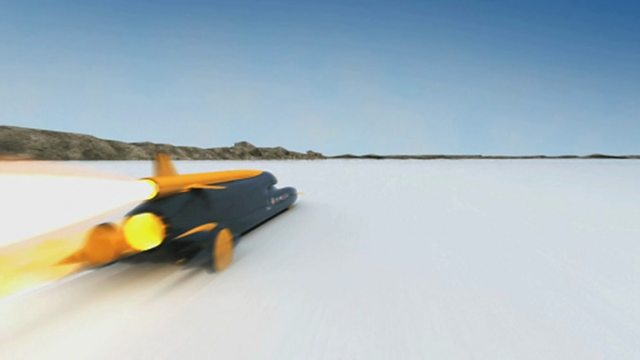
This is Bloodhound SSC. | 0:00:09 | 0:00:12 | |
It's going to be the fastest car in the world, | 0:00:12 | 0:00:15 | |
and it's designed to travel at over 1,000 miles an hour. | 0:00:15 | 0:00:18 | |
I'm Dr Yan Wong and I'm here in the home of Bloodhound | 0:00:18 | 0:00:21 | |
where scientists and engineers are all working on this amazing project. | 0:00:21 | 0:00:25 | |
And with me are children from around the country | 0:00:25 | 0:00:28 | |
who are investigating what will make this | 0:00:28 | 0:00:30 | |
one of the most incredible vehicles ever to be built. | 0:00:30 | 0:00:33 | |
It's called Bloodhound SSC. SSC stands for supersonic car. | 0:00:37 | 0:00:42 | |
It's trying to travel over 1,000 miles per hour. | 0:00:46 | 0:00:49 | |
That's faster than a bullet fired from a gun. | 0:00:49 | 0:00:52 | |
It's aiming to break the land speed record of 763 miles an hour, | 0:00:54 | 0:00:59 | |
set by this car in 1997. | 0:00:59 | 0:01:02 | |
It's taken five years | 0:01:02 | 0:01:04 | |
of the latest maths, science and engineering to design it. | 0:01:04 | 0:01:08 | |
So you've seen Bloodhound SSC now. What do you make of it? | 0:01:10 | 0:01:13 | |
It's amazing! But is it really a car? | 0:01:13 | 0:01:16 | |
It doesn't look like one. | 0:01:16 | 0:01:18 | |
Or is it a plane? | 0:01:18 | 0:01:20 | |
-Or maybe it's a bit like a boat? -ALL: What? | 0:01:20 | 0:01:23 | |
Well, that's what I want you to go and find out. | 0:01:23 | 0:01:26 | |
We've come to Mallory Park racing track in Leicestershire. | 0:01:31 | 0:01:35 | |
We want to find out why, if Bloodhound is a car, | 0:01:35 | 0:01:38 | |
it looks so different to other racing cars. | 0:01:38 | 0:01:40 | |
At the track today | 0:01:40 | 0:01:42 | |
is Bloodhound team engineer Conor and racing driver Simon. | 0:01:42 | 0:01:46 | |
Why is this car different to Bloodhound? | 0:01:46 | 0:01:49 | |
This is a distant cousin of Bloodhound. | 0:01:49 | 0:01:51 | |
This was designed to do 200 miles an hour. | 0:01:51 | 0:01:53 | |
Bloodhound, remember, does 1,000 miles an hour. | 0:01:53 | 0:01:56 | |
This car has a piston engine. | 0:01:56 | 0:01:58 | |
Bloodhound has a jet engine and a rocket motor. | 0:01:58 | 0:02:01 | |
This car is designed to go fast down the straights | 0:02:01 | 0:02:04 | |
but quick round the bends, so it's a shorter wheelbase. | 0:02:04 | 0:02:07 | |
Bloodhound, we just focus on going very fast in a straight line, | 0:02:07 | 0:02:10 | |
so a very long wheelbase. | 0:02:10 | 0:02:11 | |
Would you like to see me take this out for a run? | 0:02:11 | 0:02:14 | |
-BOTH: Yeah! -Let's do it. | 0:02:14 | 0:02:16 | |
So Bloodhound is a bit like a car but looks different | 0:02:19 | 0:02:23 | |
because it only has to go in a straight line | 0:02:23 | 0:02:25 | |
to break the land speed record - | 0:02:25 | 0:02:26 | |
it certainly won't be going around bends like this. | 0:02:26 | 0:02:30 | |
But it doesn't explain why racing cars | 0:02:35 | 0:02:38 | |
seem to come in all shapes and sizes. | 0:02:38 | 0:02:40 | |
Maybe it's something to do with how fast they go. | 0:02:40 | 0:02:43 | |
Which one of these cars is the fastest? | 0:02:43 | 0:02:45 | |
That's the interesting thing. | 0:02:45 | 0:02:47 | |
In a straight line, they're almost exactly the same top speed. | 0:02:47 | 0:02:50 | |
Conor can tell us why that's so important for Bloodhound. | 0:02:50 | 0:02:53 | |
Really great question. If you look at this car, | 0:02:53 | 0:02:56 | |
it's a really streamlined shape and really narrow wheels. | 0:02:56 | 0:02:59 | |
This car's streamlined but it's got big wings on it | 0:02:59 | 0:03:02 | |
to give it downforce and really wide tyres. | 0:03:02 | 0:03:05 | |
This is closer to Bloodhound. | 0:03:05 | 0:03:06 | |
We've got a streamlined shape and we want very narrow wheels, low drag, | 0:03:06 | 0:03:10 | |
because we're trying to be as slippery as we can | 0:03:10 | 0:03:13 | |
to go as fast as we can in a straight line. | 0:03:13 | 0:03:15 | |
We've come to a water ski park in Gloucestershire... | 0:03:20 | 0:03:22 | |
To meet Junior Championship water-skier Katie Nutt. | 0:03:22 | 0:03:26 | |
Katie started skiing when she was just four years old | 0:03:31 | 0:03:34 | |
and is now a national champion for her age. | 0:03:34 | 0:03:37 | |
Travelling at speeds of up to 32 miles an hour, | 0:03:37 | 0:03:40 | |
she certainly knows all about getting across water fast. | 0:03:40 | 0:03:43 | |
But first, we're asking Bloodhound aerodynamics expert Ben Evans | 0:03:46 | 0:03:50 | |
why he thinks Bloodhound is like a boat. | 0:03:50 | 0:03:53 | |
We think that what's going to happen, | 0:03:53 | 0:03:55 | |
even though Bloodhound is running across a solid desert surface, | 0:03:55 | 0:03:59 | |
because it's going to be going so fast, | 0:03:59 | 0:04:01 | |
it will actually be breaking up that surface | 0:04:01 | 0:04:04 | |
and turning it into almost like a liquid, | 0:04:04 | 0:04:06 | |
and it will behave a little bit like a boat. | 0:04:06 | 0:04:08 | |
So the faster it goes, the more it will raise up out of the surface. | 0:04:08 | 0:04:12 | |
What's Bloodhound got to do with waterskiing? | 0:04:12 | 0:04:15 | |
The wheels will be a little bit like Katie's water-skis. | 0:04:15 | 0:04:18 | |
As it gets faster, the car will rise up. | 0:04:18 | 0:04:20 | |
Actually, the shape of Bloodhound is very similar | 0:04:20 | 0:04:24 | |
to the shape of Katie's ski. | 0:04:24 | 0:04:26 | |
It's very long and thin and has a pointy front | 0:04:26 | 0:04:29 | |
and that's to get the drag of the car down as low as we can. | 0:04:29 | 0:04:33 | |
Is that like a rocket being very long and thin? | 0:04:33 | 0:04:36 | |
Absolutely. The reason rockets | 0:04:36 | 0:04:37 | |
are long and thin is the reason why Bloodhound is long and thin. | 0:04:37 | 0:04:41 | |
Bloodhound is a bit like a rocket, | 0:04:41 | 0:04:42 | |
just on its side, skimming across the top of the desert. | 0:04:42 | 0:04:45 | |
OK, so Katie is very low down in the water now she's moving very slowly, | 0:04:45 | 0:04:49 | |
and as the boats speeds up and pulls her, | 0:04:49 | 0:04:51 | |
she raises up out of the water. She's now on top of the water. | 0:04:51 | 0:04:55 | |
I think Bloodhound is going to do something very similar to that. | 0:04:55 | 0:04:58 | |
'Unlike Katie, Bloodhound will have to be in contact | 0:04:58 | 0:05:02 | |
'with the surface at all times | 0:05:02 | 0:05:04 | |
'in order to break the land speed record.' | 0:05:04 | 0:05:06 | |
And you can also see the waves that she's creating. | 0:05:06 | 0:05:08 | |
Bloodhound will also be creating waves, | 0:05:08 | 0:05:11 | |
but they'll be shockwaves in the air, not on the water. | 0:05:11 | 0:05:14 | |
So now her ski is right up on top of the water gliding across the top. | 0:05:14 | 0:05:18 | |
Bloodhound's wheels will have risen up on top of the desert | 0:05:18 | 0:05:21 | |
and be sliding across the top of the desert. | 0:05:21 | 0:05:24 | |
'There's one person who surely knows whether Bloodhound is a plane, | 0:05:34 | 0:05:38 | |
'and that's Bloodhound's driver Andy Green. | 0:05:38 | 0:05:41 | |
'He's also a fighter pilot for the RAF.' | 0:05:41 | 0:05:43 | |
Is Bloodhound a plane? | 0:05:43 | 0:05:45 | |
Bloodhound is very much a car. | 0:05:45 | 0:05:47 | |
The big challenge about any high-speed car | 0:05:47 | 0:05:50 | |
is keeping it on the ground, | 0:05:50 | 0:05:52 | |
and unlike an aeroplane like this, we can't generate any lift, | 0:05:52 | 0:05:55 | |
because, at five times as fast, you'd generate 25 times as much lift | 0:05:55 | 0:05:59 | |
and your car would fly. | 0:05:59 | 0:06:00 | |
We have to keep it on the ground all the time. That's difficult - | 0:06:00 | 0:06:03 | |
that's what's taken us five years of research. | 0:06:03 | 0:06:06 | |
So if you're a pilot, why are you driving Bloodhound? | 0:06:06 | 0:06:09 | |
It's a good question. | 0:06:09 | 0:06:10 | |
Of course, it is a car, | 0:06:10 | 0:06:11 | |
so why have you got a pilot who's used to flying driving the car? | 0:06:11 | 0:06:14 | |
Of course, although it's a car, it's doing supersonic speeds, | 0:06:14 | 0:06:17 | |
so it's doing jet fighter speeds, | 0:06:17 | 0:06:19 | |
it's using a jet engine and a rocket. | 0:06:19 | 0:06:21 | |
It goes five times as fast as a Formula One car. | 0:06:21 | 0:06:23 | |
It's generating huge loads. Things are happening incredibly quickly. | 0:06:23 | 0:06:27 | |
From stationary, the car will be ten miles away in 100 seconds - | 0:06:27 | 0:06:30 | |
much faster than most race cars have to cope with | 0:06:30 | 0:06:33 | |
and much more complicated, so it's very much a perfect background | 0:06:33 | 0:06:36 | |
for me as a Royal Air Force pilot. | 0:06:36 | 0:06:38 | |
That's why we've got a pilot driving the world's fastest car. | 0:06:38 | 0:06:41 | |
-So what do you think Bloodhound is? -It's shaped a lot like a plane. | 0:06:44 | 0:06:48 | |
I think it's a bit like a boat. | 0:06:48 | 0:06:50 | |
I think it's a bit like a car because it has four wheels. | 0:06:50 | 0:06:53 | |
But it's not really like any of them. | 0:06:53 | 0:06:55 | |
No. And engineers have had to understand | 0:06:55 | 0:06:58 | |
all of those things to design it. | 0:06:58 | 0:06:59 | |
That's when science is most exciting - | 0:06:59 | 0:07:01 | |
when you're doing something that no-one's done before. | 0:07:01 | 0:07:04 | |
It's an engineering adventure. | 0:07:04 | 0:07:06 | |
Bloodhound promises to be | 0:07:21 | 0:07:23 | |
the fastest car in the world but, like all cars, | 0:07:23 | 0:07:26 | |
it needs some way to power it. | 0:07:26 | 0:07:28 | |
So here at New Invention Junior School in the West Midlands, | 0:07:28 | 0:07:31 | |
we are going to build our own cars, | 0:07:31 | 0:07:33 | |
look at different ways of powering them and see which ones go fastest. | 0:07:33 | 0:07:37 | |
-Hiya. -ALL: Hello. | 0:07:37 | 0:07:38 | |
-Are you ready to build some cars? -ALL: Yeah. | 0:07:38 | 0:07:40 | |
Excellent, let's go through here. | 0:07:40 | 0:07:42 | |
Just sit down in pairs. | 0:07:42 | 0:07:44 | |
'We're going to explore two different ways of powering the cars. | 0:07:44 | 0:07:48 | |
'One involves using a rubber band tied round the car's axles, | 0:07:48 | 0:07:51 | |
'which will power the wheels. But instead of driving the wheels, | 0:07:51 | 0:07:55 | |
'the second method uses a balloon which will push the car along.' | 0:07:55 | 0:07:58 | |
The cars that you see on the road have engines | 0:08:00 | 0:08:03 | |
which directly power and turn the wheels, which is how they move. | 0:08:03 | 0:08:07 | |
However, some vehicles, like these specialist dragsters, | 0:08:07 | 0:08:10 | |
have no direct power to the wheels, | 0:08:10 | 0:08:12 | |
and instead they are pushed along by rockets or jet engines. | 0:08:12 | 0:08:15 | |
Shall we attach two balloons or one? | 0:08:23 | 0:08:25 | |
We need to attach two because it will make it go faster. | 0:08:25 | 0:08:29 | |
'Of course, you have to try experimenting with this stuff, | 0:08:29 | 0:08:32 | |
'so I'm really quite pleased | 0:08:32 | 0:08:34 | |
'that some of these kids have tried two balloons or extra elastic bands, | 0:08:34 | 0:08:37 | |
'changing the length of axles or straws.' | 0:08:37 | 0:08:40 | |
You've just got to experiment to see what works best. | 0:08:40 | 0:08:43 | |
'It's time to test our models | 0:08:43 | 0:08:45 | |
'and see which methods would work best | 0:08:45 | 0:08:47 | |
'for breaking the 1,000 miles per hour mark. | 0:08:47 | 0:08:50 | |
'But before we reveal the results, | 0:08:50 | 0:08:52 | |
'why don't you go and try out some of these designs for yourself? | 0:08:52 | 0:08:56 | |
'Up first is Bloodhound Heroes | 0:08:56 | 0:08:58 | |
'with a double balloon-powered car.' | 0:08:58 | 0:09:01 | |
Oh, pretty good, just fell off right at the end. | 0:09:04 | 0:09:07 | |
But I reckon that's two and a half seconds. | 0:09:07 | 0:09:09 | |
'Our next two racers, Teddy Bears, with a single balloon-powered car, | 0:09:12 | 0:09:16 | |
'and Jelly Beans, | 0:09:16 | 0:09:18 | |
'the only team to opt for a car powered by elastic bands, | 0:09:18 | 0:09:21 | |
'didn't quite make it to the finish line.' | 0:09:21 | 0:09:23 | |
Oh, a two-balloon car. | 0:09:23 | 0:09:25 | |
OK. No, a bit in front of it. That's it. | 0:09:29 | 0:09:32 | |
Wahey! Nicely done. One and a half seconds. | 0:09:34 | 0:09:37 | |
Right, go. | 0:09:41 | 0:09:43 | |
See? It doesn't work at all. | 0:09:43 | 0:09:44 | |
Oh, 3.85. | 0:09:46 | 0:09:48 | |
So the winner is this Bloodhound 2 balloon-powered car. | 0:09:48 | 0:09:52 | |
You've won the top prize for the land speed record | 0:09:52 | 0:09:54 | |
in New Invention Junior School, West Midlands. | 0:09:54 | 0:09:57 | |
Well done. So what did you think when you were building it? | 0:09:57 | 0:10:00 | |
Well, at first we started with one balloon, | 0:10:00 | 0:10:03 | |
but then we thought, "It's not going very fast," | 0:10:03 | 0:10:05 | |
-so then we decided to put two on to make it faster. -Yeah. | 0:10:05 | 0:10:08 | |
And they weren't inflated that huge, were they? | 0:10:08 | 0:10:11 | |
But the two made a big difference, | 0:10:11 | 0:10:13 | |
and the nozzles are pointing out backwards quite well. | 0:10:13 | 0:10:16 | |
We found that if you stuck one to the side and one to the middle | 0:10:16 | 0:10:19 | |
they wouldn't clash, so the air would come out. | 0:10:19 | 0:10:22 | |
Yeah, and the balloons keep out of each other's way as well. | 0:10:22 | 0:10:25 | |
Cos they weren't actually inflating when they were touching. | 0:10:25 | 0:10:29 | |
It rolls rather nicely, it's very smooth. | 0:10:29 | 0:10:31 | |
That must make a big difference. | 0:10:31 | 0:10:33 | |
'On our track, the elastic band car | 0:10:33 | 0:10:35 | |
'didn't have the power it needed to cross the finish line | 0:10:35 | 0:10:38 | |
'and it was the double-balloon cars which proved the most successful.' | 0:10:38 | 0:10:43 | |
So, actually, your model is really like the Bloodhound car, | 0:10:44 | 0:10:47 | |
because in normal cars, | 0:10:47 | 0:10:48 | |
the wheels are powered like those elastic band cars that we made, | 0:10:48 | 0:10:51 | |
but in Bloodhound it's powered by throwing air out the back, | 0:10:51 | 0:10:55 | |
either with a jet engine or a rocket. | 0:10:55 | 0:10:56 | |
This is actually quite similar to the way Bloodhound is propelled. | 0:10:56 | 0:11:00 | |
So Bloodhound is a bit like a boat, a plane and a car, | 0:11:10 | 0:11:13 | |
but that doesn't answer the question of what it's like to drive. | 0:11:13 | 0:11:16 | |
What do you think it would be like sitting in that cockpit | 0:11:16 | 0:11:19 | |
accelerating to 1,000 miles an hour? | 0:11:19 | 0:11:21 | |
-Really exciting. -Really frightening. | 0:11:21 | 0:11:24 | |
I'm sure it would be both of those but I bet there's a lot more to it | 0:11:24 | 0:11:28 | |
and I'd like you to find out. | 0:11:28 | 0:11:30 | |
This is the man who's going to take his life in his hands | 0:11:36 | 0:11:39 | |
driving Bloodhound. | 0:11:39 | 0:11:41 | |
Andy Green is a fighter pilot in the RAF | 0:11:41 | 0:11:44 | |
and used to fly Phantom jets like these. | 0:11:44 | 0:11:47 | |
We wanted to know what fighter pilot skills | 0:11:47 | 0:11:49 | |
he'll need to drive Bloodhound. | 0:11:49 | 0:11:50 | |
Ah, the lovely countryside of North Yorkshire. | 0:11:50 | 0:11:54 | |
Yeah, and we're here to find out | 0:11:54 | 0:11:56 | |
what it's like to be Bloodhound driver Andy Green. | 0:11:56 | 0:12:00 | |
-Really? -Yeah, come on, I'll show you. | 0:12:00 | 0:12:03 | |
Left, right, left, right, left, right. | 0:12:04 | 0:12:07 | |
Left, right. Come on, hurry up! | 0:12:07 | 0:12:09 | |
Left, right. Halt. Attention! | 0:12:09 | 0:12:12 | |
Morning, cadets. Today you're going to learn what it's like | 0:12:12 | 0:12:15 | |
to be a fighter pilot | 0:12:15 | 0:12:17 | |
like Wing Commander Andy Green and have a go in our simulator. | 0:12:17 | 0:12:20 | |
-Are you up for that? -BOTH: Yes, sir. | 0:12:20 | 0:12:23 | |
Jolly good. In that case, if you'd like to follow me? | 0:12:23 | 0:12:26 | |
This is a photograph of the inside of the cockpit | 0:12:26 | 0:12:29 | |
you're going to be sat in. | 0:12:29 | 0:12:31 | |
'Just like Bloodhound, | 0:12:31 | 0:12:32 | |
'there are loads of dials to get your head around.' | 0:12:32 | 0:12:35 | |
Three dials, your airspeed. ADI and the altimeter. | 0:12:35 | 0:12:39 | |
The power dials. Maximum flap for maximum drag. | 0:12:39 | 0:12:42 | |
Left engine, right engine. | 0:12:42 | 0:12:44 | |
I've only shown you about a third of the controls | 0:12:44 | 0:12:47 | |
that you'll have to use to fly this aircraft. | 0:12:47 | 0:12:49 | |
If you were to fly it in real life, | 0:12:49 | 0:12:51 | |
you would need to know what every single one of those dials is doing, | 0:12:51 | 0:12:55 | |
what every single switch and knob does and where it is. | 0:12:55 | 0:12:58 | |
So you're doing an awful lot all at the same time. | 0:12:58 | 0:13:01 | |
BOTH: Yes, sir. | 0:13:01 | 0:13:04 | |
-Did I catch you yawning then? -HE CHUCKLES | 0:13:04 | 0:13:06 | |
It's a lot to remember. | 0:13:06 | 0:13:08 | |
I think I'm going to struggle if I am going be flying it. | 0:13:10 | 0:13:16 | |
But I hope James will do it cos I'm going to struggle. | 0:13:16 | 0:13:20 | |
You're going to struggle? I'm going to struggle. | 0:13:20 | 0:13:23 | |
The time has come to take the controls and get a sense | 0:13:23 | 0:13:27 | |
of what Andy will have to deal with driving Bloodhound. | 0:13:27 | 0:13:31 | |
Now that's 150. | 0:13:32 | 0:13:33 | |
Now pull back very gently on the stick towards you. | 0:13:33 | 0:13:36 | |
There you go, now you've left the ground. Well done, you're flying. | 0:13:36 | 0:13:40 | |
OK, what do I do now? Do I put the wheels up? | 0:13:40 | 0:13:43 | |
Yes, lift up the lollipop handle on the left. | 0:13:43 | 0:13:45 | |
Well done, that's excellent. | 0:13:45 | 0:13:47 | |
Oh, this is well good. | 0:13:47 | 0:13:49 | |
'It was really difficult controlling the plane at high speed, | 0:13:51 | 0:13:55 | |
'especially when they had to try | 0:13:55 | 0:13:58 | |
'flying between the chimneys of a power station at 900 miles an hour.' | 0:13:58 | 0:14:02 | |
Cos it was in the dark, you were trying to find the right buttons | 0:14:04 | 0:14:08 | |
and it was quite hard. But when I crashed it, I felt really silly. | 0:14:08 | 0:14:14 | |
It felt like you were actually in a plane. It does... | 0:14:14 | 0:14:17 | |
It is a proper simulator. | 0:14:17 | 0:14:20 | |
Bloodhound, with Andy Green in, | 0:14:20 | 0:14:23 | |
it would be a lot faster than this. | 0:14:23 | 0:14:25 | |
It must be amazing going and doing what Andy does. | 0:14:25 | 0:14:30 | |
'So Andy Green's going to have a lot to think about driving the car. | 0:14:32 | 0:14:35 | |
'But what is it really going to feel like? | 0:14:35 | 0:14:39 | |
'We've come to meet the man himself, Bloodhound driver Andy Green, | 0:14:39 | 0:14:43 | |
'to show us his private plane. | 0:14:43 | 0:14:45 | |
'To my amazement, he's offered to take me for a flight | 0:14:45 | 0:14:47 | |
'to demonstrate first-hand what sort of forces he'll feel on his body.' | 0:14:47 | 0:14:51 | |
This is amazing, we're actually airborne! | 0:14:51 | 0:14:55 | |
OK, and here we're coming up to the River Thames. | 0:15:01 | 0:15:03 | |
See the river down on the right with all the boats? | 0:15:03 | 0:15:06 | |
Yeah, I see it. That is amazing. | 0:15:06 | 0:15:08 | |
I never thought I'd see it from this high. | 0:15:08 | 0:15:10 | |
'Flying this loop-the-loop makes you feel | 0:15:10 | 0:15:12 | |
'three times the force of gravity - | 0:15:12 | 0:15:15 | |
'exactly what Andy will feel when he's accelerating in Bloodhound. | 0:15:15 | 0:15:19 | |
'It's time to hold on to my seat.' | 0:15:19 | 0:15:22 | |
That's a flip-back now. There's the ground upside down. | 0:15:24 | 0:15:28 | |
'The force on my body made me feel really heavy | 0:15:28 | 0:15:30 | |
'and I couldn't lift up my hands. Pilots like Andy call this G-force, | 0:15:30 | 0:15:34 | |
'and they feel it when the plane accelerates.' | 0:15:34 | 0:15:37 | |
Going straight down. G's coming on as we accelerate. | 0:15:37 | 0:15:40 | |
And there we are, back straight and level. | 0:15:41 | 0:15:45 | |
I think my veins are popping out of my skin! | 0:15:45 | 0:15:48 | |
Yeah, it does feel a bit weird. | 0:15:48 | 0:15:51 | |
'To think we weren't travelling at speeds anywhere near to Bloodhound. | 0:15:52 | 0:15:55 | |
'No wonder they need Andy's skills as a fighter pilot | 0:15:55 | 0:15:59 | |
'to cope with all the forces he'll experience driving the car.' | 0:15:59 | 0:16:03 | |
He did really, really well. Fantastic, loved all of it. | 0:16:05 | 0:16:08 | |
Natural pilot. | 0:16:08 | 0:16:09 | |
'Wow, that was quite an adventure! | 0:16:13 | 0:16:15 | |
'But Andy told me everyone can get a sense of the forces he'll experience | 0:16:15 | 0:16:19 | |
'back on the ground at the funfair, | 0:16:19 | 0:16:21 | |
'which is why Nikola and I | 0:16:21 | 0:16:22 | |
'have come to meet Bloodhound engineer Annie Berrisford.' | 0:16:22 | 0:16:26 | |
OK, guys, we've come to the fairground today | 0:16:26 | 0:16:29 | |
so we can have a go on that ride. That's going to simulate G-force, | 0:16:29 | 0:16:32 | |
which is exactly what Andy Green will feel on Bloodhound. | 0:16:32 | 0:16:35 | |
-Do you fancy a go? -BOTH: Yeah! | 0:16:35 | 0:16:37 | |
OK, let's go. Wait for me! | 0:16:37 | 0:16:40 | |
When Andy Green accelerates in Bloodhound, | 0:16:42 | 0:16:44 | |
he'll be thrown back into his seat from G-force | 0:16:44 | 0:16:46 | |
and it will feel just the same as we do on this ride. | 0:16:46 | 0:16:49 | |
It makes simple things like lifting your hands really difficult to do. | 0:16:49 | 0:16:53 | |
just like it was for me in Andy's plane. | 0:16:53 | 0:16:56 | |
This is what Andy Green will be feeling | 0:16:57 | 0:17:00 | |
when he's going really, really fast. | 0:17:00 | 0:17:03 | |
-I thought it would be terrifying. -Are you loving it? | 0:17:03 | 0:17:05 | |
It still is, but I'm loving it. I'm glad that I went on. | 0:17:05 | 0:17:08 | |
THEY SCREAM AND LAUGH | 0:17:08 | 0:17:12 | |
-How are you feeling? Are you feeling OK? -I'm feeling great! | 0:17:12 | 0:17:15 | |
The ride felt similar to how I felt in the plane. | 0:17:17 | 0:17:21 | |
It's time to get off - too much excitement for one day! | 0:17:21 | 0:17:25 | |
You felt like you were going to be squashed. | 0:17:25 | 0:17:27 | |
You felt like you were going to vomit but you weren't. | 0:17:27 | 0:17:30 | |
It was holding you there. There was nothing really holding you up. | 0:17:30 | 0:17:33 | |
Bloodhound will be going really fast. | 0:17:33 | 0:17:35 | |
I think Andy Green's going to be feeling like that, but even worse. | 0:17:35 | 0:17:38 | |
So what's it going to be like to drive? | 0:17:38 | 0:17:41 | |
-Very difficult - there's so much to think about. -Noisy and hard work. | 0:17:41 | 0:17:45 | |
You'd probably pass out because of the amount of G-force. | 0:17:45 | 0:17:48 | |
Yeah, and Andy Green's going to have to concentrate really hard, | 0:17:48 | 0:17:52 | |
not just to watch all the instruments | 0:17:52 | 0:17:54 | |
and to activate the engines, but also to control his body | 0:17:54 | 0:17:56 | |
to make sure that the forces on it don't make him black out. | 0:17:56 | 0:17:59 | |
Wing Commander Andy Green is the man who will be driving Bloodhound | 0:18:14 | 0:18:18 | |
and he'll need to draw on all of his experiences | 0:18:18 | 0:18:21 | |
of travelling at supersonic speeds | 0:18:21 | 0:18:23 | |
if he's going to drive Bloodhound to success. | 0:18:23 | 0:18:25 | |
Fighter pilots like Andy Green need to be able to constantly monitor | 0:18:25 | 0:18:29 | |
loads of stuff that's going on around them | 0:18:29 | 0:18:31 | |
and still react almost immediately to anything that happens. | 0:18:31 | 0:18:35 | |
Oh! When you are going at 1,000 miles an hour in Bloodhound, | 0:18:35 | 0:18:38 | |
that can be a matter of life and death. | 0:18:38 | 0:18:41 | |
Here at New Invention Junior School in the West Midlands | 0:18:41 | 0:18:44 | |
we are going to find out just how hard that can be. | 0:18:44 | 0:18:46 | |
OK, so are you ready to test your reaction times? | 0:18:46 | 0:18:49 | |
What you are going to do is measure it | 0:18:49 | 0:18:51 | |
by something called the ruler drop test. | 0:18:51 | 0:18:53 | |
That involves dropping a ruler | 0:18:53 | 0:18:55 | |
and seeing if you can catch it as quickly as possible. | 0:18:55 | 0:18:57 | |
What I want you to do is hold out your thumb and finger like that. | 0:18:57 | 0:19:00 | |
I'm going to drop this ruler. I'm not going to tell you when, | 0:19:00 | 0:19:03 | |
and you've got to catch it as soon as you see it move. | 0:19:03 | 0:19:06 | |
Shall we try another one? | 0:19:07 | 0:19:09 | |
Oh, that's not too bad. Just there, OK? | 0:19:11 | 0:19:13 | |
Now, was that reasonably easy? | 0:19:13 | 0:19:16 | |
OK and now I'm going to do it and distract you at the same time. | 0:19:16 | 0:19:20 | |
So I've got a sum here and I'd like you to think... | 0:19:20 | 0:19:22 | |
I'll show you it and you have to try and calculate it | 0:19:22 | 0:19:25 | |
whilst doing this at the same time. OK? | 0:19:25 | 0:19:28 | |
So... Ready? OK? | 0:19:28 | 0:19:30 | |
47 - 35 is...? Oh! | 0:19:30 | 0:19:34 | |
HE LAUGHS | 0:19:34 | 0:19:36 | |
-That's hard! -Pretty hard, isn't it? | 0:19:36 | 0:19:38 | |
Let's see if anyone can even catch the ruler while trying to do a sum. | 0:19:38 | 0:19:42 | |
'Spilt into groups of three, one person to catch the ruler - | 0:19:44 | 0:19:48 | |
'or not, as the case may be - one person to drop it | 0:19:48 | 0:19:51 | |
'and the other to record the results. | 0:19:51 | 0:19:53 | |
'Make sure you repeat each drop three times | 0:19:53 | 0:19:56 | |
'so you can calculate an average. | 0:19:56 | 0:19:58 | |
'Right, let's see how sharp you are! | 0:20:01 | 0:20:03 | |
'Once you've all had a go, introduce the distractions. | 0:20:03 | 0:20:07 | |
'This could be a mathematical sum to work out...' | 0:20:07 | 0:20:10 | |
74 + 26? | 0:20:10 | 0:20:11 | |
100. | 0:20:13 | 0:20:15 | |
'..or a sequence of random letters | 0:20:15 | 0:20:18 | |
'or different shapes and colours to remember. | 0:20:18 | 0:20:21 | |
'Some of them are getting quite good at this, | 0:20:21 | 0:20:23 | |
'so let's try and make it harder and introduce a second distraction.' | 0:20:23 | 0:20:27 | |
Hm, green rectangle and 20. | 0:20:31 | 0:20:35 | |
19. | 0:20:35 | 0:20:36 | |
What seems to be going on here is that the children are getting | 0:20:36 | 0:20:39 | |
better and better at doing it. The things with the distractions | 0:20:39 | 0:20:42 | |
which have happened after practice, | 0:20:42 | 0:20:44 | |
they're getting quite good at. One thing we can do is try | 0:20:44 | 0:20:47 | |
and introduce some really difficult distractions. | 0:20:47 | 0:20:50 | |
OK, right, whenever you fancy. | 0:20:50 | 0:20:52 | |
So you found that pretty difficult, right? | 0:20:59 | 0:21:02 | |
You see how difficult it is when you are being distracted | 0:21:02 | 0:21:05 | |
by loads of different stuff. | 0:21:05 | 0:21:06 | |
And that's just what it's like driving Bloodhound. | 0:21:06 | 0:21:09 | |
There are all these things going on at the same time | 0:21:09 | 0:21:12 | |
that are taking your attention and you still have to be able to react. | 0:21:12 | 0:21:16 | |
Really difficult thing to do. | 0:21:16 | 0:21:18 | |
Whether you're flying a plane or cycling a bike, | 0:21:20 | 0:21:23 | |
there's always a limit to how fast you can go. | 0:21:23 | 0:21:25 | |
The same is true for Bloodhound. But why is that? | 0:21:25 | 0:21:29 | |
Have you any idea why it's so hard to go so fast? | 0:21:29 | 0:21:32 | |
Is it because Bloodhound's really heavy? | 0:21:32 | 0:21:34 | |
Is it because the engine isn't powerful enough? | 0:21:34 | 0:21:37 | |
Those are both good reasons but I think what you really need | 0:21:37 | 0:21:39 | |
to be looking into is what's stopping it, what's holding it back. | 0:21:39 | 0:21:43 | |
And so I'd like you to look into that. OK? | 0:21:43 | 0:21:45 | |
-We've come to Manchester. -Home of indoor skydiving. | 0:21:50 | 0:21:53 | |
BOTH: Let's go. | 0:21:53 | 0:21:55 | |
Skydivers know what it's like to travel through the air fast, | 0:21:57 | 0:22:00 | |
so maybe they can give us some clues about why it will be difficult | 0:22:00 | 0:22:03 | |
for Bloodhound to travel so fast. | 0:22:03 | 0:22:05 | |
We've come to meet Bloodhound engineer Sarah Covel. | 0:22:05 | 0:22:08 | |
She's in charge of Bloodhound's mission control, | 0:22:08 | 0:22:11 | |
the nerve centre of the land speed record attempt. | 0:22:11 | 0:22:14 | |
I guess you're wondering why we're here at an indoor skydiving centre. | 0:22:15 | 0:22:19 | |
This is Ben. He's an international skydiver | 0:22:19 | 0:22:21 | |
and he's basically going to be simulating how difficult it is | 0:22:21 | 0:22:25 | |
for things like Bloodhound to move through air at high speed. | 0:22:25 | 0:22:28 | |
He's travelling in wind speed of about 150 miles an hour. | 0:22:28 | 0:22:31 | |
If you can imagine, Bloodhound's going to be in a wind speed | 0:22:31 | 0:22:34 | |
of 1,000 miles an hour. So he's going to show us | 0:22:34 | 0:22:37 | |
how difficult it is for Bloodhound to move. | 0:22:37 | 0:22:40 | |
-So what do you reckon, do you want to go and have a go now? -BOTH: Yeah. | 0:22:40 | 0:22:44 | |
Come on, let's go. | 0:22:44 | 0:22:46 | |
-That's yours. -Oh, thank you. | 0:22:46 | 0:22:47 | |
It was really difficult for them to keep still | 0:23:00 | 0:23:03 | |
in the hurricane-force wind but Ben knew how to carry Nathan | 0:23:03 | 0:23:06 | |
right to the top. | 0:23:06 | 0:23:08 | |
So, then, boys, how did that feel? | 0:23:10 | 0:23:12 | |
Well good. | 0:23:12 | 0:23:14 | |
Can you imagine that ten times faster? | 0:23:14 | 0:23:16 | |
No. Too fast! | 0:23:16 | 0:23:18 | |
So you can imagine how difficult it's going to be, | 0:23:19 | 0:23:22 | |
you trying to keep your body still in there, how hard it's going | 0:23:22 | 0:23:26 | |
to be for Bloodhound to keep stable and go fast at ten times that speed. | 0:23:26 | 0:23:29 | |
Andy Green's going to have a nightmare. | 0:23:29 | 0:23:32 | |
If we turn the camera on its side, | 0:23:32 | 0:23:34 | |
Ben looks like he's travelling horizontally, just like Bloodhound. | 0:23:34 | 0:23:39 | |
And we can see how important it is to be the right shape. | 0:23:39 | 0:23:42 | |
So what Ben is doing now is he's adjusting his body shape. | 0:23:43 | 0:23:47 | |
So if he keeps streamlined, | 0:23:47 | 0:23:49 | |
he's not got very much of a surface area. | 0:23:49 | 0:23:51 | |
As he moves his body out and moves his arms out, | 0:23:51 | 0:23:54 | |
his surface area increases. | 0:23:54 | 0:23:55 | |
So as his surface area increases, more of the wind hits his body. | 0:23:55 | 0:24:00 | |
That's how he can fly so high up. That's what we have to look at. | 0:24:00 | 0:24:03 | |
With Bloodhound we need to be as streamlined as possible | 0:24:03 | 0:24:06 | |
so we don't create any drag or any lift. | 0:24:06 | 0:24:09 | |
As we can see, Ben's got his body quite tight in. | 0:24:09 | 0:24:11 | |
As he starts to move one side of his body out further, | 0:24:11 | 0:24:14 | |
he creates more lift and more drag on the side of his body, | 0:24:14 | 0:24:17 | |
creating him to spin, | 0:24:17 | 0:24:18 | |
because he's got more force acting on one side of his body. | 0:24:18 | 0:24:21 | |
With Bloodhound we need to try and keep the car completely symmetrical | 0:24:21 | 0:24:25 | |
so that when we're running along at high speed, there's no spin. | 0:24:25 | 0:24:29 | |
Like Bloodhound and the skydivers, | 0:24:34 | 0:24:36 | |
aeroplanes have to be the right shape to push through the air | 0:24:36 | 0:24:40 | |
at high speed, which is why Nathan and James have come | 0:24:40 | 0:24:43 | |
to Manchester's City Airport | 0:24:43 | 0:24:45 | |
to find out how planes manage to keep stable. | 0:24:45 | 0:24:48 | |
Sarah's brought them to meet pilot Mark to show them | 0:24:48 | 0:24:52 | |
his microlight aircraft. | 0:24:52 | 0:24:53 | |
It's a very lightweight plane, a bit like a hang glider, | 0:24:53 | 0:24:57 | |
with an engine attached, which makes it easy to see how planes can fly. | 0:24:57 | 0:25:02 | |
So what's this got to do with Bloodhound? | 0:25:02 | 0:25:04 | |
With Bloodhound, we've got to be really careful | 0:25:04 | 0:25:07 | |
not to generate any downforce or any lift, | 0:25:07 | 0:25:09 | |
and, as Mark's about to show you, the smallest amount of movement | 0:25:09 | 0:25:12 | |
in the wings can create a lot of lift and a lot of downforce. | 0:25:12 | 0:25:15 | |
I'll pass you over to Mark and he'll explain the controls to you. | 0:25:15 | 0:25:18 | |
If we push the bar forwards a tiny little bit, | 0:25:18 | 0:25:21 | |
the first thing that happens is that the nose will pitch up | 0:25:21 | 0:25:24 | |
and then the speed will start to drop off | 0:25:24 | 0:25:26 | |
because we're producing more drag. | 0:25:26 | 0:25:28 | |
We're producing more lift but we're also producing more drag. | 0:25:28 | 0:25:31 | |
If we pull the bar back a tiny little bit, the nose will lower. | 0:25:31 | 0:25:35 | |
We'll start to speed up but we'll also start to descend as well. | 0:25:35 | 0:25:38 | |
And if we move the bar sideways from left to right, | 0:25:38 | 0:25:40 | |
if we pull the left wing down, it will turn to the left. | 0:25:40 | 0:25:43 | |
If we pull the right wing down, it will turn to the right. | 0:25:43 | 0:25:47 | |
You can imagine tiny movements at these speeds, | 0:25:47 | 0:25:50 | |
these slower speeds, make a massive difference. | 0:25:50 | 0:25:53 | |
At 1,000 miles an hour, it's going to make a huge difference. | 0:25:53 | 0:25:56 | |
So we really need to watch our lift and our downforce. | 0:25:56 | 0:25:59 | |
What would happen if Bloodhound did create lift or downforce? | 0:25:59 | 0:26:03 | |
If Bloodhound created downforce, | 0:26:03 | 0:26:06 | |
the wheels are going to be forced in and we'd lose speed. | 0:26:06 | 0:26:09 | |
If we created lift, there's a danger that the car could lift | 0:26:09 | 0:26:12 | |
and flip back over if we created too much lift. | 0:26:12 | 0:26:14 | |
So we need to watch the forces very carefully | 0:26:14 | 0:26:17 | |
and we've got winglets on the side of the car, | 0:26:17 | 0:26:20 | |
like the wing of this microlight, | 0:26:20 | 0:26:22 | |
that adjust constantly to stop that from happening. | 0:26:22 | 0:26:25 | |
OK, let's go! | 0:26:25 | 0:26:26 | |
Now it's James's turn to fly in the microlight | 0:26:26 | 0:26:29 | |
and, amazingly, after reaching just 40 miles an hour, | 0:26:29 | 0:26:32 | |
pushing the bar forward is enough to get airborne. | 0:26:32 | 0:26:35 | |
Woah! | 0:26:35 | 0:26:38 | |
Woo-hoo! | 0:26:38 | 0:26:40 | |
And just tiny movements on the bar is enough to make the microlight | 0:26:40 | 0:26:44 | |
turn sharply through the air. Watch out! | 0:26:44 | 0:26:46 | |
That's cool but it's scary at the same time. | 0:26:50 | 0:26:54 | |
Touchdown! | 0:27:01 | 0:27:03 | |
Bouncy, bouncy. | 0:27:03 | 0:27:05 | |
So once the steering has been taken care of, | 0:27:08 | 0:27:12 | |
and with the power of a fighter jet engine on board, | 0:27:12 | 0:27:15 | |
you'd think Bloodhound would have no problem breaking | 0:27:15 | 0:27:17 | |
the land speed record but it's not as simple as that. | 0:27:17 | 0:27:21 | |
Right, guys, the reason we're down at the pool today is to try | 0:27:21 | 0:27:24 | |
and help us demonstrate how Bloodhound needs to work really hard | 0:27:24 | 0:27:28 | |
to cut through the air. | 0:27:28 | 0:27:29 | |
So, James, I want you to be a fast jet plane | 0:27:29 | 0:27:31 | |
trying to fly along at ground level. | 0:27:31 | 0:27:34 | |
Nathan, I want you to be a jet plane trying to fly along | 0:27:34 | 0:27:36 | |
at high altitude, so 40,000 feet. | 0:27:36 | 0:27:39 | |
When I tell you to I want you to race to the other end of the pool. | 0:27:39 | 0:27:43 | |
So on your marks...get set, go! | 0:27:43 | 0:27:48 | |
Come on, James. | 0:27:52 | 0:27:53 | |
You might not think it but there are similarities between air and water, | 0:27:53 | 0:27:57 | |
but of course water is much denser. | 0:27:57 | 0:27:59 | |
When you move through them, both air and water have to flow past you. | 0:27:59 | 0:28:04 | |
For James, pushing through water | 0:28:04 | 0:28:06 | |
is what it's like for a jet plane at ground level | 0:28:06 | 0:28:08 | |
because the air is so much thicker and it slows you down. | 0:28:08 | 0:28:12 | |
At high altitude, the air is much thinner | 0:28:12 | 0:28:15 | |
and easier to push through so you can travel a lot faster. | 0:28:15 | 0:28:20 | |
Winner! Come on, James. Come on | 0:28:20 | 0:28:22 | |
Come on, James! | 0:28:22 | 0:28:25 | |
You took 12 seconds. | 0:28:25 | 0:28:27 | |
You took 44 seconds. | 0:28:27 | 0:28:29 | |
There's a big difference there, yeah? | 0:28:29 | 0:28:31 | |
So what the pool is showing us is that, actually, air density | 0:28:31 | 0:28:34 | |
at ground level is a lot higher, the air's a lot thicker | 0:28:34 | 0:28:37 | |
and there's more resistance so you've got to work harder. | 0:28:37 | 0:28:40 | |
Nathan, it was a lot easier for you - the air's a lot thinner. | 0:28:40 | 0:28:43 | |
Ultimately it shows us | 0:28:43 | 0:28:45 | |
Bloodhound has to work extremely hard to cut through the air. | 0:28:45 | 0:28:48 | |
So what have you learnt about the problems of travelling really fast? | 0:28:48 | 0:28:52 | |
You've been doing some really cool stuff. | 0:28:52 | 0:28:54 | |
Yeah, we've been indoor skydiving and we've also been in a microlight. | 0:28:54 | 0:28:59 | |
When you're travelling at a high speed, | 0:28:59 | 0:29:01 | |
it's quite hard to push through the air resistance. | 0:29:01 | 0:29:05 | |
Right. And so air resistance is a massive problem with this. | 0:29:05 | 0:29:08 | |
And have you come across anything else? | 0:29:08 | 0:29:11 | |
When we were in the microlight, the man made a little adjustment | 0:29:11 | 0:29:14 | |
and it just swerved and you think you're going to fall out. | 0:29:14 | 0:29:17 | |
But you're not and it's just dead scary. | 0:29:17 | 0:29:20 | |
What's happening here is these little winglets on Bloodhound, | 0:29:20 | 0:29:23 | |
they can be adjusted a tiny amount | 0:29:23 | 0:29:25 | |
and that changes how the air flows over the body. | 0:29:25 | 0:29:28 | |
But it's really difficult to get the engineering right | 0:29:28 | 0:29:31 | |
so that the whole thing stays on the ground. | 0:29:31 | 0:29:33 | |
If you do get it right, you can be a world record breaker. | 0:29:33 | 0:29:36 | |
Fighter jets can travel really fast | 0:29:53 | 0:29:56 | |
but even a fighter jet can't get to 1,000 miles an hour | 0:29:56 | 0:29:59 | |
if it's at ground level, | 0:29:59 | 0:30:01 | |
which is the speed Bloodhound is designed to go at. | 0:30:01 | 0:30:04 | |
That's because at ground level there's much more air | 0:30:04 | 0:30:07 | |
and it becomes really difficult | 0:30:07 | 0:30:09 | |
when you go fast to push all that air out of the way in time. | 0:30:09 | 0:30:13 | |
And here at Links Primary School in South London | 0:30:13 | 0:30:16 | |
we're going to investigate | 0:30:16 | 0:30:18 | |
how Bloodhound is designed to deal with that. | 0:30:18 | 0:30:21 | |
So you probably don't think of air | 0:30:21 | 0:30:23 | |
anything like water over there, do you? | 0:30:23 | 0:30:26 | |
ALL: No. | 0:30:26 | 0:30:27 | |
No, but they are both quite similar, actually. | 0:30:27 | 0:30:30 | |
They both flow around things, they are both fluids. | 0:30:30 | 0:30:33 | |
It's just that air is quite light and water is quite dense, | 0:30:33 | 0:30:36 | |
it's quite hard to push out of the way. | 0:30:36 | 0:30:39 | |
We'll be messing around with water | 0:30:39 | 0:30:40 | |
to show you how to design things that go really fast. | 0:30:40 | 0:30:43 | |
Here, we're going to drop two pieces of modelling clay into water | 0:30:43 | 0:30:47 | |
to show that increasing the power alone isn't enough to travel | 0:30:47 | 0:30:51 | |
through water quickly. I'm going to drop mine | 0:30:51 | 0:30:53 | |
and my volunteer is going to throw hers in as hard as she can. | 0:30:53 | 0:30:56 | |
And everyone else can look and see if they hit... | 0:30:56 | 0:30:59 | |
which one hits first, OK? | 0:30:59 | 0:31:01 | |
And I'll do three, two, and one and then we'll throw, yeah, OK? | 0:31:01 | 0:31:04 | |
Three, two, one. Go! | 0:31:04 | 0:31:06 | |
It's about the same! It's really hard. | 0:31:06 | 0:31:09 | |
If you are going really fast, | 0:31:09 | 0:31:12 | |
things slow down so quickly that basically it makes no difference. | 0:31:12 | 0:31:15 | |
But we're going to show the big difference it makes | 0:31:15 | 0:31:19 | |
if you just change the shape of the Plasticine. | 0:31:19 | 0:31:21 | |
You'll need two large drinks bottles with the tops cut off. | 0:31:21 | 0:31:24 | |
Fill them with equal amounts of water | 0:31:24 | 0:31:27 | |
and then you'll need two pieces of modelling clay, | 0:31:27 | 0:31:30 | |
which must be the same size. | 0:31:30 | 0:31:32 | |
With one piece, mould a flat shape like the one I've just used, | 0:31:32 | 0:31:36 | |
and with the other, experiment making different shapes to see how | 0:31:36 | 0:31:39 | |
quickly they travel through the water. | 0:31:39 | 0:31:42 | |
Make sure you drop them at the same time, | 0:31:42 | 0:31:44 | |
so you can compare the two accurately. | 0:31:44 | 0:31:48 | |
So when you are trying to make things go fast through water, | 0:31:48 | 0:31:51 | |
think of shapes of things that you know go really fast. | 0:31:51 | 0:31:54 | |
OK, so have a go yourselves and see which shapes are the fastest. | 0:31:56 | 0:32:00 | |
Our two best performers are the green ball and the red dart | 0:32:01 | 0:32:05 | |
so let's put them head to head and test them in the big tank | 0:32:05 | 0:32:08 | |
to see which one is the quickest. | 0:32:08 | 0:32:10 | |
Yes! Ooohh! | 0:32:10 | 0:32:13 | |
Did you notice what happened? | 0:32:16 | 0:32:18 | |
As soon as these ones move sideways, they slow down. | 0:32:18 | 0:32:22 | |
So if they go straight all the way through the water they are fine, | 0:32:22 | 0:32:25 | |
but as soon as they turn side on, they are no good! | 0:32:25 | 0:32:28 | |
What do you think we could do about that? Go on. | 0:32:28 | 0:32:31 | |
Put fins on it? | 0:32:31 | 0:32:32 | |
Yeah, you could put something at the end, like a fin, | 0:32:32 | 0:32:35 | |
that makes sure it carries going straight all the way through. | 0:32:35 | 0:32:38 | |
Let's try it with this one. | 0:32:38 | 0:32:39 | |
The fins need to be really thin, though. | 0:32:39 | 0:32:42 | |
Could try something like that, I guess. | 0:32:42 | 0:32:45 | |
Three, two, one... | 0:32:47 | 0:32:49 | |
This action replay clearly shows that the streamline shape | 0:32:52 | 0:32:56 | |
of the red dart with fins for added stability makes it a clear winner. | 0:32:56 | 0:33:01 | |
So this fast shape... | 0:33:01 | 0:33:03 | |
Well, it's a bit like Bloodhound, really, isn't it? | 0:33:03 | 0:33:06 | |
A pointy front and fins at the back | 0:33:06 | 0:33:10 | |
keeps it going straight. That's how to go really fast. | 0:33:10 | 0:33:14 | |
It's one thing going fast, 1,000 miles an hour, but how do you stop? | 0:33:23 | 0:33:27 | |
Anyone, any ideas about how you slow this thing down? | 0:33:27 | 0:33:30 | |
Maybe some brakes? | 0:33:30 | 0:33:31 | |
Maybe a rocket in the other direction? | 0:33:31 | 0:33:34 | |
Those are both good ideas but there's a lot more | 0:33:34 | 0:33:36 | |
to slowing down than you might think, so see what you can discover. | 0:33:36 | 0:33:40 | |
We've come to Santa Pod in Northamptonshire. | 0:33:44 | 0:33:47 | |
-Home of the fastest motor sport on earth. -Let's go! | 0:33:47 | 0:33:50 | |
We've come to meet Bloodhound engineer Annie Berrisford. | 0:34:06 | 0:34:10 | |
And away from the track we found a car that looks | 0:34:10 | 0:34:12 | |
a bit like Bloodhound - it's long and thin. | 0:34:12 | 0:34:15 | |
So we asked Annie how this car compares to Bloodhound. | 0:34:15 | 0:34:18 | |
OK, guys, so this is the Split Second car. | 0:34:18 | 0:34:21 | |
It's a jet-powered drag car, | 0:34:21 | 0:34:22 | |
so that means it's powered by this jet engine | 0:34:22 | 0:34:25 | |
and it goes in a straight line, just like Bloodhound does. | 0:34:25 | 0:34:28 | |
So Bloodhound also has a jet engine | 0:34:28 | 0:34:30 | |
and is designed to go only in a straight line. | 0:34:30 | 0:34:33 | |
This is Julian, who is the driver, | 0:34:33 | 0:34:35 | |
who's the mad guy sitting in the small cockpit there. | 0:34:35 | 0:34:38 | |
How fast do think this car can go? | 0:34:38 | 0:34:40 | |
Top speed, about 360 miles an hour. | 0:34:40 | 0:34:42 | |
So if it's going that fast, how do you think we slow this car down? | 0:34:42 | 0:34:46 | |
-BOTH: Parachutes. -Parachutes, that's right. | 0:34:46 | 0:34:48 | |
We've got two parachutes sitting at the back of the car. | 0:34:48 | 0:34:51 | |
Every time, we use one parachute, there's a second parachute. | 0:34:51 | 0:34:54 | |
If that goes wrong, we've got the second just in case. | 0:34:54 | 0:34:57 | |
It's nice to know you're not going to go off the end of the track. | 0:34:57 | 0:35:01 | |
We asked Annie if there are any other types of brakes on the car. | 0:35:01 | 0:35:04 | |
OK, so not only has this car got parachutes at the back | 0:35:04 | 0:35:07 | |
of the car, it's actually got wheel brakes as well on the front | 0:35:07 | 0:35:10 | |
of the car and on the rear wheels. | 0:35:10 | 0:35:12 | |
So why do these have to have brakes? | 0:35:12 | 0:35:15 | |
This has brakes purely to stop it at very low speeds | 0:35:15 | 0:35:18 | |
and to hold it on the start line. | 0:35:18 | 0:35:20 | |
If you were to use these when the car was going as fast as it does, | 0:35:20 | 0:35:23 | |
it would burn out the brakes. | 0:35:23 | 0:35:24 | |
So you need the parachutes for the high-speed running | 0:35:24 | 0:35:27 | |
and wheel brakes for the low-speed running. | 0:35:27 | 0:35:29 | |
-Will Bloodhound have brakes? -Yeah, Bloodhound also has brakes. | 0:35:29 | 0:35:33 | |
But exactly the same as on this car, we'll use them | 0:35:33 | 0:35:35 | |
to hold the car on the start line | 0:35:35 | 0:35:37 | |
and then also to just slow it down at lower speeds, | 0:35:37 | 0:35:40 | |
so below 100 miles an hour. | 0:35:40 | 0:35:41 | |
Back on the track, it's time to take the car for a run. | 0:35:44 | 0:35:47 | |
Julian uses his wheel brakes to line up on the starting line. | 0:35:47 | 0:35:52 | |
And after a mega fast run reaching just under 230 miles an hour, | 0:35:59 | 0:36:02 | |
it's the parachutes that slow him down, just like Bloodhound will do. | 0:36:02 | 0:36:07 | |
The difference is that Bloodhound will go four times as fast, | 0:36:07 | 0:36:10 | |
which is faster than a bullet fired from a gun. | 0:36:10 | 0:36:14 | |
You don't have to be a grown-up to join in the fun. | 0:36:14 | 0:36:17 | |
Some children as young as eight do this sport. | 0:36:17 | 0:36:20 | |
Meet 13-year-old Paige Wheeler and her little sister Belle. | 0:36:20 | 0:36:25 | |
Paige started the sport when she was just ten | 0:36:27 | 0:36:29 | |
but her eight-year-old sister is officially | 0:36:29 | 0:36:32 | |
the world's youngest dragster racer. | 0:36:32 | 0:36:34 | |
Well, this is my car. | 0:36:34 | 0:36:36 | |
I have a parachute here. Then I have the big tyres. | 0:36:38 | 0:36:41 | |
They're mainly that big so that, | 0:36:41 | 0:36:44 | |
you know, I can get a lot of traction on the track | 0:36:44 | 0:36:46 | |
so I can go faster. | 0:36:46 | 0:36:48 | |
This is my engine. | 0:36:48 | 0:36:50 | |
And then my car's really skinny at the front and big at the back | 0:36:50 | 0:36:53 | |
because it needs to be aerodynamic so it can go faster. | 0:36:53 | 0:36:58 | |
What's it like to drive your car? | 0:36:58 | 0:37:00 | |
When I first put my foot down, my head goes right back into the seat. | 0:37:00 | 0:37:03 | |
It actually really hurts. | 0:37:03 | 0:37:05 | |
How fast do you go? | 0:37:05 | 0:37:06 | |
My top speed is 86 miles per hour, | 0:37:06 | 0:37:09 | |
but we're restricted to 85. | 0:37:09 | 0:37:12 | |
Although her car is a lot smaller than Bloodhound, | 0:37:12 | 0:37:15 | |
Paige has to consider all the same things - | 0:37:15 | 0:37:18 | |
how to accelerate as quickly as possible with her engine | 0:37:18 | 0:37:22 | |
and then how to slow down with her brakes | 0:37:22 | 0:37:24 | |
before running off the end of the track - all in a matter of seconds. | 0:37:24 | 0:37:27 | |
This is what it's like for her | 0:37:32 | 0:37:34 | |
travelling at up to 80 miles an hour. | 0:37:34 | 0:37:36 | |
Imagine what it will be like for Bloodhound's driver, | 0:37:36 | 0:37:40 | |
Andy Green, travelling over 12 times faster at 1,000 miles an hour. | 0:37:40 | 0:37:44 | |
So we know how Bloodhound will slow down | 0:37:46 | 0:37:48 | |
but just how quickly will it slow down? | 0:37:48 | 0:37:51 | |
Back at the racing track, we asked Bloodhound team-mate Conor | 0:37:52 | 0:37:56 | |
to help us find out how quickly brakes can stop a car. | 0:37:56 | 0:37:59 | |
You guys are going to put these boxes where you think is best, | 0:38:01 | 0:38:04 | |
in the middle of the road. | 0:38:04 | 0:38:07 | |
OK, guys, so look over to the side of the track. | 0:38:07 | 0:38:09 | |
The end of those green barriers there, that's where Simon, | 0:38:09 | 0:38:12 | |
our friendly racing driver, is going to start braking. | 0:38:12 | 0:38:15 | |
He's in a family car, the surface is quite grippy. | 0:38:15 | 0:38:17 | |
Nice, grippy tyres, racing driver - he will be good at the brakes. | 0:38:17 | 0:38:21 | |
Have a think. It's your guess how far it will take him to stop. | 0:38:21 | 0:38:24 | |
Don't want to hit the boxes | 0:38:24 | 0:38:25 | |
but we want to get it close. 60 miles an hour. | 0:38:25 | 0:38:28 | |
So that's almost like motorway speed in your mum and dad's cars. | 0:38:28 | 0:38:32 | |
You think? So that's starting from here. | 0:38:32 | 0:38:35 | |
You think that's enough? | 0:38:35 | 0:38:38 | |
Further. 60 miles an hour. | 0:38:40 | 0:38:42 | |
60. | 0:38:43 | 0:38:44 | |
-There. -There? -Yeah. | 0:38:45 | 0:38:47 | |
-Do you think we should get out the way, then? -Yep. | 0:38:47 | 0:38:49 | |
I think we probably should, come this side. | 0:38:49 | 0:38:52 | |
You pretty much chose around the same distance. | 0:38:52 | 0:38:54 | |
You're both putting the boxes down round the same point. | 0:38:54 | 0:38:58 | |
-How far do you think that is? Five metres? Ten metres? -Um... | 0:38:58 | 0:39:01 | |
Yeah, about nine. | 0:39:01 | 0:39:03 | |
Maybe nine metres? | 0:39:03 | 0:39:04 | |
Seven. | 0:39:04 | 0:39:06 | |
'When racing driver Simon gets to the end of the green barrier, | 0:39:06 | 0:39:09 | |
'he'll slam on the brakes. | 0:39:09 | 0:39:12 | |
'Let's see what happens.' | 0:39:12 | 0:39:14 | |
What do you think, guys? | 0:39:17 | 0:39:18 | |
-Were you expecting that? -BOTH: No. | 0:39:18 | 0:39:20 | |
-It took longer that you thought. -Yeah. | 0:39:20 | 0:39:22 | |
And that's with the really grippy tyres with a racing driver | 0:39:22 | 0:39:25 | |
on a really clean grippy circuit. | 0:39:25 | 0:39:27 | |
So, stopping - more of a challenge than you thought, yeah? | 0:39:27 | 0:39:32 | |
-How far off do you think you were? -About half. -About half. | 0:39:32 | 0:39:35 | |
Do you think Simon started braking early as well? I think he did. | 0:39:35 | 0:39:39 | |
I think he was worried about hitting the boxes in his car. | 0:39:39 | 0:39:42 | |
Braking, slowing something down, | 0:39:42 | 0:39:44 | |
is a huge challenge and almost as difficult as getting it to go fast. | 0:39:44 | 0:39:47 | |
Really important to do it safely. | 0:39:47 | 0:39:49 | |
So what have you learnt about how Bloodhound is going to slow down? | 0:39:52 | 0:39:56 | |
It's going to need a lot of space to slow down. | 0:39:56 | 0:39:59 | |
The car will be going too fast for normal brakes, so it will overheat. | 0:39:59 | 0:40:03 | |
I think it'll use a parachute. | 0:40:03 | 0:40:05 | |
Yeah, it's also going to use these things on the side here, | 0:40:05 | 0:40:08 | |
which are called air brakes. They pop out and as the air hits them, | 0:40:08 | 0:40:12 | |
it slows down, it creates something called drag | 0:40:12 | 0:40:14 | |
and that's what the parachute does as well. | 0:40:14 | 0:40:17 | |
When the parachutes pop out, the air gets caught in them, causes drag | 0:40:17 | 0:40:20 | |
and that's how this slows down. | 0:40:20 | 0:40:22 | |
It's going to be quite an experience for Andy Green to slow down so fast. | 0:40:22 | 0:40:26 | |
Bloodhound is travelling so fast that brakes alone | 0:40:48 | 0:40:53 | |
aren't enough to stop it, | 0:40:53 | 0:40:55 | |
so it uses a couple of different ways of stopping | 0:40:55 | 0:40:58 | |
and one of those is a parachute. | 0:40:58 | 0:41:00 | |
I'm at Links Primary School | 0:41:00 | 0:41:02 | |
to investigate what makes a good parachute. | 0:41:02 | 0:41:05 | |
-Have any of you made a parachute before? -No! | 0:41:05 | 0:41:08 | |
If I have a tissue like this and I just drop it... Whoa. | 0:41:08 | 0:41:13 | |
Yeah? | 0:41:13 | 0:41:15 | |
But if I just squish it up like that and then drop it, | 0:41:15 | 0:41:18 | |
what's going to happen? | 0:41:18 | 0:41:20 | |
So why does that happen? | 0:41:20 | 0:41:21 | |
Because in a parachute, it has to be flat | 0:41:23 | 0:41:27 | |
but when you put it in a ball, | 0:41:27 | 0:41:30 | |
no air can push it up, so it goes directly down. | 0:41:30 | 0:41:32 | |
Exactly, so it needs a big, what's called a surface area, | 0:41:32 | 0:41:36 | |
it needs a big area to catch all that air as it comes down | 0:41:36 | 0:41:39 | |
and that's really what makes a good parachute. | 0:41:39 | 0:41:41 | |
So we've got cloths, string, Sellotape, card | 0:41:41 | 0:41:45 | |
and you are going to have to work out how to make your own parachute | 0:41:45 | 0:41:49 | |
and stop an egg from breaking. OK? | 0:41:49 | 0:41:52 | |
Let's get cracking! | 0:41:52 | 0:41:54 | |
Why don't you try making your own parachute? | 0:41:54 | 0:41:57 | |
Think about other materials that you could use. | 0:41:57 | 0:42:00 | |
We've decided to make a hot air balloon design, so it will catch it | 0:42:04 | 0:42:09 | |
and we're going to put the egg in that cup there, | 0:42:09 | 0:42:12 | |
and the cup will sort of be a cushion. | 0:42:12 | 0:42:16 | |
OK, it's time to put some of these designs to the test. | 0:42:22 | 0:42:26 | |
Three, two, one... | 0:42:26 | 0:42:28 | |
Yeah, fine! | 0:42:31 | 0:42:33 | |
Right, I think this ground is too soft. | 0:42:35 | 0:42:38 | |
None of the eggs are breaking, it's just far too easy. | 0:42:38 | 0:42:40 | |
I'm going to have to make this a bit more challenging! | 0:42:40 | 0:42:43 | |
Let's go over here and I'll climb up on the roof! | 0:42:43 | 0:42:47 | |
-Hiya! -Yeah! | 0:42:48 | 0:42:50 | |
-So shall I try them one by one, yeah? -Yeah! | 0:42:51 | 0:42:55 | |
OK, ready? | 0:42:55 | 0:42:57 | |
-Arrgh! -LAUGHTER | 0:42:58 | 0:43:00 | |
Not bad. | 0:43:03 | 0:43:06 | |
Did it survive? | 0:43:06 | 0:43:07 | |
A tiny bit, just a tiny bit. | 0:43:07 | 0:43:09 | |
So who just Sellotaped an egg to a plastic bag?! | 0:43:09 | 0:43:12 | |
Well and truly scrambled! | 0:43:18 | 0:43:20 | |
< Three, two, one! | 0:43:22 | 0:43:25 | |
It survived! It survived, yeah! | 0:43:27 | 0:43:31 | |
-So did you see what happened there? -Yeah. -Quite a lot of them broke, | 0:43:33 | 0:43:37 | |
but the best ones were the ones that floated down really slowly, | 0:43:37 | 0:43:40 | |
that caught lots of air and also had some cushioning on the bottom. | 0:43:40 | 0:43:44 | |
So Bloodhound uses a parachute, amongst other things, to slow down. | 0:43:44 | 0:43:48 | |
It's very effective when you catch lots of air. | 0:43:48 | 0:43:51 | |
We're on a mission to find out what's needed to build | 0:43:54 | 0:43:57 | |
the world's fastest car. | 0:43:57 | 0:43:59 | |
Now, just like a normal car, Bloodhound has wheels. | 0:43:59 | 0:44:02 | |
But there's something very different about them. Have you noticed what? | 0:44:02 | 0:44:05 | |
Well, maybe my willing investigators have found something out. | 0:44:05 | 0:44:09 | |
So like any normal car, Bloodhound has four wheels. | 0:44:09 | 0:44:12 | |
But what's different about them? Have you noticed anything? | 0:44:12 | 0:44:16 | |
It doesn't have any tyres. | 0:44:16 | 0:44:18 | |
Yes, it doesn't have any tyres. And there's a very good reason for that. | 0:44:18 | 0:44:21 | |
And what I'd like you to do is find out why. | 0:44:21 | 0:44:24 | |
Unlike a normal car, Bloodhound only has to go in a straight line | 0:44:28 | 0:44:33 | |
to break the land speed record, but surely it still needs tyres? | 0:44:33 | 0:44:38 | |
We've come to Mallory Park racing track in Leicestershire. | 0:44:38 | 0:44:41 | |
And we're going to burn some rubber! | 0:44:41 | 0:44:43 | |
Hundreds of different types of cars use this track every day, | 0:44:46 | 0:44:51 | |
from racing cars to motorbikes. | 0:44:51 | 0:44:53 | |
So where better to try to find out why tyres are normally | 0:44:53 | 0:44:56 | |
so important for driving? | 0:44:56 | 0:44:58 | |
At the track today is Bloodhound team mate Conor | 0:44:58 | 0:45:01 | |
and racing driver Simon. | 0:45:01 | 0:45:03 | |
They've put a swingometer device on top of the car, | 0:45:03 | 0:45:06 | |
so what on earth is that all about? | 0:45:06 | 0:45:08 | |
And more importantly, what's it got to do with Bloodhound? | 0:45:08 | 0:45:12 | |
We're going to go on the track this time with Simon in this car. | 0:45:13 | 0:45:16 | |
We're going to use this arrow to show what's going on with this car | 0:45:16 | 0:45:20 | |
as the tyres grip as we go through the bends. | 0:45:20 | 0:45:22 | |
When we're in the car and feel our bodies being thrown left and right, | 0:45:22 | 0:45:26 | |
we'll chat and try and figure out which way we think the arrow's going | 0:45:26 | 0:45:30 | |
and which way the forces are acting on us in the car | 0:45:30 | 0:45:33 | |
-as it goes round the bends. OK? -Yep. | 0:45:33 | 0:45:35 | |
We wouldn't be able to drive along like this if we didn't have tyres. | 0:45:37 | 0:45:40 | |
Simon would put his foot on the throttle | 0:45:40 | 0:45:42 | |
and probably the wheels would just spin and spin and spin. | 0:45:42 | 0:45:45 | |
Feel the grip. Feel the tyre gripping, | 0:45:45 | 0:45:47 | |
pushing you right over that side. | 0:45:47 | 0:45:49 | |
Which way did you feel yourselves going? | 0:45:49 | 0:45:52 | |
Left then right. | 0:45:52 | 0:45:53 | |
Get ready for another change, another change. Well done. | 0:45:53 | 0:45:57 | |
When you go into the corner, the car rolls one way. | 0:45:57 | 0:46:00 | |
You change direction and the car rolls the other way. | 0:46:00 | 0:46:05 | |
And if there were no tyres on these wheels, | 0:46:05 | 0:46:07 | |
we'd just slip straight off the track, | 0:46:07 | 0:46:09 | |
because there is very little grip without having the rubber. | 0:46:09 | 0:46:12 | |
-Feel the forces and when we go left, which way does your body go? -Right. | 0:46:12 | 0:46:17 | |
-And when we go right, which way does your body go? -Left. | 0:46:17 | 0:46:19 | |
Which way do you think the arrow on the roof went? Same as you? | 0:46:19 | 0:46:22 | |
Same as you. Is that how your mum and dad drive? | 0:46:22 | 0:46:26 | |
-No. -My dad does. He's a maniac. | 0:46:26 | 0:46:28 | |
But having tyres doesn't always mean your car will stay on the road. | 0:46:32 | 0:46:36 | |
We wanted to know why these cars were spinning even with tyres. | 0:46:36 | 0:46:39 | |
So we asked Bloodhound team-mate Annie Beresford. | 0:46:39 | 0:46:42 | |
OK, guys, what we've got here is cars doing drifting. | 0:46:42 | 0:46:48 | |
So they've got normal road tyres on, | 0:46:48 | 0:46:51 | |
exactly like what you've got on your car that you came in today, | 0:46:51 | 0:46:54 | |
but I bet you weren't driving like this. | 0:46:54 | 0:46:57 | |
Now, your tyres are normally giving you the grip | 0:46:57 | 0:47:00 | |
that you need to stay on the road and drive sensibly round corners. | 0:47:00 | 0:47:04 | |
These guys are actually spinning their wheels so fast | 0:47:04 | 0:47:07 | |
that they're losing that grip and enabling them to slide. | 0:47:07 | 0:47:11 | |
We're really lucky with Bloodhound | 0:47:11 | 0:47:13 | |
in that we're going in a straight line only | 0:47:13 | 0:47:15 | |
so we don't actually have to go round any corners. | 0:47:15 | 0:47:18 | |
Bloodhound's wheels will need to travel so fast, | 0:47:18 | 0:47:21 | |
they'd also lose grip. Tyres would get so hot, they'd explode. | 0:47:21 | 0:47:26 | |
If Bloodhound had tyres, the grip would actually slow the car down. | 0:47:26 | 0:47:30 | |
But not having any tyres comes at a price. | 0:47:30 | 0:47:33 | |
You saw how important tyres are in that car whizzing round the track. | 0:47:33 | 0:47:37 | |
Have a play on these bikes and see how important tyres are on a bike | 0:47:37 | 0:47:40 | |
-and see whether you can spot a difference, OK? -Yep. | 0:47:40 | 0:47:43 | |
So jump on, go for a ride around, then we'll have a chat. | 0:47:43 | 0:47:46 | |
Ready, guys? Off you go. | 0:47:46 | 0:47:47 | |
There's something very strange about Anton's bike | 0:47:54 | 0:47:57 | |
that's making it very difficult to steer and so bumpy. | 0:47:57 | 0:48:01 | |
How was that? | 0:48:02 | 0:48:04 | |
-Bumpy. -Slippy? -Yeah. | 0:48:04 | 0:48:05 | |
Did you feel like you were going to fall off at all? Wobbly? | 0:48:05 | 0:48:08 | |
Yeah, when I was turning back round, I felt like I was going to slip. | 0:48:08 | 0:48:11 | |
We saw your back wheel was all over the place because there's no tyre. | 0:48:11 | 0:48:15 | |
You were fine because you had lovely squashy tyres, nice and grippy. | 0:48:15 | 0:48:19 | |
-Could you do that every day or was that a one-off? -One-off. -One-off. | 0:48:19 | 0:48:22 | |
So on the road, on bikes, tyres are a great thing. | 0:48:22 | 0:48:26 | |
But for Bloodhound, we're too fast for tyres. | 0:48:26 | 0:48:29 | |
The fastest tyres in the world, 450 miles an hour, we're going 1,000, | 0:48:29 | 0:48:33 | |
so Bloodhound has solid wheels. | 0:48:33 | 0:48:35 | |
Just like you, we're running on the rims, no tyres. | 0:48:35 | 0:48:38 | |
So we have to design that into the car. | 0:48:38 | 0:48:40 | |
Bloodhound's wheels are also really thin for such a big car | 0:48:40 | 0:48:43 | |
and we wanted to know why. | 0:48:43 | 0:48:45 | |
It's time to get our skates on. | 0:48:45 | 0:48:47 | |
-How did you find that? Was it good? -Yeah, slippy. -Slippery. | 0:48:56 | 0:49:00 | |
Really slippy? Why do you think that was so slippy? | 0:49:00 | 0:49:03 | |
Is it because our blades on our shoes are really thin? | 0:49:03 | 0:49:05 | |
Yeah, your blades are really thin | 0:49:05 | 0:49:07 | |
and you're on a really, really slippy surface | 0:49:07 | 0:49:10 | |
and there's very little friction between the two. | 0:49:10 | 0:49:12 | |
Whereas if you were to step onto the Tarmac, it's really grippy | 0:49:12 | 0:49:16 | |
and you wouldn't slide anywhere - like Bloodhound. | 0:49:16 | 0:49:19 | |
We've actually got very thin wheels so we can cut through the ground | 0:49:19 | 0:49:23 | |
very, very easily and there's not a lot of friction on those wheels. | 0:49:23 | 0:49:27 | |
It also means stopping and slowing down is harder for us. | 0:49:27 | 0:49:30 | |
We can't use wheel brakes because the wheels will slide quite easily. | 0:49:30 | 0:49:34 | |
So what have you learnt about Bloodhound's wheels? | 0:49:38 | 0:49:41 | |
The wheels are made out of aluminium and if they were proper tyres, | 0:49:41 | 0:49:44 | |
-at high speed they would explode. -Right, OK, anything else? | 0:49:44 | 0:49:47 | |
Yes, the Bloodhound car did not have any tyres | 0:49:47 | 0:49:49 | |
because the tyres would grip to the ground and make it go slower. | 0:49:49 | 0:49:53 | |
OK, but if it doesn't have tyres, it must be really bumpy, yeah? | 0:49:53 | 0:49:57 | |
A normal car would have tyres to go round the bend, but the Bloodhound | 0:49:57 | 0:50:02 | |
does not need tyres because it is going in a straight line. | 0:50:02 | 0:50:06 | |
Well, glad I'm not riding it! | 0:50:06 | 0:50:08 | |
Bloodhound is designed to go at 1,000 miles an hour, | 0:50:24 | 0:50:27 | |
and that's going to make it the fastest car in the world. | 0:50:27 | 0:50:30 | |
But although, like a normal car, | 0:50:30 | 0:50:33 | |
it's got wheels, it doesn't have any tyres. | 0:50:33 | 0:50:36 | |
We're here at Links Primary School in South London | 0:50:36 | 0:50:39 | |
to try and find out why that is. | 0:50:39 | 0:50:41 | |
So do you know why a normal car has tyres? Go on, then. | 0:50:41 | 0:50:45 | |
-To grip onto the road? -Yeah, and that grip is called friction. | 0:50:45 | 0:50:49 | |
Here's a really quick demo to show how powerful friction is. | 0:50:49 | 0:50:52 | |
Interlace the pages of two paperback books | 0:50:52 | 0:50:55 | |
and see if you can pull them apart. | 0:50:55 | 0:50:59 | |
Arrgghh. It's pretty strong. | 0:50:59 | 0:51:02 | |
All that's holding those together is the friction between the pages. | 0:51:02 | 0:51:06 | |
The harder you pull, the more they push together | 0:51:06 | 0:51:10 | |
and the more friction there is. | 0:51:10 | 0:51:11 | |
Do you want to have a go? | 0:51:11 | 0:51:13 | |
But Bloodhound isn't using the tyres to power it, | 0:51:16 | 0:51:19 | |
it's using a jet engine and a rocket, | 0:51:19 | 0:51:21 | |
and so it doesn't need to grip the road like that. | 0:51:21 | 0:51:24 | |
And, besides, it's not even going round corners, | 0:51:24 | 0:51:26 | |
so it doesn't need the tyres to grip when going around corners. | 0:51:26 | 0:51:29 | |
Even if it did have tyres, the tyres might be in a bit of trouble. | 0:51:29 | 0:51:33 | |
I'll show you why, but it's going to get messy! | 0:51:33 | 0:51:35 | |
For this bit, all you're going to need is a turntable, | 0:51:38 | 0:51:41 | |
or something similar that spins round, and some jelly. | 0:51:41 | 0:51:46 | |
We'll put that in the middle, yeah? | 0:51:46 | 0:51:49 | |
Eww, it looks like bogey! | 0:51:49 | 0:51:51 | |
Do you want to try spinning it? | 0:51:55 | 0:51:57 | |
Bit faster. | 0:51:57 | 0:51:59 | |
-Can you see what's happening to it? -I think... | 0:51:59 | 0:52:02 | |
-So did you see what was happening there to the jelly? -Yeah. | 0:52:10 | 0:52:14 | |
-So what was happening? -It was spreading around | 0:52:14 | 0:52:18 | |
and then the force was taking it in different directions. | 0:52:18 | 0:52:22 | |
Absolutely, the forces on it were just throwing it in all directions. | 0:52:22 | 0:52:26 | |
-It just went splurrtt, didn't it? -It's like an explosion. | 0:52:26 | 0:52:29 | |
That's what would happen to tyres if they went that fast on Bloodhound. | 0:52:29 | 0:52:33 | |
If you're doing this at home | 0:52:40 | 0:52:42 | |
or if you don't have a turntable, try raiding the kitchen cupboards | 0:52:42 | 0:52:45 | |
and see if you can find a salad spinner. | 0:52:45 | 0:52:48 | |
Right, let's spin it up! | 0:52:48 | 0:52:50 | |
-Let's take the lid off! -Where's it all gone?! | 0:52:56 | 0:52:59 | |
That really has disintegrated. | 0:52:59 | 0:53:00 | |
-Look, it's all coming out of the bottom as well! -Ugh! | 0:53:00 | 0:53:04 | |
So this is what would happen to car tyres going at that sort of speed. | 0:53:04 | 0:53:08 | |
They would just completely disintegrate! Look at that! | 0:53:08 | 0:53:11 | |
All cars need an engine, | 0:53:18 | 0:53:19 | |
but where do you get one that gets you to 1,000 miles an hour? | 0:53:19 | 0:53:23 | |
Well, that's the challenge for our team of investigators to find out. | 0:53:23 | 0:53:27 | |
So it's a big car. | 0:53:27 | 0:53:28 | |
Have you spotted anything that would propel it forward? | 0:53:28 | 0:53:32 | |
-It seems to have two enormous exhausts. -Well spotted. | 0:53:32 | 0:53:36 | |
What do you think is going to go in there, and in there? | 0:53:36 | 0:53:39 | |
That's for you to find out. | 0:53:39 | 0:53:40 | |
We're here at a secret rocket testing centre in Buckinghamshire. | 0:53:58 | 0:54:04 | |
Shhhh, this way. | 0:54:04 | 0:54:05 | |
Hello there. Welcome to the Bloodhound rocket test site. | 0:54:15 | 0:54:19 | |
My name's Daniel Jubb. I'm the rocket scientist on Bloodhound SSC. | 0:54:19 | 0:54:22 | |
-Would you like to find out more about how rockets work? -Yes! | 0:54:22 | 0:54:25 | |
Excellent, let's go and do some experiments. | 0:54:25 | 0:54:28 | |
So what has tug-of-war got to do with rockets and Bloodhound? | 0:54:38 | 0:54:41 | |
To understand how rockets work and what makes Bloodhound move, | 0:54:41 | 0:54:45 | |
you have to understand about forces. | 0:54:45 | 0:54:48 | |
You're both exerting a force on this rope, but it's not moving, | 0:54:48 | 0:54:51 | |
so the forces are balanced. But if you introduce a larger force, | 0:54:51 | 0:54:54 | |
like the thrust from a rocket or a jet engine, | 0:54:54 | 0:54:57 | |
we can start things moving. | 0:54:57 | 0:54:59 | |
Stop! | 0:54:59 | 0:55:01 | |
But to accelerate to 1,000 miles an hour, | 0:55:04 | 0:55:07 | |
Bloodhound is going to need a huge force to push it along. | 0:55:07 | 0:55:11 | |
Although it will have a fighter jet engine, that won't be enough. | 0:55:11 | 0:55:15 | |
It's going to need a rocket. | 0:55:15 | 0:55:16 | |
This is the kind of rocket you may be familiar with - a firework. | 0:55:19 | 0:55:22 | |
It works on the same principle we're going to use | 0:55:22 | 0:55:25 | |
to propel Bloodhound across the desert at 1,000 miles an hour. | 0:55:25 | 0:55:28 | |
We have gunpowder inside this rocket. | 0:55:28 | 0:55:30 | |
Now, that's a mixture of a fuel and an oxidizer in solid form. | 0:55:30 | 0:55:35 | |
When we ignite that, it generates a huge volume of hot gas. | 0:55:35 | 0:55:38 | |
We expand those hot gasses through a nozzle | 0:55:38 | 0:55:41 | |
and accelerate them rearward at very high speed. | 0:55:41 | 0:55:44 | |
That produces a force - thrust - | 0:55:44 | 0:55:46 | |
acting on the rocket to propel it forwards. | 0:55:46 | 0:55:49 | |
-Wow! -That's amazing! | 0:55:59 | 0:56:01 | |
So to generate that enormous volume of hot gas in a rocket, | 0:56:08 | 0:56:11 | |
you need to burn a fuel. | 0:56:11 | 0:56:12 | |
Daniel showed us just how powerful some solid fuels can be. | 0:56:14 | 0:56:17 | |
The secret is they contain their own oxygen, | 0:56:17 | 0:56:20 | |
which everything needs to burn well. | 0:56:20 | 0:56:22 | |
But Bloodhound's going to need | 0:56:22 | 0:56:24 | |
something more advanced than a fireworks rocket. | 0:56:24 | 0:56:26 | |
Cool! | 0:56:26 | 0:56:29 | |
Instead, it's going to use a mixture of solid fuel | 0:56:29 | 0:56:33 | |
and this special liquid called HTP, high-test peroxide, | 0:56:33 | 0:56:37 | |
which is so reactive, it instantly burns the fuel. | 0:56:37 | 0:56:39 | |
It doesn't even need a match to light it. | 0:56:39 | 0:56:42 | |
This really is rocket science!! | 0:56:42 | 0:56:44 | |
Now, in Bloodhound, | 0:56:44 | 0:56:45 | |
we're using a very large quantity of high-test peroxide | 0:56:45 | 0:56:49 | |
to burn a rubber fuel in our hybrid rocket. | 0:56:49 | 0:56:51 | |
Should have brought some marshmallows! | 0:56:51 | 0:56:54 | |
So what's this contraption? | 0:57:00 | 0:57:03 | |
This is the six-inch hybrid rocket | 0:57:03 | 0:57:04 | |
that we've been developing for Bloodhound. | 0:57:04 | 0:57:07 | |
It's not the full-size one that's going to go on the car. | 0:57:07 | 0:57:10 | |
The full-size one will be three times the diameter and twice as long, | 0:57:10 | 0:57:14 | |
but it will actually produce about ten times as much thrust. | 0:57:14 | 0:57:17 | |
In this combustion chamber, we've got our solid fuel | 0:57:17 | 0:57:21 | |
and in this big tank behind us, we've got our hydrogen peroxide, HTP. | 0:57:21 | 0:57:26 | |
Which way will the car move? | 0:57:26 | 0:57:28 | |
The car moves forwards and the rocket exhaust is firing out the door. | 0:57:28 | 0:57:32 | |
So the gasses are being pushed in that direction | 0:57:32 | 0:57:34 | |
and that's exerting a force in this direction against the stand. | 0:57:34 | 0:57:38 | |
Would you like to see the control room | 0:57:38 | 0:57:40 | |
-and watch a video of the rocket firing? -Yes! -Let's go! | 0:57:40 | 0:57:43 | |
Five...four...three...two...one... | 0:57:43 | 0:57:48 | |
ignition. | 0:57:48 | 0:57:51 | |
Wow! I wouldn't like to have that | 0:57:54 | 0:57:57 | |
going off in the back of my mum and dad's car! | 0:57:57 | 0:58:00 | |
So what have you learnt about how Bloodhound's going to go forwards? | 0:58:02 | 0:58:07 | |
Bloodhound needs a huge rocket to propel it forwards. | 0:58:07 | 0:58:09 | |
Yeah, that's right! In fact, it's got two engines. | 0:58:09 | 0:58:12 | |
It's got a jet engine here | 0:58:12 | 0:58:13 | |
and that's going to take it to 300 miles an hour | 0:58:13 | 0:58:15 | |
and then they're going to fire off the rocket down here | 0:58:15 | 0:58:18 | |
which will take it to the full 1,000. | 0:58:18 | 0:58:20 | |
-What do you think it's going to be like when that goes off? -Very noisy. | 0:58:20 | 0:58:23 | |
-Very noisy. -Scary. -Yeah. | 0:58:23 | 0:58:26 | |
But it'll only last for ten seconds, | 0:58:26 | 0:58:28 | |
because once they've reached the land speed record, | 0:58:28 | 0:58:31 | |
the rocket's going to cut out and it'll be time to slow down again. | 0:58:31 | 0:58:34 | |
Subtitles by Red Bee Media Ltd | 0:58:56 | 0:59:00 |