Treasures of the Anglo Saxons
Similar Content
Browse content similar to Treasures of the Anglo Saxons. Check below for episodes and series from the same categories and more!
Transcript
| Line | From | To | |
|---|---|---|---|
BELLS CHIME | 0:00:02 | 0:00:04 | |
For almost 1,000 years, | 0:00:12 | 0:00:14 | |
Norman cathedrals and castles have dominated the British landscape. | 0:00:14 | 0:00:19 | |
But this Norman legacy has eclipsed another culture. | 0:00:21 | 0:00:24 | |
A golden treasure trove of their art remained buried in the countryside. | 0:00:28 | 0:00:33 | |
The lost art of a people the Normans conquered. | 0:00:37 | 0:00:41 | |
The art of the Anglo-Saxons. | 0:00:41 | 0:00:45 | |
The discovery of these golden hoards | 0:00:48 | 0:00:50 | |
would radically alter our interpretation of the Anglo-Saxons. | 0:00:50 | 0:00:54 | |
They used materials and techniques that brought together | 0:01:00 | 0:01:03 | |
the ideas and beliefs of Scandinavia, | 0:01:03 | 0:01:06 | |
mainland Europe and the Middle East. | 0:01:06 | 0:01:09 | |
The Anglo-Saxons developed a complex artistic language | 0:01:14 | 0:01:18 | |
which combined both their pagan past and their Christian future. | 0:01:18 | 0:01:23 | |
They created a world of codes and messages | 0:01:29 | 0:01:33 | |
that revealed the inner workings of the Anglo-Saxon mind, much of which | 0:01:33 | 0:01:38 | |
has remained hidden until now. | 0:01:38 | 0:01:41 | |
Surprisingly, much of the Anglo-Saxon art in British museums | 0:02:02 | 0:02:06 | |
was actually discovered less than a century ago. | 0:02:06 | 0:02:09 | |
In the Ashmolean Museum in Oxford, among its array | 0:02:11 | 0:02:14 | |
of priceless artefacts, | 0:02:14 | 0:02:16 | |
is one of the most comprehensive collections | 0:02:16 | 0:02:18 | |
of Anglo-Saxon gold work. | 0:02:18 | 0:02:20 | |
When I used to come here as a student, I was mesmerised | 0:02:28 | 0:02:32 | |
by the beauty and intricacy of these glittering artworks. | 0:02:32 | 0:02:36 | |
The craftsmanship and the detail of each one captivated me. | 0:02:36 | 0:02:40 | |
Over the years, many archaeologists and historians | 0:02:45 | 0:02:48 | |
have studied virtually every aspect of these Anglo-Saxon hoards. | 0:02:48 | 0:02:53 | |
But I'm the first art historian to try and take a fresh look at them. | 0:02:53 | 0:02:59 | |
The early Anglo-Saxons were violent warriors | 0:03:08 | 0:03:12 | |
who carried with them an amazing wealth of personal art. | 0:03:12 | 0:03:16 | |
Jewellery they would wear into battle. | 0:03:17 | 0:03:19 | |
When I look at them, it's amazing to think that | 0:03:24 | 0:03:27 | |
these are all over 1,000 years old and each one tells their own story. | 0:03:27 | 0:03:32 | |
The story of the Anglo-Saxons begins at the start of the 4th century. | 0:03:44 | 0:03:50 | |
They were not a single tribe, | 0:03:50 | 0:03:52 | |
they were a combination of different tribes. | 0:03:52 | 0:03:55 | |
They came from what is now the Netherlands, | 0:03:55 | 0:03:58 | |
northern Germany and Denmark. | 0:03:58 | 0:04:01 | |
Their art is full of symbols and messages | 0:04:07 | 0:04:10 | |
that refer to Norse myth and legend. | 0:04:10 | 0:04:13 | |
Images of Odin with his horned helmet, | 0:04:13 | 0:04:16 | |
and other animals | 0:04:16 | 0:04:19 | |
like these serpents that slither over the artwork. | 0:04:19 | 0:04:22 | |
But by the end of the Anglo-Saxon period, in the 11th century, | 0:04:22 | 0:04:27 | |
they developed one of the most complex visual languages on earth. | 0:04:27 | 0:04:32 | |
This Dark Age artistic movement was stopped pretty much dead | 0:04:35 | 0:04:40 | |
in its tracks by the Normans, | 0:04:40 | 0:04:42 | |
and their artistic goals could not have been more different. | 0:04:42 | 0:04:46 | |
One of the first things the Normans did, after defeating | 0:05:02 | 0:05:05 | |
the Anglo-Saxons in 1066, was to build the mighty Durham Cathedral. | 0:05:05 | 0:05:11 | |
The architecture is one of occupation. | 0:05:15 | 0:05:18 | |
The Normans were all about building | 0:05:18 | 0:05:20 | |
permanent, public art, unlike the early Anglo-Saxons | 0:05:20 | 0:05:24 | |
whose warrior culture demanded smaller, portable, personal art. | 0:05:24 | 0:05:29 | |
When the Normans took over, | 0:05:42 | 0:05:44 | |
they set about remaking much of Anglo-Saxon culture into their own. | 0:05:44 | 0:05:49 | |
However, some remnants of the old Anglo-Saxon world would endure | 0:05:52 | 0:05:57 | |
this Norman cultural onslaught. | 0:05:57 | 0:06:01 | |
In ancient libraries like this, | 0:06:07 | 0:06:10 | |
a few precious Anglo-Saxon stories and poems did survive. | 0:06:10 | 0:06:15 | |
They have enthralled me ever since I was a schoolgirl. | 0:06:15 | 0:06:18 | |
The world of the early Anglo-Saxons is mainly one of the spoken word. | 0:06:20 | 0:06:24 | |
There are virtually no written records, but we catch glimpses | 0:06:24 | 0:06:27 | |
of their vivid culture from the poetry and riddles written down | 0:06:27 | 0:06:31 | |
by monks in later centuries. | 0:06:31 | 0:06:32 | |
For example, the epic poem The Wanderer | 0:06:32 | 0:06:35 | |
tells of a warrior far from the life of the hall. | 0:06:35 | 0:06:38 | |
SHE READS IN OLD ENGLISH | 0:06:40 | 0:06:42 | |
Although the Normans brought their own language with them, | 0:07:07 | 0:07:11 | |
some words spoken by the Anglo-Saxons still survive today. | 0:07:11 | 0:07:15 | |
Mother and father, Monday and Tuesday, he and she, all these words | 0:07:15 | 0:07:20 | |
come from the Anglo-Saxons, but aside from these words and poems, | 0:07:20 | 0:07:24 | |
there's a lack of written evidence. | 0:07:24 | 0:07:26 | |
As a result, the popular conception | 0:07:26 | 0:07:28 | |
for centuries was that the Dark Ages were precisely that, dark. | 0:07:28 | 0:07:33 | |
With it comes to the very early Anglo-Saxon treasures, | 0:07:39 | 0:07:42 | |
these only survived because | 0:07:42 | 0:07:45 | |
they were buried in the ground long before the Normans came. | 0:07:45 | 0:07:48 | |
We are still finding more of this golden art today. | 0:07:48 | 0:07:52 | |
The biggest haul of Anglo-Saxon gold ever discovered | 0:07:54 | 0:07:56 | |
has been found in a field in Staffordshire. | 0:07:56 | 0:07:59 | |
It is astonishing. I never in my career thought I'd be holding | 0:07:59 | 0:08:03 | |
this kind of treasure. | 0:08:03 | 0:08:04 | |
The footage of the dig is extraordinary. | 0:08:04 | 0:08:07 | |
It just didn't seem to stop. | 0:08:07 | 0:08:10 | |
-Unbelievable. -It's the sort of thing you dream of. | 0:08:10 | 0:08:14 | |
This has lain underground for more than 1,300 years. | 0:08:14 | 0:08:18 | |
At a cost of some £3.5 million, the Staffordshire hoard | 0:08:24 | 0:08:28 | |
has now been bought for the nation. | 0:08:28 | 0:08:30 | |
-Hello, Dave. -Hello. Welcome to Birmingham. | 0:08:34 | 0:08:37 | |
'The archaeologist who oversaw the initial find, Dave Simmons, | 0:08:37 | 0:08:41 | |
'has been busy cataloguing some of the 3,500 pieces found in the hoard. | 0:08:41 | 0:08:47 | |
'I'm most keen to see the processional cross which remains | 0:08:47 | 0:08:51 | |
'twisted from the day it was grabbed by an Anglo-Saxon warrior.' | 0:08:51 | 0:08:55 | |
This is actually the largest | 0:08:55 | 0:08:57 | |
single piece in the hoard. | 0:08:57 | 0:08:59 | |
It's about 140 grams of gold staring you in the face there. | 0:08:59 | 0:09:02 | |
Gosh! Can we look at it close up? | 0:09:02 | 0:09:04 | |
Yes, we can. | 0:09:04 | 0:09:05 | |
What we have here is probably a processional cross of some kind. | 0:09:05 | 0:09:10 | |
It's amazing to see it like this. | 0:09:10 | 0:09:12 | |
It's a pretty remarkable piece. | 0:09:12 | 0:09:14 | |
If you look at the reconstruction, | 0:09:14 | 0:09:16 | |
you can see there are these three little holes. | 0:09:16 | 0:09:18 | |
This thing would originally have been fastened to | 0:09:18 | 0:09:21 | |
the top of a pole and carried as a processional cross. | 0:09:21 | 0:09:24 | |
Probably to make it fit in the hoard, it's been folded up. | 0:09:24 | 0:09:28 | |
If I turn it over, you can see | 0:09:28 | 0:09:31 | |
the arms have just been folded in on itself | 0:09:31 | 0:09:34 | |
and that's actually the bottom. | 0:09:34 | 0:09:36 | |
You can see the three little holes. | 0:09:36 | 0:09:38 | |
In the 7th century, this could have been a military weapon. | 0:09:38 | 0:09:42 | |
This is your secret weapon, your religion into battle on your side. | 0:09:42 | 0:09:45 | |
So I presume you think it's war booty, then? | 0:09:45 | 0:09:48 | |
I find it hard to understand how you acquire the bits from 90 plus swords | 0:09:48 | 0:09:54 | |
without it being something connected with war. | 0:09:54 | 0:09:56 | |
This is warrior bling. | 0:09:56 | 0:09:58 | |
This is people wearing really dramatic, really elaborate | 0:09:58 | 0:10:01 | |
gold decoration to their swords, to their equipment. | 0:10:01 | 0:10:05 | |
Everything about the way these things are cut and designed is about | 0:10:05 | 0:10:09 | |
the effect on a battlefield. | 0:10:09 | 0:10:11 | |
The phrase that I like is the idea of the psychopathic peacock. | 0:10:11 | 0:10:15 | |
This is a man who will chop you in half with his sword, | 0:10:15 | 0:10:18 | |
without thinking twice about it | 0:10:18 | 0:10:19 | |
and because he's that kind of person, he's valued by the king. | 0:10:19 | 0:10:23 | |
People have looked at a lot of the things here | 0:10:23 | 0:10:25 | |
and said, surely they're made for parade, they're not for real battle. | 0:10:25 | 0:10:29 | |
Yes, they are. You're in that battle looking as magnificent | 0:10:29 | 0:10:32 | |
as you can because that tells everybody how important you are. | 0:10:32 | 0:10:36 | |
The Staffordshire hoard is one of the most significant discoveries | 0:10:43 | 0:10:46 | |
of Anglo-Saxon art ever made. | 0:10:46 | 0:10:49 | |
It's staggering to think | 0:10:53 | 0:10:54 | |
that this is all war booty, taken from the bodies of fallen warriors | 0:10:54 | 0:10:59 | |
after a battle that ended more than 1,200 years ago. | 0:10:59 | 0:11:04 | |
Looking at the intricate design and beautiful craftsmanship, | 0:11:13 | 0:11:18 | |
it's a sobering thought that in order to see this detail clearly, | 0:11:18 | 0:11:23 | |
you'd have to get very close indeed to the man wearing it. | 0:11:23 | 0:11:26 | |
It would probably be the last thing | 0:11:29 | 0:11:31 | |
you ever saw, given their fearsome reputation for chopping people up. | 0:11:31 | 0:11:36 | |
But why did these beautifully jewelled pagan warriors | 0:11:38 | 0:11:41 | |
come to Britain in the first place? | 0:11:41 | 0:11:43 | |
The simple answer is there were no Roman soldiers here to stop them. | 0:11:50 | 0:11:54 | |
The Romans quite liked building walls. | 0:11:57 | 0:12:01 | |
In fact, they built one right across the entire country | 0:12:01 | 0:12:04 | |
to stop the barbaric Picts and Scots from attacking Roman Britain. | 0:12:04 | 0:12:09 | |
They did a good job of keeping out not just the Picts and Scots, | 0:12:09 | 0:12:13 | |
but also invaders from Northern Europe, ancestors of Anglo-Saxons. | 0:12:13 | 0:12:19 | |
By the start of the 4th century, the Roman Empire was in decline. | 0:12:30 | 0:12:35 | |
And the provinces first to go | 0:12:37 | 0:12:39 | |
would be the ones furthest from Rome. | 0:12:39 | 0:12:42 | |
In 410, the Emperor Honorius wrote to | 0:12:45 | 0:12:48 | |
the local authorities in Britain with news they must have dreaded. | 0:12:48 | 0:12:53 | |
Rome would no longer be able to send reinforcements to help defend them | 0:12:53 | 0:12:57 | |
against barbarian attacks. | 0:12:57 | 0:12:59 | |
The British monk Gildas, writing some 150 years after this event, | 0:12:59 | 0:13:04 | |
imaginatively described it as the groan of the Britons. | 0:13:04 | 0:13:08 | |
According to Gildas, initially three boatloads | 0:13:11 | 0:13:14 | |
of Saxon warriors arrived to defend against the Picts in the North. | 0:13:14 | 0:13:18 | |
They might have been mercenaries, | 0:13:22 | 0:13:23 | |
invited over by Vortigern, a legendary Ancient British warlord. | 0:13:23 | 0:13:28 | |
However, they soon rebelled, | 0:13:32 | 0:13:34 | |
and as more of their fellow tribesmen arrived, | 0:13:34 | 0:13:37 | |
they began to take over. | 0:13:37 | 0:13:39 | |
With no way of knowing how much of this is true, the Romano-British | 0:13:42 | 0:13:46 | |
certainly defended themselves, but the Anglo-Saxons were here to stay. | 0:13:46 | 0:13:50 | |
By the 5th century, the Anglo-Saxons had taken over | 0:14:05 | 0:14:08 | |
most of the eastern half of England. | 0:14:08 | 0:14:11 | |
This is Finglesham in Kent, | 0:14:16 | 0:14:17 | |
and here on the village sign, you can see a little figure. | 0:14:17 | 0:14:21 | |
Odin, the Norse God. | 0:14:21 | 0:14:23 | |
A central character in all the early Anglo-Saxon pagan beliefs. | 0:14:23 | 0:14:28 | |
And they've put him on the village sign, not because the inhabitants are pagan - well, they might be - | 0:14:28 | 0:14:34 | |
but because near here, an archaeological dig | 0:14:34 | 0:14:36 | |
unearthed a golden belt buckle with a depiction of Odin. | 0:14:36 | 0:14:40 | |
It's now known as the Finglesham buckle | 0:14:40 | 0:14:43 | |
and it's one of the most famous Anglo-Saxon artworks found in Kent. | 0:14:43 | 0:14:47 | |
The Finglesham buckle was unearthed in 1934 on the Northbourne estate. | 0:14:52 | 0:14:58 | |
At the time, Lord Northbourne was a small boy. | 0:15:00 | 0:15:04 | |
He remembers the discovery of an Anglo-Saxon grave | 0:15:04 | 0:15:08 | |
that aroused the interest of some local archaeologists. | 0:15:08 | 0:15:11 | |
If you look at this mess out here, which was a chalk quarry, | 0:15:14 | 0:15:18 | |
somebody noticed that there was what was obviously a grave in it. | 0:15:18 | 0:15:22 | |
And Mr Stebbing, who was the Mayor of Sandwich, | 0:15:22 | 0:15:27 | |
and a friend of his who was also an archaeologist, came out here, | 0:15:27 | 0:15:30 | |
had a look at it, decided there must be something interesting behind this | 0:15:30 | 0:15:34 | |
and they excavated the first 10 or 15 graves, I think, up here. | 0:15:34 | 0:15:39 | |
These lovely finds that were coming out of your land | 0:15:39 | 0:15:42 | |
ended up in your possession? | 0:15:42 | 0:15:44 | |
Well, that was the law in those days, | 0:15:44 | 0:15:47 | |
and actually what happened was about half of them went to local museums. | 0:15:47 | 0:15:51 | |
And the other half, my father retained. | 0:15:51 | 0:15:54 | |
The family still have the treasures and Lord Northbourne took me | 0:15:57 | 0:16:01 | |
to his son's house to see them. | 0:16:01 | 0:16:03 | |
This is my son, Charles. | 0:16:03 | 0:16:04 | |
-Lovely to meet you. -Pleased to meet you. | 0:16:04 | 0:16:06 | |
You're going to show me the treasures? | 0:16:06 | 0:16:08 | |
-I have the treasures here. -Wonderful. | 0:16:08 | 0:16:12 | |
-My goodness. -So I'm going to show you the buckle here. | 0:16:12 | 0:16:16 | |
This is the famous Finglesham buckle, | 0:16:16 | 0:16:18 | |
which I'll put down for you here. | 0:16:18 | 0:16:19 | |
Oh, my gosh. | 0:16:19 | 0:16:22 | |
-My goodness, can I pick it up? -Yes, absolutely. | 0:16:22 | 0:16:25 | |
Wow. | 0:16:25 | 0:16:27 | |
It's a solid piece of metal, isn't it? | 0:16:27 | 0:16:31 | |
So it's gilded | 0:16:31 | 0:16:33 | |
with a silver back plate. | 0:16:33 | 0:16:35 | |
I mean, everything about it, | 0:16:35 | 0:16:37 | |
it's so golden and bright, | 0:16:37 | 0:16:39 | |
it would have looked so amazing on a military attire. | 0:16:39 | 0:16:44 | |
If we have a look at the figure, we know it's Odin, of course, | 0:16:44 | 0:16:48 | |
because of this teardrop-shaped head | 0:16:48 | 0:16:50 | |
and these hook-beaked birds coming out from the prow of the helmet. | 0:16:50 | 0:16:55 | |
And then he's wearing his own version of the buckle | 0:16:55 | 0:16:58 | |
around his middle. | 0:16:58 | 0:17:00 | |
I'm very excited, sorry, I'm getting a bit hot and excited at this! | 0:17:00 | 0:17:05 | |
It's interesting that he's naked, because this was one of the things | 0:17:05 | 0:17:09 | |
that set apart the early so-called barbarian warriors, | 0:17:09 | 0:17:12 | |
that they would run into battle naked, wielding their weapons. | 0:17:12 | 0:17:16 | |
I get an overwhelming | 0:17:16 | 0:17:17 | |
sense of excitement holding such an amazing piece of art like this. | 0:17:17 | 0:17:21 | |
It is a national treasure, | 0:17:21 | 0:17:23 | |
something hugely important to our art history. | 0:17:23 | 0:17:27 | |
All of these finds from Finglesham really give us | 0:17:39 | 0:17:43 | |
a vivid picture of 5th-century Anglo-Saxon England. | 0:17:43 | 0:17:48 | |
These are Germanic pieces, pagan pieces, | 0:17:48 | 0:17:51 | |
full of imagery that's coming out of the pagan belief system. | 0:17:51 | 0:17:55 | |
Birds, Odin with his spears. | 0:17:55 | 0:17:58 | |
So what do we know about Odin | 0:18:16 | 0:18:18 | |
and the pagan beliefs of the Anglo-Saxons? | 0:18:18 | 0:18:20 | |
Well, Odin was the chief god in Norse mythology. | 0:18:22 | 0:18:26 | |
Ruler of Asgard, the location of Valhalla, which was the great hall | 0:18:26 | 0:18:31 | |
where dead warriors believed they would go to in the afterlife | 0:18:31 | 0:18:34 | |
to feast and drink for all eternity. | 0:18:34 | 0:18:37 | |
Snakes, boars, bears, wolves and ravens, all these animals | 0:18:42 | 0:18:47 | |
appear in Anglo-Saxon art and each is tied to a specific Norse legend. | 0:18:47 | 0:18:52 | |
Warriors believed they could transform into these animals. | 0:18:52 | 0:18:56 | |
It was these pagan beliefs that fostered the idea | 0:18:58 | 0:19:01 | |
that the Anglo-Saxons were primitive. | 0:19:01 | 0:19:04 | |
For a long time, historians thought that very early Anglo-Saxon kings | 0:19:13 | 0:19:17 | |
were barbarians, not nearly as sophisticated as the Christian | 0:19:17 | 0:19:21 | |
Romano-Britons they'd conquered. | 0:19:21 | 0:19:23 | |
And the archaeological evidence seemed to support this, | 0:19:23 | 0:19:26 | |
suggesting they lived in simple wooden structures like this hovel. | 0:19:26 | 0:19:32 | |
However, the truth was very different. | 0:19:32 | 0:19:34 | |
And it wasn't until Britain was faced with another Germanic invasion | 0:19:34 | 0:19:37 | |
that an archaeological discovery was made that would | 0:19:37 | 0:19:40 | |
transform our understanding of the Anglo-Saxon world forever. | 0:19:40 | 0:19:44 | |
In 1939, as Britain prepared for war, a team of archaeologists | 0:19:54 | 0:19:59 | |
were preparing to excavate an Anglo-Saxon burial site | 0:19:59 | 0:20:02 | |
at Sutton Hoo in East Anglia. | 0:20:02 | 0:20:04 | |
What they found astonished them. | 0:20:08 | 0:20:11 | |
It was a longboat, 18 metres from stem to stern. | 0:20:11 | 0:20:15 | |
And inside, it was full of precious artefacts, | 0:20:15 | 0:20:19 | |
the like of which no-one had seen before. | 0:20:19 | 0:20:22 | |
There was so much treasure, | 0:20:24 | 0:20:26 | |
a man with this wealth couldn't have lived in a hovel. | 0:20:26 | 0:20:29 | |
The archaeologist concluded that this had to be the grave of a king. | 0:20:31 | 0:20:36 | |
'This is easily the most magnificent collection | 0:20:36 | 0:20:39 | |
'of Saxon jewellery ever found. | 0:20:39 | 0:20:41 | |
'Probably the finest piece artistically | 0:20:41 | 0:20:44 | |
'is the great gold buckle, over 14 ounces of solid gold. | 0:20:44 | 0:20:48 | |
'Sliding latches on the back plate | 0:20:48 | 0:20:50 | |
'allow it to open and show how it was attached to the leather belt.' | 0:20:50 | 0:20:54 | |
Today, the Sutton Hoo treasures | 0:21:11 | 0:21:13 | |
have pride of place in the British Museum's Anglo-Saxon collection. | 0:21:13 | 0:21:18 | |
The finds from Sutton Hoo would literally rewrite the history books. | 0:21:20 | 0:21:25 | |
If you look at some of the details, it's clear these objects are coming | 0:21:31 | 0:21:35 | |
straight out of Scandinavia. | 0:21:35 | 0:21:37 | |
Here is the raven of Odin, the beast of battle, its beak curling round. | 0:21:37 | 0:21:43 | |
And these amazing long claws curving in on themselves. | 0:21:46 | 0:21:51 | |
This is Odin's bird, | 0:21:52 | 0:21:55 | |
ready to crawl over the bodies of the deceased on the battlefield. | 0:21:55 | 0:21:58 | |
And the helmet, very Scandinavian. | 0:22:00 | 0:22:03 | |
It must have made quite an impression on the battlefield. | 0:22:03 | 0:22:06 | |
Here coming up the front we have two dragons, | 0:22:06 | 0:22:10 | |
big snarling teeth meeting in the middle and protecting the crown. | 0:22:10 | 0:22:15 | |
And then over the eyebrows, two boars, their eyes | 0:22:15 | 0:22:18 | |
picked out in glistening garnets. | 0:22:18 | 0:22:21 | |
Boars were very potent symbols to Anglo-Saxon warriors. | 0:22:23 | 0:22:28 | |
Let me explain why. | 0:22:28 | 0:22:30 | |
In the pagan beliefs of the early Anglo-Saxons, | 0:22:37 | 0:22:40 | |
the boar symbolised fertility. | 0:22:40 | 0:22:43 | |
The goddess Freya rode one called Hildesvini into battle, | 0:22:43 | 0:22:47 | |
that is when she wasn't riding her cat-drawn chariot. | 0:22:47 | 0:22:50 | |
This was one of the few times when saying someone is a BOAR in bed | 0:22:52 | 0:22:56 | |
was actually a compliment. | 0:22:56 | 0:22:59 | |
But birds and boars weren't the only animal symbols depicted | 0:23:08 | 0:23:12 | |
on the Sutton Hoo treasures. | 0:23:12 | 0:23:14 | |
There are also snakes, lots of snakes. | 0:23:14 | 0:23:17 | |
You can see them writhing over the surface of the golden belt buckle. | 0:23:17 | 0:23:22 | |
Here, two intertwine around one another | 0:23:24 | 0:23:28 | |
in this beautiful, interlaced pattern. | 0:23:28 | 0:23:31 | |
But why the fascination with snakes? | 0:23:31 | 0:23:34 | |
The snakes are in fact Jormungandr, | 0:23:47 | 0:23:51 | |
or the world serpent from Norse mythology. | 0:23:51 | 0:23:54 | |
Legend has it that he was the son of another god that Odin tossed | 0:23:54 | 0:23:58 | |
into the sea, where he grew into a serpent. | 0:23:58 | 0:24:02 | |
A serpent large enough to surround the entire world | 0:24:06 | 0:24:09 | |
and grab his own tail. | 0:24:09 | 0:24:12 | |
It was literally the worm that turned the world. | 0:24:12 | 0:24:15 | |
And the Anglo-Saxons believed that | 0:24:15 | 0:24:17 | |
if the snake or worm ever let go of its tail, then the world would end. | 0:24:17 | 0:24:22 | |
And this is my absolute favourite piece. | 0:24:33 | 0:24:36 | |
The Sutton Hoo shoulder clasps. And you can see that serpents | 0:24:36 | 0:24:40 | |
writhe all over it. | 0:24:40 | 0:24:42 | |
They interlace down the sides here, along the bottom and winding up here | 0:24:42 | 0:24:47 | |
in this intricate pattern. | 0:24:47 | 0:24:49 | |
And then there are the boars. | 0:24:57 | 0:24:58 | |
There's two of them at each end of the shoulder clasp. | 0:24:58 | 0:25:01 | |
They're quite difficult to make out. | 0:25:01 | 0:25:03 | |
If I isolate just one, you can see the snout with the tusk here | 0:25:03 | 0:25:07 | |
and you follow the shape of the head up to the ear | 0:25:07 | 0:25:12 | |
and round below the face with the spine coming all the way down here. | 0:25:12 | 0:25:16 | |
And then the little trotter at the back. | 0:25:16 | 0:25:19 | |
These pieces show us just how sophisticated and international | 0:25:26 | 0:25:30 | |
the Anglo-Saxons were. | 0:25:30 | 0:25:32 | |
Glass from Italy, garnet from India, | 0:25:32 | 0:25:36 | |
and these delicate chequerboard patterns. | 0:25:36 | 0:25:39 | |
Some of them are only a millimetre wide. | 0:25:39 | 0:25:42 | |
It's amazing craftsmanship | 0:25:43 | 0:25:46 | |
and something only a few elite jewellers could reproduce today. | 0:25:46 | 0:25:50 | |
Garrard's are one of the most famous jewellers in the world. | 0:26:01 | 0:26:05 | |
The craftsmen create some of the most exclusive jewellery. | 0:26:05 | 0:26:10 | |
With pieces ranging upwards of a quarter of a million pounds, | 0:26:15 | 0:26:19 | |
their jewellery adorns billionaires, pop stars and royalty. | 0:26:19 | 0:26:24 | |
The way we're looking at it there, and then we see the side... | 0:26:27 | 0:26:30 | |
'Designer Stephen Webster, the man in charge, believes | 0:26:30 | 0:26:33 | |
'the techniques the Anglo-Saxon smiths used to make shoulder clasps | 0:26:33 | 0:26:37 | |
'are the same ones still in use today.' | 0:26:37 | 0:26:40 | |
This is where the jewellery manufacturing process | 0:26:44 | 0:26:48 | |
has really not moved on the way that | 0:26:48 | 0:26:51 | |
you might have thought over 1,600 years, 1,500 years or something. | 0:26:51 | 0:26:56 | |
There's a lot of small hand tools | 0:26:56 | 0:26:59 | |
and even though they would have been cruder, these are very, very similar. | 0:26:59 | 0:27:05 | |
So we've got a ring here that's for a customer in Las Vegas. | 0:27:05 | 0:27:08 | |
-So the best way to go about that is to carve this in wax. -Right. | 0:27:08 | 0:27:12 | |
So this is the first technique that's the same. | 0:27:12 | 0:27:15 | |
He's carving in wax and... | 0:27:15 | 0:27:16 | |
Do you want to show us some of the tools that you use for carving? | 0:27:16 | 0:27:20 | |
Yeah, I'm just using sculpers and a scraper. | 0:27:20 | 0:27:24 | |
So these are just sharp steel tools. | 0:27:24 | 0:27:27 | |
-Again, they don't look particularly modern. -They're not! | 0:27:27 | 0:27:30 | |
There's nothing modern on his bench, not even his lunch! | 0:27:30 | 0:27:34 | |
To make the hundreds of garnet inserts, the Anglo-Saxons | 0:27:36 | 0:27:39 | |
would have glued them to sticks like this | 0:27:39 | 0:27:42 | |
and cut them to size on a grinding stone. | 0:27:42 | 0:27:45 | |
I couldn't resist the opportunity to have a go myself. | 0:27:50 | 0:27:53 | |
-Oh, my God. -Are you nervous? | 0:27:53 | 0:27:55 | |
Yes, I'm really nervous. | 0:27:55 | 0:27:57 | |
-I don't want to... -The thing to do is to hold it firm but go in | 0:27:57 | 0:28:01 | |
and feel it so you feel it bite. | 0:28:01 | 0:28:04 | |
-That's it and then you just keep it like that. -Oh, wow. OK. | 0:28:04 | 0:28:08 | |
Wow. | 0:28:12 | 0:28:13 | |
Oh, I can see it's wearing down. | 0:28:13 | 0:28:16 | |
We have lift-off. | 0:28:16 | 0:28:18 | |
-Wow. -Well, anyway, you get the gist of it. | 0:28:19 | 0:28:22 | |
The rest is just time. | 0:28:22 | 0:28:25 | |
Well, I've certainly worn a little bit down. | 0:28:25 | 0:28:27 | |
But that must take ages to cut that whole shape out. | 0:28:27 | 0:28:30 | |
It gives you an idea. We've got a modern tool, we've got electricity | 0:28:30 | 0:28:35 | |
so they're just going to work it | 0:28:35 | 0:28:37 | |
-with whatever they had. -It puts it into perspective. | 0:28:37 | 0:28:39 | |
A minute of doing that and it's barely scratched the gem | 0:28:39 | 0:28:44 | |
and yet they'd have to do that over and over... | 0:28:44 | 0:28:46 | |
-All of them. A lot of work. -Have I done it well? | 0:28:46 | 0:28:50 | |
-You did it well. -Fantastic. | 0:28:50 | 0:28:53 | |
So I guess the million-dollar question is, | 0:28:54 | 0:28:56 | |
to make that pair of Sutton Hoo shoulder clasps, how much? | 0:28:56 | 0:29:01 | |
-We think it would be just shy of £200,000. -Right. | 0:29:01 | 0:29:06 | |
And it would take how long, do you think? | 0:29:06 | 0:29:09 | |
Well, we figured on something close to four weeks each. | 0:29:09 | 0:29:13 | |
You know, there's not that many short cuts. We've got better tools | 0:29:13 | 0:29:18 | |
and better things available but it's still a lot of handwork. | 0:29:18 | 0:29:21 | |
200 grand and two months, you'd end up with shoulder clasps. | 0:29:21 | 0:29:26 | |
-Absolutely. -Thank you. | 0:29:26 | 0:29:28 | |
To the Anglo-Saxons, the smiths who created their jewellery | 0:29:33 | 0:29:37 | |
must have seemed like magicians. | 0:29:37 | 0:29:40 | |
In fact, they even made one smith a god. | 0:29:40 | 0:29:45 | |
And his story is an epic tale of enchanting jewels, rape and murder. | 0:29:45 | 0:29:51 | |
The tale of Weyland is one of my favourite Norse legends. | 0:30:01 | 0:30:05 | |
Weyland the smith was a happily married man | 0:30:05 | 0:30:08 | |
who made fantastic swords and jewellery. | 0:30:08 | 0:30:10 | |
One night in his sleep | 0:30:10 | 0:30:12 | |
he was captured by the cruel King Nidud. | 0:30:12 | 0:30:15 | |
The king imprisoned Weyland on an island and forced him | 0:30:19 | 0:30:22 | |
to make jewellery for him. | 0:30:22 | 0:30:24 | |
To make sure he couldn't escape, the king ordered him to be hamstrung. | 0:30:24 | 0:30:28 | |
Crippled, knowing he wouldn't see his wife again, | 0:30:31 | 0:30:34 | |
Weyland exacted a terrible revenge. | 0:30:34 | 0:30:37 | |
He murdered the king's sons, fashioned goblets from their skulls, | 0:30:40 | 0:30:44 | |
jewels from their eyes and a brooch from their teeth. | 0:30:44 | 0:30:47 | |
Weyland then took back his wedding ring from the king's daughter | 0:30:49 | 0:30:53 | |
before raping her, fathering a son and escaping on a pair of wings. | 0:30:53 | 0:30:59 | |
A truly grim fairy-tale, but one that might actually | 0:31:07 | 0:31:10 | |
contain a grain of truth. | 0:31:10 | 0:31:12 | |
Many of the Anglo-Saxon smiths may well have been slaves like Weyland. | 0:31:15 | 0:31:20 | |
The golden treasures found at Sutton Hoo had made historians question | 0:31:21 | 0:31:25 | |
whether Anglo-Saxon kings really had lived in small, wooden hovels. | 0:31:25 | 0:31:30 | |
It couldn't have been in places like this. | 0:31:32 | 0:31:35 | |
After the Second World War, archaeologists discovered evidence | 0:31:41 | 0:31:45 | |
that Anglo-Saxon kings lived in giant wooden palaces. | 0:31:45 | 0:31:50 | |
We now think that Anglo-Saxon kings lived in huge halls like this. | 0:31:52 | 0:31:57 | |
Digs at Yavering in Northumbria unearthed a hall | 0:31:57 | 0:32:00 | |
twice the size of this one with an auditorium that seated over 300 people. | 0:32:00 | 0:32:04 | |
These halls feature in Old English poems like the epic Beowulf | 0:32:13 | 0:32:17 | |
which, for me, gives the most evocative idea of life in the hall. | 0:32:17 | 0:32:21 | |
Indeed, the poem opens with the command "Hwaet!", | 0:32:21 | 0:32:23 | |
"Listen!", which you can imagine being shouted across a crowded hall | 0:32:23 | 0:32:28 | |
of drunken warriors. | 0:32:28 | 0:32:29 | |
SHE READS IN OLD ENGLISH | 0:32:33 | 0:32:38 | |
This replica hall was built by the Regia Anglorum society. | 0:33:03 | 0:33:07 | |
The 700 members devote their weekends | 0:33:07 | 0:33:10 | |
to recreating Anglo-Saxon life in Kent. | 0:33:10 | 0:33:15 | |
We wanted somewhere where we could do practical archaeology | 0:33:15 | 0:33:20 | |
and to recreate things which we know exist in the archaeological record | 0:33:20 | 0:33:25 | |
in the environment in which they had originally been used. | 0:33:25 | 0:33:29 | |
-So it's like living research. -That's right. | 0:33:29 | 0:33:31 | |
It is somewhere where we can trace the footprints of our ancestors. | 0:33:31 | 0:33:35 | |
We feel very strongly that | 0:33:35 | 0:33:38 | |
if we can trace their footprints in time, we can see what they saw. | 0:33:38 | 0:33:41 | |
You think the interior of these halls would have been brightly decorated and coloured? | 0:33:41 | 0:33:46 | |
Very much so. | 0:33:46 | 0:33:47 | |
We know our Anglo-Saxon ancestors enjoyed bright colours | 0:33:47 | 0:33:50 | |
because they lived in a fairly drab world. | 0:33:50 | 0:33:53 | |
The apex of our porch has some very pretty colours on there. | 0:33:53 | 0:33:58 | |
Yes, because it's a very bright use of blues and reds and golds. | 0:33:58 | 0:34:02 | |
-Absolutely. -And very regal as well. | 0:34:02 | 0:34:05 | |
Yeah, you might even say it looked like a Chinese restaurant! | 0:34:05 | 0:34:09 | |
In 597, a man came across the sea with an idea that would transform | 0:34:19 | 0:34:24 | |
the art of the Anglo-Saxons. | 0:34:24 | 0:34:26 | |
St Augustine was on a mission from God and Pope Gregory. | 0:34:27 | 0:34:32 | |
He stepped off his boat right here. | 0:34:35 | 0:34:37 | |
Well, just over there, close to what is now St Augustine's golf course. | 0:34:37 | 0:34:41 | |
Legend has it that Pope Gregory's decision | 0:34:52 | 0:34:55 | |
to convert the pagan Anglo-Saxons came about thanks to a papal pun. | 0:34:55 | 0:35:00 | |
On seeing some Angles in a Roman slave market, he asked, | 0:35:01 | 0:35:05 | |
"Where are they from?" | 0:35:05 | 0:35:06 | |
Hearing that they are Angles, | 0:35:06 | 0:35:08 | |
he said, "They are not Angles, but Angels." | 0:35:08 | 0:35:12 | |
So the Pope decided the Angle-Angels were so beautiful, | 0:35:14 | 0:35:18 | |
they had to be Christian. | 0:35:18 | 0:35:20 | |
He dispatched St Augustine to ensure that all the British Isles | 0:35:20 | 0:35:25 | |
would now follow him and God, not Odin and lots of pagan gods. | 0:35:25 | 0:35:30 | |
So what was life like in these newly converted kingdoms? | 0:35:32 | 0:35:37 | |
It was quite nice, actually. | 0:35:38 | 0:35:40 | |
According to Bede, a monk writing some time later, | 0:35:47 | 0:35:51 | |
in Edwin's Northumbria, it was completely safe | 0:35:51 | 0:35:53 | |
for a woman and child to walk from one end of his lands to the other. | 0:35:53 | 0:35:59 | |
And when times were tough | 0:35:59 | 0:36:01 | |
and peasants turned up at Edwin's Great Hall in search of food, | 0:36:01 | 0:36:06 | |
he not only gave them his dinner but the silver plate it was on, too. | 0:36:06 | 0:36:11 | |
What a nice man! | 0:36:11 | 0:36:13 | |
It sounds like a peaceful time. | 0:36:16 | 0:36:18 | |
It wasn't always quite like that | 0:36:18 | 0:36:20 | |
but it was a time when pagan and Christian beliefs did co-exist, | 0:36:20 | 0:36:24 | |
and this was reflected in the art. | 0:36:24 | 0:36:27 | |
Mama. | 0:36:27 | 0:36:29 | |
CLOCK CHIMES | 0:36:29 | 0:36:32 | |
Here, in the British Museum, | 0:36:32 | 0:36:34 | |
is one of the best examples that shows how readily the Anglo-Saxons | 0:36:34 | 0:36:38 | |
were prepared to follow both Christ and Odin. | 0:36:38 | 0:36:42 | |
This is one of my favourite pieces - | 0:36:55 | 0:36:57 | |
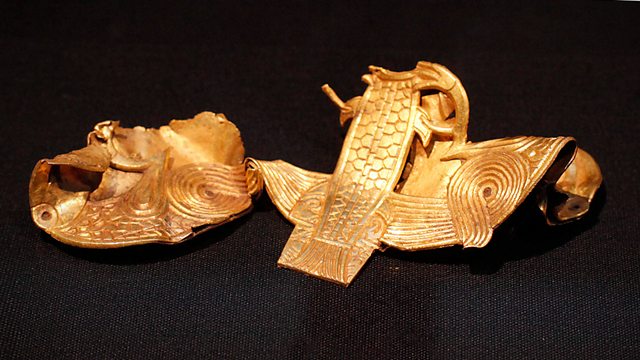
the silver and gilt belt buckle from Crundale, in Kent. | 0:36:57 | 0:37:02 | |
This is a serious piece of double-edged art...literally. | 0:37:02 | 0:37:05 | |
Look at how these symbols sit alongside each other. | 0:37:05 | 0:37:08 | |
Knotted pagan snakes and a Christian fish. | 0:37:08 | 0:37:13 | |
This piece clearly shows it was made at a time when the Anglo-Saxons | 0:37:15 | 0:37:19 | |
were hedging their bets, | 0:37:19 | 0:37:21 | |
embracing Christianity and keeping hold of their pagan heritage. | 0:37:21 | 0:37:25 | |
Looking at it now, you can imagine the sort of man who commissioned it. | 0:37:28 | 0:37:33 | |
One week he's fasting for Easter, | 0:37:33 | 0:37:36 | |
the next he's feasting for the goddess Aostra. | 0:37:36 | 0:37:39 | |
For about a century, | 0:37:48 | 0:37:50 | |
the Anglo-Saxons continued to flip between paganism and Christianity. | 0:37:50 | 0:37:55 | |
And some time in the 7th century, one piece of art was created | 0:37:55 | 0:38:00 | |
that perfectly encapsulated this eclectic view of the world. | 0:38:00 | 0:38:04 | |
In 1857, Victorian collector Sir Augustus Wollaston Franks | 0:38:08 | 0:38:13 | |
was on a shopping trip to Paris | 0:38:13 | 0:38:15 | |
in pursuit of his famous pastime - buying antiques. | 0:38:15 | 0:38:19 | |
He heard about a rather unusual item a dealer had for sale. | 0:38:22 | 0:38:26 | |
It had lain hidden for nearly 1,000 years. | 0:38:26 | 0:38:29 | |
And eventually, it wound up in a Parisian antique shop. | 0:38:30 | 0:38:34 | |
When Wollaston Franks saw it, he couldn't resist. | 0:38:34 | 0:38:37 | |
Today, it's known as the Franks casket. | 0:38:44 | 0:38:47 | |
Carved out of whalebone, it's an amazing visual representation | 0:38:47 | 0:38:52 | |
of the early Anglo-Saxons' view of the history of the world. | 0:38:52 | 0:38:56 | |
It's well over 1,200 years old now | 0:39:00 | 0:39:02 | |
and it has to be kept in a climate-controlled case. | 0:39:02 | 0:39:05 | |
It's far too delicate to be handled. | 0:39:08 | 0:39:11 | |
So the British Museum had this replica made, which I can hold. | 0:39:11 | 0:39:16 | |
And this means I can show you that the Franks casket is a truly | 0:39:16 | 0:39:19 | |
three-dimensional art object. It's like an Anglo-Saxon Rubik's Cube. | 0:39:19 | 0:39:24 | |
If we start at the front, where the key would enter the lock, missing... | 0:39:24 | 0:39:29 | |
We've got two very enigmatic scenes. | 0:39:29 | 0:39:32 | |
We've the legendary Germanic story of Weyland the smith. | 0:39:34 | 0:39:38 | |
Weyland has killed the king's son and is offering a drugged goblet | 0:39:40 | 0:39:46 | |
made from his skull to the daughter. | 0:39:46 | 0:39:50 | |
And to the side of this are three figures, | 0:39:51 | 0:39:53 | |
the Three Magi, approaching two figures here. | 0:39:53 | 0:39:58 | |
Mary and Jesus have been abbreviated to teardrop-shaped heads. | 0:40:00 | 0:40:05 | |
A scene from Germanic myth alongside a Christian image. | 0:40:08 | 0:40:11 | |
But if we turn it round to the left, something else enters the equation. | 0:40:11 | 0:40:15 | |
A scene from Roman legend. | 0:40:15 | 0:40:19 | |
Here we've got a very unusual version | 0:40:19 | 0:40:21 | |
of Romulus and Remus | 0:40:21 | 0:40:23 | |
being nursed by the wolf. | 0:40:23 | 0:40:24 | |
Typically, | 0:40:24 | 0:40:26 | |
they are shown as children underneath the wolf, | 0:40:26 | 0:40:28 | |
but the Anglo-Saxons | 0:40:28 | 0:40:30 | |
have shown them as full-grown adults lying out prostate on the ground. | 0:40:30 | 0:40:35 | |
With this upside-down wolf here. | 0:40:39 | 0:40:42 | |
But I love this object because it captures that moment | 0:40:46 | 0:40:49 | |
when the Anglo-Saxons are moving from paganism to Christianity. | 0:40:49 | 0:40:54 | |
And in this one piece we've got so many of the legends and so much | 0:40:54 | 0:40:58 | |
of the imagery that had previously dominated Anglo-Saxon art. | 0:40:58 | 0:41:02 | |
A century after St Augustine had landed, | 0:41:18 | 0:41:21 | |
stone symbols of the Christian faith | 0:41:21 | 0:41:23 | |
began to dominate the British landscape. | 0:41:23 | 0:41:26 | |
In the wooden world of the Anglo-Saxons, | 0:41:31 | 0:41:34 | |
stone crosses made a big impact. | 0:41:34 | 0:41:37 | |
This proved to be an effective advertising campaign, | 0:41:38 | 0:41:41 | |
one that definitely said | 0:41:41 | 0:41:43 | |
paganism was fading away and Christianity was here to stay. | 0:41:43 | 0:41:47 | |
New churches and abbeys sprung up throughout the Anglo-Saxon lands. | 0:41:54 | 0:41:59 | |
In 674, Abbot Benedict Biscop founded a monastery here. | 0:42:03 | 0:42:08 | |
Very few Anglo-Saxon buildings survive, | 0:42:08 | 0:42:11 | |
but inside, the entire chancel is original. | 0:42:11 | 0:42:14 | |
In its day, this place was an island of Mediterranean culture | 0:42:26 | 0:42:30 | |
in a sea of barbarism. | 0:42:30 | 0:42:32 | |
The abbot, Biscop, was a well-travelled man. | 0:42:38 | 0:42:41 | |
In his lifetime, he made many trips to Rome, and I think | 0:42:41 | 0:42:44 | |
he fell in love with the place. | 0:42:44 | 0:42:46 | |
So much so that he decided to create a little bit of Rome | 0:42:53 | 0:42:57 | |
here in the Northeast of England. | 0:42:57 | 0:43:00 | |
The chancery he built is now one of the oldest buildings in Britain. | 0:43:04 | 0:43:09 | |
But working in stone wasn't the only idea Biscop brought back | 0:43:09 | 0:43:13 | |
from his travels. | 0:43:13 | 0:43:15 | |
Biscop introduced another new concept, one the Anglo-Saxons | 0:43:15 | 0:43:19 | |
had never seen before and one that we couldn't live without today... | 0:43:19 | 0:43:23 | |
glazed windows. | 0:43:23 | 0:43:25 | |
This is it, one of the earliest stained-glass windows in Britain. | 0:43:25 | 0:43:31 | |
But Jarrow wasn't to be remembered for its stonework and glass. | 0:43:34 | 0:43:38 | |
There was another art form that it was to become world famous for. | 0:43:38 | 0:43:42 | |
Manuscripts. | 0:43:42 | 0:43:44 | |
Although the whole country was now Christian, the Church | 0:43:51 | 0:43:55 | |
was effectively split in two. | 0:43:55 | 0:43:57 | |
On the one side were the newly converted Anglo-Saxons in England. | 0:43:59 | 0:44:04 | |
On the other were the Celtic churches in the rest of the country. | 0:44:04 | 0:44:08 | |
The easiest way to understand their artistic and spiritual differences | 0:44:11 | 0:44:15 | |
is to look at how they both drew people. | 0:44:15 | 0:44:18 | |
This is the Mac Durnan Gospel. | 0:44:20 | 0:44:23 | |
It's typical of the style of manuscript produced | 0:44:23 | 0:44:26 | |
by the very early Christians in the Celtic parts of Britain and Ireland. | 0:44:26 | 0:44:30 | |
It's small because it was designed to be carried by the clergymen | 0:44:30 | 0:44:34 | |
as they travelled around the land preaching. | 0:44:34 | 0:44:36 | |
The depiction of the figure is very stylised. | 0:44:39 | 0:44:43 | |
It's almost a cartoon. | 0:44:43 | 0:44:46 | |
If you look at the feet, they're cloven, not at all realistic. | 0:44:46 | 0:44:51 | |
Some scholars have speculated | 0:44:51 | 0:44:53 | |
it comes from a belief that only God can create the true image of man. | 0:44:53 | 0:44:57 | |
The Anglo-Saxons, who took their ideas directly from St Augustine | 0:45:01 | 0:45:05 | |
and Rome, had no problem drawing man, and his feet, naturalistically. | 0:45:05 | 0:45:12 | |
This is the Durham Cassiodorus. A fantastic Anglo-Saxon manuscript. | 0:45:12 | 0:45:16 | |
Take a look at the figure here. | 0:45:16 | 0:45:19 | |
It's far more naturalistic and realistic. | 0:45:19 | 0:45:23 | |
And the treatment of the feet, no cloven hooves here. | 0:45:23 | 0:45:26 | |
The artist has even included tiny little toenails. | 0:45:26 | 0:45:30 | |
It's far more in keeping with the classical tradition of art | 0:45:30 | 0:45:33 | |
that's coming out of Rome. | 0:45:33 | 0:45:35 | |
The Celtic and Anglo-Saxon Christians couldn't agree | 0:45:37 | 0:45:41 | |
when to celebrate Easter. | 0:45:41 | 0:45:44 | |
And although these different approaches to drawing feet | 0:45:44 | 0:45:47 | |
may seem trivial to us now, at the time they represented | 0:45:47 | 0:45:50 | |
a real fundamental difference between the two Christian camps. | 0:45:50 | 0:45:55 | |
These two artistic styles may seem irreconcilable, but one man's life | 0:45:55 | 0:46:00 | |
was to inspire an artwork that would bring the two together. | 0:46:00 | 0:46:04 | |
His name was St Cuthbert and he spent most of his life | 0:46:11 | 0:46:15 | |
on the Holy Island of Lindisfarne. | 0:46:15 | 0:46:18 | |
St Cuthbert was one of Lindisfarne's earliest bishops. | 0:46:27 | 0:46:32 | |
The most remarkable thing about Cuthbert | 0:46:32 | 0:46:34 | |
was he was all things to all men. | 0:46:34 | 0:46:36 | |
He was a nobleman, a hermit, a monk and a bishop. | 0:46:36 | 0:46:41 | |
And in death, he was to become | 0:46:41 | 0:46:43 | |
one of the Anglo-Saxons' most treasured saints. | 0:46:43 | 0:46:47 | |
In 687, Cuthbert died and was buried here. | 0:46:53 | 0:46:58 | |
11 years later, the monks of Lindisfarne opened his coffin | 0:46:58 | 0:47:02 | |
and made an amazing discovery. | 0:47:02 | 0:47:04 | |
Cuthbert didn't rot. | 0:47:04 | 0:47:06 | |
Because of this, he was declared a saint | 0:47:06 | 0:47:09 | |
and a cult would grow up around him. | 0:47:09 | 0:47:11 | |
In death, Cuthbert managed one final miraculous act, | 0:47:18 | 0:47:23 | |
and it would reconcile the artistic differences between the Anglo-Saxon | 0:47:23 | 0:47:28 | |
and Celtic churches. | 0:47:28 | 0:47:30 | |
He inspired another bishop of Lindisfarne, Eadfrith, | 0:47:32 | 0:47:36 | |
to create a manuscript of such beauty | 0:47:36 | 0:47:38 | |
it would become one of the pinnacles of Anglo-Saxon artistic achievement. | 0:47:38 | 0:47:43 | |
This is it. This is the Lindisfarne Gospels, | 0:47:44 | 0:47:48 | |
the finest piece of art from the Dark Ages, and a national treasure. | 0:47:48 | 0:47:52 | |
Well, this isn't actually it. The original is in the British Library. | 0:47:52 | 0:47:56 | |
But this one manuscript | 0:47:56 | 0:47:58 | |
is the culmination of centuries of Anglo-Saxon artistic endeavour. | 0:47:58 | 0:48:02 | |
Not only that, it manages to resolve the stylistic differences | 0:48:02 | 0:48:06 | |
of the two Christian factions. | 0:48:06 | 0:48:09 | |
Let's look at it in a little more detail. | 0:48:20 | 0:48:23 | |
Here we have an image | 0:48:23 | 0:48:25 | |
of Matthew the Evangelist, writing in his gospel book. | 0:48:25 | 0:48:28 | |
And if you look at details like the feet, | 0:48:28 | 0:48:32 | |
you can see the same sort of imagery | 0:48:32 | 0:48:35 | |
that we saw in the Durham Cassiodorus. | 0:48:35 | 0:48:37 | |
That naturalistic treatment of the figure | 0:48:37 | 0:48:40 | |
that's coming directly from Rome with St Augustine. | 0:48:40 | 0:48:43 | |
And alongside this, we get these full-page illuminations | 0:48:56 | 0:49:00 | |
called carpet pages, | 0:49:00 | 0:49:01 | |
where the swirls move the eye from image into text. | 0:49:01 | 0:49:07 | |
But look at this carpet page in detail. | 0:49:07 | 0:49:10 | |
Here we've got Celtic whorls and spirals, | 0:49:10 | 0:49:13 | |
just like we saw in the Mac Durnan Gospels, here in the borders. | 0:49:13 | 0:49:18 | |
They knot along the edges, here. | 0:49:18 | 0:49:21 | |
And then we've also got Anglo-Saxon animal interlace, | 0:49:25 | 0:49:29 | |
just like we saw on the Sutton Hoo belt buckle, | 0:49:29 | 0:49:32 | |
where the serpents and beasts wound into one another. | 0:49:32 | 0:49:36 | |
And if you look at this carpet page, | 0:49:44 | 0:49:46 | |
it's the same imagery we've seen on the Sutton Hoo shoulder clasps. | 0:49:46 | 0:49:50 | |
Look at the centre, the exact same geometric patterning. | 0:49:50 | 0:49:54 | |
It's no accident that they're called carpet pages. | 0:49:58 | 0:50:02 | |
They certainly resemble Islamic prayer rugs, | 0:50:02 | 0:50:05 | |
and it's possible that Eadfrith had seen a Middle Eastern carpet. | 0:50:05 | 0:50:09 | |
He certainly had an encyclopaedic knowledge of Celtic, Anglo-Saxon | 0:50:09 | 0:50:14 | |
and Christian art of Rome. | 0:50:14 | 0:50:16 | |
Today, the Lindisfarne Gospels are considered | 0:50:19 | 0:50:23 | |
one of the world's greatest artworks, | 0:50:23 | 0:50:25 | |
but less than a century after they were made, | 0:50:25 | 0:50:28 | |
they were nearly destroyed | 0:50:28 | 0:50:30 | |
by a new wave of violent, bloodthirsty pagan invaders. | 0:50:30 | 0:50:35 | |
In 793, the Vikings sacked Lindisfarne, | 0:50:42 | 0:50:47 | |
slaughtering their monks and plundering their treasures. | 0:50:47 | 0:50:51 | |
By 871, nearly all the Anglo-Saxon kingdoms | 0:51:00 | 0:51:04 | |
had been defeated and ravaged by the marauding Vikings. | 0:51:04 | 0:51:09 | |
Only the newly-crowned King of Wessex stood against them. | 0:51:16 | 0:51:21 | |
His name was Alfred - Alfred the Great. | 0:51:24 | 0:51:27 | |
And Winchester was his capital city. | 0:51:27 | 0:51:30 | |
Under Alfred, | 0:51:36 | 0:51:38 | |
Winchester became the very model of Anglo-Saxon civilisation, | 0:51:38 | 0:51:43 | |
a place where art and culture would flourish. | 0:51:43 | 0:51:46 | |
During his reign, Alfred introduced many concepts we take for granted, | 0:51:50 | 0:51:54 | |
like taxes to pay for the defence of his cities. | 0:51:54 | 0:51:59 | |
However, he would never decisively defeat the Vikings. | 0:52:03 | 0:52:08 | |
But he did stop them from conquering England completely. | 0:52:08 | 0:52:11 | |
Winchester Cathedral was built by the people that did ultimately | 0:52:20 | 0:52:24 | |
conquer Anglo-Saxon England, the Normans. | 0:52:24 | 0:52:27 | |
But beneath it lies the remains of a great Anglo-Saxon cathedral. | 0:52:27 | 0:52:32 | |
During his 28 years on the throne, | 0:52:53 | 0:52:55 | |
Alfred made the building of new churches and monasteries a priority. | 0:52:55 | 0:53:00 | |
The Church, and his faith, were very important to Alfred. | 0:53:07 | 0:53:11 | |
He believed the reason that the Vikings had come to rape | 0:53:11 | 0:53:14 | |
and pillage his land was simple. | 0:53:14 | 0:53:16 | |
His people were not pious enough. | 0:53:16 | 0:53:18 | |
To atone for this lack of piety, Alfred made the production of art | 0:53:23 | 0:53:27 | |
dedicated to the glory of God his mission. | 0:53:27 | 0:53:31 | |
And this is his legacy. | 0:53:33 | 0:53:35 | |
It became known as the Winchester School and it shows how the artistry | 0:53:35 | 0:53:39 | |
and creativity of the Anglo-Saxons developed in later centuries. | 0:53:39 | 0:53:44 | |
There's still loads of Anglo-Saxon motifs here. | 0:53:51 | 0:53:54 | |
The bold use of colour, the gold, this interlacing knotwork here. | 0:53:54 | 0:53:59 | |
And as we move on to later works, | 0:53:59 | 0:54:02 | |
you see even more naturalism and movement in pieces like this. | 0:54:02 | 0:54:06 | |
Look at the treatment of the figure. | 0:54:15 | 0:54:18 | |
And the drapery here. | 0:54:18 | 0:54:21 | |
There's an increasing freedom of expression in pieces like this, | 0:54:25 | 0:54:30 | |
where the characters are filling the space | 0:54:30 | 0:54:34 | |
and pouring out across the illumination. | 0:54:34 | 0:54:37 | |
And looking at this, you can really see why Anglo-Saxon manuscripts | 0:54:40 | 0:54:45 | |
became such highly-prized artworks throughout Europe. | 0:54:45 | 0:54:48 | |
The freedom and expressiveness of the late Anglo-Saxon period | 0:55:01 | 0:55:06 | |
was not limited to manuscripts. | 0:55:06 | 0:55:08 | |
There was one piece of jewellery that when it was found, | 0:55:08 | 0:55:13 | |
looked so fresh and was in such good condition | 0:55:13 | 0:55:16 | |
the British Museum thought it was fake. | 0:55:16 | 0:55:18 | |
Of all the works produced in the late Anglo-Saxon period, for me, | 0:55:24 | 0:55:29 | |
this, the Fuller brooch, represents most clearly | 0:55:29 | 0:55:33 | |
both where Anglo-Saxon art has come from and where it's heading to. | 0:55:33 | 0:55:37 | |
It's personal, it's portable, and shiny, | 0:55:43 | 0:55:46 | |
just like the other early Anglo-Saxon warrior bling. | 0:55:46 | 0:55:50 | |
But the animals and pagan symbols have now virtually gone. | 0:55:50 | 0:55:56 | |
It represents the five senses | 0:55:56 | 0:55:59 | |
and the four stages of life around the edge. | 0:55:59 | 0:56:01 | |
The most important thing is the treatment of the figures. | 0:56:02 | 0:56:06 | |
You can see that there's very little naturalism. | 0:56:06 | 0:56:09 | |
Take a look at this central character. The eyes are so enlarged | 0:56:09 | 0:56:13 | |
and the face has been reduced just to the basic features. | 0:56:13 | 0:56:17 | |
Then you have these figures around the side. | 0:56:17 | 0:56:20 | |
Their bodies are elongated. | 0:56:20 | 0:56:22 | |
Their gowns are turned into abstract patterns. | 0:56:22 | 0:56:26 | |
And they're surrounded by these shapes and arrows. | 0:56:26 | 0:56:30 | |
All of this treatment of figural depiction | 0:56:30 | 0:56:33 | |
was to disappear for another 1,000 years. | 0:56:33 | 0:56:35 | |
That is, until Picasso. | 0:56:35 | 0:56:38 | |
But of course, the Anglo-Saxons never did get as far as Picasso. | 0:56:42 | 0:56:47 | |
The Bayeux Tapestry tells the story of their defeat. | 0:56:51 | 0:56:54 | |
At the Battle of Hastings, the Anglo-Saxons were the losers. | 0:56:59 | 0:57:04 | |
And history, even art history, is always written by the winners. | 0:57:04 | 0:57:09 | |
After their victory in 1066, this is one of the first works of art | 0:57:13 | 0:57:17 | |
the Normans commissioned. | 0:57:17 | 0:57:19 | |
For me, the Bayeux Tapestry lacks the sort of imagination | 0:57:19 | 0:57:24 | |
and artistic freedom that made the Anglo-Saxons so special. | 0:57:24 | 0:57:28 | |
As I look at this replica now, how it follows step-by-step | 0:57:31 | 0:57:35 | |
the story of the Norman victory, I can't help but wonder how different | 0:57:35 | 0:57:40 | |
the story of Anglo-Saxon art would have been were they not defeated | 0:57:40 | 0:57:44 | |
and so many of their treasures lost. | 0:57:44 | 0:57:47 | |
But maybe this is one of the beauties of Anglo-Saxon art. | 0:57:52 | 0:57:57 | |
The fact that so much of it | 0:57:57 | 0:57:59 | |
was buried for 1,000 years in the British countryside | 0:57:59 | 0:58:02 | |
means that today, we can see it with truly fresh eyes. | 0:58:02 | 0:58:07 | |
And with every new discovery, our understanding of the Anglo-Saxons | 0:58:07 | 0:58:11 | |
will keep changing and shine a new light on the Dark Ages. | 0:58:11 | 0:58:16 | |
MACHINE BEEPS | 0:58:21 | 0:58:23 | |
BEEPS GET FASTER | 0:58:24 | 0:58:27 | |
Oh. Rubbish. | 0:58:44 | 0:58:45 | |
Subtitles by Red Bee Media Ltd | 0:58:45 | 0:58:49 |