Woke up This Morning Blues America
Similar Content
Browse content similar to Woke up This Morning. Check below for episodes and series from the same categories and more!
Transcript
| Line | From | To | |
|---|---|---|---|
The blues is one of the greatest inventions of the 20th century. | 0:00:03 | 0:00:07 | |
BLUES MUSIC PLAYS | 0:00:07 | 0:00:10 | |
# I woke up this morning | 0:00:14 | 0:00:17 | |
# Feeling round for my shoes... # | 0:00:17 | 0:00:20 | |
It's such simple music, it seems timeless. | 0:00:20 | 0:00:22 | |
# Well, I woke up this morning feeling round... # | 0:00:22 | 0:00:28 | |
But the blues does have a history and it keeps changing. | 0:00:28 | 0:00:32 | |
For the 1920's New York record industry, | 0:00:34 | 0:00:37 | |
the blues was a parade of powerful women on stage, | 0:00:37 | 0:00:40 | |
singing about sex, sadness and feeling blue. | 0:00:40 | 0:00:43 | |
# I woke up this morning | 0:00:43 | 0:00:46 | |
# With an awful aching head... # | 0:00:46 | 0:00:50 | |
This is the story of how a folk art met up with new media | 0:00:52 | 0:00:56 | |
and became the bedrock of American music. | 0:00:56 | 0:00:58 | |
# Woke up this morning I looked round for my shoes... # | 0:00:59 | 0:01:03 | |
From the Deep South came the blues that gave birth to rock 'n' roll. | 0:01:03 | 0:01:07 | |
In the 1960's, white kids got the blues. | 0:01:09 | 0:01:12 | |
# I am the little red rooster | 0:01:12 | 0:01:15 | |
# Too lazy to crow for... # | 0:01:15 | 0:01:18 | |
The blues ended the 20th century as the ultimate brand of authenticity. | 0:01:18 | 0:01:23 | |
Music that could be celebrated by prisoners and presidents. | 0:01:27 | 0:01:31 | |
This is music with humble beginnings. | 0:01:31 | 0:01:34 | |
# Woke up this morning | 0:01:34 | 0:01:36 | |
# And found my baby gone... # | 0:01:36 | 0:01:40 | |
It's a bent note here. It's something that says, | 0:01:57 | 0:02:01 | |
"I've been somewhere and you've been there, too, | 0:02:01 | 0:02:04 | |
"but we don't necessarily want to talk about it." | 0:02:04 | 0:02:07 | |
And blues is kind of like that. | 0:02:07 | 0:02:10 | |
It's kind of a mystery and long may it stay a mystery, you know. | 0:02:10 | 0:02:13 | |
The blues may have had its roots in Africa, | 0:02:15 | 0:02:18 | |
but the music was born in the USA. | 0:02:18 | 0:02:20 | |
# I'm going down in Louisiana... # | 0:02:20 | 0:02:24 | |
Why is it that there is no blues in Cuba, no blues in Puerto Rico, | 0:02:24 | 0:02:31 | |
no blues in St Kitts and Nevis? | 0:02:31 | 0:02:33 | |
Why is that not happening? | 0:02:33 | 0:02:36 | |
# I'm going down in New Orleans... # | 0:02:36 | 0:02:39 | |
In 1865, the American Civil War freed the slaves. | 0:02:41 | 0:02:46 | |
By around 1900, the blues had emerged in the deep south. | 0:02:46 | 0:02:50 | |
Their musical roots may have been ripped from the African soil, but to | 0:02:50 | 0:02:53 | |
talk to each other, black Americans needed to forge a new language. | 0:02:53 | 0:02:57 | |
In the United States, the music was broken up, | 0:02:59 | 0:03:03 | |
the people were broken up. | 0:03:03 | 0:03:04 | |
They were not parts of the same tribe, | 0:03:04 | 0:03:06 | |
so there was nothing to express it except the blues. | 0:03:06 | 0:03:11 | |
# Well, you know, I just found out | 0:03:11 | 0:03:16 | |
# My trouble just begun... # | 0:03:16 | 0:03:20 | |
From the start, the blues spoke in the first person, | 0:03:20 | 0:03:23 | |
talking about moving on and leaving your troubles behind. | 0:03:23 | 0:03:26 | |
# I'm going down in New Orleans... # | 0:03:26 | 0:03:32 | |
The blues comes actually as a release from the kind | 0:03:32 | 0:03:35 | |
of strict localism, you call it, you know, being confined. | 0:03:35 | 0:03:40 | |
And it's... you suddenly get songs about people travelling, | 0:03:40 | 0:03:44 | |
and people going to see this and people what they met on the road. | 0:03:44 | 0:03:47 | |
BLUES MUSIC PLAYS | 0:03:55 | 0:04:00 | |
# I'm on my way but I don't know where... # | 0:04:01 | 0:04:05 | |
Appropriately, a railroad station was the setting for a crucial | 0:04:08 | 0:04:12 | |
early encounter with the blues. | 0:04:12 | 0:04:14 | |
Here, a college-educated black man named WC Handy, | 0:04:14 | 0:04:18 | |
the leader of a coloured band, met a "lean loose-jointed Negro" vagrant. | 0:04:18 | 0:04:21 | |
We're in Tutwiler, Mississippi and this place is famous in blues | 0:04:25 | 0:04:28 | |
lore because some time around 1903 this is the spot where | 0:04:28 | 0:04:33 | |
WC Handy recalled that he had first heard the blues. | 0:04:33 | 0:04:36 | |
He was sitting here and heard a musician playing | 0:04:43 | 0:04:48 | |
a guitar by pulling a knife across the strings, | 0:04:48 | 0:04:51 | |
and Handy recalled it was the weirdest sound he had ever heard. | 0:04:51 | 0:04:54 | |
The blues was being improvised all over the south | 0:05:01 | 0:05:04 | |
for pleasure and profit. | 0:05:04 | 0:05:06 | |
FRANTIC BLUES MUSIC PLAYS | 0:05:11 | 0:05:14 | |
Later, Handy heard in Cleveland, Mississippi, | 0:05:17 | 0:05:19 | |
not too far away from here, an African American string band | 0:05:19 | 0:05:22 | |
playing the blues, and that was also a really pivotal moment | 0:05:22 | 0:05:25 | |
because that's when he realised, he saw people throwing | 0:05:25 | 0:05:28 | |
coins at their feet and realised that he could make money off it. | 0:05:28 | 0:05:32 | |
The sort of music Handy heard is played | 0:05:34 | 0:05:36 | |
today by The Ebony Hillbillies. | 0:05:36 | 0:05:39 | |
Early blues music was dance music designed for adults to | 0:05:47 | 0:05:51 | |
get them to come to some place and drink and have a good time, | 0:05:51 | 0:05:54 | |
and so it's mating music, essentially. | 0:05:54 | 0:05:57 | |
It's about men and women. | 0:05:57 | 0:05:59 | |
The driving instrumental part of the blues certainly | 0:06:02 | 0:06:06 | |
comes from early fiddle music, slave fiddle players, banjo players, | 0:06:06 | 0:06:11 | |
but the blues was purposely formed as the dance music | 0:06:11 | 0:06:14 | |
so the musicians would make money, you know, to come to dance halls. | 0:06:14 | 0:06:17 | |
Oh, he got me! | 0:06:23 | 0:06:24 | |
-He got you too?! -Yeah, me too! | 0:06:26 | 0:06:29 | |
At the turn of the century, the blues was being | 0:06:32 | 0:06:35 | |
played by the poorest people on whatever came to hand. | 0:06:35 | 0:06:38 | |
THEY SING | 0:06:45 | 0:06:49 | |
You see old slavery pictures, | 0:06:54 | 0:06:55 | |
guys working on the railroad track, they get to hitting the hammer the | 0:06:55 | 0:06:59 | |
same way, you know, then they make up a song - ha-poom, ha-poom, ha-poom. | 0:06:59 | 0:07:03 | |
I've heard guys that have put a piece on wire on the side | 0:07:07 | 0:07:09 | |
of a house and played, take the tambourine and play, they take a | 0:07:09 | 0:07:13 | |
washing tub, they take a wash board, take spoons, you know, anything | 0:07:13 | 0:07:18 | |
that you put together like that with a feeling, somebody will listen. | 0:07:18 | 0:07:22 | |
Handy translated the weird sounds that he heard | 0:07:27 | 0:07:30 | |
into a publishing empire. | 0:07:30 | 0:07:32 | |
In WC Handy Park in Memphis, | 0:07:36 | 0:07:38 | |
a statue commemorates the writer, composer and publisher | 0:07:38 | 0:07:42 | |
who gave himself the title, "Father of the Blues". | 0:07:42 | 0:07:45 | |
Around 1914, in the era before records and radio, | 0:07:50 | 0:07:54 | |
Handy's Memphis Blues and St Louis Blues became sheet music hits. | 0:07:54 | 0:07:58 | |
What's really significant about Handy hearing this music is | 0:08:00 | 0:08:04 | |
that within a decade he was writing these and making good | 0:08:04 | 0:08:07 | |
money off of this music, so we often talk about blues as a folk | 0:08:07 | 0:08:12 | |
music, but almost from its inception it was also commercialised. | 0:08:12 | 0:08:17 | |
Soon this new musical form | 0:08:22 | 0:08:23 | |
was crisscrossing the southern states of America. | 0:08:23 | 0:08:26 | |
Today we think of minstrel shows as crude caricatures of black music, | 0:08:32 | 0:08:36 | |
but at the beginning of the 20th century, dozens of African American | 0:08:36 | 0:08:40 | |
minstrels were putting on tent shows across the south. | 0:08:40 | 0:08:44 | |
# Woke up this morning Same thing on my mind | 0:08:44 | 0:08:48 | |
# Woke up this morning Same thing on my mind... # | 0:08:48 | 0:08:52 | |
Minstrel shows and their successors, the medicine shows, which toured | 0:08:52 | 0:08:56 | |
the south right through the first half of the 20th century, were | 0:08:56 | 0:09:00 | |
in a sense, academies for musicians who wanted to become professional. | 0:09:00 | 0:09:04 | |
The tent shows travelled through the countryside, where audiences | 0:09:08 | 0:09:12 | |
heard versions of the latest tunes from the big city. | 0:09:12 | 0:09:15 | |
They were almost like travelling salesmen for songs. | 0:09:17 | 0:09:21 | |
They would pick up stuff all over the place, | 0:09:21 | 0:09:23 | |
whether from the vernacular, | 0:09:23 | 0:09:25 | |
from songs that were being sung in plantations, | 0:09:25 | 0:09:29 | |
or by professional troupes, | 0:09:29 | 0:09:31 | |
by musical comedy troupes that was available on sheet music, | 0:09:31 | 0:09:35 | |
and they mixed it altogether. | 0:09:35 | 0:09:37 | |
LIVELY BLUES MUSIC PLAYS | 0:09:37 | 0:09:40 | |
The men and women writing and performing the blues were ambitious. | 0:09:43 | 0:09:46 | |
They used the latest media to bring their music to the public. | 0:09:46 | 0:09:50 | |
It was New York, the capital of the new recording industry, | 0:09:53 | 0:09:57 | |
that made the blues a driving force in popular music. | 0:09:57 | 0:10:00 | |
Initially, the record business ignored black musicians. | 0:10:06 | 0:10:10 | |
You have to remember that in this period, in the teens and '20s, | 0:10:10 | 0:10:14 | |
the money in songs was in publishing, it was not in recording. | 0:10:14 | 0:10:18 | |
And Perry Bradford, who was a black songwriter, | 0:10:18 | 0:10:21 | |
he was a contemporary and a competitor of WC Handy, | 0:10:21 | 0:10:26 | |
was writing these songs and he wanted to get hits. | 0:10:26 | 0:10:30 | |
# I can't eat a bite | 0:10:30 | 0:10:34 | |
# For the man I love... # | 0:10:34 | 0:10:37 | |
In 1920, Perry Bradford scored a big hit with | 0:10:37 | 0:10:40 | |
Crazy Blues, sung by Mamie Smith. | 0:10:40 | 0:10:43 | |
# So I got the crazy blues | 0:10:43 | 0:10:47 | |
# If my baby went away... # | 0:10:47 | 0:10:52 | |
It's said to have sold a million copies. No-one knows for sure, | 0:10:52 | 0:10:56 | |
but what is certain is that it launched the blues as pop music. | 0:10:56 | 0:11:00 | |
# Now I got the crazy blues... # | 0:11:00 | 0:11:03 | |
In the early 1920's, | 0:11:06 | 0:11:07 | |
record companies began to release race records - | 0:11:07 | 0:11:10 | |
music by black performers for black audiences. | 0:11:10 | 0:11:13 | |
# The blues ain't nothing but your lover on your mind... # | 0:11:13 | 0:11:20 | |
The first successful blues singers were women. | 0:11:22 | 0:11:25 | |
The threat to whites was not black women, it was | 0:11:25 | 0:11:30 | |
black men, so the black men on the stage were forced to black up. | 0:11:30 | 0:11:35 | |
Black women were not. | 0:11:35 | 0:11:36 | |
They could perform with their own skin, | 0:11:36 | 0:11:40 | |
but a black man had to be a clown. | 0:11:40 | 0:11:43 | |
He had to put on funny clothes and do funny dances. | 0:11:43 | 0:11:46 | |
There was always interaction, although not always favourable, | 0:11:52 | 0:11:56 | |
between American white males and black women. | 0:11:56 | 0:12:01 | |
They were allowed to do or be vocal or say certain things that the | 0:12:01 | 0:12:04 | |
black males wouldn't be able to say or do. | 0:12:04 | 0:12:07 | |
# The blues ain't nothing but a slow aching heart... # | 0:12:07 | 0:12:13 | |
They were more showbiz in their own way, | 0:12:18 | 0:12:21 | |
even though they were as gut blues as anybody else, | 0:12:21 | 0:12:25 | |
but they had to dress it up and there is nothing like a dressed up | 0:12:25 | 0:12:28 | |
lady to turn the interests, I think. | 0:12:28 | 0:12:30 | |
# I love my man | 0:12:30 | 0:12:33 | |
# But he treats me like a dog... # | 0:12:33 | 0:12:36 | |
Luckily they were some of the most phenomenally great singers. | 0:12:38 | 0:12:41 | |
Even through those old records, | 0:12:41 | 0:12:43 | |
you can tell the timbre of their voice and their delivery was amazing | 0:12:43 | 0:12:48 | |
cos this was out pre-microphone, | 0:12:48 | 0:12:49 | |
so you know these girls had to be able to project. | 0:12:49 | 0:12:53 | |
In segregated 1920's America, the blues queens performed on a black | 0:12:55 | 0:13:00 | |
theatre circuit and they lived their lives in a black underworld. | 0:13:00 | 0:13:04 | |
When the artists used to perform and travel around, they would have | 0:13:06 | 0:13:10 | |
to stay in people's houses, which turned out to be things that we | 0:13:10 | 0:13:15 | |
called the buffet flats in which you could get entertainment, food, | 0:13:15 | 0:13:18 | |
you could get a bed | 0:13:18 | 0:13:20 | |
and you could get a bed with someone else in it if you wanted. | 0:13:20 | 0:13:24 | |
# Woke up this morning | 0:13:24 | 0:13:26 | |
# When chickens were crowing for days... # | 0:13:26 | 0:13:31 | |
The blues may have been a view from the bottom of society, | 0:13:32 | 0:13:36 | |
but in 1923 the blues produced its first superstar, Bessie Smith. | 0:13:36 | 0:13:41 | |
A dark brown woman from Chattanooga Tennessee, | 0:13:41 | 0:13:44 | |
she was a veteran of ten years touring with minstrel shows. | 0:13:44 | 0:13:48 | |
# Some people call me a hobo | 0:13:48 | 0:13:52 | |
# Some call me a bum | 0:13:52 | 0:13:55 | |
# Nobody knows my name | 0:13:55 | 0:13:57 | |
# Nobody knows what I've done... # | 0:13:57 | 0:14:00 | |
Bessie Smith was talking about the woes of life with women | 0:14:02 | 0:14:07 | |
and that's probably why she was so popular. | 0:14:07 | 0:14:10 | |
She talked about domestic violence, which is what we call it now. | 0:14:10 | 0:14:14 | |
She talked about even fighting back. | 0:14:14 | 0:14:16 | |
Come on out. You're gonna move. | 0:14:16 | 0:14:18 | |
Don't you hit me. Now wait a minute there! Grab the woman. | 0:14:18 | 0:14:23 | |
Emerging from a dirt poor background, | 0:14:25 | 0:14:28 | |
Bessie Smith at her peak commanded 2,000-a-week | 0:14:28 | 0:14:31 | |
for her live performances. | 0:14:31 | 0:14:32 | |
# Woke my baby | 0:14:32 | 0:14:36 | |
# He's done left this town... # | 0:14:36 | 0:14:40 | |
Bessie Smith lives the blues, especially those sexual songs, | 0:14:43 | 0:14:47 | |
because she had a reputation and she lived up to it. | 0:14:47 | 0:14:50 | |
One of my favourites is Sugar in My Bowl, you know. | 0:14:50 | 0:14:54 | |
# I need a little sugar in my bowl | 0:14:54 | 0:14:58 | |
# I need a little hot dog on my roll | 0:14:58 | 0:15:01 | |
# I could stand some loving for so bad | 0:15:01 | 0:15:05 | |
# I feel so funny I feel so sad... # | 0:15:05 | 0:15:09 | |
You know, it's just something to entice. | 0:15:09 | 0:15:14 | |
You know, you're going to listen to things that entice you. | 0:15:14 | 0:15:17 | |
You're going to eat food that entices you, you know. | 0:15:17 | 0:15:20 | |
Why not have a little spiciness in the music? | 0:15:20 | 0:15:23 | |
The blues was black music making a lot of money for its superstars, | 0:15:30 | 0:15:34 | |
but the structure of the music came out of work songs and churches. | 0:15:34 | 0:15:37 | |
If it wasn't for Cavalry, where I would be? | 0:15:38 | 0:15:43 | |
Yeah! Yeah! | 0:15:43 | 0:15:45 | |
The call and response between the preacher | 0:15:45 | 0:15:47 | |
and the congregation came ultimately from Africa. | 0:15:47 | 0:15:51 | |
In tribal music, one singer sang a line and the others sang it back. | 0:15:51 | 0:15:55 | |
-Oh a hill called Cavalry. -Yeah! | 0:15:55 | 0:15:59 | |
In the blues, the second voice became an instrumental voice. | 0:15:59 | 0:16:03 | |
-Y'all praying with me? -Yeah! -Y'all praying with me? -Yeah! | 0:16:03 | 0:16:07 | |
The call and response, when you sing the blues, | 0:16:07 | 0:16:11 | |
you say a word, a lyric, whatever and then you play behind that, you know. | 0:16:11 | 0:16:17 | |
For instance, I said, "Thank you, sir." Duh, duh, duh. | 0:16:17 | 0:16:21 | |
You know, "Thank you, sir." Duh, duh, duh. You know. | 0:16:21 | 0:16:23 | |
-At Cavalry. -At Cavalry. | 0:16:23 | 0:16:26 | |
We hear... the words. | 0:16:26 | 0:16:29 | |
Yeah! | 0:16:29 | 0:16:31 | |
The call and response, you can go back to early Africa, | 0:16:31 | 0:16:34 | |
and it's usually based on a form of people returning from a hunt, | 0:16:34 | 0:16:39 | |
saying, "I caught this blah, blah, blah." | 0:16:39 | 0:16:42 | |
And the people say, "Yeah, you sure you caught that." | 0:16:42 | 0:16:45 | |
It's acknowledgement and confirmation. | 0:16:45 | 0:16:49 | |
You know, "Did you hear that?" "Yes, I heard that." | 0:16:49 | 0:16:51 | |
"What did I say?" "This is what you said." "What does it mean?" | 0:16:51 | 0:16:54 | |
"It means this." | 0:16:54 | 0:16:55 | |
-We're going to show them on a hill called Calvary. -Yeah! | 0:16:55 | 0:16:59 | |
Religion spoke of the life to come, | 0:17:01 | 0:17:04 | |
but the blues was rooted in the here and now. | 0:17:04 | 0:17:07 | |
# I hate to see | 0:17:10 | 0:17:14 | |
# The evening sun go down... # | 0:17:14 | 0:17:18 | |
The music evolved into the 12-bar blues, | 0:17:26 | 0:17:29 | |
turning sadness into stoicism | 0:17:29 | 0:17:31 | |
and misfortune into humour. | 0:17:31 | 0:17:34 | |
The blues is definitely more than just a sadness. | 0:17:34 | 0:17:38 | |
Because basically a blues, especially | 0:17:38 | 0:17:40 | |
if you deal with the 12-bar, it's set up like a joke. | 0:17:40 | 0:17:43 | |
You know, you repeat the line twice, | 0:17:43 | 0:17:45 | |
then you've got the punch line at the end. | 0:17:45 | 0:17:47 | |
"I've got a man that treats me like a rat. | 0:17:47 | 0:17:49 | |
"I've got a man that treats me like a rat. | 0:17:49 | 0:17:51 | |
"He gets me so worried I don't know where I'm at." | 0:17:51 | 0:17:54 | |
It's a happy music, it truly is. | 0:17:54 | 0:17:56 | |
It's just that some of the subject matter of the blues | 0:17:56 | 0:18:02 | |
sometimes had that sad feeling, | 0:18:02 | 0:18:05 | |
but truly, it is not a sad music. | 0:18:05 | 0:18:09 | |
VINTAGE BLUES RECORDING | 0:18:09 | 0:18:12 | |
# When the blues come and take me... # | 0:18:18 | 0:18:21 | |
In 1926, race records got into a new market and a new type of southern | 0:18:25 | 0:18:29 | |
solo artist, Blind Lemon Jefferson, a street singer from Texas. | 0:18:29 | 0:18:35 | |
His high lonesome voice and solitary guitar sounded like another | 0:18:35 | 0:18:38 | |
world from the Vaudeville women who had dominated blues recordings. | 0:18:38 | 0:18:42 | |
It was a different kind of blues. | 0:18:46 | 0:18:48 | |
It's one-on-one. A person is just kind of howlin' at the moon. | 0:18:48 | 0:18:52 | |
There's no ulterior motive | 0:18:52 | 0:18:55 | |
for a cat to do what he does | 0:18:55 | 0:18:59 | |
because he's expressin' his or her soul to the universe. | 0:18:59 | 0:19:04 | |
# You're so good lookin'... # | 0:19:04 | 0:19:06 | |
Blind Lemon Jefferson may have sounded like a voice | 0:19:10 | 0:19:13 | |
howling at the moon, but he was backed by a business plan. | 0:19:13 | 0:19:16 | |
Paramount Records employed black producer Jay Mayo Williams | 0:19:16 | 0:19:19 | |
to run their race records division. | 0:19:19 | 0:19:22 | |
In his catalogue, Williams appealed to his customers, asking | 0:19:22 | 0:19:26 | |
if they could recommend any new blues talent. | 0:19:26 | 0:19:28 | |
And, by God, someone working in a record store in Dallas wrote | 0:19:30 | 0:19:34 | |
to Paramount Records and said there's this guy | 0:19:34 | 0:19:37 | |
plays down by the tracks here, who gets these huge crowds | 0:19:37 | 0:19:41 | |
and if we had a record of him we could sell a bunch of them. | 0:19:41 | 0:19:43 | |
And that was Blind Lemon Jefferson | 0:19:43 | 0:19:45 | |
and the record company thought he sounded terrible, | 0:19:45 | 0:19:48 | |
but they gave it a try and, by God, it sold all over the country. | 0:19:48 | 0:19:52 | |
MUSIC: "One Kind Favor" by Blind Lemon Jefferson | 0:19:52 | 0:19:56 | |
# Well, there's one kind favour I ask of you... # | 0:19:58 | 0:20:03 | |
He became a recording star and his success transported him | 0:20:03 | 0:20:07 | |
far away from singing on street corners in Texas. | 0:20:07 | 0:20:10 | |
# It's a long, long lane, ain't got no end | 0:20:16 | 0:20:20 | |
# It's a long, long lane, ain't got no end | 0:20:21 | 0:20:25 | |
# It's a long, long lane It ain't got no end | 0:20:26 | 0:20:31 | |
# It's a bad wind that never change... # | 0:20:31 | 0:20:35 | |
He did all right for himself. They say he owned his own car, he had | 0:20:36 | 0:20:40 | |
his own chauffeur to drive him around. He was a doozy. | 0:20:40 | 0:20:45 | |
That's it. I don't know about ragged. | 0:20:46 | 0:20:49 | |
Some people say he was mighty sophisticated. | 0:20:49 | 0:20:51 | |
Some people say he had some of the wildest suits you ever seen. | 0:20:51 | 0:20:55 | |
# Have you ever heard a coffin sound? | 0:20:57 | 0:21:01 | |
# Have you ever heard a coffin sound? # | 0:21:01 | 0:21:06 | |
The success of Blind Lemon Jefferson gave birth to a new | 0:21:06 | 0:21:09 | |
style of the blues, as if the vagrant with a guitar | 0:21:09 | 0:21:13 | |
heard by WC Handy at the railroad station had come back to life. | 0:21:13 | 0:21:16 | |
But this time he was selling a lot of records. | 0:21:16 | 0:21:20 | |
THEY SING TOGETHER | 0:21:20 | 0:21:23 | |
All over the south, the songsters were auditioning. | 0:21:26 | 0:21:28 | |
They were street musicians with a big repertory of songs, | 0:21:31 | 0:21:35 | |
but the record companies wanted just one thing. | 0:21:35 | 0:21:38 | |
The reason these fellows got pressed so hard into the blues is | 0:21:38 | 0:21:41 | |
because the recording companies found out that blues was big | 0:21:41 | 0:21:44 | |
business, so all these musicians who'd run around singing pop | 0:21:44 | 0:21:49 | |
songs and ballads of the day end up writing a bunch of blueses. | 0:21:49 | 0:21:54 | |
HE SINGS | 0:21:54 | 0:21:57 | |
The record company would simply go to the | 0:22:01 | 0:22:03 | |
songsters and they would go to the south, go to Atlanta. | 0:22:03 | 0:22:06 | |
They would just say, "Everybody come who wants to sing for us." | 0:22:06 | 0:22:09 | |
They'd get a hotel, everyone would stay four or five people to | 0:22:09 | 0:22:12 | |
a room, they would go and hear the songs. | 0:22:12 | 0:22:15 | |
They would pick the blues and nothing else. | 0:22:15 | 0:22:18 | |
There was one region that supplied spectacular blues | 0:22:26 | 0:22:28 | |
talent for this southern market. | 0:22:28 | 0:22:30 | |
The Mississippi Delta was a flat area | 0:22:30 | 0:22:33 | |
formed by the Mississippi and Yazoo rivers. | 0:22:33 | 0:22:36 | |
# I'd rather be the Devil... # | 0:22:37 | 0:22:41 | |
It was amazingly fertile soil for cotton | 0:22:48 | 0:22:50 | |
and it proved equally fertile for music. | 0:22:50 | 0:22:53 | |
But this was no ancient landscape | 0:22:56 | 0:22:58 | |
of big plantations filled with former slaves. | 0:22:58 | 0:23:01 | |
There was virtually nobody in the Mississippi Delta | 0:23:01 | 0:23:04 | |
until quite late because it was flooded. | 0:23:04 | 0:23:08 | |
They had to build the levees on the Mississippi river. | 0:23:08 | 0:23:10 | |
You needed the army corps of engineers | 0:23:10 | 0:23:12 | |
in order to get the modern Deltas. | 0:23:12 | 0:23:14 | |
And what that meant was the population | 0:23:19 | 0:23:21 | |
that was there at the beginning | 0:23:21 | 0:23:23 | |
of the 20th century when blues was happening was very, very young. | 0:23:23 | 0:23:27 | |
In the Delta everybody was ready to get into the new style, which | 0:23:31 | 0:23:34 | |
was blues, and so it becomes this huge blues centre, | 0:23:34 | 0:23:37 | |
not because it's ancient, but for exactly the opposite reason. | 0:23:37 | 0:23:41 | |
VINTAGE BLUES MUSIC | 0:23:44 | 0:23:47 | |
Will Dockery's farm was hacked out of the wilderness | 0:24:01 | 0:24:03 | |
in the 1890's to become one of the biggest plantations in the Delta. | 0:24:03 | 0:24:07 | |
When Mr Will first got here there were bears and panthers, er, | 0:24:09 | 0:24:12 | |
and the whole place was covered in woods. | 0:24:12 | 0:24:15 | |
And so he set about to clear it, and he needed help, and so that's | 0:24:15 | 0:24:19 | |
how he got so many people to come here cos he realised that these | 0:24:19 | 0:24:23 | |
thousands of acres that he wanted to clear needed lots of helpers. | 0:24:23 | 0:24:27 | |
By 1920, there were more than 2,000 workers living on Dockery. | 0:24:39 | 0:24:43 | |
It was like a small town, a town which needed | 0:24:43 | 0:24:47 | |
entertaining on a Saturday night. | 0:24:47 | 0:24:49 | |
Well, once you had this commissary situation | 0:24:49 | 0:24:51 | |
and people standing out here in front of it being paid on Saturday | 0:24:51 | 0:24:54 | |
afternoon, it was the perfect place for these blues singers to come. | 0:24:54 | 0:24:57 | |
The greatest entertainer based at Dockery was Charlie Patton, | 0:25:05 | 0:25:09 | |
the father of the Delta blues. | 0:25:09 | 0:25:11 | |
Patton sang at the top of his voice. | 0:25:11 | 0:25:15 | |
He liked to clown, throw the guitar behind his head. | 0:25:15 | 0:25:18 | |
He liked to talk to people in the audience, | 0:25:18 | 0:25:20 | |
but he was a performer. He was an entertainer. | 0:25:20 | 0:25:23 | |
# She's tryin' to keep it here | 0:25:26 | 0:25:30 | |
# My rudder got sucked in | 0:25:32 | 0:25:35 | |
# She's tryin' to keep it here... # | 0:25:35 | 0:25:39 | |
He had a lot of the extremes. He had a lot of the hard lives | 0:25:50 | 0:25:54 | |
and he had a lot of women. | 0:25:54 | 0:25:57 | |
He played... Every blues man gets a little but he had a lot! | 0:25:57 | 0:26:03 | |
# But I got something to find them something with... # | 0:26:05 | 0:26:11 | |
He had him a rough wife and they lived a rough life, | 0:26:15 | 0:26:18 | |
and that's what killed him in his 40's... | 0:26:18 | 0:26:21 | |
And that's what almost got him killed | 0:26:23 | 0:26:25 | |
a few times before that, I'd wager! | 0:26:25 | 0:26:28 | |
VINTAGE BLUES RECORDING | 0:26:29 | 0:26:32 | |
The blues singers travelled the south and performed on isolated | 0:26:39 | 0:26:43 | |
plantations, but talent scouts connected them to recording studios. | 0:26:43 | 0:26:48 | |
The most important venue was a furniture store | 0:26:48 | 0:26:51 | |
in Jackson, Mississippi, owned by a white man, HC Speir. | 0:26:51 | 0:26:55 | |
Well, really he's the godfather of Delta blues. | 0:26:57 | 0:27:00 | |
He is to Delta blues and Mississippi blues what Sam Phillips was | 0:27:00 | 0:27:04 | |
to rock and roll with his Sun label in the 1950's. | 0:27:04 | 0:27:08 | |
# Will you kill a man? Yes, I will... # | 0:27:08 | 0:27:11 | |
Gayle Dean Wardlow tracked down HC Speir | 0:27:14 | 0:27:16 | |
and interviewed him before his death. | 0:27:16 | 0:27:19 | |
This is HC Speir, Jackson, Mississippi. | 0:27:19 | 0:27:22 | |
By 1926, I became a talent scout through all the southern states. | 0:27:22 | 0:27:28 | |
Well, he would walk up when he was on the streets | 0:27:28 | 0:27:32 | |
and listen to a musician play. | 0:27:32 | 0:27:34 | |
He was looking for four original songs. | 0:27:34 | 0:27:36 | |
The reason many bluesmen never got recorded is | 0:27:36 | 0:27:39 | |
they didn't have enough original material. | 0:27:39 | 0:27:41 | |
VINTAGE BLUES RECORDING | 0:27:41 | 0:27:45 | |
Speir told tales of drunken blues singers | 0:27:51 | 0:27:53 | |
and bootleg liquor that fuelled Saturday night parties. | 0:27:53 | 0:27:57 | |
People came to drink and they came to dance | 0:27:58 | 0:28:01 | |
and they were drinking moonshine. | 0:28:01 | 0:28:03 | |
And, you know, some of this | 0:28:03 | 0:28:04 | |
moonshine was made through lead radiators, so I mean it had | 0:28:04 | 0:28:08 | |
a high lead content, but there was always booze to be found at a party. | 0:28:08 | 0:28:11 | |
HC Speir said the bluesman, he said he don't fit. | 0:28:19 | 0:28:23 | |
He said he got to have a drink before he can make a record | 0:28:23 | 0:28:26 | |
and he smells a little bit, but he says they're great guitar players. | 0:28:26 | 0:28:31 | |
He said the Delta blues was kind of like the meat barrel - | 0:28:35 | 0:28:39 | |
it smells a little bit. And someone like Bessie Smith, | 0:28:39 | 0:28:42 | |
the city singers, they had dolled it up and put perfume on their blues. | 0:28:42 | 0:28:46 | |
Speir got a letter from Charlie Patton in the Delta | 0:28:57 | 0:28:59 | |
and basically Patton said, "I think I'm as good as anyone who's | 0:28:59 | 0:29:03 | |
"been recorded and I would like to audition for you." | 0:29:03 | 0:29:06 | |
Speir got Patton a record contract. | 0:29:07 | 0:29:09 | |
Patton was good. Patton was one of the best talents I ever had | 0:29:09 | 0:29:13 | |
and he was one of the best sellers, too, on record. | 0:29:13 | 0:29:16 | |
His records made him famous | 0:29:17 | 0:29:19 | |
and he passed on his tips to the next generation. | 0:29:19 | 0:29:22 | |
I done started to make records, I was ploughing, | 0:29:22 | 0:29:26 | |
ploughing on the plantation, | 0:29:26 | 0:29:29 | |
and a man come through picking the guitar called Charlie Patton, | 0:29:29 | 0:29:34 | |
and I liked his sounds. | 0:29:34 | 0:29:36 | |
And so, every night that I'd get off of work, | 0:29:36 | 0:29:40 | |
I'd go to his house and he'd learn me how to pick the guitar, | 0:29:40 | 0:29:44 | |
so I got good with it. | 0:29:44 | 0:29:46 | |
For the musicians who started life on these plantations, | 0:29:47 | 0:29:51 | |
Howlin' Wolf, Muddy Waters, BB King and many more, | 0:29:51 | 0:29:54 | |
the blues offered a way out. | 0:29:54 | 0:29:56 | |
Excuse me. These guys never picked cotton in their life, | 0:29:56 | 0:30:00 | |
that's why they're playing the blues, you know, | 0:30:00 | 0:30:03 | |
to get out of the cotton fields, they were playing. | 0:30:03 | 0:30:06 | |
The black families working in these cotton fields were share | 0:30:07 | 0:30:10 | |
croppers and for many, it was a modernised form of slavery. | 0:30:10 | 0:30:14 | |
# Cos it's harder than ever been before... # | 0:30:22 | 0:30:27 | |
Mississippi was the poorest state in the Union. | 0:30:28 | 0:30:31 | |
Segregation was total and the white man's word was the rule of law. | 0:30:31 | 0:30:36 | |
A white shop keeper like HC Speir | 0:30:37 | 0:30:40 | |
understood why this was fertile soil for the blues. | 0:30:40 | 0:30:44 | |
You take the Negro. | 0:30:44 | 0:30:46 | |
For 100 years, he's been deprived of so many privileges. | 0:30:46 | 0:30:51 | |
They could get into the fields and become more satisfied with themselves | 0:30:51 | 0:30:56 | |
by singing, you understand. | 0:30:56 | 0:30:58 | |
It was singing off something that has happened to them. | 0:30:58 | 0:31:02 | |
A white man would take him and keep him for a week or two and not pay | 0:31:02 | 0:31:06 | |
him anything, and even maybe kill one or two now and then. | 0:31:06 | 0:31:09 | |
BELL TOLLS | 0:31:09 | 0:31:12 | |
It isn't what we hear. It's what we don't hear. | 0:31:15 | 0:31:18 | |
What we don't hear in the blues is the real reason for the blues - | 0:31:18 | 0:31:21 | |
the segregation and the discrimination. | 0:31:21 | 0:31:24 | |
The control was total. | 0:31:24 | 0:31:27 | |
# Sing this song and I ain't gonna sing no more... # | 0:31:27 | 0:31:31 | |
Well, to me, the blues is the expression where a people | 0:31:32 | 0:31:38 | |
couldn't express themselves. | 0:31:38 | 0:31:40 | |
Those riffs and those songs came off of the expression of not being | 0:31:40 | 0:31:44 | |
able to say to their slave master vocally that "I don't like this". | 0:31:44 | 0:31:48 | |
# Down 61 Highway | 0:31:50 | 0:31:54 | |
# It be the only road I know... # | 0:31:54 | 0:31:58 | |
What is the cause of we being on the Highway 61? | 0:31:59 | 0:32:02 | |
129 women and children here starving | 0:32:02 | 0:32:08 | |
and suffering, but we, who have the bite, are dividing with them. | 0:32:08 | 0:32:13 | |
Thousands of black people began to vote with their feet, | 0:32:17 | 0:32:21 | |
leaving poverty in the south for jobs in the north. | 0:32:21 | 0:32:25 | |
Their numbers were boosted by the Wall Street crash in 1929 | 0:32:25 | 0:32:28 | |
and the depression that followed. | 0:32:28 | 0:32:30 | |
It signalled hard times for the music industry. | 0:32:32 | 0:32:35 | |
Sales of records slumped and the blues recording sessions dried up. | 0:32:35 | 0:32:39 | |
# Lordy, some folks sat down | 0:32:39 | 0:32:42 | |
# Greyhound busses don't run. # | 0:32:42 | 0:32:46 | |
Delta bluesmen like Son House and Skip James | 0:32:47 | 0:32:51 | |
made records that were commercial flops. | 0:32:51 | 0:32:53 | |
# I'm so tired of here | 0:32:53 | 0:32:56 | |
# So tired of New Orleans | 0:32:56 | 0:32:57 | |
# I'm so tired of... # | 0:32:57 | 0:33:00 | |
Their music would lie buried like a time capsule. | 0:33:00 | 0:33:02 | |
But in the 1960's, they would be rediscovered | 0:33:07 | 0:33:10 | |
and acclaimed as masters of the Delta blues by a young white | 0:33:10 | 0:33:13 | |
audience who adopted the blues as their own. | 0:33:13 | 0:33:17 | |
# If that don't settle my drunken spree | 0:33:17 | 0:33:21 | |
# I'll never get drunk again... # | 0:33:21 | 0:33:25 | |
The path that led these young white people to the | 0:33:25 | 0:33:27 | |
blues began with a new kind of record scout driving south - | 0:33:27 | 0:33:31 | |
the folklorist. | 0:33:31 | 0:33:32 | |
# Be my woman, girl, I'll | 0:33:32 | 0:33:36 | |
# Be your man... | 0:33:36 | 0:33:39 | |
# Be my woman... # | 0:33:39 | 0:33:41 | |
The only white people so far involved in the blues had | 0:33:41 | 0:33:44 | |
been record manufacturers looking for hits. | 0:33:44 | 0:33:47 | |
But the folklorists were looking for music they wanted to preserve. | 0:33:49 | 0:33:52 | |
THEY SING | 0:33:56 | 0:33:58 | |
John Lomax had grown up in Texas | 0:33:58 | 0:34:00 | |
and had a long-standing love of folk music. | 0:34:00 | 0:34:04 | |
# His wife and his sister too... # | 0:34:04 | 0:34:08 | |
In 1933, he and his son, Alan, received a grant | 0:34:08 | 0:34:12 | |
from the Library of Congress to motor through the south, | 0:34:12 | 0:34:15 | |
visiting big penitentiaries to make recordings. | 0:34:15 | 0:34:19 | |
My son and I conceived the idea this summer that the best way | 0:34:19 | 0:34:24 | |
to get real Negro singing in the Negro idiom was to find | 0:34:24 | 0:34:28 | |
the Negro who had the least contact with the whites. | 0:34:28 | 0:34:32 | |
People have written that my grandfather | 0:34:32 | 0:34:35 | |
was obsessed with the prisons | 0:34:35 | 0:34:38 | |
and he wanted to capture something isolated. | 0:34:38 | 0:34:41 | |
But he wanted to find the oldest material, | 0:34:41 | 0:34:44 | |
which is a very important thing to do. | 0:34:44 | 0:34:47 | |
It's like archaeology. It was very scientific. | 0:34:47 | 0:34:51 | |
THEY SING | 0:34:51 | 0:34:54 | |
Prisons in the south were huge farms, which were run for profit. | 0:35:03 | 0:35:07 | |
I think you could almost call it | 0:35:14 | 0:35:16 | |
an extension of slavery in the 20th century. | 0:35:16 | 0:35:19 | |
And the men had to work from sun up to sun down what they called | 0:35:19 | 0:35:23 | |
"from cane to caint", | 0:35:23 | 0:35:25 | |
from when you can't see in the morning until when you | 0:35:25 | 0:35:27 | |
can't see in the night. You know, the whole of the day in unbearable heat. | 0:35:27 | 0:35:32 | |
ALL SING TOGETHER | 0:35:32 | 0:35:36 | |
The music sung by black prisoners inspired an extraordinary | 0:35:45 | 0:35:49 | |
passion in the young Alan Lomax. | 0:35:49 | 0:35:51 | |
He would spend the rest of his life recording music | 0:35:51 | 0:35:54 | |
created by people at the bottom of society. | 0:35:54 | 0:35:58 | |
I had heard all the symphonies there were, | 0:35:58 | 0:36:01 | |
and the chamber music and the best jazz, | 0:36:01 | 0:36:04 | |
and I said, "This is the greatest music." | 0:36:04 | 0:36:07 | |
There were 50 black men, who were working under the whip and the gun, | 0:36:07 | 0:36:12 | |
and they had the soul to make the most wonderful song I'd ever heard. | 0:36:12 | 0:36:17 | |
The most spectacular discovery the Lomaxes made in jail was | 0:36:21 | 0:36:25 | |
a 45-year-old prisoner, Huddie Ledbetter, known as Lead Belly. | 0:36:25 | 0:36:30 | |
HE SINGS SOMBRELY | 0:36:30 | 0:36:33 | |
He was a convicted murderer | 0:36:37 | 0:36:39 | |
and had a fantastic repertory of blues and ballads. | 0:36:39 | 0:36:42 | |
# Take this hammer | 0:36:44 | 0:36:46 | |
# Haaa! | 0:36:46 | 0:36:48 | |
# If he asks you | 0:36:48 | 0:36:50 | |
# Haaa... # | 0:36:50 | 0:36:51 | |
He had a big, penetrating voice. | 0:36:56 | 0:36:58 | |
He was a dynamic presence, almost frightening to some people. | 0:36:58 | 0:37:03 | |
He was, in one sense, a great performer, | 0:37:03 | 0:37:05 | |
you knew it from the second you saw him. | 0:37:05 | 0:37:07 | |
But another way you thought, "This guy is beyond performance." | 0:37:07 | 0:37:10 | |
# My girl, my girl, don't lie to me | 0:37:10 | 0:37:17 | |
# Tell me where did you sleep last night. # | 0:37:17 | 0:37:22 | |
When Lead Belly got out of jail and met the media it became | 0:37:22 | 0:37:26 | |
clear how much American journalists enjoyed writing about bad black men. | 0:37:26 | 0:37:30 | |
Life Magazine published a profile, | 0:37:30 | 0:37:33 | |
"Bad Nigger Makes Good Minstrel". | 0:37:33 | 0:37:36 | |
He was called a "Murderous Minstrel", | 0:37:36 | 0:37:38 | |
a "Sweet singer of the swamplands | 0:37:38 | 0:37:40 | |
"here to do a few tunes between homicides". | 0:37:40 | 0:37:44 | |
# I'm going where the cold wind blows... # | 0:37:44 | 0:37:48 | |
This narrative had been shaped by reporters | 0:37:50 | 0:37:52 | |
and the like who wanted to see, number one, a murderer who was | 0:37:52 | 0:37:56 | |
out walking around and a murderer who sang songs that people | 0:37:56 | 0:37:59 | |
enjoyed, which was, you know, it's priceless. | 0:37:59 | 0:38:01 | |
# My girl, my girl Don't you lie to me... # | 0:38:01 | 0:38:07 | |
In February, 1935, John Lomax took Lead Belly to a mansion | 0:38:07 | 0:38:12 | |
in Connecticut where a newsreel crew staged and filmed a re-construction | 0:38:12 | 0:38:17 | |
of Lead Belly's journey from singing convict to grateful performer. | 0:38:17 | 0:38:21 | |
Lead Belly, what are you doing here? | 0:38:21 | 0:38:24 | |
Boss, I've come here to be your man. | 0:38:24 | 0:38:26 | |
I've come here to work for you the rest of my life. | 0:38:26 | 0:38:29 | |
It is scripted in kind of cringing detail to | 0:38:29 | 0:38:34 | |
show Lead Belly as a servile, | 0:38:34 | 0:38:39 | |
compliant... | 0:38:39 | 0:38:42 | |
plantation negro | 0:38:42 | 0:38:45 | |
who John Lomax shepherds out of confinement. | 0:38:45 | 0:38:50 | |
Thank you sir, boss. | 0:38:50 | 0:38:52 | |
I'll drive you all over the United States. | 0:38:52 | 0:38:55 | |
I'll tie your shoestrings for you | 0:38:55 | 0:38:57 | |
and you won't have to tie your shoestrings | 0:38:57 | 0:38:59 | |
as long as I work for you. | 0:38:59 | 0:39:00 | |
Later, John Lomax was embarrassed by this newsreel, | 0:39:00 | 0:39:03 | |
while Lead Belly was angry because he didn't get paid. | 0:39:03 | 0:39:05 | |
Thank you, sir boss. Thank you, sir. | 0:39:06 | 0:39:08 | |
Despite growing tension between them, Lead Belly performed | 0:39:08 | 0:39:11 | |
with Lomax at Harvard University and literary conferences. | 0:39:11 | 0:39:15 | |
He got a new audience that was unexpected | 0:39:16 | 0:39:21 | |
and that was educated, middle class whites who were very liberal. | 0:39:21 | 0:39:26 | |
He didn't really have an audience among blacks. | 0:39:26 | 0:39:29 | |
Lead Belly was never a success with black audiences, and white society | 0:39:32 | 0:39:35 | |
saw him as wild-eyed and dangerous, an embodiment of his race. | 0:39:35 | 0:39:39 | |
However Lead Belly did find support in left wing circles. | 0:39:39 | 0:39:43 | |
We do not preach the sure hope of socialism in the lives | 0:39:43 | 0:39:47 | |
of these young comrades of ours... | 0:39:47 | 0:39:50 | |
As the blues entered white liberal society, | 0:39:51 | 0:39:54 | |
the music could now be heard in the context of civil rights. | 0:39:54 | 0:39:57 | |
The blues were getting political. | 0:39:58 | 0:40:00 | |
# I want all the coloured people to listen to me | 0:40:01 | 0:40:04 | |
# Don't ever try to get a home in Washington DC | 0:40:04 | 0:40:07 | |
# Cos it's a bourgeois town | 0:40:07 | 0:40:09 | |
# Oooh, it's a bourgeois town | 0:40:09 | 0:40:11 | |
# I got the bourgeois blues and I'm sure gonna spread the news... # | 0:40:13 | 0:40:17 | |
The only support for blacks in the south | 0:40:17 | 0:40:20 | |
in the '30s was the Communist Party, so there was a great symbiosis | 0:40:20 | 0:40:25 | |
between the communists and this black. | 0:40:25 | 0:40:28 | |
And in 1936, a meeting of the American Communist Party, they did | 0:40:28 | 0:40:31 | |
officially recognise the blues as the voice of the proletarian black. | 0:40:31 | 0:40:38 | |
UPBEAT BLUES MUSIC | 0:40:38 | 0:40:40 | |
But proletarian black record buyers were dancing to a different beat. | 0:40:46 | 0:40:50 | |
The blues records that dominated the Harlem hit parade of the 1930's | 0:40:50 | 0:40:54 | |
were by the Count Basie Orchestra. | 0:40:54 | 0:40:56 | |
# Don't the moon look lonesome shining through the trees? | 0:40:56 | 0:41:00 | |
# Don't the moon look lonesome shining through the trees? | 0:41:02 | 0:41:07 | |
# Don't your house look lonesome when your baby pack up to leave? # | 0:41:07 | 0:41:13 | |
You say to dance you must have a beat. | 0:41:13 | 0:41:16 | |
Every beat you put your foot down on a beat | 0:41:16 | 0:41:19 | |
and that's what Basie does for you. | 0:41:19 | 0:41:21 | |
You can dance to Basie, it don't matter what he plays, any sound. | 0:41:21 | 0:41:25 | |
And that's why dah-dah, | 0:41:25 | 0:41:29 | |
dah-dah, dah-dah... | 0:41:29 | 0:41:31 | |
That's so pronounced you can't miss it! | 0:41:31 | 0:41:33 | |
# You can't love me, baby, and treat me that way... # | 0:41:35 | 0:41:38 | |
Count Basie's band combined the blues sound of Bessie Smith | 0:41:41 | 0:41:44 | |
with the latest developments in swing. | 0:41:44 | 0:41:46 | |
It was a very successful formula. | 0:41:46 | 0:41:49 | |
He took an eight-bar phrase, made it a 12-bar phrase | 0:41:49 | 0:41:53 | |
and now you got the blues. | 0:41:53 | 0:41:55 | |
And he had 16 guys who can shout it. | 0:41:55 | 0:41:59 | |
Oh, God, they were great! | 0:41:59 | 0:42:01 | |
# In the evening | 0:42:01 | 0:42:03 | |
# In the evening | 0:42:03 | 0:42:08 | |
# Mama, when the sun goes down... # | 0:42:08 | 0:42:11 | |
The blues singers were getting more sophisticated. | 0:42:11 | 0:42:14 | |
The new style of blues crooners, | 0:42:14 | 0:42:16 | |
like Leroy Carr, were no longer shouting the blues. | 0:42:16 | 0:42:19 | |
We have electrical recording - simple as that. | 0:42:19 | 0:42:23 | |
You didn't need to shout, so these singers could be more intimate. | 0:42:23 | 0:42:27 | |
There's another innovation comes at the same time - radio. | 0:42:27 | 0:42:31 | |
So, an intimate voice, | 0:42:31 | 0:42:33 | |
singing softly in a radio late at night - irresistible. | 0:42:33 | 0:42:38 | |
# Well, it's hard to tell Hard to tell | 0:42:38 | 0:42:42 | |
# Which one will treat you the best | 0:42:42 | 0:42:44 | |
# When the sun goes down... # | 0:42:44 | 0:42:48 | |
This melody was not lost on a young man in Mississippi. | 0:42:48 | 0:42:51 | |
# Well, it's hard to tell It's hard to tell | 0:42:51 | 0:42:55 | |
# When all your love's in vain | 0:42:55 | 0:42:58 | |
# All your love's in vain... # | 0:42:58 | 0:43:01 | |
In 1936, a 25-year-old walked into HC Speir's | 0:43:01 | 0:43:05 | |
store in Jackson, Mississippi - his name was Robert Johnson. | 0:43:05 | 0:43:10 | |
He had a bunch of songs | 0:43:10 | 0:43:12 | |
and he wanted an audition to make some records. | 0:43:12 | 0:43:14 | |
# Well, I felt lonesome I was lonesome | 0:43:14 | 0:43:17 | |
# And I could not help but cry | 0:43:17 | 0:43:21 | |
# All my love's in vain... # | 0:43:21 | 0:43:23 | |
Robert Johnson really used his ears and he listened to everything | 0:43:23 | 0:43:27 | |
that was going on around him. | 0:43:27 | 0:43:29 | |
And he took in everything that was | 0:43:29 | 0:43:32 | |
goin' on around him, all the popular musicians, | 0:43:32 | 0:43:35 | |
he took them off other instruments and arranged them for his instrument. | 0:43:35 | 0:43:39 | |
He's the first person we have from the blues world who had heard | 0:43:39 | 0:43:44 | |
all the blues records and, as a result, | 0:43:44 | 0:43:48 | |
he's the first person who doesn't just play a style from his place. | 0:43:48 | 0:43:52 | |
He's like already this compendium of the greatest blues | 0:43:52 | 0:43:57 | |
styles of the '20s and early '30s, and he's putting it all together. | 0:43:57 | 0:44:01 | |
# I woke up this morning | 0:44:07 | 0:44:10 | |
# Looking round for my shoes... # | 0:44:10 | 0:44:14 | |
In his short lifetime, Robert Johnson recorded 29 songs. | 0:44:14 | 0:44:18 | |
He remained almost totally unknown. | 0:44:18 | 0:44:21 | |
But beginning in the 1960's, Johnson's songs would see him | 0:44:24 | 0:44:27 | |
acclaimed as, "King of the Delta Blues Singers". | 0:44:27 | 0:44:31 | |
# I got these old walking blues... # | 0:44:31 | 0:44:36 | |
I think he brought the idea of writing them yourself | 0:44:36 | 0:44:41 | |
and playing them yourself to a new peak, you know, where it | 0:44:41 | 0:44:45 | |
became important that you were actually singing your own songs. | 0:44:45 | 0:44:49 | |
# I've been mistreated | 0:44:52 | 0:44:54 | |
# And I don't mind dying | 0:44:54 | 0:44:58 | |
# Well... # | 0:45:01 | 0:45:02 | |
His guitar playing is on the virtuoso scale. | 0:45:02 | 0:45:05 | |
This is... You're listening to an orchestra. | 0:45:05 | 0:45:08 | |
You're not listening to one guy - this is impossible. | 0:45:08 | 0:45:11 | |
In New York City, Robert Johnson had one very important fan. | 0:45:28 | 0:45:32 | |
John Hammond was a record producer from a wealthy background who | 0:45:35 | 0:45:39 | |
combined left wing politics, | 0:45:39 | 0:45:41 | |
man-about-town sophistication with a very discerning ear. | 0:45:41 | 0:45:45 | |
He discovered and encouraged Count Basie, Billie Holiday and Bob Dylan. | 0:45:47 | 0:45:52 | |
Hammond described Johnson as "the greatest Negro blues singer | 0:45:54 | 0:45:57 | |
"who has cropped up in recent years", in a Communist magazine. | 0:45:57 | 0:46:01 | |
He asked the magazine to sponsor a concert he was planning, | 0:46:01 | 0:46:04 | |
which would showcase the rich heritage of black music. | 0:46:04 | 0:46:08 | |
I'm sure John had never bothered to join anything, | 0:46:10 | 0:46:13 | |
but he didn't mind contributing to the Communist Party | 0:46:13 | 0:46:17 | |
if they would help make it possible to have this concert. | 0:46:17 | 0:46:21 | |
Hammond sent scouts down south to locate Robert Johnson, | 0:46:24 | 0:46:27 | |
but they returned with the news that Johnson had died | 0:46:27 | 0:46:29 | |
in mysterious circumstances. | 0:46:29 | 0:46:31 | |
Nevertheless, the show went on. | 0:46:35 | 0:46:37 | |
In December of 1938, John Hammond put on a concert here at | 0:46:42 | 0:46:46 | |
Carnegie Hall, the most prestigious classical music venue in New York. | 0:46:46 | 0:46:51 | |
He called it, From Spirituals to Swing | 0:46:51 | 0:46:53 | |
and the idea was that he was taking swing music, | 0:46:53 | 0:46:56 | |
which everyone knew as a pop music, and trying to show its depth, | 0:46:56 | 0:47:01 | |
put it in context of spirituals, of blues, of African music, | 0:47:01 | 0:47:05 | |
and suggest that this was serious art. | 0:47:05 | 0:47:08 | |
This was something they should take with the same seriousness | 0:47:08 | 0:47:11 | |
as European classical music. | 0:47:11 | 0:47:13 | |
UPTEMPO BLUES MUSIC PLAYS | 0:47:15 | 0:47:17 | |
Hammond began the show by playing two Robert Johnson records. | 0:47:26 | 0:47:29 | |
Then, as a substitute, he brought on another blues singer - | 0:47:37 | 0:47:41 | |
Big Bill Broonzy. | 0:47:41 | 0:47:42 | |
# Way down yonder in New Orleans | 0:47:42 | 0:47:46 | |
# Looking for a girl that I had never seen... # | 0:47:46 | 0:47:49 | |
Broonzy was based in Chicago. | 0:47:51 | 0:47:53 | |
He had released over 100 records under his own name. | 0:47:53 | 0:47:56 | |
He wore sharp suits and played the latest musical styles, | 0:47:56 | 0:48:00 | |
but because Hammond was in love with the idea the blues came from the | 0:48:00 | 0:48:03 | |
primitive countryside, he presented Broonzy as a simple farmhand. | 0:48:03 | 0:48:07 | |
Hammond wrote, "Big Bill Broonzy was prevailed | 0:48:11 | 0:48:14 | |
"upon to leave his Arkansas farm and mule, | 0:48:14 | 0:48:18 | |
"and make his very first trek to the big city to | 0:48:18 | 0:48:20 | |
"appear before a predominantly white audience." | 0:48:20 | 0:48:23 | |
He was completely a Chicago musician, | 0:48:25 | 0:48:28 | |
but his job in that concert was to represent the rural blues, | 0:48:28 | 0:48:34 | |
and so they turned him into that. | 0:48:34 | 0:48:37 | |
And Big Bill Broonzy was no fool and realised that that was a good | 0:48:37 | 0:48:40 | |
part to play and kept playing it in New York, in London, in Paris. | 0:48:40 | 0:48:46 | |
# I got the key to the highway | 0:48:46 | 0:48:50 | |
# And I'm bound to go... # | 0:48:51 | 0:48:55 | |
# Hey | 0:48:55 | 0:48:57 | |
# Hey-hey | 0:48:57 | 0:48:59 | |
# Hey, Lord, Lordy, Lord | 0:48:59 | 0:49:02 | |
# Hey, Lord, Lord, Lord... # | 0:49:02 | 0:49:05 | |
The blues was being re-defined. | 0:49:06 | 0:49:08 | |
It was no longer just black pop music. | 0:49:08 | 0:49:11 | |
It was now folk art from the era before records and radio. | 0:49:11 | 0:49:16 | |
Its new middle class white audience heard the blues as music | 0:49:16 | 0:49:19 | |
endangered by the modern world. | 0:49:19 | 0:49:22 | |
ARCHIVE: Musicians and sociologists can now study American folk songs | 0:49:22 | 0:49:26 | |
that have never been transcribed and would otherwise be lost | 0:49:26 | 0:49:29 | |
if the Library officials did not go into the field to record | 0:49:29 | 0:49:33 | |
unknown primitive singers. | 0:49:33 | 0:49:35 | |
In 1941, John Lomax's son, Alan, was at the Archive of Folk Song | 0:49:36 | 0:49:42 | |
at the Library of Congress and he was heading back into the field. | 0:49:42 | 0:49:46 | |
# It ain't what you do It's the way that you do it | 0:49:46 | 0:49:48 | |
# It ain't what you do It's the way that you do it | 0:49:48 | 0:49:51 | |
# It ain't what you do It's the way that you do it | 0:49:51 | 0:49:55 | |
# That's what gets results... # | 0:49:55 | 0:49:57 | |
Working with a team of black academics, Lomax set out to | 0:49:57 | 0:50:00 | |
examine every aspect of music in the Mississippi Delta. | 0:50:00 | 0:50:03 | |
They visited juke joints to discover what the locals were listening to. | 0:50:05 | 0:50:09 | |
It wasn't Robert Johnson's blues but recordings by urban, | 0:50:09 | 0:50:12 | |
black hit makers. | 0:50:12 | 0:50:14 | |
In Lomax's notes there's a wonderful | 0:50:15 | 0:50:18 | |
account of late one night he's wandering around, | 0:50:18 | 0:50:23 | |
stumbles across | 0:50:23 | 0:50:25 | |
a juke joint on the edge of a cotton field and opens the door to find the | 0:50:25 | 0:50:30 | |
whole place lit up and everybody in there jitterbugging to Fats Waller. | 0:50:30 | 0:50:35 | |
# It ain't what you do It's the way that you do it | 0:50:35 | 0:50:38 | |
# It ain't what you play It's the way that you play it... # | 0:50:38 | 0:50:42 | |
This could have been any place. | 0:50:42 | 0:50:44 | |
In his field trip through the Delta, Lomax recorded one man who | 0:50:47 | 0:50:51 | |
was to become a blues legend - a 28-year-old tractor driver, | 0:50:51 | 0:50:56 | |
McKinley Morganfield, also known as Muddy Waters. | 0:50:56 | 0:51:00 | |
# Like blowing my horn | 0:51:06 | 0:51:08 | |
# I woke up this morning and found my little baby gone... # | 0:51:08 | 0:51:14 | |
Muddy Waters had a profitable sideline distilling illegal liquor, | 0:51:14 | 0:51:19 | |
so he was suspicious of this white man and his recording equipment. | 0:51:19 | 0:51:22 | |
Muddy thinks that Alan Lomax is going to bust Muddy for bootlegging | 0:51:22 | 0:51:27 | |
moonshine and so Muddy doesn't trust this guy as far as he can throw him. | 0:51:27 | 0:51:31 | |
The way Alan Lomax wins Muddy's trust is Alan, white, | 0:51:31 | 0:51:35 | |
drinks out of the cup that Muddy has just had a sip out of, | 0:51:35 | 0:51:39 | |
and Muddy thinks, "Oh, my God. Even the revenue agent wouldn't | 0:51:39 | 0:51:44 | |
"drink after a black man. This guy must be serious." | 0:51:44 | 0:51:47 | |
I want to know the facts, | 0:51:47 | 0:51:49 | |
how you felt and why you felt the way you did. | 0:51:49 | 0:51:52 | |
That's a very beautiful song. | 0:51:52 | 0:51:54 | |
Well, I just felt blue and the song fell into my mind, | 0:51:54 | 0:51:59 | |
and it came to me and I start to singing and went on. | 0:51:59 | 0:52:03 | |
# I feel mistreated, girl, you know now | 0:52:03 | 0:52:06 | |
# I don't mind dying... | 0:52:06 | 0:52:09 | |
# Yeah I've been mistreated, baby, now | 0:52:18 | 0:52:22 | |
# And I don't mind dying... # | 0:52:22 | 0:52:25 | |
Alan Lomax would return to the blues all his life, | 0:52:30 | 0:52:33 | |
but he had an uneasy relationship with its commercial popularity. | 0:52:33 | 0:52:38 | |
He always felt, of course, that it was | 0:52:38 | 0:52:40 | |
the music of the people who were singing it. | 0:52:40 | 0:52:42 | |
It wasn't an industrial music, it wasn't big business music, | 0:52:42 | 0:52:45 | |
it was actual music that had come from the hearts of people, | 0:52:45 | 0:52:48 | |
and from the lives they lived. | 0:52:48 | 0:52:50 | |
Alan did not see the blues as a commercial form of music. | 0:52:51 | 0:52:54 | |
He was more interested in documenting, | 0:52:54 | 0:52:56 | |
like, the country-style blues, the early proto blues | 0:52:56 | 0:53:00 | |
and field hollers and those sorts of things. | 0:53:00 | 0:53:04 | |
At the same time that Alan Lomax was recording Muddy Waters, | 0:53:17 | 0:53:21 | |
new media were reaching the Delta. | 0:53:21 | 0:53:23 | |
The first blues radio programme | 0:53:23 | 0:53:25 | |
began to broadcast from Helena, Arkansas, | 0:53:25 | 0:53:28 | |
and they publicised themselves with a touring road show. | 0:53:28 | 0:53:31 | |
UPTEMPO BLUES MUSIC PLAYS | 0:53:31 | 0:53:34 | |
# Ain't that a pity? | 0:53:40 | 0:53:42 | |
# I declare it's a crying shame... # | 0:53:42 | 0:53:45 | |
It starts out light as air, white as snow, that's world famous King | 0:53:45 | 0:53:50 | |
Biscuit Flour, the perfect flour for all your baking needs. | 0:53:50 | 0:53:53 | |
King Biscuit Time was sponsored by a local flour manufacturer. | 0:53:55 | 0:53:59 | |
Aimed at black listeners, | 0:53:59 | 0:54:00 | |
its broadcasts were timed to catch the workers at lunchtime | 0:54:00 | 0:54:03 | |
on the plantations, including Muddy Waters. | 0:54:03 | 0:54:07 | |
Muddy used to hear the show on the air every day at 12.15 | 0:54:09 | 0:54:14 | |
and Muddy was out on the farmland listening to the show... | 0:54:14 | 0:54:18 | |
and as so many others were. | 0:54:18 | 0:54:21 | |
That's how they knew about it. | 0:54:21 | 0:54:23 | |
They said, "They should hear our kind of blues. We're the blues artists." | 0:54:23 | 0:54:27 | |
UPTEMPO BLUES MUSIC PLAYS | 0:54:27 | 0:54:31 | |
Muddy Waters was beginning to get gigs at the juke joints | 0:54:44 | 0:54:47 | |
in the Delta. | 0:54:47 | 0:54:48 | |
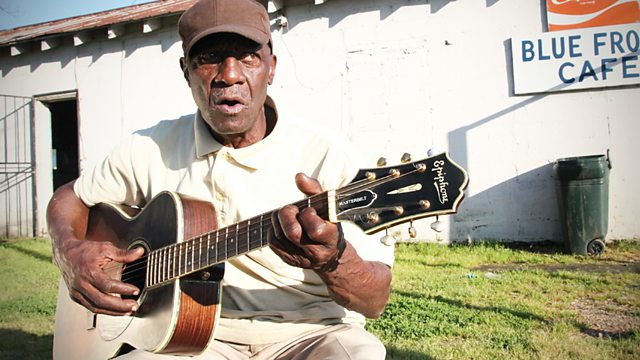
The Blue Front Cafe started in the 1940's in Bentonia, Mississippi. | 0:54:48 | 0:54:53 | |
SASSY BLUES MUSIC PLAYS | 0:54:55 | 0:54:58 | |
Juke joint music, drinking, gambling, eating... | 0:55:13 | 0:55:18 | |
I mean, you name it. | 0:55:18 | 0:55:20 | |
You'd have people come by, they'd have a harmonica in their pocket, | 0:55:20 | 0:55:25 | |
a guitar strapped across their back and they would play solo. | 0:55:25 | 0:55:29 | |
Set a cap or a bucket down in front of them, | 0:55:29 | 0:55:31 | |
and some of them would contribute, nickels, dimes, | 0:55:31 | 0:55:34 | |
pennies or whatever, and they'd play for that. | 0:55:34 | 0:55:36 | |
SASSY BLUES CONTINUES | 0:55:36 | 0:55:38 | |
CROWD CHEERING | 0:55:56 | 0:55:57 | |
But blacks were leaving the south in large numbers, | 0:56:02 | 0:56:05 | |
pushed off the land by new machines on the plantations, and pulled | 0:56:05 | 0:56:09 | |
towards the north especially Chicago by jobs in the factories. | 0:56:09 | 0:56:13 | |
The motivation for Muddy Waters to put on his best suit, | 0:56:15 | 0:56:18 | |
have his picture taken and leave Mississippi | 0:56:18 | 0:56:21 | |
arrived in the shape of a record sent by Alan Lomax. | 0:56:21 | 0:56:24 | |
In an evening at the White House devoted to celebrating | 0:56:27 | 0:56:30 | |
the blues, America's first black President focused on that moment. | 0:56:30 | 0:56:35 | |
Lomax sent Muddy two pressings from their sessions | 0:56:35 | 0:56:40 | |
together along with a cheque for 20. | 0:56:40 | 0:56:43 | |
Later in his life, Muddy recalled what happened next. | 0:56:44 | 0:56:47 | |
He said, "I carried that record up to the corner | 0:56:47 | 0:56:50 | |
"and I put it on the juke box. | 0:56:50 | 0:56:53 | |
"Just played it and played it and said, 'I can do it. 'I can do it.'" | 0:56:53 | 0:56:58 | |
In many way, that right there is the story of the blues. | 0:57:00 | 0:57:04 | |
# Well, I feel... # | 0:57:04 | 0:57:08 | |
Heading for Chicago, Muddy caught the train out of the Delta in 1943. | 0:57:09 | 0:57:15 | |
# Well, babe, I just can't be satisfied | 0:57:21 | 0:57:24 | |
# And I just... # | 0:57:24 | 0:57:26 | |
The trains were segregated. | 0:57:28 | 0:57:30 | |
Black Americans rode in carriages at the back | 0:57:30 | 0:57:33 | |
and the journey itself was an education. | 0:57:33 | 0:57:35 | |
They had a coloured car and a regular car. | 0:57:38 | 0:57:41 | |
One thing I always remember in the coloured car, | 0:57:41 | 0:57:43 | |
they left the windows open, so you'd go through the tunnels, you'd | 0:57:43 | 0:57:46 | |
get all that stuff in your face. | 0:57:46 | 0:57:48 | |
In terms of learning about | 0:57:51 | 0:57:54 | |
the real history of this country, | 0:57:54 | 0:57:57 | |
you know, nothing is sharper than that teaching. | 0:57:57 | 0:58:02 | |
# Well, I know my little old baby | 0:58:02 | 0:58:05 | |
# She gonna jump and shout | 0:58:05 | 0:58:07 | |
# That old train be late, man, and... # | 0:58:07 | 0:58:10 | |
In Chicago, Muddy plugged his guitar into electricity. | 0:58:10 | 0:58:14 | |
The music made by Muddy | 0:58:14 | 0:58:15 | |
and other musicians from the south didn't just change Chicago - | 0:58:15 | 0:58:19 | |
it changed the world. | 0:58:19 | 0:58:21 | |
Subtitles by Red Bee Media Ltd | 0:58:29 | 0:58:32 |