Ukraine's Forgotten Children
Similar Content
Browse content similar to Ukraine's Forgotten Children. Check below for episodes and series from the same categories and more!
Transcript
| Line | From | To | |
|---|---|---|---|
'Ukraine got its independence from the Soviet Union in 1991. | 0:00:08 | 0:00:14 | |
'Under the Soviet system, a mother could abandon her newborn baby | 0:00:14 | 0:00:17 | |
'in the maternity ward by simply signing it over to the state. | 0:00:17 | 0:00:21 | |
'Today, the legacy of that system is that state care has become | 0:00:21 | 0:00:27 | |
'the norm for children with any kind of disability. | 0:00:27 | 0:00:30 | |
'There are ten times as many children in state care in Ukraine | 0:00:30 | 0:00:34 | |
'as in England. | 0:00:34 | 0:00:36 | |
'I have come to find out, after two decades of independence, | 0:00:37 | 0:00:41 | |
'how disabled children are cared for in institutions today.' | 0:00:41 | 0:00:47 | |
I can see from looking at her that she's in a very chronic condition. | 0:00:52 | 0:00:57 | |
You know, she could die. | 0:00:57 | 0:00:59 | |
'I also want to meet young people who have grown up in state care and hear their stories. | 0:00:59 | 0:01:03 | |
'Under the Charter of the United Nations, of which Ukraine is a founding member, | 0:01:23 | 0:01:28 | |
'everyone has basic rights, irrespective of sickness or disability. | 0:01:28 | 0:01:32 | |
'But, even when they grow up, many of Ukraine's orphans | 0:01:33 | 0:01:36 | |
'become trapped in the system, with no right of appeal | 0:01:36 | 0:01:40 | |
'and no right to have their voices heard.' | 0:01:40 | 0:01:43 | |
I don't understand what mentally incapacitated means. | 0:01:56 | 0:01:59 | |
She says, "They can take away your camera, get out as soon as possible." | 0:01:59 | 0:02:05 | |
'I want to know what life is like for the children of Ukraine | 0:02:05 | 0:02:08 | |
'who live and die in state care.' | 0:02:08 | 0:02:10 | |
It's so sad. | 0:02:12 | 0:02:14 | |
'As co-hosts of Euro 2012, | 0:02:37 | 0:02:40 | |
'Ukraine is keen to prove it deserves a place at the EU table. | 0:02:40 | 0:02:43 | |
'Around £9 billion, more than half of it public money, | 0:02:44 | 0:02:49 | |
'has been spent on stadiums, airports, trains and hotels. | 0:02:49 | 0:02:53 | |
'But, whilst money has been found for infrastructure in major cities, | 0:02:53 | 0:02:58 | |
'the budgets for the care of the weakest members of Ukraine's society have been under strain. | 0:02:58 | 0:03:03 | |
'In the last decade, | 0:03:07 | 0:03:09 | |
'the number of state-funded institutes caring for children | 0:03:09 | 0:03:12 | |
'has increased, as families have felt the strain of the country's economic collapse | 0:03:12 | 0:03:18 | |
'following independence from the Soviet Union. | 0:03:18 | 0:03:21 | |
'For the next six months I will be filming | 0:03:21 | 0:03:24 | |
'the lives of a group of children in an institute in southern Ukraine. | 0:03:24 | 0:03:27 | |
'I've filmed in orphanages before, in Bulgaria and in Greece, | 0:03:27 | 0:03:32 | |
'and witnessed distressing scenes of neglect and abuse. | 0:03:32 | 0:03:37 | |
'But it's all too easy to criticise individual carers. | 0:03:37 | 0:03:40 | |
'What I want to understand here in Ukraine is how the system as a whole treats disabled children, | 0:03:40 | 0:03:47 | |
'so I've come to an institute with caring staff. | 0:03:47 | 0:03:50 | |
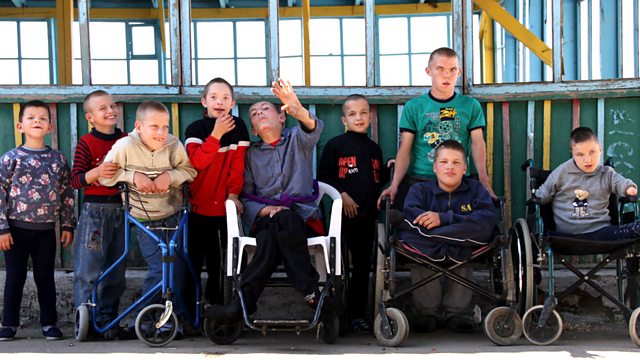
'This home houses over 100 children of very mixed abilities | 0:03:50 | 0:03:53 | |
'from the age of five to adulthood.' | 0:03:53 | 0:03:56 | |
Davay ruki. | 0:04:06 | 0:04:09 | |
'Ten-year-old Lyosha is a bright and happy child. | 0:04:34 | 0:04:38 | |
'Though he has no hands or feet, Lyosha is fiercely independent. | 0:04:38 | 0:04:44 | |
'His mother gave him up to the care of the state when he was a baby | 0:04:53 | 0:04:56 | |
'and he has been at this institute for the last six years. | 0:04:56 | 0:05:01 | |
'This makes him what is called in Ukraine a social orphan. | 0:05:01 | 0:05:05 | |
'This means that, like so many of the children here, | 0:05:05 | 0:05:08 | |
'his parents are still alive but are unable or unwilling to care for him. | 0:05:08 | 0:05:13 | |
'Lyosha is proud of the fact he makes his own bed | 0:05:40 | 0:05:43 | |
'and won't allow the carers to help him.' | 0:05:43 | 0:05:45 | |
And he goes to the toilet himself. | 0:05:45 | 0:05:47 | |
Oh, it's Katya! | 0:05:49 | 0:05:50 | |
'Katya is another social orphan. | 0:05:50 | 0:05:54 | |
'She also has living parents | 0:05:54 | 0:05:56 | |
'who signed her over to state care as a baby. | 0:05:56 | 0:05:59 | |
'She's been here for 18 years. | 0:05:59 | 0:06:02 | |
'She grew up unable to walk. | 0:06:02 | 0:06:04 | |
'It is only in recent years that she's become mobile.' | 0:06:04 | 0:06:07 | |
Misha, the teddy bear. | 0:06:14 | 0:06:16 | |
'Nikolai is the institute's director. | 0:06:17 | 0:06:21 | |
'He is clearly very committed to those in his charge. | 0:06:21 | 0:06:25 | |
'The trouble is, chronically sick children are sent to the institute | 0:06:25 | 0:06:28 | |
'and he simply does not have the qualified staff or the medical facilities to look after them. | 0:06:28 | 0:06:33 | |
'Ukraine has the worst HIV/AIDS epidemic in Europe | 0:06:46 | 0:06:50 | |
'and one of the fastest-growing epidemics in the world. | 0:06:50 | 0:06:55 | |
'Among his children, | 0:06:55 | 0:06:56 | |
'Nikolai has the challenge of caring for an HIV-positive child | 0:06:56 | 0:07:00 | |
'who the carers are scared to look after. | 0:07:00 | 0:07:04 | |
'Ideally, Nikolai would like to see all his children growing up in a family, | 0:07:21 | 0:07:26 | |
'but so far not a single child has ever been adopted | 0:07:26 | 0:07:30 | |
'from this institute.' | 0:07:30 | 0:07:32 | |
-You see, this is formal and official. -Yeah. | 0:07:41 | 0:07:44 | |
'Nikolai despairs that he is sent children who have multiple problems. | 0:08:11 | 0:08:16 | |
'Six-year-old Sasha is one of those children. | 0:08:19 | 0:08:23 | |
'His weight is dropping off him | 0:08:23 | 0:08:25 | |
'and Nikolai is at a loss as to what to do.' | 0:08:25 | 0:08:28 | |
He's so tiny, isn't he? He's so tiny. | 0:08:29 | 0:08:34 | |
Sasha's parents left him behind at the maternity hospital | 0:08:35 | 0:08:39 | |
-because he had so many problems. -Uh-huh. -So many health problems. | 0:08:39 | 0:08:43 | |
He doesn't like to be touched. | 0:08:43 | 0:08:46 | |
Also he's got something like hyperflexibility. | 0:08:48 | 0:08:51 | |
You know, when all the hips and joints can be twisted inside out. | 0:08:51 | 0:08:56 | |
I think you like being touched. Yes, I do. | 0:08:58 | 0:09:03 | |
You're a tiny thing. | 0:09:04 | 0:09:07 | |
'Olga is medically responsible for all the children here. | 0:09:11 | 0:09:15 | |
'It is hard to get qualified staff to work in remote institutes | 0:09:15 | 0:09:20 | |
'and she had retired when Nikolai asked if she would become the institute's doctor five years ago. | 0:09:20 | 0:09:25 | |
'She agreed, although she's actually a dentist. | 0:09:25 | 0:09:29 | |
'Nastya has been bedridden for years.' | 0:09:57 | 0:09:59 | |
Her rib cage is deformed | 0:10:05 | 0:10:08 | |
and it's impossible to feed her through a tube. | 0:10:08 | 0:10:11 | |
And her, basically, breathing channels | 0:10:15 | 0:10:19 | |
are very narrow and twisted. | 0:10:19 | 0:10:24 | |
Deformed from her birth. Oy. | 0:10:24 | 0:10:27 | |
Ahh, she's... Oh... | 0:10:28 | 0:10:34 | |
And she suffers from horrible bouts of epilepsy. | 0:10:34 | 0:10:38 | |
-How long has she been here for? -Well, since she was five. | 0:10:38 | 0:10:43 | |
Does she have parents? | 0:10:43 | 0:10:45 | |
Yes, she is a social orphan. | 0:10:45 | 0:10:48 | |
Her parents have given up their rights and they've never visited. | 0:10:48 | 0:10:53 | |
'Nadia is ten. | 0:11:35 | 0:11:38 | |
'She has a large cyst on her head | 0:11:38 | 0:11:40 | |
'which means she cannot sit up or move around. | 0:11:40 | 0:11:44 | |
'She simply lies here, watching and listening.' | 0:11:44 | 0:11:48 | |
All her brain is in this cyst. | 0:11:48 | 0:11:50 | |
A zdyes v cherepye nakhoditsya...zhidkost. | 0:11:50 | 0:11:55 | |
And her skull... | 0:11:55 | 0:11:57 | |
Basically what is left in her skull is liquid, she says. | 0:11:57 | 0:12:02 | |
And just connective tissues, | 0:12:02 | 0:12:05 | |
but the whole of her brain is outside in this cyst. | 0:12:05 | 0:12:10 | |
She was seen by a consultant when she was still a baby. | 0:12:19 | 0:12:22 | |
Can you imagine being one of these children, Olga? | 0:12:46 | 0:12:50 | |
Can you imagine being him? | 0:12:50 | 0:12:52 | |
Just there all day every day, for maybe 20 years. | 0:12:54 | 0:12:58 | |
You know, or Sasha. | 0:13:00 | 0:13:01 | |
You know, Sasha's never going to get better because, you know, | 0:13:03 | 0:13:06 | |
at the end of the day, they are just left. | 0:13:06 | 0:13:10 | |
'When a baby is abandoned at birth, | 0:13:21 | 0:13:24 | |
'it's placed in a baby unit up to the age of three, | 0:13:24 | 0:13:28 | |
'then moved to a children's home until five, before being | 0:13:28 | 0:13:32 | |
'passed on to an institute like Nikolai's until adulthood. | 0:13:32 | 0:13:35 | |
'According to Nikolai, where you go as an orphan is a bit of a lottery. | 0:13:38 | 0:13:42 | |
'As a result, children who, with loving care, could have lived a normal life | 0:13:42 | 0:13:47 | |
'end up alongside those with quite severe disabilities | 0:13:47 | 0:13:50 | |
'and very different needs. | 0:13:50 | 0:13:53 | |
'How you get looked after is also pot luck. | 0:13:53 | 0:13:57 | |
'Most carers are untrained and, whilst some take an interest in the children they look after, | 0:13:57 | 0:14:02 | |
'others do the minimum their job requires, just washing and feeding the children. | 0:14:02 | 0:14:07 | |
'This institute has carers who do their best | 0:14:13 | 0:14:17 | |
'but, with a ratio of nine children per carer, it's not an easy job. | 0:14:17 | 0:14:21 | |
'Under the Soviet system, | 0:14:25 | 0:14:27 | |
'it was widely accepted that institutionalised care for disabled children | 0:14:27 | 0:14:32 | |
'was potentially better than parental care. | 0:14:32 | 0:14:35 | |
'Parents were considered ignorant in the field of raising children | 0:14:36 | 0:14:40 | |
'and, although it was accepted that parents had the right to bring up | 0:14:40 | 0:14:44 | |
'their own children, this was seen as the delegated right of the state. | 0:14:44 | 0:14:47 | |
'Today, disabled children like Lyosha | 0:15:06 | 0:15:08 | |
'invariably grow up with the state as their guardian.' | 0:15:08 | 0:15:12 | |
Da. | 0:15:24 | 0:15:26 | |
'Lyosha and Katya are the best of friends | 0:15:38 | 0:15:42 | |
'and spend a lot of time together. | 0:15:42 | 0:15:46 | |
'Their parents have never visited. | 0:15:46 | 0:15:48 | |
'The present government says it's in favour of deinstitutionalisation | 0:16:30 | 0:16:34 | |
'but, despite this, according to UNICEF, | 0:16:34 | 0:16:37 | |
'the number of children in institutions has doubled in the past ten years. | 0:16:37 | 0:16:43 | |
'Poverty, unemployment, alcoholism | 0:16:43 | 0:16:45 | |
'and drug use are the main reasons for children being abandoned. | 0:16:45 | 0:16:50 | |
'Around an hour's drive from the nearest town, this institute, | 0:17:44 | 0:17:48 | |
'like many in the former Eastern Bloc, feels hidden away. | 0:17:48 | 0:17:52 | |
'The living area for the orphans is divided into different buildings, | 0:17:53 | 0:17:57 | |
'separating the bedridden, the disabled and the adults. | 0:17:57 | 0:18:00 | |
'Nikolai has fought to secure extra funding for the children in his care | 0:18:00 | 0:18:05 | |
'and in fact this institute receives around 40% more per head than the average for the region. | 0:18:05 | 0:18:12 | |
'But when one of Nikolai's children has to go to hospital | 0:18:14 | 0:18:17 | |
'he must supply all the food, nappies and medication for the duration of their stay. | 0:18:17 | 0:18:22 | |
'Three very sick children recently arrived at the institute.' | 0:18:24 | 0:18:28 | |
No-one was hiding the fact that these kids were sent here to die. | 0:18:29 | 0:18:33 | |
Two of them have already died. | 0:18:33 | 0:18:35 | |
'Two quickly died but the remaining child, Margarita, | 0:18:35 | 0:18:38 | |
'is very unwell in the local hospital. | 0:18:38 | 0:18:42 | |
'We are on our way to see Margarita but we have to film secretly | 0:18:42 | 0:18:46 | |
'because Nikolai is anxious that she's not getting the treatment she needs.' | 0:18:46 | 0:18:51 | |
Basically the level of oxygen in her blood is very low. | 0:18:53 | 0:18:58 | |
This is the doctor. | 0:18:58 | 0:19:00 | |
He said that at the moment the state of this child is kind of...satisfactory. | 0:19:00 | 0:19:05 | |
If her temperature goes down, she will be sent in this condition back to the internat, which... | 0:19:14 | 0:19:19 | |
It's not a hospital. The internat is not a hospital. | 0:19:19 | 0:19:23 | |
I don't understand. | 0:19:26 | 0:19:28 | |
Why can't you have the responsibility | 0:19:28 | 0:19:30 | |
to try to keep the child in hospital until she improves, | 0:19:30 | 0:19:33 | |
with or without a temperature? | 0:19:33 | 0:19:35 | |
"I don't know. I don't decide." | 0:20:01 | 0:20:04 | |
MARGARITA SPLUTTERS | 0:20:04 | 0:20:06 | |
'A senior paediatrician joined us.' | 0:20:36 | 0:20:38 | |
I am not a doctor but I can see from looking at her | 0:20:40 | 0:20:42 | |
that she's in very chronic condition. | 0:20:42 | 0:20:46 | |
This child... You know, she could die. | 0:20:46 | 0:20:49 | |
So, whether she's got a temperature or not, | 0:20:49 | 0:20:52 | |
I cannot understand how two doctors could send her | 0:20:52 | 0:20:56 | |
out of the hospital to an institute where there's no medication. | 0:20:56 | 0:21:00 | |
Can you please try explaining this to me? | 0:21:00 | 0:21:04 | |
"This is not our level of solving problems." | 0:21:08 | 0:21:11 | |
So doctors don't make the decisions? | 0:21:22 | 0:21:24 | |
'Margarita has parents, as too do most of the children | 0:22:14 | 0:22:19 | |
'and young adults living at Nikolai's institute. | 0:22:19 | 0:22:22 | |
'When a child reaches 18, | 0:22:27 | 0:22:30 | |
'it is the norm to be moved to an adult institute, | 0:22:30 | 0:22:33 | |
'but Nikolai tries to offer as many as he can a continued life here, | 0:22:33 | 0:22:38 | |
'rather than letting the authorities take charge, | 0:22:38 | 0:22:40 | |
'scattering them across the country | 0:22:40 | 0:22:43 | |
'into big, unfamiliar adult institutes or old people's homes. | 0:22:43 | 0:22:47 | |
'Whilst filming with these adults, | 0:23:21 | 0:23:24 | |
'I became aware of a status in Ukraine that appears to hold young people in the system | 0:23:24 | 0:23:29 | |
'even when they are capable of living in society. | 0:23:29 | 0:23:32 | |
'Some young people are officially given the status of "incapacitated" by the court. | 0:23:32 | 0:23:37 | |
'An individual may be categorised as incapacitated if they are | 0:23:41 | 0:23:46 | |
'judged to be unaware of their actions or not in control of them. | 0:23:46 | 0:23:51 | |
'Most of Nikolai's adults have this status and for many of them | 0:23:51 | 0:23:55 | |
'I would not have questioned their need for long-term care, | 0:23:55 | 0:23:59 | |
'but it seems this status is also given to some who are | 0:23:59 | 0:24:03 | |
'quite capable of being integrated into society. | 0:24:03 | 0:24:07 | |
'Tatyana Makarova, a Ukrainian businesswoman | 0:24:50 | 0:24:54 | |
'and leading expert in the gas supply industry, | 0:24:54 | 0:24:57 | |
'has been trying to help orphans in Ukraine for over a decade now. | 0:24:57 | 0:25:00 | |
'Her mobile telephone number is constantly passed around the inmates | 0:25:00 | 0:25:04 | |
'as someone who will listen and try and help. | 0:25:04 | 0:25:07 | |
'She focuses on helping the incapacitated orphans, | 0:25:08 | 0:25:11 | |
'young adults who are held by the state in psychic institutes and old people's homes. | 0:25:11 | 0:25:18 | |
'Tatyana phoned the mobiles of two incapacitated young men | 0:25:51 | 0:25:54 | |
'she has been trying to help who are being kept in an old people's home. | 0:25:54 | 0:25:59 | |
'She asked them if they would be willing to meet with us secretly, | 0:25:59 | 0:26:02 | |
'as she knew they would never get permission to talk to us officially, | 0:26:02 | 0:26:06 | |
'because they are regarded as not being responsible for their actions. | 0:26:06 | 0:26:09 | |
'They agreed, and so we met them | 0:26:09 | 0:26:12 | |
'in a maize field near the institute for old people where they now live.' | 0:26:12 | 0:26:16 | |
How old were you when you were diagnosed as mentally incapacitated? | 0:26:29 | 0:26:37 | |
'Now in his mid-30s, Lyonya was first sent to the old people's home 15 years ago. | 0:26:43 | 0:26:49 | |
'But conditions here are not as bad as in the Novosavitski psychiatric home | 0:27:01 | 0:27:05 | |
'where Lyonya was confined in 2007. | 0:27:05 | 0:27:08 | |
'He claims antipsychotic drugs were misused there as punishment.' | 0:27:10 | 0:27:13 | |
What kind of work did you have to do at the institute? | 0:28:01 | 0:28:06 | |
How many of your friends also suffered this punishment? | 0:28:23 | 0:28:26 | |
What was the worst thing you witnessed? | 0:28:35 | 0:28:37 | |
'It's one thing to be mentally unwell and to need to live in an environment with carers for life | 0:29:07 | 0:29:13 | |
'but it's another if you are capable of independent living | 0:29:13 | 0:29:16 | |
'and you are held by the system against your will. | 0:29:16 | 0:29:19 | |
'We were about to talk to Lyonya's friend, Slava, | 0:29:24 | 0:29:28 | |
'also an inmate at the same geriatric institute.' | 0:29:28 | 0:29:31 | |
Is that a long way away, that person's voice and dog? | 0:29:31 | 0:29:34 | |
'The institute's director had got wind that outsiders were in the area.' | 0:29:48 | 0:29:53 | |
We don't have any rights because he is incapacitated. | 0:30:22 | 0:30:27 | |
OK, we'd better get the camera and go. | 0:30:43 | 0:30:47 | |
-We'd better shift quickly because... -Yeah, they called the police. | 0:30:49 | 0:30:53 | |
-Have they done it already? -They might just threaten, but it's better for us to go. -Exactly. | 0:30:53 | 0:30:58 | |
But, erm, what... | 0:30:59 | 0:31:01 | |
Tak, nam podozhdit za predelu oblasti nado vyekhat, vy schitaetye? | 0:31:01 | 0:31:04 | |
'We called Tatyana.' | 0:31:04 | 0:31:07 | |
She says they are capable of anything. | 0:31:07 | 0:31:11 | |
They can call the police and they can take away your camera. | 0:31:11 | 0:31:16 | |
So what does she think is the worst-case scenario? | 0:31:16 | 0:31:19 | |
Kak vy dumayetye? Oni seychas nas nashli? | 0:31:19 | 0:31:22 | |
Tatyana says that they can lock them up | 0:31:22 | 0:31:26 | |
in an institution for mentally disabled | 0:31:26 | 0:31:30 | |
and give them more injections of aminazine and haloperidol. | 0:31:30 | 0:31:37 | |
I'm asking what we can do actually to protect them, | 0:31:37 | 0:31:40 | |
what she can do or what we can do, because we are really worried what will happen to them. | 0:31:40 | 0:31:45 | |
But they have her telephone number, | 0:31:45 | 0:31:48 | |
so she's the first point of contact for them, right, | 0:31:48 | 0:31:50 | |
-so they will get in touch with her if anything changes, correct? -It's unpredictable, she said. | 0:31:50 | 0:31:55 | |
Tatyana says that basically | 0:32:09 | 0:32:11 | |
when orphans graduate from orphanages there is nowhere to go for them. | 0:32:11 | 0:32:16 | |
Nowhere to go. And she says it's very easy to tuck them away | 0:32:16 | 0:32:20 | |
in these sorts of institutions because they are...free labour. | 0:32:20 | 0:32:26 | |
Tatyana says any resistance from the lads | 0:32:28 | 0:32:32 | |
has always resulted in them being punished. | 0:32:32 | 0:32:36 | |
What I don't understand is why she seems to be fighting this battle alone. | 0:32:36 | 0:32:42 | |
Where's the attention of the rest of the country? | 0:32:42 | 0:32:45 | |
Ministers, government, NGOs. | 0:32:45 | 0:32:47 | |
Where is everybody else when it comes to this? | 0:32:47 | 0:32:50 | |
Tatyana says that, "I have appealed to so many institutions and people, | 0:32:50 | 0:32:56 | |
"and basically...no response. They don't care." | 0:32:56 | 0:33:01 | |
Has Tatyana heard anything from the lads since we left? | 0:33:02 | 0:33:06 | |
She tried to get in touch with those lads but she couldn't, | 0:33:06 | 0:33:09 | |
they don't answer their mobile phones. | 0:33:09 | 0:33:12 | |
She will keep trying | 0:33:12 | 0:33:14 | |
but, as it is at the moment, she doesn't know what's happening to them | 0:33:14 | 0:33:18 | |
and she says, "I am praying to God that everything will end well." | 0:33:18 | 0:33:23 | |
'Nikolai knows that many of his orphans are destined for | 0:33:54 | 0:33:57 | |
'the kind of institute that Lyonya and Slava live in. | 0:33:57 | 0:34:02 | |
'But for a small group of Nikolai's boys | 0:34:10 | 0:34:13 | |
'there is hope for a better life. | 0:34:13 | 0:34:16 | |
'Nikolai has selected some of his more capable | 0:34:16 | 0:34:19 | |
'as boys with the most potential to learn and to develop. | 0:34:19 | 0:34:24 | |
'He wants to prevent them from becoming | 0:34:24 | 0:34:26 | |
'yet more institutionalised adults, seen as incapable of learning, | 0:34:26 | 0:34:31 | |
'so he has plans to move a selected group into a house being renovated on the campus of the institute | 0:34:31 | 0:34:37 | |
'and educate them. | 0:34:37 | 0:34:39 | |
'Nikolai managed to get donations from Russia for the renovation. | 0:34:43 | 0:34:47 | |
'The Ukrainian government also contributed | 0:34:47 | 0:34:49 | |
'after Nikolai highlighted how things need to change. | 0:34:49 | 0:34:52 | |
'It's a huge responsibility to take on in such a remote place | 0:34:52 | 0:34:57 | |
'but Nikolai wants to start giving his children a better life | 0:34:57 | 0:35:01 | |
'and this is the first step. | 0:35:01 | 0:35:03 | |
'The boys will live and learn together side-by-side as an extended family.' | 0:35:04 | 0:35:10 | |
When you think about moving into the little house, what feelings do you get inside you? | 0:36:08 | 0:36:13 | |
Are you going to help when you're in the small house? | 0:36:24 | 0:36:28 | |
You'd like to help the staff? | 0:36:31 | 0:36:33 | |
'The boys will move into the group home in a few weeks | 0:36:41 | 0:36:44 | |
'but in the meantime life continues unchanged. | 0:36:44 | 0:36:49 | |
'Sergei is 15 and was handed over to the state by his parents as a small child. | 0:37:04 | 0:37:10 | |
'His notes say that he has been diagnosed with oligophrenia. | 0:37:11 | 0:37:15 | |
'This is a Soviet-era diagnosis, not recognised in the West. | 0:37:15 | 0:37:19 | |
'It translates as feeble-minded. | 0:37:19 | 0:37:23 | |
'Though his files also state that Sergei dreams of having a family | 0:37:23 | 0:37:27 | |
'and gets angry when he's ignored. | 0:37:27 | 0:37:29 | |
'He appears to be very capable | 0:37:31 | 0:37:33 | |
'and he has a real interest in anything technical. | 0:37:33 | 0:37:36 | |
'In the new group home, | 0:37:36 | 0:37:38 | |
'Sergei has been told that there will be a computer for him to use. | 0:37:38 | 0:37:43 | |
'Sasha is the leader of the boys moving into the group home | 0:37:48 | 0:37:52 | |
'and is very popular and caring. | 0:37:52 | 0:37:54 | |
'His file says that he suffers from hydrocephalus and a degree of idiocy | 0:37:54 | 0:37:59 | |
'but also notes that he is very cooperative and very helpful to the staff. | 0:37:59 | 0:38:04 | |
'With so many to look after and a lack of individual attention | 0:38:07 | 0:38:10 | |
'and stimulation, institutionalisation sets in, | 0:38:10 | 0:38:15 | |
'with the boys showing classic behaviour like rocking and self-harming. | 0:38:15 | 0:38:20 | |
'In 2006, when Ukraine ratified the UN Convention on Inhuman or Degrading Treatment, | 0:39:24 | 0:39:30 | |
'the government promised to create a system of independent monitoring of institutes within a year. | 0:39:30 | 0:39:37 | |
'But, six years later, | 0:39:37 | 0:39:38 | |
'human rights groups say that no effective system is in place. | 0:39:38 | 0:39:43 | |
'Around 80,000 children are thought to be in residential care in Ukraine, | 0:39:49 | 0:39:53 | |
'though official figures are unclear. | 0:39:53 | 0:39:56 | |
'Institutional life often lacks any real structure. | 0:40:00 | 0:40:04 | |
'There is little attempt to integrate the orphans into the local community. | 0:40:04 | 0:40:09 | |
'They tend to be hidden away from society, without education | 0:40:09 | 0:40:13 | |
'or developmental care and without sufficient stimulation. | 0:40:13 | 0:40:17 | |
'It's inevitable the children will go downhill. | 0:40:17 | 0:40:20 | |
'It's three months since we were last here | 0:40:21 | 0:40:24 | |
'and life at Nikolai's institute is particularly stressful | 0:40:24 | 0:40:28 | |
'because he has such very sick children to take care of, | 0:40:28 | 0:40:31 | |
'yet this is officially a non-medical establishment. | 0:40:31 | 0:40:35 | |
'Today, however, there's a good feeling around the campus, | 0:40:39 | 0:40:43 | |
'as Sergei, Sasha and the rest of the boys are rehearsing | 0:40:43 | 0:40:46 | |
'for the opening ceremony of the group home in a few weeks' time. | 0:40:46 | 0:40:50 | |
'Nikolai has just learned that a surprise educational assessment | 0:41:25 | 0:41:28 | |
'by the local authorities is taking place today | 0:41:28 | 0:41:32 | |
'and the children going into the group home have been named as those to be assessed. | 0:41:32 | 0:41:37 | |
'Everyone is worried that this assessment could jeopardise the move of some of the boys | 0:41:37 | 0:41:42 | |
'if they are categorised as not capable of learning. | 0:41:42 | 0:41:45 | |
'Sasha is the first and is very nervous.' | 0:41:45 | 0:41:50 | |
"Ahh." | 0:42:39 | 0:42:40 | |
Gromko, "Ahh." | 0:42:43 | 0:42:46 | |
-I yeshchye skazhi, "Aah." -Ahh. | 0:42:46 | 0:42:49 | |
'Each of the rest of the boys is then assessed.' | 0:43:31 | 0:43:35 | |
What happens after these assessments have been made? | 0:44:15 | 0:44:18 | |
'The purpose of the assessment was not explained to Nikolai, | 0:44:41 | 0:44:45 | |
'nor was he told how the boys had performed, | 0:44:45 | 0:44:47 | |
'but hopefully all the boys will be allowed to move into the new group home as planned. | 0:44:47 | 0:44:54 | |
'Three months have passed since we were last in Ukraine | 0:45:01 | 0:45:05 | |
'and Tatyana has been continuing to fight for the freedom of the incapacitated. | 0:45:05 | 0:45:10 | |
'She has successfully managed to get a handful of young men | 0:45:10 | 0:45:14 | |
'out of the institutes where they were being held | 0:45:14 | 0:45:17 | |
'by arranging to transfer their guardianship. | 0:45:17 | 0:45:20 | |
'Tatyana has arranged for us to meet Boris. | 0:45:22 | 0:45:26 | |
'He is officially incapacitated | 0:45:26 | 0:45:28 | |
'but while he was living in an institute a worker, Zinaida, got to know him | 0:45:28 | 0:45:33 | |
'and, with Tatyana's help, was able to take over Boris's guardianship.' | 0:45:33 | 0:45:38 | |
-Zdravstvuytye. -Dobriy dyen. | 0:45:38 | 0:45:40 | |
'Born in the Soviet era, Boris has never been happier | 0:45:40 | 0:45:44 | |
'than living here with Zinaida, who he calls Mother, | 0:45:44 | 0:45:47 | |
'and her mother, who he calls Grandmother. | 0:45:47 | 0:45:50 | |
'He is so very proud to have a family at last. | 0:45:50 | 0:45:54 | |
'His dream is to be rid of his incapacitated status | 0:45:54 | 0:45:58 | |
'so he can enjoy the basic rights of those living free in society.' | 0:45:58 | 0:46:01 | |
This is where Boris sleeps. | 0:46:03 | 0:46:05 | |
He is growing seeds here, you see. | 0:46:12 | 0:46:14 | |
'Boris has a friend, Misha, who is also incapacitated. | 0:46:23 | 0:46:27 | |
'They were in an institute together and Tatyana also found him a guardian, | 0:46:27 | 0:46:32 | |
'who has allowed him to come and stay with Boris. | 0:46:32 | 0:46:35 | |
'Boris had no idea he was incapacitated | 0:49:47 | 0:49:51 | |
'until Zinaida tried to become his guardian. | 0:49:51 | 0:49:54 | |
'Boris was an inmate of the same old people's home | 0:51:14 | 0:51:17 | |
'that Lyonya and Slava from the maize field still live in. | 0:51:17 | 0:51:20 | |
'Nikolai hopes that by giving some of his children the chance to live in a group home | 0:54:12 | 0:54:17 | |
'they may escape the kind of life in an adult institute | 0:54:17 | 0:54:21 | |
'that Boris had to endure. | 0:54:21 | 0:54:23 | |
'Today, the boys selected for the group home are moving in. | 0:54:27 | 0:54:31 | |
'It is a day of mixed emotions for Lyosha. | 0:54:39 | 0:54:42 | |
'He is starting a new life in a small group home just a few hundred yards away | 0:54:42 | 0:54:47 | |
'but he is leaving his best friend, Katya, behind.' | 0:54:47 | 0:54:50 | |
Poshli. Natashye, do svidaniya. | 0:56:50 | 0:56:52 | |
THEY SPEAK IN RUSSIAN | 0:57:06 | 0:57:11 | |
HE GASPS | 0:57:57 | 0:58:00 | |
HE SPEAKS IN RUSSIAN | 0:58:43 | 0:58:44 | |
'For the first time in their lives, | 0:58:44 | 0:58:47 | |
'all these boys will get regular schooling.' | 0:58:47 | 0:58:51 | |
DOG BARKS | 0:59:01 | 0:59:03 | |
'According to an independent sociological institute, | 1:01:47 | 1:01:50 | |
'at least 20% of those labelled as incapacitated | 1:01:50 | 1:01:53 | |
'are perfectly capable of independent living. | 1:01:53 | 1:01:57 | |
'While Boris waits for his next court date, | 1:01:58 | 1:02:01 | |
'he is enjoying sharing some time with Misha in the local community.' | 1:02:01 | 1:02:05 | |
Takiye dela. | 1:03:24 | 1:03:27 | |
'Tatyana feels that the fate of the incapacitated | 1:03:32 | 1:03:36 | |
'reflects a system that sees them as worthless throwaway people. | 1:03:36 | 1:03:40 | |
'It's been three months since we last saw Sasha. | 1:03:43 | 1:03:47 | |
'He is weaker now.' | 1:03:47 | 1:03:49 | |
He eats well but he's losing weight and they can't explain why. | 1:03:49 | 1:03:55 | |
I just find it astounding that a professional would look at him | 1:04:00 | 1:04:04 | |
and the state of him, and say, "You're fine. | 1:04:04 | 1:04:08 | |
"You can go back to the institute. You're fine." | 1:04:08 | 1:04:11 | |
MISHA LAUGHS | 1:04:44 | 1:04:46 | |
BANGING | 1:05:02 | 1:05:04 | |
'Regardless of the growing cyst on Nadia's head, | 1:05:08 | 1:05:11 | |
'she still manages to stay cheerful. | 1:05:11 | 1:05:13 | |
'Two of Nikolai's bedridden, Nastya and Margarita, | 1:05:56 | 1:06:01 | |
'are both back in hospital, having had a short spell in the institute. | 1:06:01 | 1:06:05 | |
'Nastya is due to be discharged in the next day or two | 1:06:08 | 1:06:12 | |
'but is in need of more nappies, so we head to the hospital with her supplies.' | 1:06:12 | 1:06:17 | |
Doesn't seem like too many doctors in here! | 1:06:17 | 1:06:19 | |
-Yes, doesn't seem like there's anybody here at all. -No! | 1:06:19 | 1:06:24 | |
Ghost town. | 1:06:24 | 1:06:26 | |
'When we arrive, we can't find any staff.' | 1:06:26 | 1:06:30 | |
Have we lost her? | 1:06:31 | 1:06:33 | |
No, no, she's trying to find someone from the medical staff. | 1:06:33 | 1:06:36 | |
-Can you smell her, Olga? -Mm-hm. | 1:06:41 | 1:06:45 | |
Just smells like sort of rotting skin. | 1:06:46 | 1:06:49 | |
Yeah. | 1:06:49 | 1:06:51 | |
Bless her. | 1:06:54 | 1:06:56 | |
She's due back to Nikolai's on Monday. So that's three days. | 1:06:57 | 1:07:03 | |
Nastya. | 1:07:08 | 1:07:11 | |
Nastya. | 1:07:13 | 1:07:14 | |
SHE BREATHES WITH DIFFICULTY Nastya. | 1:07:19 | 1:07:23 | |
She just can't breathe. Nastya. | 1:07:33 | 1:07:36 | |
I don't understand how she's alone, without anybody around. | 1:07:37 | 1:07:43 | |
I mean, we've just walked straight in here from outside. | 1:07:43 | 1:07:46 | |
-I just don't understand. -Oy, Bozhe, Bozhe. | 1:07:46 | 1:07:50 | |
-Inna, she's a daughter of one of the nurses. -OK. | 1:07:52 | 1:07:57 | |
And she said that they all left the building | 1:07:57 | 1:07:59 | |
and went to a different building to have a staff meeting. | 1:07:59 | 1:08:03 | |
-Right. -So she's looking after the premises at the moment. | 1:08:03 | 1:08:07 | |
Nyet. | 1:08:09 | 1:08:10 | |
And Inna is an accountant. She's not a doctor. | 1:08:15 | 1:08:20 | |
How many children are on the corridor? | 1:08:21 | 1:08:25 | |
-15. -Right. | 1:08:29 | 1:08:31 | |
'While we're at the hospital, | 1:08:50 | 1:08:52 | |
'Nikolai calls with some very bad news. | 1:08:52 | 1:08:55 | |
'One of the bedridden boys, who shared the same room as Nastya back at the institute, has died. | 1:08:55 | 1:09:02 | |
'He was just 11 years old. | 1:09:02 | 1:09:04 | |
'He was given up by his parents to the state, | 1:09:09 | 1:09:12 | |
'so Nikolai's job now is to bury him.' | 1:09:12 | 1:09:14 | |
What diagnosis do they give at the hospital as to the cause of death? | 1:09:17 | 1:09:23 | |
-He suffered from...hydrocephalia. -OK, yeah. | 1:09:23 | 1:09:27 | |
Hydrocephalia, you know, it's swelling of the brain, yes. | 1:09:27 | 1:09:32 | |
And that's the official diagnosis. | 1:09:32 | 1:09:35 | |
But it's kind of strange because... Olga, for example, the doctor, | 1:09:35 | 1:09:41 | |
she told me that on Thursday they were able to play with him, | 1:09:41 | 1:09:44 | |
and this is not a child who looked like he was about to die. | 1:09:44 | 1:09:49 | |
He was not considered really sick. | 1:09:49 | 1:09:53 | |
'It is normal in Ukraine for an institute to have its own cemetery, | 1:10:05 | 1:10:09 | |
'but it feels less normal that it's not just the old who are buried, | 1:10:09 | 1:10:13 | |
'but so many young children, whilst in state care, are also buried.' | 1:10:13 | 1:10:17 | |
-More than 400 children are buried... -From the institute? -From the institute. | 1:10:20 | 1:10:27 | |
-Good grief, Nikolai. -Three children died this year. | 1:10:27 | 1:10:31 | |
He was born on the 7th December 2000, and only on Thursday, | 1:10:32 | 1:10:38 | |
just a few days ago, they played with him, and one of the nurses, | 1:10:38 | 1:10:42 | |
she liked to play with him because he responded very well. | 1:10:42 | 1:10:46 | |
The whole of his short life, Nikolai says, was spent around a bed, | 1:10:46 | 1:10:53 | |
and outside, just a little bit of outside. | 1:10:53 | 1:10:56 | |
But otherwise he lived and died from his bed, didn't he? | 1:10:56 | 1:11:00 | |
-Because he was bedridden and stayed there for the majority of the time. -Yeah. | 1:11:00 | 1:11:04 | |
-Yeah. -Ohh. | 1:11:04 | 1:11:07 | |
It's so sad. | 1:11:07 | 1:11:09 | |
'Ukraine is minus 20 degrees in the depths of winter.' | 1:12:10 | 1:12:14 | |
DOG BARKS | 1:12:22 | 1:12:24 | |
'Tatyana has arranged for us to meet with Dennis, | 1:12:37 | 1:12:39 | |
'another young incapacitated man, who Tatyana is helping with | 1:12:39 | 1:12:43 | |
'the legal challenge of trying to get his status reviewed. | 1:12:43 | 1:12:47 | |
'Dennis hopes he may soon be categorised as normal | 1:12:50 | 1:12:53 | |
'and maybe recognised by the courts as somebody who can be responsible for his actions. | 1:12:53 | 1:12:59 | |
'Dennis has cerebral palsy | 1:12:59 | 1:13:00 | |
'and has been in and out of different institutes, | 1:13:00 | 1:13:03 | |
'running away several times, and he ended up | 1:13:03 | 1:13:06 | |
'living on the streets as a preference to life in an institute. | 1:13:06 | 1:13:09 | |
'Like Lyonya, Dennis was sent to Novosavitski psychiatric institute. | 1:13:29 | 1:13:34 | |
'An inquiry found that one inmate was beaten to death | 1:13:56 | 1:13:59 | |
'and the institute is now under new management. | 1:13:59 | 1:14:02 | |
'The institute insists that sedatives are no longer used as punishment, | 1:14:02 | 1:14:07 | |
'that there is no more forced labour | 1:14:07 | 1:14:09 | |
'and no deaths as a result of sedative misuse. | 1:14:09 | 1:14:12 | |
'They say there's no physical punishment and patients take no part in burials, | 1:14:12 | 1:14:17 | |
'but human-rights activists claim that there were many more | 1:14:17 | 1:14:21 | |
'unexplained deaths which have never been investigated. | 1:14:21 | 1:14:25 | |
'Tatyana has worked relentlessly to get both Dennis and Boris | 1:14:49 | 1:14:53 | |
'into the courts to fight for their official freedom. | 1:14:53 | 1:14:57 | |
'Until now, the incapacitated status has effectively imprisoned | 1:14:57 | 1:15:01 | |
'many young men and women in the system for life, | 1:15:01 | 1:15:04 | |
'but an inmate in an institution in the east of Ukraine | 1:15:04 | 1:15:08 | |
'has just had her incapacitated label removed by the court. | 1:15:08 | 1:15:12 | |
'This is the first time ever that an inmate of an institute | 1:15:12 | 1:15:16 | |
'has had this status revoked. | 1:15:16 | 1:15:18 | |
'If Tatyana can realise this for Dennis and Boris, | 1:15:18 | 1:15:20 | |
'it will be an extraordinary achievement. | 1:15:20 | 1:15:24 | |
'Dennis was one of those she rescued from an old people's home. | 1:15:37 | 1:15:40 | |
'The roads to Nikolai's institute are perilous in the winter. | 1:18:21 | 1:18:24 | |
'A journey that took one hour in the summer now takes six. | 1:18:24 | 1:18:28 | |
'The winter brings big problems for Nikolai, | 1:18:29 | 1:18:31 | |
'as he finds it difficult to get out of the institute and onto the main road | 1:18:31 | 1:18:36 | |
'to provide any of his hospitalised children with their supplies of food, nappies and medication. | 1:18:36 | 1:18:41 | |
'All this makes Dr Olga's job even more difficult.' | 1:18:42 | 1:18:46 | |
Margarita is very unwell. She's taken to district hospital, Olga says. | 1:18:50 | 1:18:55 | |
-She's very worried. -Where did she go? | 1:18:55 | 1:18:57 | |
-Nastya and Margarita. -Nastya's gone as well? | 1:19:08 | 1:19:12 | |
Yeah, and she says, you know, she is in a very bad state. | 1:19:12 | 1:19:16 | |
'Nikolai arrived with more bad news. | 1:19:17 | 1:19:20 | |
'Nadia's been suffering a lot of discomfort with her head cyst.' | 1:19:20 | 1:19:23 | |
Ahh, she's... Ohh. | 1:19:57 | 1:20:00 | |
Nanichka, skazhi, "Rita." | 1:20:19 | 1:20:23 | |
-Rita. -"Rita." Umnichka. | 1:20:26 | 1:20:29 | |
Privyet. Da. Privyet. | 1:20:30 | 1:20:33 | |
'But Nikolai does have some good news to share with us. | 1:20:46 | 1:20:50 | |
'Sasha is being adopted by a family from abroad. | 1:20:50 | 1:20:53 | |
'He is the first child ever to be adopted from this institute. | 1:20:53 | 1:20:57 | |
'Plans are beginning for a second group home, | 1:20:58 | 1:21:02 | |
'so that Katya and Larisa can benefit, too. | 1:21:02 | 1:21:05 | |
'But it all boils down to getting enough money, | 1:21:05 | 1:21:07 | |
'not just to set it up, but to sustain it for years to come. | 1:21:07 | 1:21:10 | |
'Nikolai took three years to fundraise for the boys' house. | 1:21:13 | 1:21:17 | |
'He is keen to show us how the boys are getting along. | 1:21:19 | 1:21:24 | |
'It is quite extraordinary to witness their progress. | 1:21:42 | 1:21:46 | |
'For the first time, these boys are attending daily classes | 1:21:46 | 1:21:50 | |
'and learning skills that will hopefully one day help them to live independently.' | 1:21:50 | 1:21:56 | |
-TEACHER: -Plyus odin. | 1:22:08 | 1:22:11 | |
Odin, dva, tri. | 1:22:12 | 1:22:14 | |
Tri. | 1:22:14 | 1:22:16 | |
Pokushay. | 1:22:50 | 1:22:51 | |
And then? | 1:23:58 | 1:23:59 | |
'Whilst the group home gives the boys a much better life for now, | 1:24:22 | 1:24:26 | |
it is worrying that all of this could be in vain, | 1:24:26 | 1:24:29 | |
'should they end up in adult institutes like those described by Lyonya, Boris and Dennis. | 1:24:29 | 1:24:35 | |
'As for the disabled orphans, unless institutes like Nikolai's | 1:24:37 | 1:24:41 | |
'are given suitably qualified medical personnel and facilities, | 1:24:41 | 1:24:45 | |
'then it seems Ukraine's weakest members will continue to move in and out of hospital | 1:24:45 | 1:24:51 | |
'before coming to rest in the institutes' cemeteries. | 1:24:51 | 1:24:55 | |
'Nikolai received a home movie of Sasha from his new parents overseas | 1:25:03 | 1:25:08 | |
'and we had shown it to the staff earlier on. | 1:25:08 | 1:25:11 | |
'But just as we were preparing to leave | 1:25:11 | 1:25:14 | |
'three more carers approached us and asked if they could also | 1:25:14 | 1:25:18 | |
'see the movie of Sasha, as we had a copy on our laptop. | 1:25:18 | 1:25:22 | |
'Sasha is the lucky one. | 1:26:08 | 1:26:10 | |
'He has a family of his own now | 1:26:10 | 1:26:13 | |
'and he has a chance of having a fulfilling life.' | 1:26:13 | 1:26:16 | |
Subtitles by Red Bee Media Ltd | 1:28:29 | 1:28:31 |