Children of Syria
Similar Content
Browse content similar to Children of Syria. Check below for episodes and series from the same categories and more!
Transcript
| Line | From | To | |
|---|---|---|---|
This programme contains scenes which some viewers may find upsetting. | 0:00:02 | 0:00:05 | |
AIRCRAFT RUMBLES OVERHEAD | 0:00:05 | 0:00:07 | |
There's no end in sight to this brutal war. | 0:00:07 | 0:00:10 | |
The children of Syria are trapped in this conflict. | 0:00:11 | 0:00:14 | |
To understand the war, you have to listen to them. | 0:00:17 | 0:00:20 | |
For the past six months, we followed the lives of six children. | 0:00:29 | 0:00:33 | |
Many are learning to hate. | 0:00:42 | 0:00:44 | |
'Many more are deeply traumatised.' | 0:00:55 | 0:00:57 | |
Tell me what it was like for you inside. | 0:00:57 | 0:01:00 | |
Hope, innocence has been lost. | 0:01:09 | 0:01:13 | |
Syria's war is a war on childhood. | 0:01:19 | 0:01:22 | |
The lives of the children are shaping Syria's future. | 0:01:24 | 0:01:27 | |
MAN CALLS OUT RHYTHMICALLY | 0:01:39 | 0:01:42 | |
It's February. | 0:02:08 | 0:02:10 | |
Jalal and his friends prepare for a national children's event, | 0:02:10 | 0:02:13 | |
sports day. | 0:02:13 | 0:02:15 | |
HE SINGS | 0:02:15 | 0:02:18 | |
Jalal lives in a southern suburb of the capital, Damascus. | 0:03:02 | 0:03:05 | |
In 2011, President Bashar al-Assad's forces | 0:03:10 | 0:03:14 | |
suppressed pro-democracy protests, | 0:03:14 | 0:03:17 | |
sparking a conflict that became a full-scale uprising. | 0:03:17 | 0:03:20 | |
By 2012, rebels took up arms in Jalal's neighbourhood. | 0:03:24 | 0:03:27 | |
Jalal's father and uncle joined neighbourhood defence units | 0:04:01 | 0:04:05 | |
set up to fight for the government. | 0:04:05 | 0:04:07 | |
The war, fought street-to-street, tore children's lives apart. | 0:04:31 | 0:04:35 | |
Jalal's neighbourhood is now on a war footing. | 0:05:03 | 0:05:05 | |
Every Syrian family has a story of sacrifice and suffering. | 0:05:07 | 0:05:11 | |
Last year, the violence struck his family. | 0:05:14 | 0:05:17 | |
GUNSHOT | 0:06:00 | 0:06:03 | |
Just streets from Jalal's home, | 0:06:03 | 0:06:05 | |
the front line in a key battle for Damascus. | 0:06:05 | 0:06:08 | |
Two years ago, government forces pushed rebels back. | 0:06:10 | 0:06:14 | |
But the area is still divided. | 0:06:14 | 0:06:16 | |
GUNSHOT IN DISTANCE | 0:06:17 | 0:06:19 | |
This is what now divides one side of Tadamon from the other. | 0:06:22 | 0:06:27 | |
This is the neighbourhood where Jalal used to play, | 0:06:27 | 0:06:30 | |
used to go to school, used to be with his friends, | 0:06:30 | 0:06:32 | |
and now some of his friends are on the other side. | 0:06:32 | 0:06:36 | |
GUNSHOTS | 0:06:36 | 0:06:38 | |
Rebel fighters occupy buildings metres away. | 0:06:40 | 0:06:43 | |
Government forces encircle and besiege | 0:06:48 | 0:06:50 | |
rebel strongholds around Damascus... | 0:06:50 | 0:06:52 | |
..cutting off food and medicine to force them to surrender. | 0:06:54 | 0:06:59 | |
Warplanes and artillery pound the suburbs, | 0:07:07 | 0:07:10 | |
but rebel positions are also neighbourhoods | 0:07:10 | 0:07:13 | |
where tens of thousands of families live. | 0:07:13 | 0:07:16 | |
BOOMING IN DISTANCE | 0:07:19 | 0:07:21 | |
BIRDSONG | 0:07:21 | 0:07:22 | |
Next to Jalal's neighbourhood, Yarmouk, home to some 18,000 people, | 0:07:27 | 0:07:33 | |
trapped by the siege in the fight against rebel groups. | 0:07:33 | 0:07:37 | |
Desperate families queue for UN food. | 0:07:38 | 0:07:40 | |
BABY CRIES | 0:08:04 | 0:08:06 | |
I've seen many devastated areas in Syria, | 0:08:09 | 0:08:12 | |
but I've never, ever seen one like this. | 0:08:12 | 0:08:15 | |
How does a child begin to understand | 0:08:15 | 0:08:19 | |
when they see their parents bent over by the sheer exhaustion | 0:08:19 | 0:08:25 | |
of simply surviving another day? | 0:08:25 | 0:08:28 | |
'His son is called Kifah.' | 0:08:52 | 0:08:54 | |
How old are you? | 0:08:54 | 0:08:56 | |
Tell me what it was like for you inside. | 0:08:57 | 0:09:00 | |
-WOMAN TRANSLATES -Yeah. | 0:09:00 | 0:09:02 | |
'Kifah's family, like most residents here, is of Palestinian origin, | 0:09:12 | 0:09:17 | |
'refugees from earlier Middle East wars. | 0:09:17 | 0:09:20 | |
'Their refuge now feels like a prison.' | 0:09:20 | 0:09:23 | |
What do you want to do now? | 0:09:25 | 0:09:27 | |
Kifah's mother has permission to leave. | 0:09:36 | 0:09:39 | |
She's about to give birth. | 0:09:39 | 0:09:41 | |
Kifah and his sisters are going with her to stay with relatives. | 0:09:41 | 0:09:45 | |
Their father isn't allowed out. | 0:09:46 | 0:09:49 | |
Kifah doesn't know when he'll see him again. | 0:09:49 | 0:09:51 | |
Homs, about 100 miles north of Damascus. | 0:10:06 | 0:10:10 | |
The opposition calls it the capital of the revolution. | 0:10:16 | 0:10:19 | |
Homs has seen some of the worst of the fighting. | 0:10:21 | 0:10:24 | |
It's a key city in the battle for Syria. | 0:10:24 | 0:10:27 | |
It's February. | 0:10:29 | 0:10:31 | |
The UN helps broker a deal | 0:10:31 | 0:10:32 | |
to allow civilians to leave the city's embattled old quarter. | 0:10:32 | 0:10:37 | |
It's been under siege and bombardment for nearly two years. | 0:10:37 | 0:10:41 | |
Children escape from that dark hole | 0:10:41 | 0:10:44 | |
to the glare of bright lights and balloons. | 0:10:44 | 0:10:48 | |
Eight-year-old Bara'a - her name means "innocence" - | 0:10:52 | 0:10:56 | |
has her first proper meal in a long time. | 0:10:56 | 0:10:59 | |
And what do you want to do now? | 0:11:09 | 0:11:11 | |
SHE SPEAKS IN ARABIC | 0:11:24 | 0:11:26 | |
Bara'a and her family are moved to a shelter in a local school | 0:11:30 | 0:11:35 | |
along with fighters who've also fled the old city. | 0:11:35 | 0:11:38 | |
They're all closely monitored in this makeshift detention centre. | 0:11:41 | 0:11:45 | |
Not everyone in Bara'a's family survived the siege. | 0:11:47 | 0:11:52 | |
Her mother and brother were killed in a bombardment next to their home. | 0:11:52 | 0:11:56 | |
When there were explosions, when you used to hear the guns, | 0:12:20 | 0:12:25 | |
what did you do? | 0:12:25 | 0:12:26 | |
Bara'a doesn't know when she'll be able to go back to school, | 0:12:49 | 0:12:53 | |
where she'll live next. | 0:12:53 | 0:12:56 | |
There are millions of Syrian children like her. | 0:13:00 | 0:13:03 | |
Daad is also a child displaced by war. | 0:13:47 | 0:13:50 | |
Her family fled their home outside Damascus. | 0:13:51 | 0:13:54 | |
SHE SPEAKS IN ARABIC | 0:13:55 | 0:13:57 | |
Now they live above a shop in the old city, in a small storeroom. | 0:14:10 | 0:14:14 | |
They came here after living out of their car for seven months. | 0:14:16 | 0:14:20 | |
Daad's father now sells second-hand clothes | 0:14:20 | 0:14:23 | |
to try to make ends meet. | 0:14:23 | 0:14:24 | |
Daad lost her old spacious home in 2012 | 0:14:51 | 0:14:55 | |
when it was in the line of fire between the regime and the rebels. | 0:14:55 | 0:14:59 | |
Hard to be a mother? Mm? | 0:16:34 | 0:16:37 | |
In this war, no-one is sure what will happen next. | 0:17:07 | 0:17:10 | |
It's March. The street next to Jalal's school is hit by a mortar. | 0:17:24 | 0:17:29 | |
The bodies of two children are brought out in sacks | 0:17:33 | 0:17:36 | |
by their relatives to be taken for burial. | 0:17:36 | 0:17:39 | |
MUSIC PLAYS | 0:18:11 | 0:18:14 | |
Jalal joins a demonstration against the rebels | 0:18:19 | 0:18:22 | |
in support of the president. | 0:18:22 | 0:18:24 | |
His neighbourhood is predominantly Alawite, | 0:18:25 | 0:18:28 | |
the same Islamic sect as Bashar al-Assad. | 0:18:28 | 0:18:31 | |
One of Jalal's best friends, 15-year-old Hassan, | 0:18:56 | 0:18:59 | |
has joined the local defence unit. | 0:18:59 | 0:19:01 | |
Did you use it? | 0:19:02 | 0:19:03 | |
You should be playing football, not fighting. | 0:19:12 | 0:19:15 | |
But war separates him from some of his friends. | 0:20:24 | 0:20:27 | |
The corrosive effects of this war | 0:21:32 | 0:21:34 | |
are also felt 250 miles north in Turkey. | 0:21:34 | 0:21:37 | |
There's been a massive exodus of Syrians into neighbouring countries. | 0:21:39 | 0:21:44 | |
In March, a steady stream crosses the Turkish border, | 0:21:44 | 0:21:48 | |
many escaping attacks by President Assad's forces. | 0:21:48 | 0:21:51 | |
Ten-year-old Ezadine | 0:21:54 | 0:21:56 | |
is one of more than a million and a half refugee children. | 0:21:56 | 0:21:59 | |
Just over the mountain is Ezadine's home town. | 0:22:06 | 0:22:09 | |
His new home is a two-room container. | 0:22:22 | 0:22:25 | |
His world is steeped in the hatred of war. | 0:22:25 | 0:22:29 | |
'Ezadine's father fought with the Free Syrian Army | 0:22:43 | 0:22:47 | |
'until he was injured. | 0:22:47 | 0:22:48 | |
'Omar is 15. | 0:22:48 | 0:22:50 | |
'He's been fighting with the rebels for two years.' | 0:22:50 | 0:22:53 | |
Do you want to finish your schooling someday? | 0:22:53 | 0:22:55 | |
Are you proud of your brother? | 0:23:24 | 0:23:26 | |
Ezadine prepares to say goodbye to his brother. | 0:23:40 | 0:23:43 | |
Omar will soon cross the border again to fight inside Syria. | 0:23:43 | 0:23:48 | |
In March, the battles also intensify around Damascus. | 0:24:23 | 0:24:27 | |
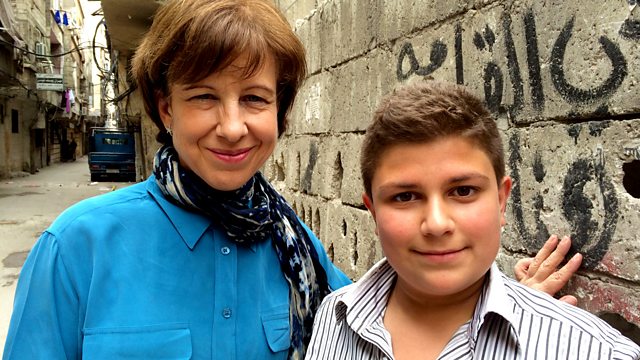
I try to find the child I met a month before...escaping the siege. | 0:24:29 | 0:24:33 | |
The little boy that we met in Yarmouk, Kifah, | 0:24:36 | 0:24:39 | |
left such an impression that I decided to track him down and... | 0:24:39 | 0:24:45 | |
only to find that, on first glance, | 0:24:45 | 0:24:49 | |
he's left one wasteland where his family was trapped... | 0:24:49 | 0:24:54 | |
..for another destroyed neighbourhood. | 0:24:55 | 0:24:57 | |
BOOMING IN DISTANCE | 0:25:02 | 0:25:04 | |
13-year-old Kifah has taken refuge with relatives. | 0:25:04 | 0:25:08 | |
The government recently recaptured this area. | 0:25:08 | 0:25:11 | |
The school, like thousands of others across Syria, is wrecked. | 0:25:11 | 0:25:15 | |
-Mechanic. -Mechanic. | 0:25:20 | 0:25:22 | |
Wow! That's very good. | 0:25:22 | 0:25:25 | |
-Si... Siyara. -Siyara. | 0:25:25 | 0:25:27 | |
-Englise? -Car. -Car! | 0:25:27 | 0:25:29 | |
What does Kifah think when he sees all this destruction? | 0:25:34 | 0:25:38 | |
When you are grown up, what would you like to do? | 0:25:58 | 0:26:00 | |
Doctor? What kind of doctor? | 0:26:00 | 0:26:03 | |
Kifah's father still hasn't been able to join his family. | 0:26:22 | 0:26:25 | |
His besieged suburb is still a battle ground. | 0:26:25 | 0:26:28 | |
What did you do, Kifah, when the rockets fell? What did you do? | 0:26:41 | 0:26:45 | |
Kifah seems so fragile now. Are you really worried about him? | 0:27:20 | 0:27:24 | |
Kifah's mother is due to give birth shortly. | 0:27:47 | 0:27:50 | |
A child due to be born into war. | 0:27:50 | 0:27:53 | |
Finally, some good news for Daad. | 0:28:07 | 0:28:09 | |
After a year out of school, | 0:28:09 | 0:28:11 | |
her parents found her a place, close to where they now live. | 0:28:11 | 0:28:14 | |
Schools across Syria work double shifts | 0:28:25 | 0:28:28 | |
to cope with the vast number of children of all ages | 0:28:28 | 0:28:31 | |
displaced by war. | 0:28:31 | 0:28:33 | |
WOMAN SPEAKS IN ARABIC | 0:28:33 | 0:28:36 | |
SHE SPEAKS IN ARABIC | 0:28:38 | 0:28:40 | |
But Daad's past still haunts her. | 0:29:05 | 0:29:07 | |
And yet, despite everything, | 0:29:45 | 0:29:47 | |
Syria's children are still delighted by rituals. | 0:29:47 | 0:29:51 | |
CHATTER | 0:30:25 | 0:30:28 | |
'But life gets harder. | 0:31:02 | 0:31:04 | |
'Daad's father isn't earning much money. | 0:31:04 | 0:31:07 | |
'They don't want to leave Syria, | 0:31:07 | 0:31:09 | |
'but they're starting to wonder if they can survive here.' | 0:31:09 | 0:31:12 | |
It's April. | 0:31:24 | 0:31:25 | |
The government steps up its offensive against rebels | 0:31:25 | 0:31:28 | |
still inside the besieged old quarter of Homs. | 0:31:28 | 0:31:31 | |
The regime is predicting victory in this key city. | 0:31:33 | 0:31:36 | |
Bara'a! | 0:31:43 | 0:31:45 | |
'I go back to Homs to find Bara'a.' | 0:31:45 | 0:31:47 | |
As-salamu alaykum. | 0:31:47 | 0:31:50 | |
Nice to see you. | 0:31:50 | 0:31:52 | |
Her family left the besieged old city in February | 0:31:54 | 0:31:57 | |
during an evacuation. | 0:31:57 | 0:31:58 | |
They've been moved from a makeshift detention centre | 0:32:05 | 0:32:08 | |
to a school where dozens of families have been given shelter. | 0:32:08 | 0:32:12 | |
What do you like about this centre? | 0:32:18 | 0:32:20 | |
All these kids, who've come from areas completely convulsed by war, | 0:32:45 | 0:32:50 | |
come here, and yet just over the sound of the children's laughter, | 0:32:50 | 0:32:55 | |
there's the constant sound of artillery, gunfire, | 0:32:55 | 0:32:59 | |
explosions in the distance. | 0:32:59 | 0:33:02 | |
Children, they don't seem to notice when they're playing, | 0:33:02 | 0:33:05 | |
but they know it's there. | 0:33:05 | 0:33:08 | |
Tell me what you're drawing. These are yours? Uh? Yeah? | 0:33:15 | 0:33:19 | |
LYSE DOUCET: | 0:33:19 | 0:33:21 | |
EXPLOSION | 0:33:41 | 0:33:44 | |
You OK? | 0:33:46 | 0:33:48 | |
Something's landed. OK. | 0:33:48 | 0:33:50 | |
Is she OK? OK, stay safe. This is what happens a lot. | 0:33:50 | 0:33:53 | |
Just when you least expect it, | 0:33:53 | 0:33:55 | |
there's been an explosion very close to the school. | 0:33:55 | 0:33:58 | |
Look at the smoke. | 0:34:01 | 0:34:02 | |
-Where? When? -Stay. | 0:34:04 | 0:34:06 | |
-Just a second. -Stay, stay. -Where is it? Where is it? What is it? | 0:34:06 | 0:34:09 | |
-What happened? -Mortar. -Mortar? Where did it land? | 0:34:09 | 0:34:12 | |
SHOUTING | 0:34:12 | 0:34:14 | |
Oh... | 0:34:21 | 0:34:22 | |
Oh, my God, Phil. Are you OK? | 0:34:22 | 0:34:25 | |
One of them's hit. | 0:34:25 | 0:34:27 | |
You're hit. | 0:34:27 | 0:34:28 | |
Two of my colleagues are injured and are taken to hospital. | 0:34:29 | 0:34:33 | |
Our vehicles are badly damaged. | 0:34:34 | 0:34:36 | |
One child living in this school is lightly wounded. | 0:34:37 | 0:34:40 | |
This is what happens day in, day out in Syria. | 0:34:49 | 0:34:51 | |
The mortar strikes, there's chaos, injuries and sometimes death, | 0:34:51 | 0:34:55 | |
and then see how quickly things go back to what they were before. | 0:34:55 | 0:35:00 | |
But you can't call this normal. | 0:35:01 | 0:35:03 | |
Government assaults on rebel-held areas are often indiscriminate. | 0:35:11 | 0:35:15 | |
Crude barrel bombs packed with explosives and dropped from aircraft | 0:35:17 | 0:35:22 | |
are wounding and killing a growing number of children. | 0:35:22 | 0:35:25 | |
Mariam is nine years old, from a village outside Homs. | 0:35:53 | 0:35:57 | |
For the past year, she's been a refugee in Turkey. | 0:35:57 | 0:36:01 | |
Mariam's rebel-held village | 0:36:36 | 0:36:38 | |
regularly came under attack by Syrian government forces. | 0:36:38 | 0:36:41 | |
What happened at the hospital? | 0:37:16 | 0:37:18 | |
Mariam's home is now a tented refugee camp on the Syrian border. | 0:37:43 | 0:37:47 | |
She likes to escape to the nearby wheat fields. | 0:37:48 | 0:37:52 | |
They remind her of her farm. | 0:37:52 | 0:37:53 | |
There is no accurate figure | 0:38:39 | 0:38:41 | |
for the number of children maimed and killed in this war. | 0:38:41 | 0:38:45 | |
The estimates run to many tens of thousands. | 0:38:45 | 0:38:48 | |
Mariam's father is still stuck inside Syria. | 0:38:50 | 0:38:54 | |
She doesn't know when she'll see him again. | 0:38:54 | 0:38:56 | |
MUSIC PLAYS | 0:39:14 | 0:39:16 | |
In Damascus, a big day out for Jalal and his friends. | 0:39:24 | 0:39:28 | |
They've been preparing for it for some time. | 0:39:28 | 0:39:31 | |
It's children's sports day. | 0:39:40 | 0:39:43 | |
Even sport isn't free from war. | 0:39:43 | 0:39:46 | |
Days like this play a role in government mobilisation. | 0:40:15 | 0:40:19 | |
For decades, Syrian students were raised to support the regime. | 0:40:20 | 0:40:24 | |
Now they're called to defend their president. | 0:40:26 | 0:40:29 | |
MUSIC PLAYS | 0:40:57 | 0:41:00 | |
CHEERING | 0:41:55 | 0:41:57 | |
Daad's family faces a new crisis in the old city of Damascus. | 0:42:24 | 0:42:29 | |
Now Daad's family faces eviction from this storeroom. | 0:43:21 | 0:43:25 | |
Near the Turkish border, | 0:44:16 | 0:44:18 | |
the war inside Syria becomes more complicated. | 0:44:18 | 0:44:22 | |
The opposition is deeply divided. | 0:44:22 | 0:44:25 | |
Factions are fighting against each other. | 0:44:25 | 0:44:27 | |
Ezadine waits the crossing. | 0:44:28 | 0:44:31 | |
His brother, Omar, is arriving today from the front. | 0:44:31 | 0:44:34 | |
Omar, who fights for the Free Syrian Army, | 0:45:18 | 0:45:20 | |
blames the atrocities on extreme Islamist fighters. | 0:45:20 | 0:45:24 | |
Rebels still control swathes of territory. | 0:46:31 | 0:46:34 | |
Fighting against President Bashar al-Assad's forces | 0:46:34 | 0:46:37 | |
intensifies in the north. | 0:46:37 | 0:46:39 | |
Ezadine's anger is directed not just towards the president | 0:47:39 | 0:47:43 | |
but also his Alawite community. | 0:47:43 | 0:47:46 | |
It's late April. | 0:48:21 | 0:48:23 | |
The war goes on near Jalal's house in Damascus, | 0:48:23 | 0:48:26 | |
but not on the same scale. | 0:48:26 | 0:48:28 | |
Jalal's father is still with the local defence unit, | 0:48:38 | 0:48:42 | |
but the mood on some streets is more relaxed. | 0:48:42 | 0:48:45 | |
Jalal hopes his former friends across the front line | 0:49:38 | 0:49:42 | |
will return someday to support President Assad's Syria. | 0:49:42 | 0:49:45 | |
Every Friday evening, Jalal's family gathers. | 0:50:12 | 0:50:16 | |
There's a growing mood here, at least, | 0:50:18 | 0:50:21 | |
that recent gains by President Assad's forces | 0:50:21 | 0:50:24 | |
could herald a turning point. | 0:50:24 | 0:50:26 | |
BOOMING IN DISTANCE | 0:51:14 | 0:51:16 | |
It's early May in the old city of Homs. | 0:51:22 | 0:51:26 | |
The last of the rebel fighters have done a deal with the government | 0:51:26 | 0:51:30 | |
that allows them to leave for another rebel-held area. | 0:51:30 | 0:51:33 | |
It's the end of the brutal two-year siege. | 0:51:33 | 0:51:36 | |
The government surrender-or-starve tactic has worked here, | 0:51:37 | 0:51:42 | |
as well as in some other areas. | 0:51:42 | 0:51:44 | |
But it's come at a heavy price. | 0:51:46 | 0:51:49 | |
Not much is left. | 0:51:49 | 0:51:51 | |
Bara'a, her father and sister, Ala'a, can now return | 0:51:56 | 0:51:59 | |
to see their old neighbourhood and the home they fled a few months ago. | 0:51:59 | 0:52:04 | |
On the way to their street, we pass their old school. | 0:52:11 | 0:52:15 | |
Bara'a's home has been looted and stripped bare. | 0:52:37 | 0:52:40 | |
Bara'a's family took shelter here from constant shelling, | 0:52:54 | 0:52:57 | |
mortar and rocket fire during the siege. | 0:52:57 | 0:53:00 | |
Their brother was mortally wounded, | 0:53:10 | 0:53:13 | |
their mother decapitated. | 0:53:13 | 0:53:15 | |
They go to tend the graves. | 0:53:29 | 0:53:32 | |
Since the Syrian military entered the area, | 0:53:42 | 0:53:45 | |
the mosque has been set on fire and the tombstones smashed. | 0:53:45 | 0:53:49 | |
The graves have been tampered with. | 0:53:57 | 0:53:59 | |
Bara'a's father quickly covers up exposed bodies. | 0:53:59 | 0:54:03 | |
It's mid-May. | 0:54:53 | 0:54:55 | |
There's some good news for Kifah. | 0:54:55 | 0:54:57 | |
He has a new baby sister. | 0:54:57 | 0:54:59 | |
After a pregnancy spent with fear, hunger and bombardment, | 0:55:12 | 0:55:16 | |
it's a huge relief to have a healthy child. | 0:55:16 | 0:55:19 | |
Kifah's father hasn't seen his new daughter. | 0:55:34 | 0:55:37 | |
He's still stuck inside the suburb of Yarmouk. | 0:55:37 | 0:55:40 | |
In May, we finally get permission from the army | 0:55:52 | 0:55:55 | |
to return to the besieged area. | 0:55:55 | 0:55:57 | |
Fighting continues, despite efforts to reach a truce. | 0:55:58 | 0:56:02 | |
Food and medicine are still scarce. | 0:56:02 | 0:56:05 | |
When aid does get in, queues are long and desperate. | 0:56:07 | 0:56:11 | |
We're trying to find Kifah's father. | 0:56:24 | 0:56:27 | |
We've brought him photographs of his new baby. | 0:56:27 | 0:56:30 | |
He hasn't seen the little one. | 0:56:31 | 0:56:34 | |
He also hasn't seen his family for months. | 0:56:34 | 0:56:37 | |
He's still trapped, just like everyone else here. | 0:56:37 | 0:56:40 | |
We aren't allowed to go in any further. | 0:56:44 | 0:56:47 | |
We don't reach Kifah's father. | 0:56:47 | 0:56:50 | |
Syria's war is now well into its fourth year, with no end in sight. | 0:56:54 | 0:56:59 | |
Kifah still isn't at school, | 0:57:00 | 0:57:03 | |
just like three million other Syrian children. | 0:57:03 | 0:57:05 | |
When do you hope to go back to school? | 0:57:14 | 0:57:16 | |
But children on all sides | 0:57:20 | 0:57:21 | |
are further than ever from reconciliation. | 0:57:21 | 0:57:24 | |
With every day that passes, children are displaced, traumatised, killed. | 0:58:22 | 0:58:28 | |
These children are the future of Syria. | 0:58:45 | 0:58:48 | |
The longer this war goes on, the darker that future may be. | 0:58:48 | 0:58:53 |