The Vanished Capital of the Pharoah Lost Cities of the Ancients
Similar Content
Browse content similar to The Vanished Capital of the Pharoah. Check below for episodes and series from the same categories and more!
Transcript
| Line | From | To | |
|---|---|---|---|
Of all the wonders of Ancient Egypt, Ramesses the Great's capital, | 0:00:04 | 0:00:09 | |
the City of Piramesse, was one of the most spectacular. | 0:00:09 | 0:00:13 | |
The pharaoh lavished a fortune on building his capital. | 0:00:15 | 0:00:19 | |
But long ago, the whole city and all its treasures vanished... | 0:00:19 | 0:00:25 | |
off the face of the earth. | 0:00:25 | 0:00:27 | |
The lost city of Piramesse became the stuff of legend. | 0:00:29 | 0:00:33 | |
Until, 3,000 years later, its rediscovery opened up | 0:00:33 | 0:00:38 | |
one of the most bizarre puzzles in the history of archaeology. | 0:00:38 | 0:00:42 | |
Because when Piramesse reappeared, | 0:00:44 | 0:00:47 | |
it was in the wrong place. | 0:00:47 | 0:00:50 | |
A place where Ramesses the Great could never have built it. | 0:00:52 | 0:00:55 | |
A place that didn't even exist at the time Ramesses was alive. | 0:00:57 | 0:01:01 | |
This is the strange story of how an entire city could vanish, | 0:01:05 | 0:01:10 | |
only to reappear thousands of years later in the wrong place. | 0:01:10 | 0:01:16 | |
3,000 years ago, Egypt was ruled by a master builder, | 0:01:47 | 0:01:51 | |
a pharaoh determined to leave a permanent mark on history. | 0:01:51 | 0:01:58 | |
Ramesses II was born a commoner, but became one of the greatest kings of the Ancient World. | 0:01:58 | 0:02:05 | |
He ruled Egypt for over 60 years and fathered 100 children. | 0:02:05 | 0:02:10 | |
Across his empire he built temples and monuments. | 0:02:11 | 0:02:14 | |
But his masterpiece, the place closest to his heart, | 0:02:14 | 0:02:18 | |
was the city he named after himself... | 0:02:18 | 0:02:21 | |
..Piramesse. | 0:02:23 | 0:02:25 | |
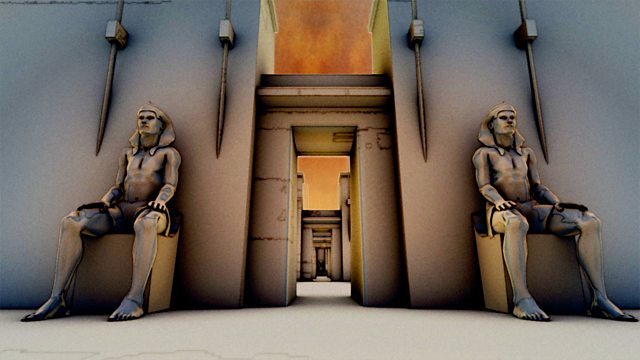
A vast citadel of white and azure, Piramesse was filled with monuments | 0:02:28 | 0:02:33 | |
designed to inspire awe in all who entered. | 0:02:33 | 0:02:36 | |
The city was one of Ramesses' most ambitious creations, | 0:02:40 | 0:02:44 | |
built on the Nile as a gateway between Ancient Egypt and the sea. | 0:02:44 | 0:02:49 | |
This was a thriving port, a hub of the Ancient World. | 0:02:54 | 0:02:57 | |
Up to 300,000 people lived here. The very rich and the very poor. | 0:02:57 | 0:03:03 | |
Nobility, craftsmen and slaves. | 0:03:03 | 0:03:07 | |
Merchants came from far and wide to trade here. | 0:03:07 | 0:03:10 | |
At the heart of the city, Ramesses built a massive army garrison, | 0:03:18 | 0:03:23 | |
housing thousands of soldiers, charioteers and horsemen. | 0:03:23 | 0:03:28 | |
His garrison would have had stabling for hundreds of war horses and chariots and it was from Piramesse | 0:03:29 | 0:03:36 | |
that the pharaoh rode out to his greatest battles. | 0:03:36 | 0:03:40 | |
Ramesses the Great never stopped adding to his capital. | 0:03:47 | 0:03:51 | |
Year after year, new statues of the pharaoh were erected all through the city. | 0:03:51 | 0:03:57 | |
A production line of skilled craftsmen and workers was employed | 0:03:57 | 0:04:01 | |
throughout his reign to add and embellish new statues and monuments. | 0:04:01 | 0:04:06 | |
As home to the king and the seat of power, Piramesse must have looked as if it would last for ever. | 0:04:07 | 0:04:13 | |
But, just a couple of hundred years after it was built... | 0:04:15 | 0:04:19 | |
..the entire city vanished. | 0:04:21 | 0:04:24 | |
For thousands of years, Piramesse was utterly lost | 0:04:35 | 0:04:40 | |
and the fate of this great city became the stuff of legend. | 0:04:40 | 0:04:44 | |
The quest to find it again would baffle experts | 0:04:47 | 0:04:51 | |
and provide one of the strangest twists in the history of archaeology. | 0:04:51 | 0:04:56 | |
By the beginning of the 20th century, | 0:05:11 | 0:05:14 | |
Egyptologists were puzzled. | 0:05:14 | 0:05:18 | |
Most of the great cities of the pharaohs had already been discovered. | 0:05:18 | 0:05:22 | |
All except the famous Piramesse. | 0:05:23 | 0:05:26 | |
It would become almost a holy grail of Egyptologists | 0:05:30 | 0:05:33 | |
to actually try and find this fabulous city. | 0:05:33 | 0:05:36 | |
Everyone knew from the ancient texts that Ramesses II didn't build his new capital | 0:05:40 | 0:05:46 | |
near the great temples at Karnak and Luxor, the traditional seats of power of Ancient Egypt. | 0:05:46 | 0:05:53 | |
Nor did he build it ancient Memphis, near present day Cairo where the great pyramids lay. | 0:05:53 | 0:05:59 | |
Instead, he built it where he'd been raised. | 0:06:01 | 0:06:04 | |
The lush Nile Delta, where the river fans out into branches that flow down to the Mediterranean Sea. | 0:06:04 | 0:06:12 | |
The texts were clear. | 0:06:12 | 0:06:13 | |
Ramesses had built his city on the eastern most branch of the Nile in the Delta. | 0:06:13 | 0:06:20 | |
You might think this would make the search for Piramesse easy. | 0:06:20 | 0:06:25 | |
But you'd be wrong. | 0:06:25 | 0:06:26 | |
One of the big problems with finding Piramesse was the problem | 0:06:28 | 0:06:32 | |
that the eastern branch of the Nile, which we know it lay on, had gone. | 0:06:32 | 0:06:36 | |
Over time, the branches of the Nile in the Delta often change course, | 0:06:39 | 0:06:44 | |
so it's impossible to know where the easternmost branch was in Ramesses' time. | 0:06:44 | 0:06:49 | |
This ancient branch of the Nile has silted up and disappeared long ago. | 0:06:49 | 0:06:55 | |
Without this knowledge, finding the lost city | 0:06:55 | 0:06:58 | |
would mean scouring the whole eastern side of the Nile Delta. | 0:06:58 | 0:07:01 | |
The absence of this single most important clue | 0:07:04 | 0:07:07 | |
was a crucial obstacle to finding Ramesses' capital. | 0:07:07 | 0:07:11 | |
Luckily, archaeologists knew exactly what remains to look for, | 0:07:11 | 0:07:15 | |
because ancient texts had given a detailed description of Piramesse. | 0:07:15 | 0:07:20 | |
First thing we knew about Piramesse was that it was a military garrison. | 0:07:22 | 0:07:27 | |
It was the place from which King Ramesses II launched his campaigns into Syria Palestine. | 0:07:29 | 0:07:36 | |
Therefore, the presence of soldiers, chariotry... | 0:07:39 | 0:07:43 | |
..would clearly have to be something which any candidate for the site of Piramesse would have to have. | 0:07:46 | 0:07:53 | |
One would certainly expect in Piramesse to have a lot of statues | 0:07:56 | 0:08:02 | |
and other monuments of Ramesses II. | 0:08:02 | 0:08:05 | |
Ramesses had a production line of workers in quarries, | 0:08:10 | 0:08:13 | |
churning out statues of himself, carved out of the living rock. | 0:08:13 | 0:08:18 | |
Piramesse was filled with hundreds of images of the pharaoh, some as big as 28 metres high. | 0:08:18 | 0:08:25 | |
Next, Ramesses II's personal mark, his cartouche, | 0:08:32 | 0:08:38 | |
would have been carved into the city's great monuments. | 0:08:38 | 0:08:41 | |
Each cartouche was like a brand, placed on objects as a stamp of ownership. | 0:08:54 | 0:08:59 | |
Looking at the cartouche here of Ramesses, this little seated figure | 0:09:07 | 0:09:12 | |
with a hawk's head and a sun disc on its head, is the Sun God Ra. | 0:09:12 | 0:09:18 | |
We then go down to this sign here which reads "mes" | 0:09:22 | 0:09:28 | |
and the following two signs read "su". | 0:09:28 | 0:09:32 | |
So we have "Ra-mes-su". | 0:09:32 | 0:09:34 | |
This is "mery" or "beloved". | 0:09:37 | 0:09:41 | |
And then the sign in the top left hand corner of the cartouche | 0:09:41 | 0:09:44 | |
which is the great God Amun, the King of the Gods. | 0:09:44 | 0:09:48 | |
So we have the whole thing reading "Ra-mes-su-mery Amun". | 0:09:50 | 0:09:55 | |
Or, "Ramesses, beloved of Amun". | 0:09:55 | 0:09:58 | |
Piramesse we know had major temples. | 0:10:06 | 0:10:10 | |
Particularly dedicated to the god Amun. | 0:10:10 | 0:10:13 | |
Any site which is claimed to be Piramesse must have evidence for temples. | 0:10:15 | 0:10:20 | |
And finally, there'd be the home of the pharaoh himself. | 0:10:25 | 0:10:29 | |
We know very little about the palaces of the pharaohs, | 0:10:31 | 0:10:35 | |
but you'd expect them to be very large with great open courtyards. | 0:10:35 | 0:10:40 | |
The floors would have been of painted plaster, the walls as well. | 0:10:40 | 0:10:43 | |
So that's the sort of thing one would expect to find in Ramesses' palace. | 0:10:43 | 0:10:47 | |
So once you'd found a site you believed was Piramesse, | 0:10:51 | 0:10:54 | |
you'd have to find the remains of these key markers to prove you'd really found the legendary city. | 0:10:54 | 0:11:00 | |
And they'd all have to be conclusively dated to the time of Ramesses II. | 0:11:02 | 0:11:07 | |
Find all of these and you've found the lost city of Piramesse. | 0:11:09 | 0:11:14 | |
The story of how Ramesses' lost capital was finally discovered began back in the 1920s, | 0:11:25 | 0:11:32 | |
when archaeologists were scouring Egypt's desert landscapes, | 0:11:32 | 0:11:36 | |
looking for the lost treasures of the pharaohs. | 0:11:36 | 0:11:39 | |
Somewhere out there lay Piramesse, still waiting to be found. | 0:11:43 | 0:11:47 | |
At the time, few wanted to take on the challenge of searching the vast | 0:11:53 | 0:11:57 | |
and remote far eastern Delta, in search of Ramesses' lost city. | 0:11:57 | 0:12:02 | |
But if anyone wanted to find Piramesse, this was where they had to go. | 0:12:02 | 0:12:07 | |
And one man was prepared to take on that challenge. | 0:12:09 | 0:12:12 | |
Pierre Montet was one of France's leading Egyptologists. | 0:12:18 | 0:12:21 | |
He assembled a team to embark on an expedition | 0:12:21 | 0:12:24 | |
that he hoped would secure his name in the history books. | 0:12:24 | 0:12:28 | |
He'd heard of a strange ancient site deep in the Nile Delta | 0:12:30 | 0:12:34 | |
that had gone largely unexplored and he thought it might be significant. | 0:12:34 | 0:12:39 | |
It was just possible that this site could be a lost treasure. | 0:12:42 | 0:12:46 | |
Montet's destination was Tanis, in the north-eastern corner of the Nile Delta. | 0:12:53 | 0:12:58 | |
Tanis was a very remote site at the end of a very long track | 0:13:05 | 0:13:09 | |
set in a landscape that looks like the surface of the moon. | 0:13:09 | 0:13:13 | |
When Montet eventually reached the remains, his hopes were high of finding a spectacular lost world. | 0:13:24 | 0:13:31 | |
What do you think, sir? | 0:13:58 | 0:14:01 | |
Looks promising. | 0:14:01 | 0:14:04 | |
Tanis went beyond Montet's wildest dreams. | 0:14:11 | 0:14:15 | |
Though the ancient Nile had long since gone, | 0:14:23 | 0:14:26 | |
everything else about the site fitted the clues for Ramesses' lost city, Piramesse. | 0:14:26 | 0:14:32 | |
Everywhere he looked he found half buried monuments of Ramesses the Great. | 0:14:47 | 0:14:52 | |
"Ra-mes-su mery Amun." | 0:15:03 | 0:15:05 | |
"The one born of Ra, beloved of Amun." | 0:15:05 | 0:15:08 | |
We've been here five minutes, I've already seen his cartouche in what, three separate places? | 0:15:08 | 0:15:13 | |
Incredible. | 0:15:13 | 0:15:16 | |
This was one of the vital clues needed to confirm whether this truly was Piramesse. | 0:15:16 | 0:15:21 | |
Montet's initial trip to Tanis left him in no doubt | 0:15:27 | 0:15:31 | |
that Ramesses II's lost city lay buried beneath his feet. | 0:15:31 | 0:15:35 | |
Better send word to Cairo. | 0:15:37 | 0:15:40 | |
We've got an awful lot of work ahead of us. | 0:15:40 | 0:15:42 | |
But this site would become famous for reasons far stranger than Montet could ever have imagined. | 0:15:48 | 0:15:55 | |
The remains at Tanis secured Montet's name in the world of Egyptology. | 0:16:04 | 0:16:09 | |
Within a few years, he'd established a full-time excavation site | 0:16:09 | 0:16:14 | |
and, under his leadership, the work became an obsession. | 0:16:14 | 0:16:17 | |
He published journals and identified the remains of a massive temple dedicated to the god Amun. | 0:16:24 | 0:16:31 | |
As Montet's work progressed, his fame and reputation spread across the world. | 0:16:42 | 0:16:47 | |
The more his teams excavated, the more statues and obelisks of Ramesses they unearthed. | 0:16:54 | 0:17:00 | |
All the evidence went to confirm that this had to be the lost city of Piramesse. | 0:17:00 | 0:17:05 | |
Another one. | 0:17:05 | 0:17:08 | |
40 found already. | 0:17:08 | 0:17:10 | |
In Piramesse we know that Ramesses constantly erected new statues of himself throughout his long reign. | 0:17:19 | 0:17:27 | |
There was a workforce employed across his city to build and decorate his image. | 0:17:27 | 0:17:32 | |
Eventually, there were over 100 statues of the pharaoh throughout Piramesse. | 0:17:34 | 0:17:39 | |
So it was no wonder Montet dug up so many beautifully preserved specimens. | 0:17:40 | 0:17:46 | |
Many of these statues were colossal. | 0:17:46 | 0:17:49 | |
Some weighed over 1,000 tons. | 0:17:49 | 0:17:53 | |
Carved from granite, they were built to last. | 0:17:53 | 0:17:56 | |
As Montet uncovered more and more monuments, it all confirmed to him that Tanis was Piramesse... | 0:18:02 | 0:18:09 | |
..allowing him to imagine what this great city must once have looked like. | 0:18:13 | 0:18:19 | |
Pierre Montet was probably the great French excavator of his generation, | 0:18:19 | 0:18:23 | |
and was very keen on producing the big picture. | 0:18:23 | 0:18:27 | |
But there's something not quite right at Tanis. | 0:18:31 | 0:18:35 | |
It's true. | 0:18:36 | 0:18:38 | |
There really is something not quite right at Tanis. | 0:18:38 | 0:18:42 | |
Something about the stones and statues that doesn't add up. | 0:18:42 | 0:18:46 | |
Something that Montet refused to acknowledge. | 0:18:49 | 0:18:54 | |
Here you are. | 0:18:54 | 0:18:57 | |
Pity he's not all with us. | 0:18:57 | 0:18:59 | |
Well, we've found plenty of others that are. | 0:19:01 | 0:19:04 | |
Look, over thousands of years there's bound to be some displacement to be expected. | 0:19:04 | 0:19:09 | |
-But the rest of him will turn up somewhere. -Hm... | 0:19:09 | 0:19:13 | |
You don't agree? | 0:19:13 | 0:19:16 | |
Well, some displacement is to be expected, of course. But... | 0:19:16 | 0:19:22 | |
It's just that the more we excavate, | 0:19:24 | 0:19:26 | |
the more we find structures with pieces missing or that don't fit together at all. | 0:19:26 | 0:19:31 | |
It's just seems a little...odd. | 0:19:31 | 0:19:35 | |
It was not unusual for parts of 3,000-year-old statues to break off and go missing. | 0:19:39 | 0:19:45 | |
It was just that at Tanis, everything seemed slightly out of place. | 0:19:47 | 0:19:52 | |
With nothing quite as it should be, it was turning into a very peculiar dig site. | 0:19:52 | 0:19:58 | |
And then, other strange anomalies began turning up. | 0:20:00 | 0:20:04 | |
Puzzling finds from other places, suggesting Piramesse might lie elsewhere. | 0:20:04 | 0:20:10 | |
Show me. | 0:20:10 | 0:20:12 | |
He says it was dug up about 30 kilometres from here. | 0:20:12 | 0:20:16 | |
He claims it's from Piramesse. | 0:20:18 | 0:20:20 | |
Well, the cartouche is certainly that of Ramesses II, | 0:20:26 | 0:20:31 | |
but, er, can anyone seriously compare a wall tile with what we have here? | 0:20:31 | 0:20:38 | |
If it's proof of Piramesse he's after, he's standing in it. | 0:20:38 | 0:20:41 | |
It's written in almost every stone around us. | 0:20:43 | 0:20:46 | |
We have a temple of Amun the size of Karnak, more obelisks than any other site in Egypt. | 0:20:46 | 0:20:52 | |
We've only just scratched the surface. | 0:20:52 | 0:20:55 | |
THEY LAUGH | 0:20:55 | 0:20:57 | |
Now, come on, back to work. That's enough. Back to work. | 0:20:57 | 0:21:00 | |
Montet spent the rest of his career convinced he had found at Tanis the great lost capital of Piramesse. | 0:21:11 | 0:21:21 | |
And the truth is, he had. | 0:21:21 | 0:21:23 | |
These ARE the ancient monuments and buildings of Ramesses' magnificent city. | 0:21:25 | 0:21:31 | |
But there was a bizarre twist to his discovery. | 0:21:31 | 0:21:34 | |
Because this is NOT where Ramesses built them. | 0:21:38 | 0:21:42 | |
Montet had unwittingly stumbled upon a baffling mystery, | 0:21:43 | 0:21:48 | |
one that would take science another 60 years to unravel. | 0:21:48 | 0:21:52 | |
Pierre Montet died in 1966. | 0:22:10 | 0:22:14 | |
That same year, an Austrian archaeologist, Manfred Bietak, | 0:22:14 | 0:22:18 | |
set off on a journey of investigation that would turn Montet's discoveries on their head. | 0:22:18 | 0:22:25 | |
In doing so, he would finally solve the strange puzzle surrounding Ramesses the Great's vanished city. | 0:22:30 | 0:22:37 | |
What Bietak discovered is so strange that it appears to defy the laws of logic. | 0:22:44 | 0:22:51 | |
These are the monuments of Piramesse. | 0:22:52 | 0:22:56 | |
However, they are found in the wrong place. | 0:22:56 | 0:23:00 | |
What's more, he has absolute proof of it. | 0:23:05 | 0:23:09 | |
Manfred Bietak was interested in the role played by the Nile in ancient times, | 0:23:35 | 0:23:41 | |
when he stumbled upon the strange truth about Piramesse. | 0:23:41 | 0:23:45 | |
He was trying to trace the lost riverbeds and waterways of the Nile | 0:23:46 | 0:23:50 | |
in order to map out what the Delta would have looked like at the time of the pharaohs. | 0:23:50 | 0:23:55 | |
Today there are only two branches of the Nile in the Delta. | 0:23:59 | 0:24:03 | |
But we know that in the past the river branches have switched course many times. | 0:24:03 | 0:24:10 | |
Through history, the Nile would have had different branches all across | 0:24:10 | 0:24:14 | |
the Delta - branches that have long ago dried up and disappeared. | 0:24:14 | 0:24:18 | |
The reason for this is that each branch of the Nile in the Delta carries so much silt from upstream | 0:24:22 | 0:24:28 | |
that its riverbed keeps building up until the water can no longer flow through it. | 0:24:28 | 0:24:34 | |
At that moment, the river branch will switch course, finding a new route down to the sea | 0:24:34 | 0:24:40 | |
and carving out a new path, sometimes far away from the old riverbed. | 0:24:40 | 0:24:45 | |
The only way to trace these ancient waterways is to study a contour map. | 0:24:49 | 0:24:56 | |
All lost rivers leave tell-tale signs in the contour lines on maps, | 0:24:56 | 0:25:01 | |
signs that an expert can trace to find the ancient path of the old dried-up river. | 0:25:01 | 0:25:06 | |
By studying contour lines, Bietak finally came up with a single map | 0:25:09 | 0:25:15 | |
charting every ancient silted up branch and waterway of the Nile through the eastern Delta. | 0:25:15 | 0:25:21 | |
There were many lost channels and each had been active at some time in the past 5,000 years. | 0:25:21 | 0:25:29 | |
On this reconstruction map, | 0:25:29 | 0:25:32 | |
with the help of the study of the contours of the Delta landscape, | 0:25:32 | 0:25:37 | |
I was able to reconstruct the variety of Nile branches in antiquity. | 0:25:37 | 0:25:43 | |
This one map held the truth about Piramesse, because it would reveal where the city should lie. | 0:25:46 | 0:25:53 | |
The ancient texts said it lay on the Delta's easternmost branch. | 0:25:53 | 0:25:58 | |
So all Bietak had to do was to work out which was | 0:25:59 | 0:26:03 | |
the easternmost branch of the Nile at the time of Ramesses the Great. | 0:26:03 | 0:26:08 | |
To do that, he had to date all the ancient branches. | 0:26:08 | 0:26:13 | |
And he did that with pottery. | 0:26:13 | 0:26:15 | |
In Egypt, cities and settlements were built | 0:26:25 | 0:26:28 | |
along active branches of the Nile, which supplied them with drinking water, sanitation and transport. | 0:26:28 | 0:26:35 | |
Like all ancient settlements, Piramesse's busy streets and markets | 0:26:35 | 0:26:39 | |
would have left behind tons of rubbish - above all, pottery. | 0:26:39 | 0:26:43 | |
That pottery can be dated and so tell you the date of the city itself. | 0:26:45 | 0:26:49 | |
By dating the pottery of all the settlements | 0:26:56 | 0:26:58 | |
along the ancient lost branches of the Nile, that will tell you | 0:26:58 | 0:27:02 | |
when each settlement was inhabited and therefore when that particular branch of the Nile was active. | 0:27:02 | 0:27:10 | |
Every kind of pottery or ceramic has a unique signature that dates it in time. | 0:27:19 | 0:27:24 | |
The type of clay, the way it was made, the techniques of firing | 0:27:24 | 0:27:29 | |
and glazing can all be pinpointed to specific periods. | 0:27:29 | 0:27:34 | |
Our days it is possible to date within | 0:27:34 | 0:27:39 | |
approximately 30-50 years accurately by ceramic alone. | 0:27:39 | 0:27:45 | |
So, by combining his map of ancient waterways with his knowledge of dating pottery, | 0:27:46 | 0:27:51 | |
Bietak was able to pinpoint where and when the Nile flowed through the Delta at each moment in history. | 0:27:51 | 0:27:58 | |
What's more, the amounts of pottery along the old riverbeds | 0:28:00 | 0:28:04 | |
would tell him where the biggest ancient settlements were. | 0:28:04 | 0:28:07 | |
Just as Montet would have predicted, Bietak found that one of these branches of the Nile, | 0:28:10 | 0:28:16 | |
known as the Tanitic branch, ran directly past Tanis, | 0:28:16 | 0:28:20 | |
where Montet had found Piramesse. | 0:28:20 | 0:28:23 | |
The problem came when Bietak dated the settlements along this branch. | 0:28:25 | 0:28:29 | |
Here is Tanis, | 0:28:37 | 0:28:39 | |
and this is the course of the Tanitic branch of the Nile, | 0:28:40 | 0:28:44 | |
with numerous sites along its banks, | 0:28:44 | 0:28:48 | |
but no site dates from the time of Ramesses II. | 0:28:48 | 0:28:53 | |
Which means this branch of the Nile | 0:28:53 | 0:28:56 | |
didn't even exist at the time of Ramesses the Great. | 0:28:56 | 0:29:00 | |
This eliminates the Tanitic branch | 0:29:00 | 0:29:04 | |
of being active in the time of Ramesses II. | 0:29:04 | 0:29:07 | |
Also it rules out that Tanis had been Piramesse. | 0:29:07 | 0:29:13 | |
What Bietak had discovered was extraordinary. | 0:29:13 | 0:29:18 | |
There was no pottery at Tanis from the time of Ramesses the Great. | 0:29:18 | 0:29:23 | |
All of it dates from at least 200 years after his death. | 0:29:23 | 0:29:28 | |
This meant that despite all of Pierre Montet's genuine finds... | 0:29:35 | 0:29:39 | |
..the Great Pharaoh couldn't possibly have built his capital city here. | 0:29:41 | 0:29:46 | |
Tanis contained lots of ancient pottery, | 0:29:50 | 0:29:53 | |
and Montet assumed that, like the statues and obelisks at the site, | 0:29:53 | 0:29:58 | |
it also came from the time of Ramesses II. | 0:29:58 | 0:30:01 | |
So he had never painstakingly dated it all. | 0:30:03 | 0:30:06 | |
If he had, he would have discovered the bizarre truth about Tanis - | 0:30:07 | 0:30:13 | |
that there was no city here at the time of Ramesses the Great. | 0:30:15 | 0:30:20 | |
Not a single pottery shard has been collected from the time of Ramesses II or before, | 0:30:22 | 0:30:29 | |
but everything is post Ramesses II and this is a very important point. | 0:30:29 | 0:30:34 | |
And yet, the monuments, statues and buildings here are, | 0:30:35 | 0:30:38 | |
without doubt, those of Piramesse, built by Ramesses the Great. | 0:30:38 | 0:30:44 | |
It was a bizarre paradox. | 0:30:46 | 0:30:48 | |
How can a magnificent city turn up in a place where it could never have been built? | 0:30:48 | 0:30:54 | |
And where on earth should it have been in the first place? | 0:30:54 | 0:30:57 | |
Bietak was intrigued. | 0:31:09 | 0:31:11 | |
He felt compelled to solve the puzzle left by Montet | 0:31:11 | 0:31:15 | |
and find the real site of Piramesse. | 0:31:15 | 0:31:18 | |
And, thanks to his map, he had the means of finding it. | 0:31:18 | 0:31:23 | |
By using pottery to date the lost eastern channels of the Nile, | 0:31:23 | 0:31:27 | |
one immediately stood out - | 0:31:27 | 0:31:30 | |
the ancient Pelusiac branch, | 0:31:30 | 0:31:32 | |
stretching over 180 kilometres in length. | 0:31:32 | 0:31:37 | |
Along the course of this ancient branch, | 0:31:37 | 0:31:39 | |
pottery had been discovered dating from the time of Ramesses the Great, | 0:31:39 | 0:31:44 | |
which meant that it had to be the active, most eastern branch of the Nile at the time of Ramesses. | 0:31:44 | 0:31:51 | |
So Piramesse must lie somewhere along this lost Pelusiac branch. | 0:31:52 | 0:31:58 | |
At this point, Bietak teamed up with German archaeologist Edgar Pusch to find the city. | 0:32:00 | 0:32:06 | |
Here, we have Tanis, | 0:32:06 | 0:32:09 | |
which we know is not Piramesse. | 0:32:09 | 0:32:13 | |
And then over here, | 0:32:13 | 0:32:15 | |
we have the Pelusiac Nile branch, | 0:32:15 | 0:32:18 | |
running something like this. | 0:32:18 | 0:32:22 | |
And along it we do have evidence of settlement remains of Ramesses II and his followers - | 0:32:25 | 0:32:33 | |
but here, at Qantir, | 0:32:33 | 0:32:37 | |
we have an incredible concentration of settlement remains of Ramesses II. | 0:32:37 | 0:32:45 | |
There had been clues suggesting Qantir was the site of Piramesse, | 0:32:48 | 0:32:53 | |
going back to the time of Montet. | 0:32:53 | 0:32:55 | |
Yeah, he says it was dug up about 30 kilometres from here. | 0:32:55 | 0:32:59 | |
He claims it's from Piramesse. | 0:32:59 | 0:33:01 | |
This is Qantir - | 0:33:06 | 0:33:08 | |
30 kilometres south of Tanis. | 0:33:08 | 0:33:11 | |
Could this be the site of the lost city of Piramesse? | 0:33:13 | 0:33:18 | |
When Pusch first arrived, there was nothing to see at Qantir. | 0:33:21 | 0:33:25 | |
No statues, no obelisks, no temples - | 0:33:28 | 0:33:32 | |
nothing to suggest this could once have been home to the ancient world's great lost capital. | 0:33:32 | 0:33:38 | |
When I came first to this area and to the site, I was shocked. | 0:33:40 | 0:33:45 | |
Nothing was to be seen at the surface, | 0:33:45 | 0:33:47 | |
no clue where to dig and where to excavate. | 0:33:47 | 0:33:52 | |
The region around Qantir is one of the most fertile in Egypt | 0:33:52 | 0:33:57 | |
and has been so intensively cultivated, | 0:33:57 | 0:33:59 | |
all evidence of ancient worlds on the surface has been obliterated. | 0:33:59 | 0:34:04 | |
It's the archaeological equivalent of a scorched earth. | 0:34:04 | 0:34:08 | |
When we started to work in this area, every colleague told us, "You won't find a thing. | 0:34:11 | 0:34:19 | |
"Everything is destroyed, nothing is there." | 0:34:19 | 0:34:21 | |
And yet, somewhere here, amongst these fields, | 0:34:21 | 0:34:26 | |
so Pusch and Bietak proposed, lurked the Holy Grail of Egyptology - | 0:34:26 | 0:34:31 | |
Ramesses II's spectacular lost city of Piramesse. | 0:34:35 | 0:34:40 | |
And so they began to excavate. | 0:34:49 | 0:34:51 | |
They were after any clue, however small, that might prove them right. | 0:34:54 | 0:34:58 | |
Miraculously, just three days into the dig and only ten centimetres below the surface, | 0:35:01 | 0:35:07 | |
Pusch's team found some tantalising evidence. | 0:35:07 | 0:35:11 | |
These odd carved objects would ultimately turn out to be the first crucial piece of evidence | 0:35:29 | 0:35:35 | |
suggesting that Qantir, this unprepossessing place, might just be everything they were hoping for. | 0:35:35 | 0:35:42 | |
But, at the time, no-one had a clue what they were. | 0:35:42 | 0:35:47 | |
We didn't have the slightest idea of what they could be, | 0:35:47 | 0:35:51 | |
so they were called something like "broken fragment of a vase", | 0:35:51 | 0:35:55 | |
"broken fragment of a dagger handle" or something like this. | 0:35:55 | 0:36:02 | |
They kept digging and finding more and more of these mysterious objects. | 0:36:03 | 0:36:08 | |
And then they found something rather wonderful. | 0:36:08 | 0:36:11 | |
Now, this is a real surprising find - a complete set of horse bits. | 0:36:18 | 0:36:24 | |
Made from bronze, locally produced - the only one ever found in Egypt. | 0:36:24 | 0:36:30 | |
It is in such a condition that it looks like it was made yesterday. | 0:36:30 | 0:36:34 | |
When they unearthed the floor of the buildings within which the objects had been found, | 0:36:41 | 0:36:46 | |
they discovered another surprise. | 0:36:46 | 0:36:49 | |
We found a special set of stones consisting of a tethering stone up front here, | 0:36:57 | 0:37:05 | |
then an opening in the ground surrounded by limestone. | 0:37:05 | 0:37:09 | |
Now, the size of all this is in such a way that a horse of that time, a male horse, | 0:37:09 | 0:37:15 | |
would be tethered to those two stones, | 0:37:15 | 0:37:18 | |
that it would be urinating directly into these openings, | 0:37:18 | 0:37:23 | |
giving us the possibility to say that we do have horse toilets. | 0:37:23 | 0:37:29 | |
And a little archaeological experiment shows this and proves this. | 0:37:29 | 0:37:34 | |
We took mules, which have about the same size as the horses in ancient times, | 0:37:34 | 0:37:39 | |
and one of these mules did us the favour of urinating directly into the openings. | 0:37:39 | 0:37:47 | |
Six rows of ten rooms each | 0:37:50 | 0:37:52 | |
and in each room several positions to tether horses. | 0:37:52 | 0:37:56 | |
It meant the complex must once have been home to at least 460 horses. | 0:37:56 | 0:38:02 | |
Stabling on such a large scale could only mean some kind of military complex. | 0:38:08 | 0:38:13 | |
Horses were the mainstay of a pharaoh's army | 0:38:16 | 0:38:20 | |
and the site certainly dated to the time of Ramesses the Great. | 0:38:20 | 0:38:23 | |
But stables were not unique to Piramesse. | 0:38:27 | 0:38:30 | |
It was the continued discovery of hundreds more of the mystery objects, | 0:38:36 | 0:38:41 | |
some of them completely intact, that finally proved the most significant. | 0:38:41 | 0:38:47 | |
Only by chance we found out what these objects were. | 0:38:47 | 0:38:52 | |
I was going through the Cairo Museum | 0:38:52 | 0:38:54 | |
and I suddenly saw that there are knobs like this | 0:38:54 | 0:38:59 | |
immediately connected with the yoke of the state chariots of Tutankhamen. | 0:38:59 | 0:39:06 | |
Thousands of these stone knobs would have held together | 0:39:13 | 0:39:17 | |
the harnesses of Ramesses the Great's many war chariots. | 0:39:17 | 0:39:20 | |
When combined with the number of horses stabled here, this could only amount to one thing. | 0:39:26 | 0:39:32 | |
As ancient texts spoke of Piramesse as having a large chariot garrison, | 0:39:37 | 0:39:41 | |
it was exactly the size of complex you'd expect to find | 0:39:41 | 0:39:44 | |
at the lost site of Ramesses II's capital city. | 0:39:44 | 0:39:49 | |
But it had taken Pusch and Bietak years of excavation just to unearth the garrison. | 0:40:02 | 0:40:08 | |
At this rate of digging, it would take hundreds of years | 0:40:08 | 0:40:11 | |
to prove if they had truly found the site of Piramesse. | 0:40:11 | 0:40:15 | |
And so they turned instead to a new technology that, without lifting a stone, | 0:40:19 | 0:40:24 | |
would conclusively unlock the secrets of what lay beneath the fields of Qantir. | 0:40:24 | 0:40:29 | |
But when it arrived, the electromagnetic scanner | 0:40:33 | 0:40:36 | |
was hardly the piece of cutting edge technology they'd expected. | 0:40:36 | 0:40:40 | |
Nobody believed ever that it would work. | 0:40:42 | 0:40:47 | |
Just the same, we said, "OK, you took the trouble of coming here, now let's set up the device." | 0:40:47 | 0:40:54 | |
The walls and foundations of ancient settlements all leave tell-tale traces in the ground. | 0:41:00 | 0:41:06 | |
The electromagnetic scanner can penetrate the ground to read those traces. | 0:41:08 | 0:41:14 | |
If the foundations of Piramesse were beneath these fields, | 0:41:16 | 0:41:20 | |
the scanner would reveal traces of the roads, walls and buildings | 0:41:20 | 0:41:25 | |
hidden there without the need to dig. | 0:41:25 | 0:41:27 | |
At first, no-one thought for a moment that anything of any interest would be revealed in the scans. | 0:41:33 | 0:41:39 | |
But they were wrong. | 0:41:42 | 0:41:43 | |
There it was. | 0:41:46 | 0:41:49 | |
Absolutely incredible. None of us believed it. | 0:41:49 | 0:41:52 | |
There was the layout of a building. | 0:41:52 | 0:41:55 | |
We were literally crying and I can... | 0:41:58 | 0:42:02 | |
I must admit it, I'm still close to crying remembering these things. | 0:42:02 | 0:42:06 | |
Laid out before him were the outlines of a building | 0:42:06 | 0:42:10 | |
hidden just a few centimetres beneath the ground. | 0:42:10 | 0:42:14 | |
We could see the wall is going like this. | 0:42:14 | 0:42:17 | |
And there it is destroyed and so and so and so. | 0:42:17 | 0:42:21 | |
We said, "OK, immediately back out to the field. Continue the magnetic measurements, this is it. | 0:42:21 | 0:42:27 | |
"It really works." | 0:42:27 | 0:42:30 | |
Since that first day, they have scanned an area of two square kilometres around Qantir, | 0:42:41 | 0:42:48 | |
the largest study of its kind in the world. | 0:42:48 | 0:42:51 | |
Exposed, for the first time in thousands of years, beneath the fields of Qantir... | 0:42:57 | 0:43:04 | |
..are the foundations of the vast ancient city of Piramesse. | 0:43:06 | 0:43:12 | |
The most wonderful part of all this huge area | 0:43:26 | 0:43:31 | |
is a building in the middle of our scan, one huge structure, | 0:43:31 | 0:43:37 | |
covering more than 41,000 square metres, | 0:43:37 | 0:43:42 | |
the centre of which is a building which shows a sequence of rooms, | 0:43:42 | 0:43:49 | |
all of them with symmetrically arranged columns. | 0:43:49 | 0:43:55 | |
The function of this building is most probably a temple. | 0:43:55 | 0:44:00 | |
Temples were central to life in Ancient Egypt. | 0:44:03 | 0:44:07 | |
Their huge columned halls and cavernous interiors | 0:44:07 | 0:44:10 | |
deliberately designed to inspire awe as much as to intimidate. | 0:44:10 | 0:44:16 | |
This is the western part of our scan. | 0:44:26 | 0:44:30 | |
A villa area with long stretching, straight running streets | 0:44:30 | 0:44:36 | |
branching off at right angles. | 0:44:36 | 0:44:40 | |
The estates themselves surrounded by white lines, which are the surrounding walls. | 0:44:40 | 0:44:46 | |
The southern edge of this settlement and villa area is denoted by a black line | 0:44:47 | 0:44:54 | |
and giving the shoreline of the Pelusiac Nile branch. | 0:44:54 | 0:44:59 | |
Laid out along avenues in a distinctive grid, | 0:44:59 | 0:45:02 | |
these were the homes of the wealthy. | 0:45:02 | 0:45:05 | |
It's in this area of the site that large inscribed door lintels | 0:45:05 | 0:45:10 | |
have been found bearing the names of Egyptian generals and royalty | 0:45:10 | 0:45:14 | |
and looking out across the banks of the Nile. | 0:45:14 | 0:45:17 | |
The eastern part of our scan shows a much denser building area, | 0:45:21 | 0:45:28 | |
also divided by streets, | 0:45:28 | 0:45:32 | |
but they are neither straight nor on a clear grid. | 0:45:32 | 0:45:37 | |
This area of very small houses | 0:45:37 | 0:45:41 | |
might be an area where not only socially lower-ranking people were once living, | 0:45:41 | 0:45:48 | |
but also workshops might have been in operation. | 0:45:48 | 0:45:53 | |
This other sizeable neighbourhood with its haphazard, tightly-packed layout | 0:45:55 | 0:46:00 | |
has all the characteristics of a more workaday part of the city, both residential and trade. | 0:46:00 | 0:46:05 | |
In contrast to the villa district, people here lived cheek by jowl along packed, twisting streets. | 0:46:08 | 0:46:14 | |
So you have a clear distinction between the west and the east. | 0:46:14 | 0:46:22 | |
With the layout and style of architecture forming a strong sense of the scale of Piramesse, | 0:46:24 | 0:46:30 | |
one structure, perhaps the most breathtaking of all, | 0:46:30 | 0:46:33 | |
is out of the reach of even the most high-tech scanning equipment. | 0:46:33 | 0:46:37 | |
The modern day town of Qantir is a jumbled collection of ramshackle buildings, | 0:46:43 | 0:46:48 | |
typical of a delta town today. | 0:46:48 | 0:46:50 | |
Judging by its central position on the scan, | 0:46:52 | 0:46:55 | |
it is almost certainly sitting slap-bang on the top of Ramesses II's palace. | 0:46:55 | 0:47:01 | |
According to accounts of the time, | 0:47:05 | 0:47:07 | |
Ramesses the Great's palace was vast, | 0:47:07 | 0:47:10 | |
the heart of the city, adorned with monuments celebrating his rule and longevity. | 0:47:10 | 0:47:16 | |
The outside walls would have dazzled, | 0:47:16 | 0:47:19 | |
painted white and decorated with glazed tiles. | 0:47:19 | 0:47:23 | |
As incredible as the scan of Piramesse is, | 0:47:27 | 0:47:30 | |
all it provides us with is the footprint of the city's once impressive architecture. | 0:47:30 | 0:47:35 | |
But we can get a glimpse of what it must once have looked like | 0:47:40 | 0:47:43 | |
from other sites where Ramesses the Great's influence was felt. | 0:47:43 | 0:47:47 | |
The vast majority of the temples of Ramesses II's time are now lost. | 0:47:49 | 0:47:54 | |
However, when one looks at the great pylon he erected at Luxor temple... | 0:47:54 | 0:48:00 | |
..when you look at his constructions at Karnak... | 0:48:08 | 0:48:11 | |
..and also the slightly later temple at Medinet Habu... | 0:48:20 | 0:48:24 | |
..one gets a flavour of what the buildings that once | 0:48:32 | 0:48:35 | |
dominated the city of Piramesse may have looked like. | 0:48:35 | 0:48:39 | |
With such a large expanse of the city laid bare, | 0:48:42 | 0:48:46 | |
the scan had one more secret to reveal. | 0:48:46 | 0:48:49 | |
These bare areas showed where lakes, canals and waterways | 0:48:50 | 0:48:54 | |
ran through Piramesse, fed by the Nile. | 0:48:54 | 0:48:58 | |
This final piece of the jigsaw completed the picture | 0:49:00 | 0:49:03 | |
and showed just how unique Piramesse truly was. | 0:49:03 | 0:49:07 | |
It contained huge temples... | 0:49:09 | 0:49:12 | |
..palatial riverside villas of the wealthy... | 0:49:14 | 0:49:17 | |
..winding cramped streets of less well-heeled neighbourhoods | 0:49:19 | 0:49:24 | |
and the site of the palace of the pharaoh himself. | 0:49:24 | 0:49:28 | |
But it was Ramesses the Great's choice of location within the Nile Delta | 0:49:36 | 0:49:41 | |
that made the city so unique. | 0:49:41 | 0:49:43 | |
With canals fed by the waters of the Nile, | 0:49:48 | 0:49:51 | |
Piramesse was quite simply... | 0:49:51 | 0:49:53 | |
..the Venice of its day. | 0:49:55 | 0:49:57 | |
But if Bietak and Pusch had indeed found Piramesse at Qantir, | 0:50:04 | 0:50:09 | |
what was it that Montet had discovered at Tanis? | 0:50:09 | 0:50:12 | |
Once you've recognised that Piramesse is indeed at Qantir, | 0:50:15 | 0:50:19 | |
you start wondering, "Well, what on earth is Tanis then?" | 0:50:19 | 0:50:22 | |
There are buildings there which really any detached observer know must come from Piramesse. | 0:50:24 | 0:50:31 | |
So what are they doing there? | 0:50:31 | 0:50:33 | |
Is it a hoax? | 0:50:33 | 0:50:35 | |
Have aliens dropped them there? | 0:50:35 | 0:50:37 | |
Piramesse had been found, but it seemed to be in two places at once. | 0:50:39 | 0:50:46 | |
The buildings were in Tanis, but the foundations are beneath Qantir. | 0:50:46 | 0:50:52 | |
How could this have happened? | 0:50:52 | 0:50:54 | |
The answer is intriguing. | 0:50:57 | 0:50:59 | |
Ramesses the Great had chosen to locate his capital on the ancient Pelusiac branch of the Nile | 0:51:07 | 0:51:13 | |
and the river was its lifeblood. | 0:51:13 | 0:51:16 | |
But the city was also at the mercy of the river and one day it would spell doom to Piramesse. | 0:51:19 | 0:51:25 | |
That moment came around 150 years after the death of Ramesses II. | 0:51:29 | 0:51:34 | |
The Pelusiac branch of the Nile silted up. | 0:51:40 | 0:51:44 | |
It dwindled away until the river finally switched course altogether, | 0:51:46 | 0:51:51 | |
leaving the Venice of its day without water. | 0:51:51 | 0:51:55 | |
What happened was that the Pelusiac branch of the Nile, | 0:52:01 | 0:52:07 | |
which passed Piramesse here, was blocked in its lower reaches. | 0:52:07 | 0:52:13 | |
The Pelusiac branch of the Nile lost its waters to the Tanitic branch of the Nile, | 0:52:15 | 0:52:22 | |
which became the main artery of the Nile traffic. | 0:52:22 | 0:52:28 | |
For Piramesse, this spelt disaster. | 0:52:28 | 0:52:31 | |
Now isolated from the world, it looked as though this magnificent city would have to be abandoned. | 0:52:34 | 0:52:40 | |
But instead, after the death of Ramesses the Great, | 0:52:44 | 0:52:48 | |
his successors decided to do something extraordinary. | 0:52:48 | 0:52:51 | |
The clue to what the ancient Egyptians did to Piramesse 3,000 years ago | 0:53:00 | 0:53:05 | |
lies hidden in the middle of an unassuming field in modern day Qantir. | 0:53:05 | 0:53:10 | |
Here are the feet of one of the many colossal statutes | 0:53:25 | 0:53:29 | |
that Ramesses the Great built at Piramesse. | 0:53:29 | 0:53:33 | |
The rest of the statue is somewhere else. | 0:53:33 | 0:53:38 | |
Pity he's not all with us. | 0:53:38 | 0:53:40 | |
There's bound to be some displacement to be expected, | 0:53:40 | 0:53:44 | |
but the rest of him will turn up somewhere. | 0:53:44 | 0:53:47 | |
The feet of some statues at Tanis had been left behind at Qantir | 0:53:47 | 0:53:52 | |
when the ancient Egyptians did something incredible. | 0:53:52 | 0:53:55 | |
They moved their city. | 0:53:58 | 0:54:01 | |
And they moved it to where the new branch of the Nile now flowed. | 0:54:04 | 0:54:09 | |
Piramesse was abandoned | 0:54:12 | 0:54:16 | |
and a new town, new residence | 0:54:16 | 0:54:21 | |
was built up along the Tanitic branch of the Nile. This was Tanis. | 0:54:21 | 0:54:28 | |
It was at last possible to solve the mystery at the heart of the story of Piramesse - | 0:54:37 | 0:54:43 | |
how it ended up being in two places at once. | 0:54:43 | 0:54:47 | |
About 150 years after Ramesses' death, | 0:54:49 | 0:54:52 | |
when the river around Piramesse silted up, | 0:54:52 | 0:54:55 | |
the city ceased to function. | 0:54:55 | 0:54:58 | |
Unwilling to abandon this splendid place, | 0:54:58 | 0:55:01 | |
the ancient Egyptians decided to move the entire city to where the Nile had moved to. | 0:55:01 | 0:55:07 | |
Slowly Piramesse was disassembled block by block, statue by statue. | 0:55:15 | 0:55:20 | |
It was a monumental feat, | 0:55:23 | 0:55:25 | |
undertaken to keep alive one of the greatest cities ever created. | 0:55:25 | 0:55:30 | |
The largest statues weighed up to 1,000 tons. | 0:55:37 | 0:55:41 | |
Moving any single piece would have taken a workforce of hundreds, | 0:55:49 | 0:55:53 | |
using sleds to transport the pieces through the city. | 0:55:53 | 0:55:58 | |
Monuments, like statues and obelisks, | 0:56:03 | 0:56:05 | |
would have been taken down and transported whole. | 0:56:05 | 0:56:08 | |
Temples and other buildings, a single piece at a time. | 0:56:13 | 0:56:17 | |
With no surviving accounts of the actual event, | 0:56:37 | 0:56:40 | |
we can only wonder at how long such a move would have taken... | 0:56:40 | 0:56:44 | |
..and how many lives may have been lost in the effort. | 0:56:46 | 0:56:49 | |
But, like the pieces of a giant jigsaw puzzle, | 0:56:56 | 0:57:00 | |
the monuments of Ramesses II's great city were reassembled | 0:57:00 | 0:57:04 | |
on the banks of the new easternmost branch of the Nile. | 0:57:04 | 0:57:07 | |
Piramesse dies | 0:57:15 | 0:57:17 | |
and the new north-eastern capital of Egypt, Tanis, | 0:57:17 | 0:57:21 | |
rises using the stones taken from Piramesse. | 0:57:21 | 0:57:26 | |
Built with the very statues, temples and obelisks of Piramesse, | 0:57:33 | 0:57:38 | |
Tanis became the seat of power and home to a new dynasty of pharaohs. | 0:57:41 | 0:57:46 | |
Until, like all great cities and civilisations, | 0:57:48 | 0:57:53 | |
Tanis too one day crumbled and faded into history. | 0:57:53 | 0:57:57 | |
When it was discovered 3,000 years later, | 0:57:59 | 0:58:03 | |
it started a mystery that archaeologists have only just solved. | 0:58:03 | 0:58:07 | |
Subtitles by Red Bee Media Ltd 2006 | 0:58:23 | 0:58:26 | |
E-mail [email protected] | 0:58:26 | 0:58:29 |