City of the Sacred Rome: A History of the Eternal City
Similar Content
Browse content similar to City of the Sacred. Check below for episodes and series from the same categories and more!
Transcript
| Line | From | To | |
|---|---|---|---|
Rome, the Eternal City. | 0:00:03 | 0:00:05 | |
Today, it's a place dominated by Christianity. | 0:00:06 | 0:00:09 | |
Its churches rule the skyline. | 0:00:11 | 0:00:13 | |
Its faithful pack the streets. | 0:00:13 | 0:00:16 | |
Every year, thousands upon thousands of pilgrims | 0:00:16 | 0:00:21 | |
from across the world flock here to worship in the place | 0:00:21 | 0:00:25 | |
that is truly the beating heart of the Catholic faith. | 0:00:25 | 0:00:29 | |
For many, Rome's status as a holy city begins with Christianity. | 0:00:29 | 0:00:34 | |
But in fact, its origin as a sacred site | 0:00:34 | 0:00:37 | |
owes everything to its pre-Christian past. | 0:00:37 | 0:00:40 | |
It was exotic pagan deities who were first credited | 0:00:43 | 0:00:46 | |
with transforming a hillside village | 0:00:46 | 0:00:49 | |
to the capital of the most powerful empire the world has ever known. | 0:00:49 | 0:00:55 | |
These were the gods of thunder, love, war and wisdom, | 0:00:55 | 0:00:59 | |
who dominated the city for a thousand years | 0:00:59 | 0:01:03 | |
and held its fortune in their hands. | 0:01:03 | 0:01:06 | |
The very ground Rome was built on was considered sacred, | 0:01:12 | 0:01:17 | |
from its temples...to its sewers. | 0:01:17 | 0:01:20 | |
You can smell putrefaction, the sweetness of waste. | 0:01:20 | 0:01:25 | |
But it also stinks of history. It's a secret world lost in time. | 0:01:25 | 0:01:30 | |
This is a city I've always been drawn to. | 0:01:31 | 0:01:34 | |
And in this series, | 0:01:34 | 0:01:36 | |
I'm going to be discovering just how it gained its tradition of holiness. | 0:01:36 | 0:01:41 | |
I've come with the questions of both historian and tourist, | 0:01:41 | 0:01:45 | |
to examine the fabric of a place | 0:01:45 | 0:01:47 | |
where power and religion go hand in hand. | 0:01:47 | 0:01:50 | |
Rome has always been inspired | 0:01:52 | 0:01:54 | |
and shaped by its passionate sense of sacred mission. | 0:01:54 | 0:01:59 | |
Popes and emperors, kings and consuls have all believed | 0:01:59 | 0:02:04 | |
they served a higher purpose, to fulfil the will of the divine. | 0:02:04 | 0:02:10 | |
And in this episode, I'm going right back to Rome's pagan roots, | 0:02:12 | 0:02:16 | |
to a world of empires won and lost, holy ambitions fulfilled, | 0:02:17 | 0:02:22 | |
a place where signs from heaven could change the course of history | 0:02:22 | 0:02:28 | |
and men became gods. | 0:02:28 | 0:02:31 | |
I want to find out just how this once-marshy wasteland | 0:02:31 | 0:02:34 | |
became one of the world's holiest cities. | 0:02:35 | 0:02:38 | |
Every July, Rome celebrates one of its favourite festivals. | 0:02:56 | 0:03:01 | |
It's a Catholic celebration in which a statue of the Virgin Mary | 0:03:03 | 0:03:07 | |
gets a tour of Rome along the River Tiber. | 0:03:07 | 0:03:10 | |
And she's off. | 0:03:12 | 0:03:13 | |
It's quite a bizarre sight, | 0:03:20 | 0:03:22 | |
the mother of God, taking a ride on a motorboat. | 0:03:22 | 0:03:25 | |
But it does sum up Rome today. | 0:03:26 | 0:03:28 | |
Here, religious pageantry is the city's daily theatre, | 0:03:30 | 0:03:33 | |
on the streets and on the water. | 0:03:33 | 0:03:36 | |
Christianity rules the Holy City. | 0:03:40 | 0:03:43 | |
But everywhere you look, paganism lurks just beneath the surface. | 0:03:43 | 0:03:47 | |
Images of Mary on street corners were once pagan shrines | 0:03:52 | 0:03:56 | |
devoted to the household gods. | 0:03:56 | 0:03:59 | |
Ancient temples have been absorbed | 0:04:00 | 0:04:03 | |
into the fabric of Christian churches. | 0:04:03 | 0:04:05 | |
And the Pope has a pagan precedent. | 0:04:07 | 0:04:10 | |
The ancient Romans had their own high priest, the Pontifex Maximus. | 0:04:10 | 0:04:14 | |
Even this procession has echoes of the pagan world. | 0:04:17 | 0:04:21 | |
In 205 BC, there are stories of the Magna Mater, | 0:04:22 | 0:04:27 | |
a foreign goddess, being brought into Rome by boat | 0:04:27 | 0:04:30 | |
right up this river, just like this, | 0:04:30 | 0:04:32 | |
except it wouldn't have been motorboats. | 0:04:32 | 0:04:35 | |
It would have been wooden boats. | 0:04:35 | 0:04:38 | |
It wouldn't have been balloons, it would have been incense lamps. | 0:04:38 | 0:04:42 | |
But the modern, Christian Rome of today, in many ways, | 0:04:42 | 0:04:46 | |
is not so far removed | 0:04:46 | 0:04:48 | |
from the ancient, pagan Rome of gods and emperors. | 0:04:48 | 0:04:53 | |
And there's a clue to the origins of Rome's timeless sanctity | 0:04:56 | 0:04:59 | |
in its founding myth. | 0:04:59 | 0:05:02 | |
Every sacred city needs a creation story, and Rome is no different. | 0:05:06 | 0:05:12 | |
It's a tale that defined the ancient Romans. | 0:05:13 | 0:05:16 | |
And as a tourist, it's a legend you still can't escape. | 0:05:17 | 0:05:21 | |
There are glimpses of it just about everywhere. | 0:05:22 | 0:05:26 | |
And here it is, two children suckling a she-wolf. | 0:05:32 | 0:05:35 | |
It's a timeless vision of human dreams and nightmares - | 0:05:35 | 0:05:40 | |
lupine ferocity meets maternal nurture. | 0:05:40 | 0:05:44 | |
But it sums up everything the Romans wanted to believe about themselves | 0:05:44 | 0:05:49 | |
and their city's destiny. | 0:05:49 | 0:05:51 | |
According to myth, | 0:05:52 | 0:05:54 | |
Rome was founded in 753 BC | 0:05:54 | 0:05:57 | |
by the twin brothers Romulus and Remus. | 0:05:57 | 0:06:01 | |
Abandoned as babies, they were rescued by a she-wolf. | 0:06:03 | 0:06:07 | |
And once adults, they decided to found a city. | 0:06:07 | 0:06:11 | |
But it wasn't that simple. | 0:06:12 | 0:06:13 | |
Being brothers, they soon fell out over where to build it. | 0:06:13 | 0:06:17 | |
Romulus wanted to build it on the Palatine Hill. | 0:06:17 | 0:06:20 | |
Remus wanted to build it on neighbouring Aventine Hill. | 0:06:20 | 0:06:23 | |
And to make the right decision, they decided to consult the gods. | 0:06:23 | 0:06:27 | |
Signs from heaven were sent to each brother in the form of vultures. | 0:06:31 | 0:06:36 | |
Remus saw them first, six birds over the Aventine. | 0:06:39 | 0:06:42 | |
But Romulus saw more, twelve. | 0:06:44 | 0:06:45 | |
Each brother claimed the gods favoured him. | 0:06:48 | 0:06:51 | |
It was a rivalry with fatal consequences. | 0:06:53 | 0:06:56 | |
Romulus started to build walls around the Palatine | 0:06:57 | 0:07:01 | |
to mark the boundaries of his new city. | 0:07:01 | 0:07:03 | |
Remus mocked his brother by jumping over the half-built fortifications. | 0:07:03 | 0:07:09 | |
It was a challenge, and Romulus answered it by killing his brother. | 0:07:09 | 0:07:14 | |
The gods had spoken. | 0:07:15 | 0:07:17 | |
It's a legend that reflects the Roman conviction | 0:07:18 | 0:07:22 | |
that this was a city whose fate was divinely ordained. | 0:07:22 | 0:07:26 | |
So the story of Rome begins, with religious omens | 0:07:27 | 0:07:31 | |
and murderous ambition, power and religion - | 0:07:31 | 0:07:34 | |
the essential ingredients of a holy city then, and now. | 0:07:35 | 0:07:40 | |
Of course, the story is a legend. | 0:07:42 | 0:07:44 | |
And the archaeology shows that Rome actually started as a patchwork | 0:07:46 | 0:07:50 | |
of small farms on the seven hills overlooking the River Tiber. | 0:07:50 | 0:07:55 | |
Between the hills, | 0:07:56 | 0:07:57 | |
there were marshy valleys where the local people buried their dead. | 0:07:57 | 0:08:01 | |
Some time in the eighth century BC, | 0:08:01 | 0:08:04 | |
two villages that stood on the hills, | 0:08:04 | 0:08:06 | |
the Palatine and the Quirinal, merged into one settlement. | 0:08:06 | 0:08:11 | |
But there is one element in the Romulus and Remus story | 0:08:12 | 0:08:16 | |
that does seem to have a basis in historical fact, | 0:08:16 | 0:08:19 | |
and that is that right from the beginning, | 0:08:19 | 0:08:22 | |
Rome was surrounded by a boundary that was of enormous importance. | 0:08:22 | 0:08:27 | |
It marked Rome out as a sacred city. | 0:08:27 | 0:08:30 | |
This boundary was known as the Pomerium, | 0:08:34 | 0:08:37 | |
and Romans thought it originally followed | 0:08:37 | 0:08:40 | |
the line ploughed by Romulus around the city. | 0:08:40 | 0:08:43 | |
But it wasn't just about marking out territory. | 0:08:44 | 0:08:47 | |
Much more significantly, | 0:08:47 | 0:08:48 | |
the Romans believed the land within it enjoyed divine protection. | 0:08:48 | 0:08:53 | |
This gateway, known as the Arch of Dolabella, | 0:08:56 | 0:08:59 | |
was built on the line of the Pomerium. | 0:08:59 | 0:09:01 | |
And to keep the gods happy, | 0:09:02 | 0:09:04 | |
there were strict rules dictating behaviour | 0:09:04 | 0:09:07 | |
within Rome's sacred confines. | 0:09:07 | 0:09:09 | |
So on this side of the arch was outside the city, | 0:09:11 | 0:09:15 | |
where the Romans believed you could bury your dead or make war. | 0:09:15 | 0:09:18 | |
But as I walk through the archway, I enter Rome. | 0:09:18 | 0:09:22 | |
Rome begins here, and everything is sacred. | 0:09:22 | 0:09:26 | |
So if I was a soldier, for example, | 0:09:26 | 0:09:27 | |
I would have to leave my arms outside the gate. | 0:09:27 | 0:09:30 | |
Generals could not build military camps here. | 0:09:30 | 0:09:33 | |
The Romans believed that to break these rules was sacrilege. | 0:09:33 | 0:09:37 | |
And this idea of what is and isn't sacred space | 0:09:43 | 0:09:46 | |
has influenced the way the entire city has been laid out. | 0:09:46 | 0:09:51 | |
It's why one of the main thoroughfares into Rome, | 0:09:53 | 0:09:56 | |
the Appian Way, is lined with tombs. | 0:09:56 | 0:10:00 | |
But only up to a certain point. | 0:10:00 | 0:10:03 | |
They stop the moment you enter the city itself. | 0:10:04 | 0:10:07 | |
It's also why the tombs of the early Christians, the Catacombs, | 0:10:08 | 0:10:13 | |
and on the outskirts and not in the centre. | 0:10:13 | 0:10:16 | |
But the sacred space in Rome wasn't just what you saw around you, | 0:10:17 | 0:10:21 | |
it also extended beneath your feet, right underground. | 0:10:21 | 0:10:25 | |
Deep below the is one of its most secret and holy sites. | 0:10:27 | 0:10:33 | |
It's a network of some sewers, | 0:10:33 | 0:10:35 | |
but they weren't just to wash away the effluence of the Romans. | 0:10:35 | 0:10:39 | |
Like everything else in this city, they also had a sacred purpose. | 0:10:39 | 0:10:44 | |
They were said to be the brainchild of one of Rome's earliest rulers, | 0:10:47 | 0:10:51 | |
Tarquinius Priscus, fifth monarch of the city, | 0:10:51 | 0:10:55 | |
and one of a line of kings who ruled here. | 0:10:55 | 0:10:57 | |
The entrance to the sewers is in the Forum of Nerva. | 0:10:59 | 0:11:03 | |
It's here that I met up with Mark Bradley, | 0:11:03 | 0:11:06 | |
for whom they are a personal passion. | 0:11:06 | 0:11:08 | |
Truly an elegant look for la dolce vita. | 0:11:10 | 0:11:12 | |
The sewers are still in use today, so precautions have to be taken. | 0:11:14 | 0:11:19 | |
How do I look? | 0:11:19 | 0:11:20 | |
I think we're ready to face the effluvia of the ancients. | 0:11:20 | 0:11:25 | |
But I quickly realised that penetrating these faecal caverns | 0:11:27 | 0:11:32 | |
wasn't going to be easy. | 0:11:32 | 0:11:34 | |
No way! I don't think I can go down there. | 0:11:37 | 0:11:40 | |
I hate to tell you this. I'm serious. | 0:11:40 | 0:11:43 | |
Nobody's ever fallen down it. | 0:11:43 | 0:11:45 | |
Don't like the look of it. | 0:11:47 | 0:11:49 | |
Half an hour later, after a very 21st-century panic attack | 0:11:51 | 0:11:55 | |
that would have shamed the noble Romans, | 0:11:55 | 0:11:59 | |
I managed to face this terrifying abyss. | 0:11:59 | 0:12:02 | |
And as I descended into this twilight canyon of filth, | 0:12:04 | 0:12:08 | |
I could smell it before I could see it. | 0:12:08 | 0:12:11 | |
What a place! Oh, my God! | 0:12:11 | 0:12:13 | |
What is that? | 0:12:13 | 0:12:16 | |
This is absolutely extraordinary down here. | 0:12:19 | 0:12:22 | |
Yes, these are terribly, terribly important. | 0:12:22 | 0:12:24 | |
This is the Cloaca Maxima, the great sewer, | 0:12:24 | 0:12:28 | |
which is the oldest surviving intact monument in Rome. | 0:12:28 | 0:12:31 | |
Forget all the temples, all the palaces, | 0:12:31 | 0:12:34 | |
this is the real start of Rome. | 0:12:34 | 0:12:37 | |
One of the main functions of these sewers originally was to drain | 0:12:37 | 0:12:41 | |
the Forum, which was being periodically flooded by the Tiber. | 0:12:41 | 0:12:44 | |
It's massive. You can sail a boat through here. | 0:12:44 | 0:12:47 | |
And the Romans boasted about sailing boats through here. | 0:12:47 | 0:12:51 | |
Come on, let's explore. | 0:12:51 | 0:12:53 | |
This extraordinary sanitation system was built | 0:12:58 | 0:13:02 | |
right back in the sixth century BC. | 0:13:02 | 0:13:05 | |
And its tunnels stretch for miles and miles. | 0:13:05 | 0:13:08 | |
For 2,500 years, right up until the 19th century, | 0:13:11 | 0:13:16 | |
this was the only sewer system serving the whole of Rome. | 0:13:16 | 0:13:21 | |
And the ancient Romans believed it purified the city, | 0:13:22 | 0:13:26 | |
both practically and symbolically. | 0:13:26 | 0:13:28 | |
So, Mark, why are these sewers sacred? | 0:13:31 | 0:13:33 | |
Well, these sewers are sacred, in part, because they flush waste | 0:13:33 | 0:13:39 | |
out of the city, they cleanse the city, they make it pure. | 0:13:39 | 0:13:42 | |
And there are shrines marking particular points | 0:13:43 | 0:13:46 | |
and junctions in the sewer. | 0:13:46 | 0:13:49 | |
There is a very long-standing tradition in the history of Rome | 0:13:51 | 0:13:55 | |
where unwanted elements of society - | 0:13:55 | 0:13:57 | |
so criminals, deposed tyrants, even Christian martyrs - would be | 0:13:57 | 0:14:01 | |
cast down here, symbolically, to be flushed out of the city. | 0:14:03 | 0:14:06 | |
Which emperors were actually tossed down here? | 0:14:06 | 0:14:09 | |
The one emperor who is very famous for this is the Emperor Elegabalus | 0:14:09 | 0:14:14 | |
in the early third century AD, | 0:14:14 | 0:14:15 | |
who was a depraved young emperor who made a complete mess of Rome. | 0:14:15 | 0:14:19 | |
He was eventually assassinated, his body was dragged, really foully, | 0:14:19 | 0:14:23 | |
through the sewers and evacuated outside the city. | 0:14:23 | 0:14:27 | |
That's all that's left of one of the last people to be here. | 0:14:31 | 0:14:34 | |
The Romans believed this purging of the city | 0:14:34 | 0:14:38 | |
was key to its very survival. | 0:14:38 | 0:14:40 | |
If Rome was pure, the gods would be happy. | 0:14:41 | 0:14:44 | |
And the city's fortunes would be secure. | 0:14:44 | 0:14:47 | |
I actually didn't think I'd be able to get down here, | 0:14:49 | 0:14:52 | |
but I'm so pleased I did. I love it. | 0:14:52 | 0:14:55 | |
The stones themselves speak, perhaps I should say stink, of history. | 0:14:55 | 0:15:00 | |
However disgusting it is down here - and it really is disgusting - | 0:15:00 | 0:15:03 | |
the walls, the liquid, the stink is appalling. | 0:15:03 | 0:15:08 | |
It's sweet in its horror. | 0:15:08 | 0:15:10 | |
And yet I have to tell you there is real grandeur down here | 0:15:10 | 0:15:14 | |
and it is the sacred grandeur of ancient Rome. | 0:15:14 | 0:15:18 | |
This splendid subterranean world has shown me | 0:15:27 | 0:15:30 | |
that right from its inception, Rome was regarded as a holy city, | 0:15:30 | 0:15:35 | |
above and even below the surface. | 0:15:35 | 0:15:39 | |
Oh, my God! How lovely! Sunlight, air! | 0:15:40 | 0:15:44 | |
Goodbye, ancient tunnels of Rome. | 0:15:47 | 0:15:50 | |
The sewers are one of Rome's best-kept secrets. | 0:15:55 | 0:15:58 | |
But they have an unexpected link to one of the city's | 0:16:01 | 0:16:04 | |
most popular tourist destinations that might not please | 0:16:04 | 0:16:08 | |
the thousands of people who come here. | 0:16:08 | 0:16:11 | |
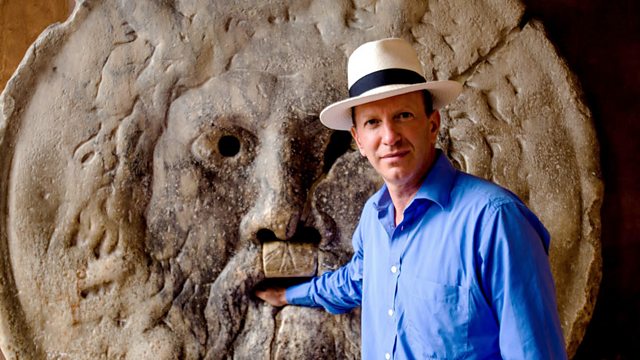
The famous Bocca della Verita, the mouth of truth, has been linked | 0:16:13 | 0:16:18 | |
since Middle Ages to a tradition | 0:16:18 | 0:16:20 | |
that if an unfaithful lover put his or her hand in the mouth, | 0:16:20 | 0:16:25 | |
it would be bitten off. | 0:16:25 | 0:16:27 | |
In Roman times, it wasn't a good idea to put your hand in that hole, | 0:16:27 | 0:16:32 | |
whether you were faithful or not. | 0:16:32 | 0:16:34 | |
This is in fact a monumental sewer cover, | 0:16:34 | 0:16:37 | |
decorated with the face of Oceanus, God of the oceans. | 0:16:37 | 0:16:42 | |
The risk was not so much from infidelity as from infection. | 0:16:42 | 0:16:48 | |
The concept of Rome as a holy city was present from the beginning. | 0:16:56 | 0:17:01 | |
And it not only shaped how the Romans designed their city, | 0:17:02 | 0:17:06 | |
it also influenced every political decision its rulers made. | 0:17:06 | 0:17:11 | |
The Romans were obsessed with the gods and their moods. | 0:17:11 | 0:17:14 | |
And that governed how they behaved from dawn till dusk. | 0:17:16 | 0:17:20 | |
Every soldier, every Caesar, believed he had a religious role. | 0:17:22 | 0:17:26 | |
To commemorate the greatness of Rome was to celebrate its holy destiny. | 0:17:26 | 0:17:32 | |
In this city, religion and politics were inseparable bedfellows. | 0:17:32 | 0:17:37 | |
Nowhere is this marriage of sacred and secular more blatant than here. | 0:17:42 | 0:17:47 | |
At the Forum, the heart of pagan Rome. | 0:17:49 | 0:17:52 | |
It was first built in the sixth century BC as a civic centre | 0:17:54 | 0:17:59 | |
after the sewers were established and the land drained. | 0:17:59 | 0:18:02 | |
And for 1,000 years, it was the centre of Roman public life. | 0:18:02 | 0:18:08 | |
Here, speeches were given, criminals were tried, laws were made. | 0:18:09 | 0:18:14 | |
And temple after temple was raised to the glory of the gods of Rome. | 0:18:14 | 0:18:19 | |
According to legend, this was home to another king of the city, | 0:18:23 | 0:18:27 | |
whose influence shaped the earliest traditions of Roman life. | 0:18:27 | 0:18:32 | |
His name was Numa Pompilius. | 0:18:32 | 0:18:34 | |
The Romans believed that it was Numa who created | 0:18:36 | 0:18:39 | |
the religious rituals and structures that made possible the rise of Rome. | 0:18:39 | 0:18:45 | |
And he did it right here. | 0:18:45 | 0:18:47 | |
When you visit the Forum for the first time, | 0:18:50 | 0:18:53 | |
you're both dazzled and bewildered. | 0:18:53 | 0:18:56 | |
It's a mishmash of architectural fragments from different ages. | 0:18:59 | 0:19:04 | |
There are traces of temples built and rebuilt. | 0:19:06 | 0:19:09 | |
Layer upon layer of Roman history. | 0:19:09 | 0:19:13 | |
Much of what stand here today belongs to the time | 0:19:14 | 0:19:17 | |
of the emperors, the last leaders to make their mark. | 0:19:17 | 0:19:22 | |
But the origins of this site can be dated right back to | 0:19:22 | 0:19:25 | |
the period of the Roman monarchy. | 0:19:25 | 0:19:27 | |
King Numa was said to have established four colleges of priests, | 0:19:29 | 0:19:33 | |
with very clear responsibilities. | 0:19:33 | 0:19:36 | |
They were not just religious, they were also political. | 0:19:36 | 0:19:39 | |
And without their say-so, | 0:19:39 | 0:19:41 | |
the entire routine of Roman politics would grind to a halt. | 0:19:41 | 0:19:45 | |
All buildings in the Forum, public or private, | 0:19:45 | 0:19:50 | |
were dedicated to the gods. | 0:19:50 | 0:19:52 | |
And all political decisions had to be made | 0:19:52 | 0:19:56 | |
on sanctified ground - from holding elections to passing laws. | 0:19:56 | 0:20:01 | |
So it was a group of priests known as the augurs | 0:20:01 | 0:20:05 | |
who had the final say over planning decisions. | 0:20:05 | 0:20:09 | |
This was the Senate house, | 0:20:09 | 0:20:11 | |
but it was also something called a "templum", a sacred space. | 0:20:11 | 0:20:14 | |
The augurs would consult the heavens to approve the site | 0:20:14 | 0:20:18 | |
and then map it out with holy staffs. | 0:20:18 | 0:20:20 | |
It was as if the Houses of Parliament | 0:20:20 | 0:20:23 | |
stood on a sacred rectangle. | 0:20:23 | 0:20:25 | |
And if the space wasn't sacred, the decisions weren't valid. | 0:20:25 | 0:20:29 | |
At the opposite end of the forum was the Regia. | 0:20:32 | 0:20:35 | |
It was the royal residence, | 0:20:35 | 0:20:37 | |
originally thought to be the Palace of King Numa | 0:20:37 | 0:20:39 | |
and the seat of secular power. | 0:20:39 | 0:20:42 | |
But it was also the centre of religious control. | 0:20:42 | 0:20:46 | |
This was once the headquarters of the Pontifex Maximus, | 0:20:46 | 0:20:50 | |
the high priest, the supreme religious authority of Rome | 0:20:50 | 0:20:54 | |
and Pontifex Maximus literally means "the greatest bridge-builder". | 0:20:54 | 0:20:58 | |
He was the bridge between gods and men. | 0:20:58 | 0:21:01 | |
He regulated the rituals of Roman life and the divine law | 0:21:01 | 0:21:06 | |
and this gave him considerable political authority. | 0:21:06 | 0:21:09 | |
But he was also a master of the Vestal Virgins | 0:21:13 | 0:21:16 | |
and right next door to his headquarters | 0:21:16 | 0:21:20 | |
was their house and temple. | 0:21:20 | 0:21:22 | |
The Virgins were priestesses of Vesta, | 0:21:24 | 0:21:26 | |
the goddess of the hearth and home, | 0:21:26 | 0:21:29 | |
who had a special link to the fortunes of the entire city. | 0:21:29 | 0:21:34 | |
The Vestal Virgins were chosen at the age of six | 0:21:34 | 0:21:37 | |
for their moral and physical perfection. | 0:21:37 | 0:21:40 | |
Their task was to tend the sacred flame | 0:21:40 | 0:21:43 | |
of the sacred hearth of the city | 0:21:43 | 0:21:46 | |
and the Romans believed that if the fire went out | 0:21:46 | 0:21:49 | |
the city itself would fall. | 0:21:49 | 0:21:51 | |
The whole forum was a place where religious practice | 0:21:55 | 0:21:58 | |
ensured Rome's political decisions had divine backing. | 0:21:58 | 0:22:03 | |
I've always been fascinated by the macabre rituals | 0:22:09 | 0:22:13 | |
that really decided the destiny of Rome. | 0:22:13 | 0:22:16 | |
So I asked Mark Bradley to give me an insight | 0:22:18 | 0:22:21 | |
into the work of a priestly group who were involved | 0:22:21 | 0:22:24 | |
in one of the gorier aspects of Roman politics - | 0:22:24 | 0:22:28 | |
they were known as the haruspices, | 0:22:28 | 0:22:31 | |
diviners from the Etruscan communities of northern Italy, | 0:22:31 | 0:22:34 | |
skilled in interpreting signs from the gods. | 0:22:34 | 0:22:38 | |
And there's a reason we're meeting in a fresh food market. | 0:22:39 | 0:22:42 | |
So, Mark, what is this still-warm, almost pulsating bloody organ | 0:22:44 | 0:22:50 | |
that we have here on the platter in this butcher's shop? | 0:22:50 | 0:22:52 | |
Well, this is a fresh liver taken from a newly sacrificed sheep. | 0:22:52 | 0:22:57 | |
What the priests would do is they'd cut open the animal | 0:22:57 | 0:23:00 | |
and they'd take out the liver while it was still pulsating | 0:23:00 | 0:23:04 | |
and they'd examine it to see what the future has in store. | 0:23:04 | 0:23:08 | |
So the first thing we need to do is orientate it correctly. | 0:23:08 | 0:23:12 | |
What the haruspices did is they used a model of the liver | 0:23:12 | 0:23:17 | |
to guide them, to remind them, to prompt them about how to read it, | 0:23:17 | 0:23:21 | |
so what we have here is a bronze model of a liver | 0:23:21 | 0:23:24 | |
from about 100 BC and this is called the Piacenza Liver, | 0:23:24 | 0:23:29 | |
and on this you can see the gall bladder, the caudal lobe, | 0:23:29 | 0:23:34 | |
and the liver was divided into 16 sections | 0:23:34 | 0:23:38 | |
and these 16 sections corresponded to the 16 regions of heaven | 0:23:38 | 0:23:42 | |
and each region was governed over by a particular god. | 0:23:42 | 0:23:47 | |
So what we'll do is we'll have a look at this liver and see what it tells us. | 0:23:47 | 0:23:51 | |
So this area here, around where the gall bladder was, | 0:23:51 | 0:23:55 | |
is an area governed by war gods | 0:23:55 | 0:23:58 | |
and if you find a discolouration, a tumour, a blood clot, | 0:23:58 | 0:24:05 | |
a bile pool or something like that in this area, | 0:24:05 | 0:24:08 | |
that might mean that the war gods are not happy, | 0:24:08 | 0:24:10 | |
this might not be a good time to go to war. | 0:24:10 | 0:24:13 | |
Another area that's very interesting is all of this area | 0:24:13 | 0:24:17 | |
which is associated with the Etruscan god Tin, | 0:24:17 | 0:24:20 | |
who is the equivalent of Jupiter in Roman cult. | 0:24:20 | 0:24:23 | |
If he's not happy you need to make a sacrifice to him | 0:24:23 | 0:24:26 | |
or you need to build a temple to him or something like that. | 0:24:26 | 0:24:29 | |
OK, so if I'm an emperor, my legions are massed | 0:24:29 | 0:24:33 | |
and I now want to invade Germany today and destroy the German tribes, | 0:24:33 | 0:24:37 | |
can I march today? Can you read the organ? | 0:24:37 | 0:24:39 | |
Well, this liver is remarkably clean. | 0:24:39 | 0:24:42 | |
This is absolutely unblemished, as far as I can see. | 0:24:42 | 0:24:45 | |
This is a good time to do pretty much anything. | 0:24:45 | 0:24:48 | |
-I'm happy, call in the centurions - we march today. -Absolutely. | 0:24:48 | 0:24:52 | |
If religion was an essential part of a politician's life, | 0:24:54 | 0:24:59 | |
for your ordinary Roman there was barely a beat in the day | 0:24:59 | 0:25:02 | |
that wasn't overseen by a god. | 0:25:02 | 0:25:04 | |
Buon giorno. | 0:25:04 | 0:25:06 | |
For the average Roman farmer, | 0:25:08 | 0:25:10 | |
it wasn't just about sowing, ploughing and reaping. | 0:25:10 | 0:25:13 | |
To get a bumper harvest they had to keep the gods happy, too. | 0:25:13 | 0:25:17 | |
In April there was the Festival of Cerialia | 0:25:21 | 0:25:23 | |
dedicated to the goddess of grain, | 0:25:23 | 0:25:26 | |
which involved heading out to the Circus Maximus in the evening | 0:25:26 | 0:25:29 | |
to watch foxes with torches tied to their tails. | 0:25:29 | 0:25:34 | |
This, apparently, protected the crops from vermin. | 0:25:34 | 0:25:39 | |
And then there was the Festival to the god Robigus who governed mildew. | 0:25:39 | 0:25:44 | |
To avoid an outbreak, farmers had to sacrifice a dog. | 0:25:44 | 0:25:48 | |
And in October, to thank Mars for the harvest, | 0:25:48 | 0:25:51 | |
it was a horse that got the chop. | 0:25:51 | 0:25:54 | |
And private rituals were as important as public festivals. | 0:25:58 | 0:26:02 | |
Families prayed daily to the household gods, the Lares, | 0:26:02 | 0:26:06 | |
whose statues they kept at home in special niches. | 0:26:06 | 0:26:10 | |
And they gathered for ceremonies in the fields to offer sacrifices, | 0:26:10 | 0:26:14 | |
ensuring the crops would ripen. | 0:26:14 | 0:26:17 | |
In fact, the Roman farmer had so many religious obligations | 0:26:17 | 0:26:21 | |
it's a wonder he had any time to tend his crops. | 0:26:21 | 0:26:24 | |
The religious structures and practices said to have been established by King Numa | 0:26:32 | 0:26:36 | |
largely formed the basis of Roman religion | 0:26:36 | 0:26:39 | |
for the entire first millennium of Rome. | 0:26:39 | 0:26:42 | |
But in 509 BC a political crisis broke out. | 0:26:43 | 0:26:45 | |
A group of aristocrats rebelled against the king, Tarquin the Proud. | 0:26:48 | 0:26:52 | |
They overthrew him and established a new political system. | 0:26:53 | 0:26:58 | |
Rome would no longer be ruled by one man but by the Senate, | 0:26:58 | 0:27:02 | |
an assembly of its leading citizens. | 0:27:02 | 0:27:04 | |
The Roman Republic was born. | 0:27:04 | 0:27:07 | |
But whatever ideas drove the change, | 0:27:09 | 0:27:12 | |
religion remained at the heart of the new regime. | 0:27:12 | 0:27:15 | |
Indeed, the more successful Rome became, the more sacred the city. | 0:27:16 | 0:27:21 | |
The dawn of the Republic was marked by an event | 0:27:30 | 0:27:34 | |
that would have seen the whole of Rome celebrating on the streets. | 0:27:34 | 0:27:37 | |
It was the dedication ceremony | 0:27:39 | 0:27:41 | |
of a building that once stood here on the Capitoline Hill. | 0:27:41 | 0:27:46 | |
The single most important temple ever erected in Rome. | 0:27:46 | 0:27:50 | |
On 13 September 509 BC, | 0:27:52 | 0:27:56 | |
this spot above the forum would have been packed with people. | 0:27:56 | 0:28:00 | |
And what an awesome spectacle it would have been. | 0:28:01 | 0:28:05 | |
They were there for the dedication of the vast new temple of Jupiter, | 0:28:05 | 0:28:09 | |
Optimus Maximus, the biggest and brightest of the Roman gods. | 0:28:09 | 0:28:15 | |
There was an altar outside for sacrifices | 0:28:15 | 0:28:17 | |
and the doors were always open | 0:28:17 | 0:28:19 | |
so passers-by could see the huge and gaudy statues of the gods within. | 0:28:19 | 0:28:24 | |
For a Roman who was there that day | 0:28:25 | 0:28:27 | |
it would have been as magnificent as it was unforgettable. | 0:28:27 | 0:28:31 | |
The entire ceremony was designed to remind the Roman people | 0:28:34 | 0:28:38 | |
that the god Jupiter was the source of Roman glory. | 0:28:38 | 0:28:41 | |
And for the new Republic, | 0:28:43 | 0:28:44 | |
this building marked a dramatic moment in the city's history. | 0:28:44 | 0:28:48 | |
This was the opening ceremony | 0:28:50 | 0:28:52 | |
of the first pagan cathedral of republican Rome. | 0:28:52 | 0:28:56 | |
The only surviving sections of the temple | 0:28:59 | 0:29:02 | |
are now in the Capitoline Museum in their original position. | 0:29:02 | 0:29:06 | |
Matthew Nicholls believes it is a building | 0:29:08 | 0:29:10 | |
that encapsulates the sacred ambitions of this new regime. | 0:29:10 | 0:29:14 | |
What we're looking at here, Simon, | 0:29:15 | 0:29:17 | |
is a wall that forms part of the foundations of the Temple of Jupiter. | 0:29:17 | 0:29:21 | |
It's not the temple itself, it merely the foundations | 0:29:21 | 0:29:23 | |
that built a huge platform on which the temple sat. | 0:29:23 | 0:29:26 | |
-And how big was it? It was enormous. -It was awe-inspiringly huge. | 0:29:26 | 0:29:29 | |
You've got to imagine a podium that was perhaps the size | 0:29:29 | 0:29:32 | |
of two Olympic swimming pools side-by-side | 0:29:32 | 0:29:34 | |
with the temple itself sitting up on top of that. | 0:29:34 | 0:29:36 | |
So this dominated central Rome? This dominated the forum? | 0:29:36 | 0:29:39 | |
It looked down on the forum, | 0:29:39 | 0:29:40 | |
it looked out across the hills and valleys of Rome. | 0:29:40 | 0:29:43 | |
It could be seen from a long way away and it was a magnificent sight. | 0:29:43 | 0:29:46 | |
Who built it and what was its political significance? | 0:29:46 | 0:29:49 | |
Its significance is really what it tells us | 0:29:49 | 0:29:51 | |
about the ambitions of the Roman state. | 0:29:51 | 0:29:54 | |
It was linked right from the start to conquest | 0:29:54 | 0:29:56 | |
and the divine mission of conquest the Romans felt they had. | 0:29:56 | 0:29:59 | |
But even though we associate this temple very closely | 0:29:59 | 0:30:02 | |
with the Roman Republic and the many rituals of the Republic, | 0:30:02 | 0:30:04 | |
in fact it was planned, it was conceived, | 0:30:04 | 0:30:07 | |
when Rome had kings, was ruled by Etruscan kings, | 0:30:07 | 0:30:09 | |
and the last of them, Tarquinius Superbus, | 0:30:09 | 0:30:12 | |
was responsible for almost bringing this temple to fruition, | 0:30:12 | 0:30:15 | |
and then his rule was blown away in the revolution. | 0:30:15 | 0:30:18 | |
So why did the Republic adopt this very royal enterprise? | 0:30:18 | 0:30:22 | |
Romans loved the idea that their rule and their growing empire | 0:30:22 | 0:30:25 | |
was sanctioned by the will of heaven, that this was a mission | 0:30:25 | 0:30:28 | |
that the gods entrusted to them as a people. | 0:30:28 | 0:30:30 | |
Even when the kings were gone, the Roman people could carry that mission forwards. | 0:30:30 | 0:30:34 | |
The building of this temple | 0:30:37 | 0:30:39 | |
marked a watershed in the history of the whole city. | 0:30:39 | 0:30:43 | |
It was the moment when Rome transformed | 0:30:43 | 0:30:45 | |
from being a town of small-scale temples and shrines | 0:30:45 | 0:30:49 | |
to a sacred capital embellished with its own cathedral. | 0:30:49 | 0:30:54 | |
The Temple of Jupiter was a declaration | 0:30:57 | 0:31:00 | |
of the astonishing religious and political confidence of Rome, | 0:31:00 | 0:31:05 | |
a rising power blessed and propelled on its sacred destiny | 0:31:05 | 0:31:10 | |
by the forces of the gods. | 0:31:10 | 0:31:12 | |
And that power was consolidated by the raising of ever-more temples. | 0:31:16 | 0:31:22 | |
Their remains can still be seen all over Rome. | 0:31:22 | 0:31:26 | |
As the Romans conquered new territories, | 0:31:27 | 0:31:30 | |
the spoils of victory poured into the city | 0:31:30 | 0:31:32 | |
and since the Romans attributed their success to the gods, | 0:31:32 | 0:31:36 | |
so the victors built more and more magnificent temples | 0:31:36 | 0:31:40 | |
in gratitude and in celebration. | 0:31:40 | 0:31:43 | |
Gradually the geography of the Holy City | 0:31:45 | 0:31:47 | |
began to resemble a map of Rome's ever-increasing empire. | 0:31:47 | 0:31:52 | |
And nowhere was Rome's acknowledgement of the gods clearer | 0:31:56 | 0:32:00 | |
than in one of the city's most colourful military ceremonies. | 0:32:00 | 0:32:04 | |
When a general returned from a victorious war, | 0:32:06 | 0:32:08 | |
the Senate voted him something called a Triumph, a parade through the city. | 0:32:08 | 0:32:12 | |
He rode in his chariot followed by his army, | 0:32:12 | 0:32:15 | |
by wagons heaped with booty | 0:32:15 | 0:32:17 | |
and by his shackled prisoners | 0:32:17 | 0:32:19 | |
and he ended up right here at the Via Sacra, the Sacred Way, | 0:32:19 | 0:32:23 | |
the most important street in the Roman forum. | 0:32:23 | 0:32:26 | |
Imagine the excitement. | 0:32:29 | 0:32:31 | |
The general wearing purple and gold, his face painted scarlet. | 0:32:31 | 0:32:36 | |
He was dressed as Jupiter for a day, | 0:32:36 | 0:32:38 | |
but in case the glory went to his head, | 0:32:38 | 0:32:41 | |
a slave rode behind him in his chariot whispering, | 0:32:41 | 0:32:45 | |
"Remember - you are only mortal." | 0:32:45 | 0:32:48 | |
His procession ended, of course, | 0:32:50 | 0:32:52 | |
at the Capitol and the Temple of Jupiter | 0:32:52 | 0:32:55 | |
where he laid laurels at the feet of the giant statues of the gods. | 0:32:55 | 0:32:59 | |
At that moment there'd be no doubt in any Roman's mind | 0:33:02 | 0:33:06 | |
that the gods were responsible for the city's fortunes. | 0:33:06 | 0:33:10 | |
But the success of the Republic came at a price. | 0:33:16 | 0:33:19 | |
It was the purity of Rome's religion that suffered. | 0:33:19 | 0:33:22 | |
The city's expansion into a vast empire | 0:33:25 | 0:33:28 | |
led to an influx of foreigners from Greece to Egypt. | 0:33:28 | 0:33:33 | |
And with them came their gods. | 0:33:33 | 0:33:35 | |
Rome's senators could have suppressed these new divinities | 0:33:37 | 0:33:40 | |
and stayed faithful to their own, | 0:33:40 | 0:33:43 | |
but they took a more pragmatic approach. | 0:33:43 | 0:33:46 | |
Foreign gods, like Isis and Serapis, | 0:33:47 | 0:33:50 | |
were absorbed into the state religion and in the third century BC | 0:33:50 | 0:33:55 | |
one was even imported to try and avert disaster. | 0:33:55 | 0:33:59 | |
In 205 BC, Rome faced one of its gravest crises. | 0:34:03 | 0:34:09 | |
For almost a century, the city was engaged in a power struggle | 0:34:09 | 0:34:13 | |
for control of the Mediterranean. | 0:34:13 | 0:34:15 | |
Its enemy was Carthage, led by the brilliant commander Hannibal. | 0:34:17 | 0:34:20 | |
And it was a threat that led to the introduction | 0:34:24 | 0:34:27 | |
of one of the most flamboyant and exotic new goddesses to the city - | 0:34:27 | 0:34:31 | |
just in the nick of time. | 0:34:31 | 0:34:33 | |
Rome's very existence was in peril. | 0:34:35 | 0:34:38 | |
Strange portents and mysterious hailstone storms threatened danger | 0:34:38 | 0:34:43 | |
and in their panic the Romans decide to consult the Sibylline Books, | 0:34:43 | 0:34:48 | |
sacred texts kept in the great Temple of Jupiter. | 0:34:48 | 0:34:51 | |
Their advice was clear - | 0:34:51 | 0:34:53 | |
in order to avoid defeat by Hannibal and the Carthaginians, | 0:34:53 | 0:34:56 | |
the Romans must import a foreign goddess from Asia Minor. | 0:34:56 | 0:35:01 | |
Her name was Magna Mater, the great mother, | 0:35:01 | 0:35:05 | |
and her arrival in the city | 0:35:05 | 0:35:07 | |
and her acceptance as one of its official gods - | 0:35:07 | 0:35:10 | |
that alone would help save Rome. | 0:35:10 | 0:35:13 | |
The Roman historian Livy wrote a vivid description | 0:35:26 | 0:35:29 | |
of her arrival in the city. | 0:35:29 | 0:35:31 | |
The goddess was shipped up the Tiber | 0:35:33 | 0:35:36 | |
accompanied by her cult officials known as the Galli - | 0:35:36 | 0:35:40 | |
self-castrated eunuch priests. | 0:35:40 | 0:35:44 | |
And when she arrived at the river's bank | 0:35:48 | 0:35:50 | |
she was born through the city, passed from hand to hand. | 0:35:50 | 0:35:53 | |
The whole of Rome came out to meet her. | 0:35:57 | 0:35:59 | |
Incense burners lined the streets | 0:35:59 | 0:36:02 | |
and all the Romans prayed that she would enter the city willingly. | 0:36:02 | 0:36:06 | |
It seems Rome hasn't changed as much as you might think. | 0:36:14 | 0:36:18 | |
LOUDSPEAKER CHANTS | 0:36:18 | 0:36:21 | |
Shortly after her arrival, | 0:36:30 | 0:36:32 | |
Magna Mater was given a home at the very centre of the city - | 0:36:32 | 0:36:37 | |
a temple on the Palatine Hill - | 0:36:37 | 0:36:39 | |
and her rituals were incorporated into the official calendar. | 0:36:39 | 0:36:44 | |
Three years later, Hannibal was defeated. | 0:36:46 | 0:36:50 | |
The story of Magna Mater shows how far Rome had come. | 0:36:53 | 0:36:58 | |
It transformed from sacred village to a holy city | 0:36:58 | 0:37:02 | |
dedicated to a multinational pantheon of deities. | 0:37:02 | 0:37:07 | |
But in the first century BC, 700 years after its foundation, | 0:37:12 | 0:37:17 | |
the whole city was to become a shrine | 0:37:17 | 0:37:20 | |
not just to the gods, but to a man. | 0:37:20 | 0:37:23 | |
And one man in particular. | 0:37:23 | 0:37:25 | |
It was an innovation that had its roots | 0:37:27 | 0:37:29 | |
in the rule of one of Rome's most outstanding leaders... | 0:37:29 | 0:37:33 | |
..Julius Caesar. | 0:37:34 | 0:37:37 | |
Caesar's rise to power came at a time when violence, | 0:37:39 | 0:37:42 | |
cynicism and corruption had taken hold of the Holy City. | 0:37:42 | 0:37:47 | |
As the empire grew, the struggle for control became more and more vicious | 0:37:47 | 0:37:52 | |
and religion was ripe for exploitation. | 0:37:52 | 0:37:55 | |
Portents from heaven were interpreted to justify decisions. | 0:37:57 | 0:38:01 | |
Omens and oracles were invented for political advantage. | 0:38:01 | 0:38:06 | |
And in this world, one man stood out. | 0:38:08 | 0:38:11 | |
Caesar was so exceptional, | 0:38:14 | 0:38:16 | |
the Roman state was almost too small for him. | 0:38:16 | 0:38:20 | |
Nicknamed by his own soldiers "The Balding Adulterer", | 0:38:20 | 0:38:23 | |
he was a gambler, a risk-taker, | 0:38:24 | 0:38:26 | |
and he was an arch manipulator of religion | 0:38:26 | 0:38:29 | |
for his own political ends. | 0:38:29 | 0:38:32 | |
He even claimed to be descended from the goddess Venus herself. | 0:38:32 | 0:38:36 | |
But his success provoked the jealousy and suspicion of the other nobles | 0:38:39 | 0:38:44 | |
with deadly consequences. | 0:38:44 | 0:38:46 | |
This little-known square is the closest you can get | 0:38:52 | 0:38:55 | |
to the spot where Caesar was murdered. | 0:38:55 | 0:38:58 | |
In the first century BC, these ruins were temples. | 0:38:59 | 0:39:03 | |
And on the Ides of March 44 BC, Caesar was passing here | 0:39:05 | 0:39:10 | |
when he was stabbed by a group of conspirators. | 0:39:10 | 0:39:13 | |
At first he fought back, | 0:39:14 | 0:39:16 | |
but when he saw among the assassins was Brutus, | 0:39:16 | 0:39:19 | |
his mistress's son whom he adored, he gave up. | 0:39:19 | 0:39:23 | |
His murder was meant to save the Republic, | 0:39:24 | 0:39:27 | |
but in fact it just accelerated the end of the dream. | 0:39:27 | 0:39:31 | |
With Caesar's successors, | 0:39:34 | 0:39:36 | |
Rome would no longer be ruled by the Senate as a republic | 0:39:36 | 0:39:40 | |
but by a single ruler as an autocracy. | 0:39:40 | 0:39:44 | |
And with this new political order came an innovation in Roman religion | 0:39:44 | 0:39:48 | |
which would once again have a huge physical impact on the Holy City | 0:39:48 | 0:39:54 | |
and on the daily lives of the ordinary people who lived here. | 0:39:54 | 0:39:57 | |
The Emperor wouldn't just be | 0:39:59 | 0:40:01 | |
the most powerful political leader in the western world - | 0:40:01 | 0:40:04 | |
he was about to become the son of a god. | 0:40:04 | 0:40:07 | |
Caesar's heir was his 18-year-old nephew, and adopted son, Octavian, | 0:40:15 | 0:40:21 | |
a brilliant political strategist, who combined the old and the new | 0:40:21 | 0:40:25 | |
to give Roman leaders a new status. | 0:40:27 | 0:40:29 | |
They were no longer just generals and priests - | 0:40:29 | 0:40:32 | |
they could also be gods. | 0:40:32 | 0:40:34 | |
After Caesar's death, Rome was thrown into chaos | 0:40:37 | 0:40:40 | |
and a fight for power ripped the city apart. | 0:40:42 | 0:40:44 | |
Octavian found himself in a bitter struggle to rule the Empire | 0:40:51 | 0:40:55 | |
against Caesar's right-hand man, Mark Antony. | 0:40:55 | 0:40:59 | |
Mark Antony allied himself with the irresistibly vampish | 0:41:01 | 0:41:05 | |
and hugely ambitious Queen of Egypt, Cleopatra. | 0:41:06 | 0:41:10 | |
Together, they embraced an Eastern version of power and religion. | 0:41:11 | 0:41:16 | |
But Octavian cleverly used this to turn the Romans against them. | 0:41:16 | 0:41:21 | |
Antony and Cleopatra were defeated in battle and committed suicide. | 0:41:22 | 0:41:27 | |
He by sword, she by snake. | 0:41:27 | 0:41:29 | |
And Octavian became Rome's first emperor. | 0:41:29 | 0:41:33 | |
Octavian's victory marked a crucial turning point in Rome's history. | 0:41:38 | 0:41:42 | |
Under his regime, it became the most magnificent | 0:41:43 | 0:41:46 | |
and sacred capital of the Western world. | 0:41:46 | 0:41:49 | |
Romans began to call it "the eternal city". | 0:41:51 | 0:41:54 | |
And Octavian had similarly grand ideas about his own status. | 0:41:56 | 0:42:01 | |
When Octavian became emperor, | 0:42:01 | 0:42:04 | |
he adopted a new name for his new role - Augustus Caesar. | 0:42:04 | 0:42:09 | |
Augustus means "consecrated by the augurs". | 0:42:09 | 0:42:13 | |
It was a name that evoked the favour of the gods | 0:42:13 | 0:42:15 | |
and the auspices that marked the founding of Rome. | 0:42:15 | 0:42:19 | |
The name Caesar also linked Augustus to his murdered uncle, Julius. | 0:42:26 | 0:42:32 | |
And very early on, he had a temple built here, in the Forum, | 0:42:32 | 0:42:36 | |
in his uncle's honour. | 0:42:36 | 0:42:38 | |
It doesn't look like much now, | 0:42:39 | 0:42:41 | |
but this once dominated the entire south side of the Forum. | 0:42:41 | 0:42:45 | |
Before it was built, this was where they brought Julius Caesar's body | 0:42:45 | 0:42:49 | |
after his assassination. | 0:42:49 | 0:42:51 | |
And it was here that they cremated him before huge crowds. | 0:42:51 | 0:42:55 | |
The temple marks a major change in Roman religion. | 0:42:55 | 0:42:59 | |
This is when they started to treat their rulers not as men, | 0:42:59 | 0:43:03 | |
but as gods. | 0:43:03 | 0:43:05 | |
On 1 January 42 BC, the Senate passed an unprecedented decree. | 0:43:07 | 0:43:12 | |
They declared Julius Caesar divine. | 0:43:14 | 0:43:16 | |
It made him the first historical Roman ever to be officially deified. | 0:43:17 | 0:43:23 | |
With a temple and priests, this mere mortal had now become a god. | 0:43:23 | 0:43:29 | |
And if Julius Caesar was a god, then his adopted son, Augustus, | 0:43:29 | 0:43:34 | |
had a new title - Divi Filius, son of a god. | 0:43:34 | 0:43:39 | |
But Augustus's desire for divinity wasn't satisfied by a title alone. | 0:43:48 | 0:43:54 | |
He spent the next four decades taking steps which gradually tied | 0:43:54 | 0:43:58 | |
Roman religion not just to the city of Rome, but to a single person - | 0:43:58 | 0:44:04 | |
the Emperor. | 0:44:04 | 0:44:05 | |
And he did it through a vigorous programme | 0:44:07 | 0:44:10 | |
of rebuilding and religious renewal. | 0:44:10 | 0:44:12 | |
He reinstated ancient religious festivals, | 0:44:14 | 0:44:17 | |
rebuilt crumbling temples, filled vacant priesthoods. | 0:44:17 | 0:44:20 | |
He claimed he was restoring Rome's ancient past to please the gods. | 0:44:20 | 0:44:27 | |
What he was really doing was making Rome his own. | 0:44:27 | 0:44:32 | |
Augustus subtly co-opted new powers, | 0:44:34 | 0:44:37 | |
taking on the mantle of all the major priesthoods in Rome, | 0:44:37 | 0:44:42 | |
culminating in 12 BC, | 0:44:42 | 0:44:44 | |
when he declared himself Pontifex Maximus. | 0:44:44 | 0:44:48 | |
Five years later, he divided the city into new districts. | 0:44:49 | 0:44:53 | |
And on every street corner, he built a shrine. | 0:44:54 | 0:44:57 | |
In his meticulous way, | 0:44:57 | 0:45:00 | |
he was altering the whole focus of Roman worship. | 0:45:00 | 0:45:05 | |
Very few traces of these ancient shrines remain, | 0:45:08 | 0:45:12 | |
but there's one in the Vatican Museum. | 0:45:12 | 0:45:14 | |
It's tucked away from public view in the Pope's own private gallery. | 0:45:14 | 0:45:19 | |
And its carvings show just how the shrewd Augustus was shifting | 0:45:22 | 0:45:27 | |
the object of Roman worship from the gods | 0:45:27 | 0:45:30 | |
to himself and his own family. | 0:45:30 | 0:45:32 | |
SPEAKS IN ITALIAN | 0:45:33 | 0:45:35 | |
So, what are the images on it? | 0:45:55 | 0:45:58 | |
And Augustus's family connection to the gods | 0:46:16 | 0:46:19 | |
is even more explicit in another scene. | 0:46:19 | 0:46:22 | |
What did Augustus want the people who saw this shrine to believe? | 0:46:42 | 0:46:47 | |
By putting images of his deified ancestors on shrines all over Rome, | 0:47:15 | 0:47:20 | |
and encouraging sacrifices to them, | 0:47:20 | 0:47:22 | |
Augustus was making a bold statement. | 0:47:22 | 0:47:25 | |
Augustus was inviting all ordinary Romans | 0:47:27 | 0:47:30 | |
to take part in the creation of a new imperial mythology. | 0:47:30 | 0:47:34 | |
The city of Rome was being indelibly stamped | 0:47:34 | 0:47:38 | |
with the divine claims of one family, one ruler. | 0:47:38 | 0:47:42 | |
And Augustus set the tone for the emperors who came after him. | 0:47:46 | 0:47:50 | |
During his life, he was the sole religious authority in Rome. | 0:47:51 | 0:47:55 | |
And on his death, by vote of the Senate, he too was declared a god. | 0:47:56 | 0:48:03 | |
The Forum is a living testament to Augustus's precedent. | 0:48:07 | 0:48:12 | |
Temples to the deified emperors would soon dominate this sacred space. | 0:48:12 | 0:48:17 | |
So here is the temple to the Emperor Antoninus Pius. | 0:48:19 | 0:48:24 | |
And here, these columns were the temple to the emperors Vespasian and Titus. | 0:48:24 | 0:48:29 | |
Now, Vespasian, who was a bluff soldier, | 0:48:29 | 0:48:32 | |
kept a sense of humour about divinity. | 0:48:32 | 0:48:35 | |
When he lay on his deathbed, he joked, | 0:48:35 | 0:48:38 | |
"I think I'm about to become a god." | 0:48:38 | 0:48:41 | |
But other emperors lacked his sense of detachment. | 0:48:41 | 0:48:45 | |
The demented emperor Caligula cavorted as the goddess Venus | 0:48:45 | 0:48:50 | |
in a gorgeous bejewelled dress. | 0:48:50 | 0:48:53 | |
The emperor Hadrian took all of it a step further | 0:48:53 | 0:48:56 | |
when he deified his young gay lover. | 0:48:56 | 0:49:00 | |
And as for Nero, he built a 120ft statue of himself as the sun god, | 0:49:00 | 0:49:06 | |
right here in the centre of Rome. | 0:49:06 | 0:49:09 | |
But it was the imperial cult and its demands that provoked a minor challenge | 0:49:12 | 0:49:17 | |
to Roman religion, with world-shattering consequences. | 0:49:17 | 0:49:22 | |
A new generation of foreign sects | 0:49:24 | 0:49:26 | |
were starting to gain popularity in the city. | 0:49:26 | 0:49:29 | |
And one in particular showed resistance | 0:49:29 | 0:49:33 | |
to this worship of emperors. | 0:49:33 | 0:49:35 | |
That cult was, of course, Christianity. | 0:49:37 | 0:49:40 | |
And 300 years after its emergence, | 0:49:40 | 0:49:43 | |
it would entirely reshape the city of Rome. | 0:49:43 | 0:49:47 | |
The pagan temples would be converted into churches, | 0:49:47 | 0:49:51 | |
leaving the Roman gods to crumble into dust. | 0:49:51 | 0:49:53 | |
But when it first arrived in Rome, in the first century AD, | 0:49:57 | 0:50:01 | |
Christianity looked less like a force to be feared | 0:50:01 | 0:50:04 | |
and more like a sect of cranks with peculiar | 0:50:04 | 0:50:07 | |
and preposterous beliefs, worthy of mockery. | 0:50:08 | 0:50:11 | |
And there's a glimpse of just how unthreatening the pagan Romans | 0:50:16 | 0:50:20 | |
initially thought the Christians were | 0:50:20 | 0:50:23 | |
in a rare piece of ancient graffiti, | 0:50:23 | 0:50:26 | |
uncovered by archaeologists in the 19th century. | 0:50:26 | 0:50:29 | |
So here it is. | 0:50:32 | 0:50:33 | |
It's very small and it's very hard to see, | 0:50:33 | 0:50:36 | |
and I find it absolutely fascinating. | 0:50:36 | 0:50:39 | |
What we have here is a human figure being crucified on the cross. | 0:50:39 | 0:50:45 | |
What's bizarre about it is that the person being crucified | 0:50:45 | 0:50:48 | |
has the head of a donkey. | 0:50:48 | 0:50:49 | |
There's a figure, apparently worshipping beside the cross, | 0:50:53 | 0:50:57 | |
hand raised, possibly a soldier, | 0:50:57 | 0:50:59 | |
and, underneath, it says, "Alexamenos worships his God." | 0:50:59 | 0:51:05 | |
Now what's remarkable about this is it's the first ever | 0:51:05 | 0:51:10 | |
representation of the Crucifixion in history. | 0:51:10 | 0:51:13 | |
What's interesting is that it's clearly | 0:51:17 | 0:51:20 | |
not by a Christian at all, but by a pagan Roman. | 0:51:20 | 0:51:24 | |
The graffiti dates from between the first and third centuries AD | 0:51:29 | 0:51:33 | |
and, at that time, the symbol of the cross wasn't something | 0:51:33 | 0:51:36 | |
the Christians were proud of. | 0:51:36 | 0:51:38 | |
Crucifixion was a shameful death - the method of execution | 0:51:39 | 0:51:44 | |
for the lowest criminals, like showing someone today with | 0:51:44 | 0:51:47 | |
a noose round their neck, and, in the earliest Christian art, | 0:51:47 | 0:51:50 | |
the cross doesn't appear at all, so this pagan graffiti artist | 0:51:50 | 0:51:58 | |
is deliberately mocking and insulting Christian worshippers. | 0:51:58 | 0:52:02 | |
To show Jesus with a donkey's head is the cruellest cut of all. | 0:52:02 | 0:52:07 | |
And donkey worship wasn't the only tittle-tattle | 0:52:09 | 0:52:12 | |
circulating about the Christians. | 0:52:12 | 0:52:14 | |
They were also rumoured to practise magic, | 0:52:16 | 0:52:20 | |
indulge in ritual cannibalism and even incest. | 0:52:20 | 0:52:22 | |
It was all good gossip for the Roman on the street, | 0:52:25 | 0:52:28 | |
but within 200 years, rumour had turned to concern. | 0:52:28 | 0:52:31 | |
As Rome's elite realised, this new sect was persistent | 0:52:35 | 0:52:39 | |
and potentially dangerous. | 0:52:39 | 0:52:41 | |
The Christians were well-organised, they recruited thousands | 0:52:41 | 0:52:45 | |
of new followers, but, worst of all, they refused to take part | 0:52:45 | 0:52:48 | |
in the Roman state religion, | 0:52:50 | 0:52:52 | |
claiming that they worshipped only one God. | 0:52:52 | 0:52:55 | |
They were beginning to look less like a bunch of harmless | 0:52:55 | 0:52:58 | |
and superstitious eccentrics and more like a movement | 0:52:58 | 0:53:01 | |
of defiant subversives who could no longer be controlled. | 0:53:01 | 0:53:05 | |
The Roman elite had in the past tolerated foreign gods, | 0:53:09 | 0:53:12 | |
but they were always clear that whatever people's private beliefs, | 0:53:13 | 0:53:17 | |
public loyalty to Roman religion came first. | 0:53:18 | 0:53:21 | |
After all, the fortunes of the city | 0:53:24 | 0:53:27 | |
were at the mercy of the pagan gods - | 0:53:27 | 0:53:29 | |
snub them and the consequences could be catastrophic. | 0:53:29 | 0:53:32 | |
So if a group like the Christians failed to pay due respect, | 0:53:35 | 0:53:39 | |
how would the gods react? | 0:53:39 | 0:53:41 | |
The fate of the city and its Empire hung in the balance. | 0:53:41 | 0:53:45 | |
And in the third century, it seemed as if their fears were justified. | 0:53:50 | 0:53:54 | |
The Roman Empire was beset by invasion, | 0:53:55 | 0:53:58 | |
civil war and economic depression. | 0:53:58 | 0:54:01 | |
It was on the verge of collapse... | 0:54:02 | 0:54:04 | |
..until the reign of a new emperor - Diocletian. | 0:54:05 | 0:54:08 | |
He was a superb general, who restored order by conquest, | 0:54:11 | 0:54:14 | |
reform and restoration of the old gods... | 0:54:15 | 0:54:18 | |
..but one sect resisted. | 0:54:21 | 0:54:22 | |
And when Diocletian's palace burned down | 0:54:24 | 0:54:27 | |
and the army's sacrificial portents looked bleak, | 0:54:27 | 0:54:30 | |
the Christians were blamed for failing to honour the Roman gods. | 0:54:31 | 0:54:35 | |
Diocletian decided to solve the problem by force. In 304 AD, | 0:54:36 | 0:54:42 | |
he ordered every citizen of the Empire to sacrifice publicly | 0:54:42 | 0:54:46 | |
to the Roman gods, and if the Christians refused, | 0:54:46 | 0:54:50 | |
they would be executed. | 0:54:50 | 0:54:51 | |
It was a strategy designed to drive the Christians into the open. | 0:54:54 | 0:54:58 | |
Yet, despite the threats, they remained defiant. | 0:54:59 | 0:55:02 | |
Rome's senators were baffled. | 0:55:04 | 0:55:07 | |
Why would anyone risk their lives for this upstart cult | 0:55:07 | 0:55:11 | |
whose founder died a criminal's death in a Roman outpost, | 0:55:11 | 0:55:14 | |
when the pagan gods had delivered the riches of Empire? | 0:55:14 | 0:55:17 | |
Yet, still, pagan Romans were choosing to convert, | 0:55:20 | 0:55:23 | |
and here in the suburbs of Rome, | 0:55:25 | 0:55:27 | |
there's a fascinating clue as to why. | 0:55:27 | 0:55:30 | |
This is the Catacomb of Priscilla where Christians were buried | 0:55:35 | 0:55:39 | |
in the first centuries of the church, | 0:55:39 | 0:55:42 | |
and it's one of the few places in Rome | 0:55:42 | 0:55:45 | |
that they left their mark - | 0:55:45 | 0:55:47 | |
the walls are covered by their paintings. | 0:55:47 | 0:55:50 | |
And there's one that gives an insight into just why pagan Romans | 0:55:53 | 0:55:56 | |
were choosing to face execution for this new Christian God. | 0:55:58 | 0:56:01 | |
So here it is. | 0:56:05 | 0:56:07 | |
This is a biblical scene from the Old Testament Book of Daniel | 0:56:07 | 0:56:12 | |
and it tells the story of these three Jewish characters | 0:56:12 | 0:56:16 | |
who were in exile in Babylon from Israel. | 0:56:16 | 0:56:18 | |
They refused to pray | 0:56:18 | 0:56:20 | |
to the image of the king of Babylon, Nebuchadnezzar and, as a result, | 0:56:20 | 0:56:25 | |
they were sentenced, as you can see, | 0:56:25 | 0:56:27 | |
to die horribly in this fiery furnace. | 0:56:27 | 0:56:31 | |
Parallels for Christians facing persecution in Rome were clear, | 0:56:32 | 0:56:37 | |
but there's a twist to the biblical story which gives this image | 0:56:37 | 0:56:41 | |
another dimension. | 0:56:41 | 0:56:43 | |
What's surprising about this is that if you look closely, | 0:56:44 | 0:56:48 | |
these characters are praying, but they're not burning. | 0:56:48 | 0:56:53 | |
The Book of Daniel says that they were able to walk | 0:56:53 | 0:56:56 | |
unscathed among the flames and emerge entirely unharmed. | 0:56:56 | 0:57:01 | |
Their God had saved them. | 0:57:03 | 0:57:05 | |
Now, for Christians, this had another layer of meaning. | 0:57:05 | 0:57:09 | |
The Christian God would not only save Christians from persecution, | 0:57:09 | 0:57:13 | |
he would also save them from death itself. | 0:57:13 | 0:57:16 | |
Christianity offered eternal life. | 0:57:19 | 0:57:22 | |
And this belief in eternity had huge appeal in this pagan city. | 0:57:25 | 0:57:29 | |
For your average Roman, life expectancy was only 29 | 0:57:31 | 0:57:34 | |
and daily life was hard. | 0:57:36 | 0:57:38 | |
For the poor, the slaves, | 0:57:38 | 0:57:40 | |
the Pagan Romans at the bottom of the pile, this Christian idea of | 0:57:40 | 0:57:45 | |
a new life after death offered hope | 0:57:45 | 0:57:47 | |
amidst the grind of unrelenting poverty. | 0:57:47 | 0:57:50 | |
The Roman gods may help you conquer an Empire, | 0:57:52 | 0:57:56 | |
but they didn't offer immortality. | 0:57:56 | 0:57:58 | |
It was a masterstroke. | 0:58:00 | 0:58:01 | |
Rome's leaders might be worshipping its pantheon of pagan gods | 0:58:03 | 0:58:06 | |
but some of its people were starting to look elsewhere. | 0:58:06 | 0:58:09 | |
Ancient Rome has always been a symbol of secular power, | 0:58:16 | 0:58:20 | |
but you can't understand the might of this city without also | 0:58:20 | 0:58:24 | |
grasping the sacred beliefs of the Romans themselves. | 0:58:24 | 0:58:27 | |
Right through its history, | 0:58:29 | 0:58:31 | |
Rome's greatness was inextricably linked to its sacred mission. | 0:58:31 | 0:58:35 | |
For its first thousand years, Rome's palaces and temples expressed | 0:58:37 | 0:58:43 | |
one thing - this was a holy city, | 0:58:43 | 0:58:47 | |
blessed by the gods to rule the world. | 0:58:47 | 0:58:49 | |
But all that was to change. | 0:58:50 | 0:58:52 | |
A new god was about to take Rome. | 0:58:53 | 0:58:55 | |
Next time, Rome's transformation from pagan heartland | 0:58:59 | 0:59:03 | |
to the capital of Christendom, | 0:59:03 | 0:59:05 | |
as religious revolution hits the holy city. | 0:59:05 | 0:59:08 | |
Subtitles by Red Bee Media Ltd | 0:59:24 | 0:59:26 |