Being the Brontes
Similar Content
Browse content similar to Being the Brontes. Check below for episodes and series from the same categories and more!
Transcript
| Line | From | To | |
|---|---|---|---|
In 1846, three sisters - scribbling, arguing, | 0:00:02 | 0:00:07 | |
marching round this table night after night - | 0:00:07 | 0:00:10 | |
created three of the greatest novels in the English language. | 0:00:10 | 0:00:16 | |
Jane Eyre, Wuthering Heights and Agnes Grey | 0:00:16 | 0:00:20 | |
were published within weeks of one another, | 0:00:20 | 0:00:23 | |
immediately delighting and shocking the public. | 0:00:23 | 0:00:26 | |
One woman said about Jane Eyre that if it wasn't written by a man, | 0:00:26 | 0:00:30 | |
then it must've been written by a sexual delinquent. | 0:00:30 | 0:00:33 | |
The novels are filled with unforgettable characters. | 0:00:33 | 0:00:37 | |
Plain Jane, brooding Mr Rochester, | 0:00:37 | 0:00:40 | |
steadfast Agnes | 0:00:40 | 0:00:43 | |
and the tormented Heathcliff. | 0:00:43 | 0:00:46 | |
It feels as if you're putting yourself at risk | 0:00:46 | 0:00:48 | |
just by opening the covers of a book. | 0:00:48 | 0:00:51 | |
The books seemed to come out of nowhere, as did their authors - | 0:00:51 | 0:00:55 | |
Charlotte, Emily and Anne Bronte - | 0:00:55 | 0:00:59 | |
three clergyman's daughters from the wilds of West Yorkshire. | 0:00:59 | 0:01:04 | |
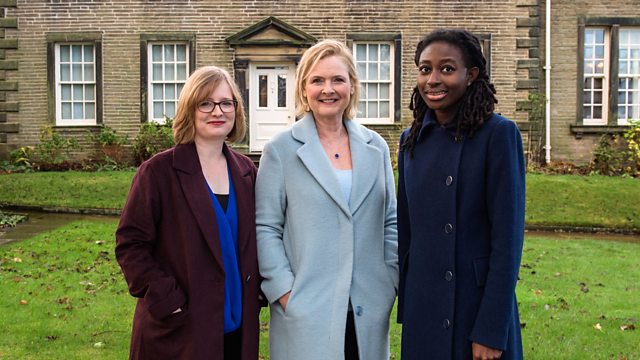
As three long-time Bronte fans, we want to find out how these | 0:01:06 | 0:01:11 | |
sheltered young spinsters produced | 0:01:11 | 0:01:14 | |
three immortal works so quickly. | 0:01:14 | 0:01:18 | |
Can we discover the secrets of their creative genius by stepping into their lives, | 0:01:18 | 0:01:24 | |
by being the Brontes? | 0:01:24 | 0:01:26 | |
I feel very comfortable in this. I'm very happy with this. | 0:01:26 | 0:01:28 | |
It's sparking something deep within me. | 0:01:28 | 0:01:30 | |
What will we learn when we venture out into | 0:01:30 | 0:01:32 | |
the windswept landscapes that inspired them? | 0:01:32 | 0:01:35 | |
-You do not want to get lost on the moors. -That's the spirit, Oyeyemi. | 0:01:35 | 0:01:39 | |
What does their sibling rivalry reveal? | 0:01:39 | 0:01:41 | |
It's kind of like an act of betrayal. | 0:01:41 | 0:01:43 | |
Charlotte must've been scared. | 0:01:43 | 0:01:45 | |
What insights will we gain from sharing their household chores... | 0:01:45 | 0:01:49 | |
..and learning about their professional misadventures? | 0:01:50 | 0:01:53 | |
Anne Bronte's charges were being so unpleasant | 0:01:53 | 0:01:56 | |
that she'd tied them to a table leg. | 0:01:56 | 0:01:58 | |
We'll even witness a Bronte wedding... | 0:01:58 | 0:02:01 | |
I will. | 0:02:01 | 0:02:03 | |
..to find out how Charlotte, Emily and Anne Bronte | 0:02:03 | 0:02:07 | |
tore open the tight-laced Victorian novel | 0:02:07 | 0:02:10 | |
and won a place in the hearts of readers forever. | 0:02:10 | 0:02:14 | |
In 1845, the three Bronte sisters | 0:02:28 | 0:02:32 | |
were all living back home | 0:02:32 | 0:02:34 | |
here in Haworth, in West Yorkshire. | 0:02:34 | 0:02:37 | |
They were unemployed, unmarried and unhappy. | 0:02:38 | 0:02:43 | |
Beneath the shy exterior of Charlotte, the oldest, | 0:02:44 | 0:02:47 | |
lay a burning ambition, and she's long had a grip on my imagination. | 0:02:47 | 0:02:52 | |
One day, when I was about 11 or 12, I took down a really | 0:02:54 | 0:02:57 | |
heavy-looking volume from a high-up shelf with | 0:02:57 | 0:03:00 | |
no pictures or anything in it | 0:03:00 | 0:03:02 | |
and it was called Jane Eyre. | 0:03:02 | 0:03:04 | |
I knew it was a story of a girl, and once I started reading, | 0:03:04 | 0:03:07 | |
I was just in that world. | 0:03:07 | 0:03:10 | |
Her childhood, the brutal treatment of that boarding school, | 0:03:10 | 0:03:14 | |
it gave me nightmares. | 0:03:14 | 0:03:16 | |
Then, I suppose, when I was older, it was the passionate love affair, | 0:03:16 | 0:03:20 | |
of course, with Mr Rochester. Who is more romantic than Mr Rochester? | 0:03:20 | 0:03:24 | |
And I suppose that's something that's always intrigued me, | 0:03:24 | 0:03:27 | |
that the fact it was this intensely shy, frail woman, Charlotte Bronte, | 0:03:27 | 0:03:32 | |
who managed to create such a passionate book. | 0:03:32 | 0:03:36 | |
I wonder where that came from? | 0:03:36 | 0:03:38 | |
The sisters wrote and grew up together, | 0:03:41 | 0:03:44 | |
but had distinct personalities and styles. | 0:03:44 | 0:03:48 | |
Emily Bronte drew on the supernatural and the Gothic | 0:03:48 | 0:03:52 | |
for her dark family saga, Wuthering Heights. | 0:03:52 | 0:03:55 | |
The book has been an inspiration for novelist Helen Oyeyemi | 0:03:57 | 0:04:02 | |
ever since she had read it as a teenager. | 0:04:02 | 0:04:04 | |
But Emily herself remains something of a mystery. | 0:04:04 | 0:04:09 | |
Reading Wuthering Heights for the first time was one of the most | 0:04:09 | 0:04:12 | |
intense experiences I've ever had while sitting still. | 0:04:12 | 0:04:15 | |
You have no idea who or what on earth Emily Bronte might be, | 0:04:15 | 0:04:20 | |
you just have the sense of a wild and singular imagination. | 0:04:20 | 0:04:24 | |
This powerful mind. | 0:04:24 | 0:04:26 | |
Her characters are so intense and go to such extremes, | 0:04:26 | 0:04:30 | |
it seems as if there's nothing that they won't say or do. | 0:04:30 | 0:04:33 | |
STEAM TRAIN WHISTLES | 0:04:37 | 0:04:39 | |
Journalist Lucy Mangan is fascinated by the youngest Bronte sister, | 0:04:39 | 0:04:44 | |
Anne, whose work was grounded in the social injustices of her day. | 0:04:44 | 0:04:49 | |
I've always loved Anne because, | 0:04:50 | 0:04:52 | |
well, mainly because she's the underdog of the three sisters. | 0:04:52 | 0:04:55 | |
And, I mean, who doesn't love an underdog? | 0:04:55 | 0:04:57 | |
She's the forgotten Bronte. | 0:04:57 | 0:04:59 | |
She was quieter than Charlotte and, frankly, less weird than Emily. | 0:04:59 | 0:05:04 | |
And I think there's a sense of... | 0:05:04 | 0:05:06 | |
to the noisy and the weird - the spoils - | 0:05:06 | 0:05:09 | |
and Anne hasn't quite had her due. | 0:05:09 | 0:05:12 | |
What I love about Anne is that she writes about real people. | 0:05:14 | 0:05:17 | |
There's none of your Gothic melodrama here. | 0:05:17 | 0:05:19 | |
Her first book, Agnes Grey, is an absolutely unsparing look | 0:05:19 | 0:05:22 | |
at the lot of an exploited governess. | 0:05:22 | 0:05:25 | |
It's not exactly agitprop, but her approach | 0:05:25 | 0:05:28 | |
is an almost campaigning one. | 0:05:28 | 0:05:30 | |
So I'm off to Haworth for the first time ever | 0:05:30 | 0:05:35 | |
and I'm really fascinated to try and get a sense of her | 0:05:35 | 0:05:38 | |
and the rest of them in their natural habitat. | 0:05:38 | 0:05:41 | |
Anne, Emily and Charlotte wrote their first novels together | 0:05:45 | 0:05:48 | |
in the dining room of the home - the parsonage at Haworth, | 0:05:48 | 0:05:52 | |
where their father Patrick was the local clergyman. | 0:05:52 | 0:05:56 | |
Well, here we are. | 0:05:56 | 0:05:59 | |
Amazing. | 0:05:59 | 0:06:01 | |
I can't quite believe we're actually in here. | 0:06:01 | 0:06:04 | |
There's something, isn't there, | 0:06:04 | 0:06:06 | |
about a place where writers have been? | 0:06:06 | 0:06:09 | |
You get this whole atmosphere. | 0:06:09 | 0:06:11 | |
Look, Jane Eyre. | 0:06:11 | 0:06:13 | |
Guys, as if I needed any more confirmation | 0:06:13 | 0:06:16 | |
that Emily Bronte was here, | 0:06:16 | 0:06:18 | |
here's some graffiti. | 0:06:18 | 0:06:20 | |
-An E. -It would be Emily, wouldn't it? -It would. | 0:06:20 | 0:06:24 | |
Wuthering Heights for you. | 0:06:24 | 0:06:27 | |
I think this is Anne's writing slope. | 0:06:27 | 0:06:31 | |
So, if I may just hold Agnes Grey over the place where it was written. | 0:06:31 | 0:06:35 | |
-You're acting like it's a shrine. -It is a shrine. It is a shrine. | 0:06:35 | 0:06:39 | |
You can just imagine them here, | 0:06:39 | 0:06:42 | |
just spurring each other on to greatness or having massive rows. | 0:06:42 | 0:06:45 | |
I'm a bit overwhelmed by how present they feel in this room. | 0:06:45 | 0:06:49 | |
They do feel present, don't they? | 0:06:49 | 0:06:52 | |
There is a spirit of the Brontes' past somehow around us. | 0:06:52 | 0:06:56 | |
-Nonsense, Kearney. Nonsense. -There is. | 0:06:56 | 0:07:00 | |
Seeing the table where the sisters wrote | 0:07:00 | 0:07:02 | |
and their personal effects has given us a taste of the Bronte magic. | 0:07:02 | 0:07:08 | |
But it was magic conjured in the midst of a tragedy | 0:07:08 | 0:07:11 | |
unfolding at the parsonage. | 0:07:11 | 0:07:13 | |
The sisters weren't just crammed in here with their father, | 0:07:15 | 0:07:18 | |
there was also a fourth Bronte sibling - their brother, Branwell. | 0:07:18 | 0:07:22 | |
In 1845, the one-time golden boy of the family | 0:07:22 | 0:07:26 | |
was descending into alcoholism. | 0:07:26 | 0:07:29 | |
Branwell used to write with the sisters, particularly Charlotte. | 0:07:31 | 0:07:35 | |
He also painted the most famous picture of them, | 0:07:35 | 0:07:39 | |
ominously painting himself out before the portrait was finished. | 0:07:39 | 0:07:43 | |
Now, he was a shadow of his former self. | 0:07:43 | 0:07:47 | |
I just think it must have been so painful for Charlotte to see | 0:07:47 | 0:07:51 | |
the disintegration of the brother she had been so close to, | 0:07:51 | 0:07:55 | |
and living with an addict like that brought real shame on the family. | 0:07:55 | 0:07:59 | |
I mean, she didn't want to have visitors coming here to the parsonage | 0:07:59 | 0:08:03 | |
and I suppose it all really came to a head - | 0:08:03 | 0:08:05 | |
it was a breaking point, really - on the night of 31 July 1845, | 0:08:05 | 0:08:11 | |
when she came back and she found him drunk right here. | 0:08:11 | 0:08:14 | |
She wrote about it in a letter to a friend. | 0:08:16 | 0:08:19 | |
She said, "He thought of nothing but stunning | 0:08:19 | 0:08:22 | |
"or drowning his distress of mind. | 0:08:22 | 0:08:25 | |
"no-one in the house could have rest." | 0:08:25 | 0:08:28 | |
So, just imagine that - | 0:08:28 | 0:08:30 | |
upstairs, her brother, raving through alcohol, | 0:08:30 | 0:08:35 | |
and some people even think that this was the origin for the idea | 0:08:35 | 0:08:38 | |
of the mad woman in the attic, that famous plotline from Jane Eyre. | 0:08:38 | 0:08:42 | |
Upstairs, there was this madman - her own brother. | 0:08:42 | 0:08:46 | |
Charlotte realised that Branwell would never be able to work | 0:08:48 | 0:08:52 | |
and provide for the family. | 0:08:52 | 0:08:54 | |
The sisters' prospects were bleak. | 0:08:54 | 0:08:57 | |
But then Charlotte discovered several poems Emily had written, | 0:08:57 | 0:09:01 | |
hidden in her desk. | 0:09:01 | 0:09:04 | |
Emily was furious that her privacy had been invaded. | 0:09:04 | 0:09:09 | |
But for the ambitious Charlotte, it was a eureka moment. | 0:09:09 | 0:09:13 | |
Maybe the sisters could earn a living from writing. | 0:09:13 | 0:09:17 | |
This was what brought Charlotte, Emily and Anne together, | 0:09:18 | 0:09:21 | |
writing around the dining-room table at the end of 1845. | 0:09:21 | 0:09:26 | |
And within weeks, they weren't just writing poems, | 0:09:26 | 0:09:30 | |
they'd embarked on their first novels. | 0:09:30 | 0:09:32 | |
It was kind of like an act of betrayal, wasn't it? | 0:09:32 | 0:09:35 | |
That for Emily, you know, for Charlotte to go into this private world, | 0:09:35 | 0:09:38 | |
she hated that, didn't she? | 0:09:38 | 0:09:39 | |
I do not want to be the sister who discovers her private poetry | 0:09:39 | 0:09:42 | |
and goes, "Hey! Just happened across this, I think we should publish." | 0:09:42 | 0:09:46 | |
No way, Charlotte must've been scared. | 0:09:46 | 0:09:49 | |
There must have been some sort of struggle going on. | 0:09:49 | 0:09:51 | |
Anne, as ever, is playing the peacemaker, really. | 0:09:51 | 0:09:54 | |
Because she sees what's kicking off over here and she goes, | 0:09:54 | 0:09:56 | |
"I've got some poems too." And she doesn't mind publishing, | 0:09:56 | 0:09:59 | |
so maybe that's what makes the possibility of publication | 0:09:59 | 0:10:02 | |
a bit more palatable to Emily. | 0:10:02 | 0:10:04 | |
Charlotte, I think, she from quite early on seemed to want to have | 0:10:04 | 0:10:08 | |
-some kind of external... -Some kind of public recognition. -Public recognition. | 0:10:08 | 0:10:12 | |
It was Charlotte who was both practical and wanting the recognition, | 0:10:12 | 0:10:15 | |
but she somehow knew that Emily and Anne would fall in. | 0:10:15 | 0:10:19 | |
She must have known that if she could get this project going | 0:10:19 | 0:10:22 | |
that they would be behind her. | 0:10:22 | 0:10:24 | |
So what do you think it was, the spur for the Brontes | 0:10:24 | 0:10:28 | |
to decide to embark on novels? | 0:10:28 | 0:10:31 | |
It's a perfect storm. | 0:10:31 | 0:10:33 | |
Because they're all suddenly at home for one reason or another, | 0:10:33 | 0:10:36 | |
they've all got this great, I think, confidence in their talent | 0:10:36 | 0:10:39 | |
and now you've almost got nothing to lose. | 0:10:39 | 0:10:42 | |
They were looking to earn a living, weren't they? | 0:10:42 | 0:10:44 | |
I mean, they were... They needed money. | 0:10:44 | 0:10:46 | |
It's all coming together in a very Bronte-like, unhappy way. | 0:10:46 | 0:10:50 | |
It must have felt like a now-or-never situation | 0:10:50 | 0:10:53 | |
and that must have aided the speed with which they got going. | 0:10:53 | 0:10:57 | |
So where did these sisters find the confidence to produce, | 0:11:00 | 0:11:04 | |
in short order, | 0:11:04 | 0:11:06 | |
Emily's Wuthering Heights, Anne's Agnes Grey | 0:11:06 | 0:11:10 | |
and Charlotte's Jane Eyre? | 0:11:10 | 0:11:13 | |
Well, the Brontes had long been writing for their own pleasure. | 0:11:14 | 0:11:18 | |
They were practised - if unpublished - authors. | 0:11:18 | 0:11:22 | |
And the sisters had a genius for drawing inspiration | 0:11:24 | 0:11:27 | |
from their own lives. | 0:11:27 | 0:11:29 | |
So what secrets of the Brontes' writing can we learn from | 0:11:30 | 0:11:34 | |
exploring their childhoods? | 0:11:34 | 0:11:36 | |
One of the most shocking parts of Jane Eyre | 0:11:38 | 0:11:41 | |
is the story of her schooldays. | 0:11:41 | 0:11:43 | |
But how much does it owe to reality? | 0:11:43 | 0:11:47 | |
I've come to Cowan Bridge in Lancashire, where Charlotte was | 0:11:47 | 0:11:50 | |
sent away to boarding school at the age of eight. | 0:11:50 | 0:11:53 | |
Beware, lest your God, | 0:11:53 | 0:11:58 | |
THE MOST HIGH, rise up in judgment | 0:11:58 | 0:12:04 | |
and condemns you. | 0:12:04 | 0:12:07 | |
The school was founded by William Carus Wilson, | 0:12:07 | 0:12:10 | |
a religious zealot who imposed a harsh regime on his pupils, | 0:12:10 | 0:12:15 | |
including Charlotte, Emily and their elder sisters | 0:12:15 | 0:12:19 | |
Maria and Elizabeth. | 0:12:19 | 0:12:21 | |
This is one of Wilson's actual sermons and it's reminiscent | 0:12:21 | 0:12:25 | |
of the kind of teaching to which Jane Eyre is subjected. | 0:12:25 | 0:12:29 | |
For he examines us as to the integrity | 0:12:29 | 0:12:33 | |
and strength of that hope. | 0:12:33 | 0:12:36 | |
It must've been terrifying for them. | 0:12:36 | 0:12:38 | |
Can you imagine hearing that as a small child? | 0:12:38 | 0:12:40 | |
There is no hope, there is no hope of salvation... | 0:12:40 | 0:12:45 | |
..but through the bloodshedding and the... | 0:12:46 | 0:12:51 | |
I'm going to meet Marianne Thormahlen, | 0:12:51 | 0:12:53 | |
who's studied the school's regime. | 0:12:53 | 0:12:55 | |
Mr Wilson's religion was very much a hellfire religion | 0:12:57 | 0:13:00 | |
and a death religion. | 0:13:00 | 0:13:03 | |
He had this idea that it was better for a child to die young, | 0:13:03 | 0:13:08 | |
before he or she had chance to commit a multitude of sins. | 0:13:08 | 0:13:13 | |
-It really was a brutal place, wasn't it? -It really was. | 0:13:13 | 0:13:16 | |
The physical conditions were terrible - cold and dark - | 0:13:16 | 0:13:22 | |
and these children were permanently semi-starved. | 0:13:22 | 0:13:25 | |
-Their father wanted the best for his girls... -Oh, absolutely. | 0:13:27 | 0:13:31 | |
-..but it ended in tragedy. -Yes, indeed. | 0:13:31 | 0:13:34 | |
The two elder girls fell ill at school | 0:13:34 | 0:13:38 | |
and were sent home to die, basically. | 0:13:38 | 0:13:41 | |
Maria after a few months, Elizabeth after a few weeks. | 0:13:41 | 0:13:45 | |
It seems clear that Charlotte later re-imagined her sister's deaths | 0:13:49 | 0:13:53 | |
in the passage where Jane Eyre's school friend Helen | 0:13:53 | 0:13:56 | |
dies in her arms. | 0:13:56 | 0:13:57 | |
"That last bit of coughing has tired me a little. | 0:13:57 | 0:14:00 | |
"I feel as if I could sleep. | 0:14:00 | 0:14:03 | |
"But don't leave me, Jane. I like to have you near me. | 0:14:03 | 0:14:07 | |
"I'll stay with you, dear Helen. No-one shall take me away." | 0:14:07 | 0:14:10 | |
The only sister who didn't experience | 0:14:10 | 0:14:13 | |
the horrors of Cowan Bridge | 0:14:13 | 0:14:15 | |
was the youngest, Anne. | 0:14:15 | 0:14:17 | |
But even at home, she couldn't escape the shadow of death. | 0:14:17 | 0:14:22 | |
I mean, the thing about the parsonage, as everyone knows, | 0:14:22 | 0:14:25 | |
is that obviously it looks out onto that extraordinary landscape of the moors. | 0:14:25 | 0:14:29 | |
But the front of the house faces a bleaker prospect. It's Haworth - | 0:14:29 | 0:14:33 | |
an industrialising mill town - and almost right outside the door | 0:14:33 | 0:14:37 | |
is the local graveyard. | 0:14:37 | 0:14:40 | |
At one point, six or seven people were being buried a day. | 0:14:40 | 0:14:45 | |
Which is no surprise in a town where the child mortality rate was 40%. | 0:14:45 | 0:14:49 | |
40% of children died before the age of six. | 0:14:49 | 0:14:52 | |
In the industrial north, growth always came at a price. | 0:14:56 | 0:14:59 | |
But the price Haworth paid seems to have been particularly high. | 0:14:59 | 0:15:04 | |
-1845, what's Haworth like? -It's a bustling little mill town. | 0:15:04 | 0:15:08 | |
It's not completely modern. It's not like Manchester, | 0:15:08 | 0:15:11 | |
one of the shock cities of the age. But it is industrialising, | 0:15:11 | 0:15:15 | |
there are three mills in the town. So it's growing in population, | 0:15:15 | 0:15:18 | |
it grows quite substantially over the period. | 0:15:18 | 0:15:20 | |
But no great hopes, presumably, that the | 0:15:20 | 0:15:22 | |
infrastructure is going to keep up with that kind of expansion? | 0:15:22 | 0:15:25 | |
No, not at all. Exactly. | 0:15:25 | 0:15:26 | |
There are privies, there is no running water. | 0:15:26 | 0:15:30 | |
And the privies are just these open, public conveniences. | 0:15:30 | 0:15:35 | |
Up to 24 families sharing one privy. Some of them are in public view. | 0:15:35 | 0:15:40 | |
One is placed on an eminence at the top of the high street. | 0:15:40 | 0:15:43 | |
So there might be dozens of people all using this earth privy, | 0:15:43 | 0:15:47 | |
visible to everybody around them. | 0:15:47 | 0:15:49 | |
And this is the world that the sisters would be walking | 0:15:49 | 0:15:52 | |
past on a daily basis. | 0:15:52 | 0:15:54 | |
What are the mortality rates like, then, in this filthy town? | 0:15:54 | 0:15:57 | |
They're shocking. The average age of death is about 25 or 26. | 0:15:57 | 0:16:01 | |
-Really? -So the Brontes live into their late 20s. | 0:16:01 | 0:16:04 | |
And, in a way, they get beyond the average at that age. | 0:16:04 | 0:16:07 | |
OK, I'm going to have to take a moment there to | 0:16:07 | 0:16:10 | |
re-jig my notions of the Brontes as the lucky ones. | 0:16:10 | 0:16:15 | |
But the Bronte children found somewhere to escape from this | 0:16:21 | 0:16:25 | |
harsh reality. | 0:16:25 | 0:16:27 | |
Between them, Charlotte, Branwell, Emily | 0:16:27 | 0:16:31 | |
and Anne created their own fantasy world. | 0:16:31 | 0:16:34 | |
SWORDS CLASH | 0:16:35 | 0:16:38 | |
It was inspired by a set of toy soldiers that Branwell had been | 0:16:38 | 0:16:44 | |
given by their father. | 0:16:44 | 0:16:46 | |
The children played with the soldiers out on the moors, | 0:16:46 | 0:16:50 | |
inventing stories about them | 0:16:50 | 0:16:52 | |
and drawing detailed maps, like this one. | 0:16:52 | 0:16:55 | |
"Soon, the piles of bleeding retches rose under our feet. | 0:16:57 | 0:17:01 | |
"We trampled remorselessly upon friend and enemy." | 0:17:01 | 0:17:05 | |
Inspired by the popular periodicals of the day, | 0:17:05 | 0:17:09 | |
they wrote up some of their stories in an unusual format. | 0:17:09 | 0:17:14 | |
So this is one of the tiny books. | 0:17:14 | 0:17:18 | |
They wrote these little books. | 0:17:18 | 0:17:21 | |
There were magazines made for the toy soldiers. | 0:17:21 | 0:17:25 | |
So, basically, they were intended for them to read. | 0:17:25 | 0:17:28 | |
Oh, so that's why they were so tiny in the first place. | 0:17:28 | 0:17:30 | |
-Oh, yeah. -So, you can see here how small. -That's astonishing. | 0:17:30 | 0:17:34 | |
You see, that gives me goose bumps, "1830, Charlotte Bronte." | 0:17:34 | 0:17:38 | |
-Isn't that incredible? -Are they writing with quill pens? | 0:17:38 | 0:17:41 | |
-Yes. -That's insane. | 0:17:41 | 0:17:43 | |
Sorry, that's just physically impossible. | 0:17:43 | 0:17:47 | |
It's amazing, isn't it? | 0:17:47 | 0:17:49 | |
They're completely uninhibited in front of each other, aren't they? | 0:17:49 | 0:17:53 | |
-When it comes to writing. -Yeah, completely. | 0:17:53 | 0:17:56 | |
I mean, I think it really helped, the fact that they were siblings, | 0:17:56 | 0:17:59 | |
because I think the sibling rivalry played the major part in it. | 0:17:59 | 0:18:02 | |
That even though there was this close connection, there was | 0:18:02 | 0:18:05 | |
a sense of powering on through this saga, | 0:18:05 | 0:18:08 | |
because they wanted to get one over on one another. | 0:18:08 | 0:18:10 | |
So you think they have a sort of perfect mixture of security | 0:18:10 | 0:18:13 | |
-and spur? -Exactly. | 0:18:13 | 0:18:14 | |
The children christened their imaginary realm Glass Town. | 0:18:14 | 0:18:18 | |
The stories were influenced by the adult periodicals they all read. | 0:18:18 | 0:18:23 | |
Some are surprisingly graphic. | 0:18:23 | 0:18:25 | |
So you have, obviously, themes of war. | 0:18:25 | 0:18:28 | |
Branwell's violent battle sagas, which are hideous to read | 0:18:28 | 0:18:32 | |
in all ways, because it's like a stream of consciousness. | 0:18:32 | 0:18:35 | |
"Listen, what a roar. | 0:18:35 | 0:18:36 | |
"Hideously broken and rattling and deep and trembling." | 0:18:36 | 0:18:40 | |
And also Charlotte as well, | 0:18:40 | 0:18:43 | |
in terms of the way that the men are presented. | 0:18:43 | 0:18:45 | |
They're very tyrannous, they're sexually alluring. | 0:18:45 | 0:18:49 | |
"The full, dark, refulgent eye lightens most gloriously. | 0:18:49 | 0:18:53 | |
"Suddenly, he lifts his head and stands erect and godlike." | 0:18:53 | 0:18:58 | |
And do you think this character prefigures | 0:18:58 | 0:19:01 | |
-some of the characters in her adult fiction? -Certainly. | 0:19:01 | 0:19:05 | |
-Mr Rochester, for example? -Certainly in terms of command and presence. | 0:19:05 | 0:19:10 | |
Almost, you know, brutish masculinity. | 0:19:10 | 0:19:15 | |
It certainly forums in the juvenilia. | 0:19:15 | 0:19:18 | |
Emily and Anne went on to create a separate world of their own, | 0:19:18 | 0:19:23 | |
ruled by women, called Gondal. | 0:19:23 | 0:19:25 | |
"I dream of moor and misty hill, where evening closes dark and chill. | 0:19:27 | 0:19:32 | |
"For lone among the mountains cold, | 0:19:32 | 0:19:35 | |
"lie those that I have loved of old." | 0:19:35 | 0:19:38 | |
How important was Gondal to Emily? | 0:19:38 | 0:19:40 | |
It was... I would say it was incredibly important. | 0:19:40 | 0:19:43 | |
I don't think that she ever broke away from her world of Gondal. | 0:19:43 | 0:19:49 | |
Even when she was writing Wuthering Heights. | 0:19:49 | 0:19:53 | |
So much of Gondal fed into Wuthering Heights. | 0:19:53 | 0:19:55 | |
All the themes - such as exile, death, imprisonment, | 0:19:55 | 0:19:59 | |
separation from loved ones. | 0:19:59 | 0:20:01 | |
All of these are staple themes of Wuthering Heights. | 0:20:01 | 0:20:05 | |
Intrigued, Helen and I try writing own little books. | 0:20:05 | 0:20:09 | |
-Have you ever written with one of these before? -No. | 0:20:09 | 0:20:12 | |
Well, let alone trying to do it in this kind of tiny... | 0:20:12 | 0:20:16 | |
Without blotting. That's what all the Victorian girls got into trouble | 0:20:16 | 0:20:19 | |
-for, wasn't it? -Oh, yeah. -Ink blots. -Blotting your copy book. | 0:20:19 | 0:20:23 | |
-Oh! Well, I started with a blot. -Yeah, me too. | 0:20:23 | 0:20:27 | |
-Every letter is a blot. -Yeah. | 0:20:27 | 0:20:30 | |
The scratching is really causing some tension for me. | 0:20:30 | 0:20:34 | |
-I used to create small books, actually. -Did you? | 0:20:35 | 0:20:38 | |
I had a doll's house. I loved the idea of doing it. | 0:20:38 | 0:20:41 | |
It's really funny, it's just come back to me. | 0:20:41 | 0:20:43 | |
Another blot. | 0:20:43 | 0:20:46 | |
The Brontes' imaginary worlds were rooted in the reality | 0:20:47 | 0:20:51 | |
of the moors that surrounded Haworth. | 0:20:51 | 0:20:55 | |
And the sisters carried on their childhood passion for walking | 0:21:05 | 0:21:09 | |
and exploring the moors through to adulthood. | 0:21:09 | 0:21:12 | |
"There are great moors behind and on each hand of me. | 0:21:14 | 0:21:18 | |
"There are waves of mountains far beyond that deep valley at my feet." | 0:21:18 | 0:21:23 | |
"On one side of the road rose a high, rough bank, where hazels | 0:21:23 | 0:21:27 | |
"and stunted oaks with their roots half exposed held uncertain tenure. | 0:21:27 | 0:21:32 | |
"And strong winds had blown some nearly horizontal." | 0:21:32 | 0:21:35 | |
We're going to retrace one of the sisters' favourite walks, | 0:21:37 | 0:21:41 | |
to the waterfall near Ponden Kirk, using a map from the time. | 0:21:41 | 0:21:45 | |
I do not want to get lost on the moors. | 0:21:47 | 0:21:49 | |
That's the spirit, Emily. | 0:21:49 | 0:21:52 | |
Oh, this map is not going to stay. | 0:21:52 | 0:21:54 | |
Oh, that wind! They wouldn't have needed maps, would they? | 0:21:54 | 0:21:58 | |
They'd have known this landscape so intimately. | 0:21:58 | 0:22:02 | |
They walked it, tramped it, for hours and hours. | 0:22:02 | 0:22:05 | |
No idea how they managed it in gale-forces, like this. | 0:22:05 | 0:22:09 | |
Why do I feel we're not quite as hardy as the Bronte sisters? | 0:22:09 | 0:22:12 | |
And we've got all the kit as well. | 0:22:12 | 0:22:15 | |
They were out here in skirts and hobnailed boots at best. | 0:22:15 | 0:22:19 | |
It would have been so liberating for them. | 0:22:19 | 0:22:23 | |
If you think of the kind of constraints they were under. | 0:22:23 | 0:22:26 | |
You know, the world of corsets and conventions. | 0:22:26 | 0:22:28 | |
And it kind of makes you want to race around now and shout | 0:22:28 | 0:22:30 | |
and scream, doesn't it? | 0:22:30 | 0:22:32 | |
-Can you imagine if you'd come out of the parsonage? -Yeah. | 0:22:32 | 0:22:36 | |
"I wish I were out of doors. | 0:22:36 | 0:22:39 | |
"I wish I were a girl again, half savage and hardy and free. | 0:22:39 | 0:22:43 | |
"I'm sure I should be myself, | 0:22:43 | 0:22:45 | |
"were I once among the heather on those hills." | 0:22:45 | 0:22:49 | |
Do you remember that wonderful scene in Jane Eyre? | 0:22:49 | 0:22:51 | |
She's escaping from Rochester | 0:22:51 | 0:22:55 | |
and she spends the night on the moors, at her wits' end. | 0:22:55 | 0:22:59 | |
And I think, you know, even on a day like this, it's very bleak. | 0:22:59 | 0:23:03 | |
The idea of spending the night was extraordinary, | 0:23:03 | 0:23:06 | |
but, for her, the moor is a place of sanctuary. | 0:23:06 | 0:23:09 | |
She talks about the moor being her mother, | 0:23:09 | 0:23:13 | |
giving her a place of refuge and safety. | 0:23:13 | 0:23:17 | |
Anne's got a poem about the wind on the moors as well. | 0:23:19 | 0:23:22 | |
I think it's this thing where she lies on the pathless moor | 0:23:22 | 0:23:25 | |
and she listens to the wind | 0:23:25 | 0:23:26 | |
and she can start to understand its language. | 0:23:26 | 0:23:29 | |
-I'm not going to lie down, but I sort of see what she means. -Yeah. | 0:23:29 | 0:23:33 | |
The moors as refuge, | 0:23:33 | 0:23:34 | |
the moors as a companion that speaks a language that only you understand. | 0:23:34 | 0:23:38 | |
It's no wonder that the sisters loved being out here. | 0:23:38 | 0:23:42 | |
Oh, there's a waterfall. | 0:23:46 | 0:23:48 | |
-Wow. Lovely, isn't it? -Oh, yes. | 0:23:55 | 0:23:57 | |
It feels so remote and so wild, doesn't it? | 0:23:57 | 0:24:01 | |
So, for all their apparently sheltered lives, | 0:24:05 | 0:24:09 | |
Charlotte, Emily and Anne already had a rich body of early experience | 0:24:09 | 0:24:13 | |
to summon up when they embarked on their first novels. | 0:24:13 | 0:24:17 | |
But during the winter of 1845, | 0:24:25 | 0:24:28 | |
as the sisters huddled round the dining-room table, | 0:24:28 | 0:24:32 | |
their writing could also draw on more recent events in their lives. | 0:24:32 | 0:24:36 | |
With no money at home, all three had been obliged to leave | 0:24:39 | 0:24:43 | |
to earn a living. | 0:24:43 | 0:24:46 | |
How did those experiences influence their work? | 0:24:46 | 0:24:49 | |
Anne, the youngest sister, spent the longest time in full employment. | 0:24:50 | 0:24:56 | |
Even though her career options were somewhat limited. | 0:24:56 | 0:25:00 | |
"Wanted, a governess, not under 25 years of age, who is competent | 0:25:00 | 0:25:04 | |
"to teach French, music, dancing and the rudiments of Italian. | 0:25:04 | 0:25:08 | |
"Ladies expecting a high salary need not apply." | 0:25:08 | 0:25:11 | |
Best to get it out there, I think. It saves time wasters. | 0:25:11 | 0:25:14 | |
If it was the 1840s and I was a middle-class, | 0:25:14 | 0:25:17 | |
reasonably well-educated young women, | 0:25:17 | 0:25:20 | |
this is all that is open to me. I can't be a doctor, | 0:25:20 | 0:25:23 | |
I can't be a lawyer. | 0:25:23 | 0:25:25 | |
I can't go to university, cos they're too expensive | 0:25:25 | 0:25:27 | |
and they're only for men. I could become an actress, | 0:25:27 | 0:25:30 | |
but that's practically synonymous with being a prostitute. | 0:25:30 | 0:25:34 | |
So I've come to Audley End in Essex, | 0:25:36 | 0:25:39 | |
where I'm told a 19th-century governess' room still exists. | 0:25:39 | 0:25:43 | |
It's interesting that both Anne and Charlotte worked as governesses, | 0:25:43 | 0:25:47 | |
like their heroines in Jane Eyre and Anne's first novel, Agnes Grey. | 0:25:47 | 0:25:51 | |
Agnes is a high-minded daughter of a clergyman | 0:25:51 | 0:25:54 | |
who becomes a governess so that she can make her own way in the world. | 0:25:54 | 0:25:58 | |
She gets a brutal awakening when working for two families, | 0:26:01 | 0:26:05 | |
the Bloomfields and the Murrays. | 0:26:05 | 0:26:07 | |
If you're Anne and you're confronted with this pile, | 0:26:10 | 0:26:14 | |
you can't help but look at something like this and think, | 0:26:14 | 0:26:19 | |
that's a place for stories. | 0:26:19 | 0:26:21 | |
But at the same time, as on a sort of human, 19-year-old girl level, | 0:26:21 | 0:26:28 | |
that is an intimidating prospect. Poor Anne, I think. | 0:26:28 | 0:26:31 | |
Poor, poor Anne. | 0:26:31 | 0:26:33 | |
So this is the governess' bedroom. | 0:26:38 | 0:26:43 | |
It's right next to the nursery. | 0:26:43 | 0:26:45 | |
They're all just on the other side of that thin little wall there. | 0:26:45 | 0:26:50 | |
She's got this fetching number. | 0:26:50 | 0:26:54 | |
Oh, it's quite a weight. | 0:26:54 | 0:26:57 | |
It's not designed for you to express your personality through. | 0:26:57 | 0:27:01 | |
This sort of single concession to femininity here, | 0:27:01 | 0:27:04 | |
with its little lace collar. | 0:27:04 | 0:27:06 | |
But, basically, it's to make you into | 0:27:06 | 0:27:09 | |
something between an official servant and invisible. | 0:27:09 | 0:27:13 | |
Or at least anonymous. | 0:27:13 | 0:27:15 | |
I think Anne was exquisitely attuned to the politics | 0:27:15 | 0:27:19 | |
of wealth and class. | 0:27:19 | 0:27:21 | |
As a governess, Agnes Grey basically goes from being | 0:27:21 | 0:27:23 | |
a middle-class woman to a domestic servant. | 0:27:23 | 0:27:26 | |
She has to project a particular kind of image | 0:27:26 | 0:27:28 | |
to keep her employers happy. | 0:27:28 | 0:27:31 | |
OK, so, it's 1840-something, my parents have just lost everything | 0:27:31 | 0:27:35 | |
and they're booting me out to work. | 0:27:35 | 0:27:37 | |
I suppose what I need to know is would the ability to quote | 0:27:37 | 0:27:39 | |
Victoria Wood appropriately do me any good at all? | 0:27:39 | 0:27:42 | |
-Because that is my only skill. -I suspect not. | 0:27:42 | 0:27:44 | |
I suspect that's quite a niche market. | 0:27:44 | 0:27:47 | |
Can you speak conversational French? | 0:27:47 | 0:27:49 | |
-Non. -A little bit of German? | 0:27:49 | 0:27:52 | |
-Nein. -Rudiments of Italian? | 0:27:52 | 0:27:56 | |
There's not even... Ciao? I don't know. No. | 0:27:56 | 0:27:59 | |
-Piano? -No. | 0:27:59 | 0:28:01 | |
-Drawing? -No. | 0:28:01 | 0:28:02 | |
Do you have a mild and pleasing disposition? | 0:28:02 | 0:28:05 | |
-I could fake one long enough to get a job, I think. -Good. | 0:28:05 | 0:28:09 | |
I think that's the thing that really matters. | 0:28:09 | 0:28:11 | |
I mean, if you look at these ads, | 0:28:11 | 0:28:13 | |
a lot of them, apart from all the rudimentary Latin | 0:28:13 | 0:28:15 | |
and the advanced Italian, they always stress mild and pleasing. | 0:28:15 | 0:28:20 | |
Mothers seem to have a real terror that they are going to let in | 0:28:20 | 0:28:22 | |
a governess to the house who's going to be very strict with the children. | 0:28:22 | 0:28:26 | |
I was going to ask you about this, because reading the first | 0:28:26 | 0:28:30 | |
section of Agnes Grey, it will almost give you a stroke. | 0:28:30 | 0:28:32 | |
It's so awful, because she's got no power. | 0:28:32 | 0:28:36 | |
The parents basically forbid her to punish the children. | 0:28:36 | 0:28:39 | |
Is this standard practice? | 0:28:39 | 0:28:41 | |
Well, it certainly was what Anne Bronte found | 0:28:41 | 0:28:43 | |
when she went to work for the Ingham family, | 0:28:43 | 0:28:46 | |
who are widely supposed to be the models for the Bloomfields. | 0:28:46 | 0:28:50 | |
She was told, "No, if they play up, come and see me." | 0:28:50 | 0:28:53 | |
But she tried a couple of times, whereupon Mrs Bloomfield said, | 0:28:53 | 0:28:57 | |
"I'm sorry, they are delightful. They are delightful." | 0:28:57 | 0:29:00 | |
"While receiving my instructions, they would lounge upon the sofa, lie | 0:29:00 | 0:29:05 | |
"on the rug, stretch, yawn, talk to each other | 0:29:05 | 0:29:08 | |
"or look out of the window. | 0:29:08 | 0:29:09 | |
"Whereas I could not so much as stir the fire or pick up | 0:29:09 | 0:29:14 | |
"the handkerchief I had dropped without being rebuked for inattention. | 0:29:14 | 0:29:18 | |
"Or told that, 'Mamma would not like me to be so careless.'" | 0:29:18 | 0:29:22 | |
There's a fascinating moment, actually, | 0:29:22 | 0:29:25 | |
in Anne Bronte's life where she really messed up. | 0:29:25 | 0:29:29 | |
One day, her charges were being so unpleasant, | 0:29:29 | 0:29:32 | |
so difficult, that she tied them to a table leg. | 0:29:32 | 0:29:35 | |
And at that point, their mother came in. | 0:29:35 | 0:29:38 | |
And let's just put it like this, | 0:29:38 | 0:29:39 | |
her services weren't required for much longer after that. | 0:29:39 | 0:29:42 | |
It's always that one moment, when you tie them to the chair, | 0:29:42 | 0:29:44 | |
-that the mother comes in. -I know. -Always. | 0:29:44 | 0:29:47 | |
What did you think when I said, "Let's try the dress on?" | 0:29:49 | 0:29:52 | |
I thought, "No." | 0:29:54 | 0:29:56 | |
But now, at the minute, I feel... | 0:29:56 | 0:29:59 | |
I feel very comfortable in this. | 0:29:59 | 0:30:01 | |
I'm very happy with this. It's sparking something deep within me. | 0:30:01 | 0:30:06 | |
There's not much you can do in a plain black governess' uniform | 0:30:06 | 0:30:10 | |
other than just go about your business. | 0:30:10 | 0:30:12 | |
Your legitimate, very legitimate business. And, of course, | 0:30:12 | 0:30:17 | |
it's just got that very un-modern feeling of | 0:30:17 | 0:30:19 | |
holding you in and upright. You're not here to slouch about and | 0:30:19 | 0:30:23 | |
be comfortable in this life, you're here to be upstanding. | 0:30:23 | 0:30:29 | |
I think I look oddly well in it. | 0:30:29 | 0:30:32 | |
Anne wrote a novel which gave a voice to the voiceless. | 0:30:37 | 0:30:41 | |
Governesses were supposed to be seen and not heard. | 0:30:41 | 0:30:45 | |
This book showed women that work outside the home was possible. | 0:30:45 | 0:30:49 | |
At least it was until your brother Branwell got involved. | 0:30:49 | 0:30:52 | |
Branwell joined Anne to be a tutor to the same family. | 0:30:53 | 0:30:57 | |
But had an affair with their mother. | 0:30:57 | 0:31:00 | |
So Anne felt she had to leave. | 0:31:00 | 0:31:02 | |
She and Branwell both went back to Haworth, | 0:31:07 | 0:31:10 | |
where Branwell proceeded to drown his sorrows in drink | 0:31:10 | 0:31:13 | |
and decent, hard-working Anne was out of a job. | 0:31:13 | 0:31:16 | |
One sister, however, was very happy to be at home - Emily. | 0:31:26 | 0:31:31 | |
Her brief foray working as a schoolteacher had | 0:31:31 | 0:31:34 | |
ended in illness, possibly a breakdown. | 0:31:34 | 0:31:37 | |
Back in Haworth, Emily ran the household for her father. | 0:31:38 | 0:31:43 | |
And as well as the normal chores of cooking and cleaning, | 0:31:43 | 0:31:48 | |
she had a rather unusual responsibility. | 0:31:48 | 0:31:51 | |
The pistol belonged to the sisters' father, the Reverend Patrick Bronte, | 0:31:53 | 0:31:58 | |
who kept it handy | 0:31:58 | 0:32:00 | |
just in case of any trouble from rioting mill workers. | 0:32:00 | 0:32:03 | |
It was Emily's job to discharge, | 0:32:04 | 0:32:07 | |
clean and reload the weapon. | 0:32:07 | 0:32:10 | |
Emily was the only Bronte sibling that the father instructed | 0:32:10 | 0:32:13 | |
in the firing of a pistol. | 0:32:13 | 0:32:15 | |
And I can see how she would have really loved this. | 0:32:15 | 0:32:19 | |
It must have provided a spark, | 0:32:21 | 0:32:24 | |
a moment of real excitement in an otherwise relentless day | 0:32:24 | 0:32:28 | |
of household tasks from morning till dusk. | 0:32:28 | 0:32:31 | |
Which is not to say | 0:32:31 | 0:32:33 | |
that the routines weren't useful to Emily's imagination as well. | 0:32:33 | 0:32:37 | |
I'm here in the kitchen at Parsonage, | 0:32:37 | 0:32:40 | |
where Emily would have made many, many loaves of bread. | 0:32:40 | 0:32:46 | |
Probably treating the dough a lot more roughly | 0:32:46 | 0:32:49 | |
than I am at the moment. | 0:32:49 | 0:32:52 | |
And I'm thinking about the ritual that she would have gone through, | 0:32:52 | 0:32:56 | |
of keeping the household running. The storylines | 0:32:56 | 0:33:00 | |
and the characters and the dialogue between the characters | 0:33:00 | 0:33:03 | |
would have been playing out in her head at exactly the same time, | 0:33:03 | 0:33:06 | |
so this simultaneous magic, in a way. | 0:33:06 | 0:33:10 | |
A lot of her drama takes place within the home. | 0:33:10 | 0:33:15 | |
Someone can be making bread | 0:33:15 | 0:33:17 | |
and somebody else can be plotting murder. | 0:33:17 | 0:33:22 | |
In Wuthering Heights, Emily shows us that the domestic sphere | 0:33:25 | 0:33:31 | |
can be as volatile and strange and, sometimes, frightening | 0:33:31 | 0:33:36 | |
at least in its intensity, as it can be out on the moors. | 0:33:36 | 0:33:39 | |
I'm going to spend the night at the Parsonage | 0:33:39 | 0:33:41 | |
and try to access Emily's conception of home. | 0:33:41 | 0:33:45 | |
I'm about to go to sleep here. | 0:33:45 | 0:33:48 | |
And I'm trying to be calm. | 0:33:48 | 0:33:52 | |
The wind has been so strong, it has literally | 0:33:55 | 0:33:58 | |
been wuthering around the house. | 0:33:58 | 0:34:00 | |
Walking past the front door, it felt as if somebody | 0:34:00 | 0:34:03 | |
was trying to get in. I'm trying to not think in that way. | 0:34:03 | 0:34:07 | |
Our first encounter with the heroine of Wuthering Heights | 0:34:07 | 0:34:11 | |
is with Cathy's ghost. | 0:34:11 | 0:34:13 | |
The child ghost scratching at the windows of a house, | 0:34:13 | 0:34:16 | |
longing to be let in. | 0:34:16 | 0:34:18 | |
There's something so shocking about the tangibility of that ghost. | 0:34:18 | 0:34:23 | |
And that's something that's influenced the way that | 0:34:23 | 0:34:26 | |
I tell stories myself. | 0:34:26 | 0:34:27 | |
"The intense horror of nightmare came over me. | 0:34:27 | 0:34:31 | |
"I tried to draw back my arm, but the hand clung to it. | 0:34:31 | 0:34:34 | |
"A most melancholy voice sobbed, 'Let me in, let me in.'" | 0:34:34 | 0:34:41 | |
CHURCH BELL CHIMES | 0:34:41 | 0:34:44 | |
It's about 7am. | 0:34:49 | 0:34:51 | |
I had a really strange night. | 0:34:51 | 0:34:54 | |
I don't think I really slept. | 0:34:54 | 0:34:56 | |
I felt like I was seeing things, but even now, | 0:34:58 | 0:35:00 | |
if you asked me what I was seeing, I couldn't tell you. | 0:35:00 | 0:35:04 | |
I know Emily in particular, as Charlotte writes, was very, | 0:35:05 | 0:35:09 | |
very reluctant to leave this life. | 0:35:09 | 0:35:11 | |
Which might have been part of the reason why I was nervous before. | 0:35:11 | 0:35:14 | |
Because I thought she might want to stick around the house. | 0:35:14 | 0:35:17 | |
Even in the next life. | 0:35:17 | 0:35:20 | |
And you know her characters in Wuthering Heights reject heaven. | 0:35:20 | 0:35:23 | |
They would rather stay here. | 0:35:23 | 0:35:25 | |
One of the most rebellious figures in Wuthering Heights is Heathcliff. | 0:35:33 | 0:35:38 | |
He's full of violence and anger. | 0:35:38 | 0:35:42 | |
But then there's this great bond and a great love between him and Cathy | 0:35:42 | 0:35:46 | |
that really he's helpless before. | 0:35:46 | 0:35:49 | |
Top Withens is said to be one of the inspirations for | 0:35:50 | 0:35:53 | |
Wuthering Heights and the house where Heathcliff lives in the story. | 0:35:53 | 0:35:58 | |
So there's something really atmospheric and suitably Gothic | 0:35:58 | 0:36:01 | |
about meeting a fellow Heathcliff fan in this ruined farmhouse. | 0:36:01 | 0:36:05 | |
I read Wuthering Heights when I must have been 16 or 17. | 0:36:05 | 0:36:08 | |
I was besotted with Heathcliff. | 0:36:08 | 0:36:11 | |
And I've never really got over it. | 0:36:11 | 0:36:14 | |
Is Heathcliff a villain or something more interesting? | 0:36:16 | 0:36:18 | |
In the narrative descriptions of Heathcliff, there's something to | 0:36:18 | 0:36:23 | |
suggest that he may not even be human, but he's a fiend, a devil. | 0:36:23 | 0:36:27 | |
He operates on a different level to many of the characters in the novel. | 0:36:27 | 0:36:33 | |
It's his nature, in the way that it's the nature of the moors to | 0:36:33 | 0:36:40 | |
destroy you if you're lost out here after dark. | 0:36:40 | 0:36:44 | |
Yeah, absolutely. | 0:36:44 | 0:36:46 | |
Once you read between the lines, I think we can see Frankenstein. | 0:36:46 | 0:36:49 | |
If we look at what happens to Frankenstein's creature, | 0:36:49 | 0:36:53 | |
He's neglected by his creator and eventually, | 0:36:53 | 0:36:56 | |
he takes his revenge on mankind. | 0:36:56 | 0:36:59 | |
Heathcliff does something very similar. | 0:36:59 | 0:37:01 | |
He's neglected and abused. And, ultimately, | 0:37:01 | 0:37:04 | |
he exacts his revenge. | 0:37:04 | 0:37:06 | |
"I have no pity. I have no pity." | 0:37:06 | 0:37:08 | |
"The more the worms writhe, | 0:37:08 | 0:37:10 | |
"the more I yearn to crush out their entrails. | 0:37:10 | 0:37:14 | |
"It is a moral teething | 0:37:14 | 0:37:16 | |
"and I grind with greater energy in proportion to the increase of pain." | 0:37:16 | 0:37:21 | |
I think what Emily Bronte does wonderfully is, | 0:37:21 | 0:37:24 | |
in the midst of all this, he remains the novel's romantic lead. | 0:37:24 | 0:37:30 | |
It's so contradictory, but it works so well. | 0:37:30 | 0:37:33 | |
And he's just driven by this passion for Catherine | 0:37:33 | 0:37:37 | |
and this desire for revenge. | 0:37:37 | 0:37:40 | |
Cathy seems to be the only other character in the novel who | 0:37:40 | 0:37:43 | |
understands Heathcliff. | 0:37:43 | 0:37:47 | |
There is the declaration she makes when she says, "I am Heathcliff." | 0:37:47 | 0:37:52 | |
And they are one character broken into two separate bodies | 0:37:52 | 0:37:55 | |
and they spend the story trying to come back together. | 0:37:55 | 0:37:59 | |
One of the most wonderful things of the book, | 0:37:59 | 0:38:02 | |
and culminates in the bodies decomposing together, | 0:38:02 | 0:38:05 | |
because he's removed the sides of the coffins. | 0:38:05 | 0:38:08 | |
So she literally becomes Heathcliff. | 0:38:08 | 0:38:10 | |
By importing exotic Gothic elements | 0:38:16 | 0:38:18 | |
into an everyday Yorkshire setting, Emily broke new ground, | 0:38:18 | 0:38:24 | |
transforming the familiar into somewhere timeless and strange. | 0:38:24 | 0:38:28 | |
However, Charlotte, like Anne, drew on her experiences | 0:38:28 | 0:38:33 | |
of the real world. | 0:38:33 | 0:38:35 | |
Which had taken her even further afield than England. | 0:38:35 | 0:38:39 | |
Charlotte was desperate to escape the confines of home. | 0:38:41 | 0:38:46 | |
She argued that she needed to learn French | 0:38:46 | 0:38:49 | |
in order to set up her own school. | 0:38:49 | 0:38:51 | |
So she came here, to Brussels, in 1842. | 0:38:51 | 0:38:55 | |
Really, it was the pretext for an adventure. | 0:38:55 | 0:38:58 | |
She didn't realise that this journey would change her life. | 0:38:58 | 0:39:04 | |
When I normally come to Brussels it's for an EU summit. | 0:39:04 | 0:39:07 | |
Not exactly the most exotic of occasions. | 0:39:07 | 0:39:09 | |
But for Charlotte, this city was hugely romantic - | 0:39:09 | 0:39:13 | |
a world away from the Parsonage in Haworth. | 0:39:13 | 0:39:16 | |
She came to live at the Pensionnat Heger. | 0:39:16 | 0:39:19 | |
She lived in the same house as her professor, | 0:39:19 | 0:39:22 | |
who she described at first as an insane tom cat. | 0:39:22 | 0:39:25 | |
A delirious hyena. | 0:39:25 | 0:39:27 | |
To begin with, Charlotte and Constantin Heger clashed, | 0:39:29 | 0:39:32 | |
sparring with one another in lessons. | 0:39:32 | 0:39:36 | |
He knew she had talent and encouraged her writing. | 0:39:36 | 0:39:39 | |
Charlotte had never received this kind of attention from such | 0:39:39 | 0:39:44 | |
a cultured and educated man before. | 0:39:44 | 0:39:46 | |
Her reaction was perhaps predictable, but catastrophic. | 0:39:46 | 0:39:50 | |
She found herself falling in love with her married professor. | 0:39:50 | 0:39:55 | |
Her intense feelings scared Charlotte so much | 0:39:57 | 0:40:00 | |
that she was driven to come to this cathedral. | 0:40:00 | 0:40:03 | |
"I actually did confess a real confession." | 0:40:13 | 0:40:17 | |
That's what Charlotte wrote to Emily. | 0:40:17 | 0:40:20 | |
She had to press the priest to hear her. | 0:40:20 | 0:40:23 | |
After all, she wasn't a Catholic herself. | 0:40:23 | 0:40:25 | |
What was it that she was so desperate for him to hear? | 0:40:25 | 0:40:29 | |
Well, she was unhappily in love with a married man | 0:40:29 | 0:40:33 | |
and had nobody really to talk to. | 0:40:33 | 0:40:36 | |
So perhaps this was the only way that she could unburden herself | 0:40:36 | 0:40:39 | |
of those guilty feelings. | 0:40:39 | 0:40:42 | |
I'm curious to find out more about Monsieur Heger | 0:40:44 | 0:40:48 | |
and why Charlotte became so infatuated with him. | 0:40:48 | 0:40:51 | |
I'm going to meet Francois Fierens... | 0:40:52 | 0:40:55 | |
-Bonjour. -Hello. -Ravie de vous recontrer. -Oui, moi aussi. | 0:40:55 | 0:40:59 | |
..Monsieur Heger's great-great-great-grandson. | 0:40:59 | 0:41:03 | |
There is a famous family portrait here. | 0:41:03 | 0:41:07 | |
You can see he's got quite passionate eyes. | 0:41:07 | 0:41:11 | |
-I have other portraits of him here. -Oh, this is him in later life? | 0:41:11 | 0:41:15 | |
-Yes. -Oh, yes. I can see there. | 0:41:15 | 0:41:18 | |
-Even later. -Oh, I like that. | 0:41:18 | 0:41:21 | |
-You can see a sense of humour there. -Yes, exactly, exactly. | 0:41:21 | 0:41:24 | |
Yes, he's glinting at the camera in quite a mischievous way. | 0:41:24 | 0:41:28 | |
Clever smiling. He had a lot of humour. | 0:41:28 | 0:41:32 | |
So do you think that he had quite a profound effect | 0:41:32 | 0:41:37 | |
on the way she went on to write her novels? | 0:41:37 | 0:41:41 | |
Charlotte believed in the genius of the artist. | 0:41:41 | 0:41:47 | |
And Constantin Heger was more focused on the work to do. | 0:41:47 | 0:41:50 | |
-The technique. -Yes, yes. | 0:41:50 | 0:41:51 | |
He was very strict about her technique. | 0:41:51 | 0:41:54 | |
-And told her to discard what wasn't necessary. -Yes. | 0:41:54 | 0:41:58 | |
I can show you here the homework of Charlotte. | 0:41:58 | 0:42:00 | |
SHE GASPS | 0:42:00 | 0:42:02 | |
So this is actually written by Charlotte Bronte? | 0:42:02 | 0:42:05 | |
-Yes, yes. -How wonderful. | 0:42:05 | 0:42:09 | |
You can see this was | 0:42:09 | 0:42:11 | |
corrected by Constantin Heger. | 0:42:11 | 0:42:15 | |
Is he correcting just the French | 0:42:15 | 0:42:18 | |
or actually the writing style as well? | 0:42:18 | 0:42:21 | |
The writing style, the expression. | 0:42:21 | 0:42:24 | |
The pupils were expected to participate themselves, | 0:42:24 | 0:42:28 | |
actively, in their own education. | 0:42:28 | 0:42:31 | |
It was not just to receive information, | 0:42:31 | 0:42:34 | |
by developing their own and personal views. | 0:42:34 | 0:42:39 | |
-He provoked something very passionate, didn't he? -Yes. | 0:42:39 | 0:42:44 | |
So what do you think really went on between the pair of them? | 0:42:44 | 0:42:48 | |
Constantin Heger was very happy in his family life. | 0:42:48 | 0:42:53 | |
Charlotte was rather isolated, not very connected | 0:42:53 | 0:42:57 | |
with the other teachers of the school, and rather alone. | 0:42:57 | 0:43:03 | |
So Charlotte went back home to live in England | 0:43:03 | 0:43:08 | |
and then all these letters started, didn't they? | 0:43:08 | 0:43:11 | |
These outpourings of very passionate letters. | 0:43:11 | 0:43:16 | |
"Day and night, I find neither rest nor peace. | 0:43:16 | 0:43:20 | |
"If I sleep, I have tormented dreams in which I see you. | 0:43:20 | 0:43:26 | |
"Always severe, always grave and angry with me." | 0:43:26 | 0:43:31 | |
What do you think happened when they arrived in Brussels? | 0:43:31 | 0:43:35 | |
What would that have meant to Monsieur Heger? | 0:43:35 | 0:43:37 | |
I don't know. Frankly, I don't know. | 0:43:37 | 0:43:39 | |
He answered the first letters once or maybe twice. | 0:43:39 | 0:43:43 | |
And thereafter, his reaction was not to answer after, | 0:43:43 | 0:43:48 | |
because the letters became so exaggerated, passionate. | 0:43:48 | 0:43:54 | |
He probably considered that the best thing to do was not to answer. | 0:43:54 | 0:43:59 | |
"Your last letter has sustained me, has nourished me, for six months. | 0:44:00 | 0:44:05 | |
"Now I need another and you will give it to me." | 0:44:05 | 0:44:07 | |
Charlotte was so obsessed by her one-sided love affair | 0:44:09 | 0:44:13 | |
with Monsieur Heger that it became the focus of her first novel, | 0:44:13 | 0:44:19 | |
which wasn't Jane Eyre - it was called The Professor. | 0:44:19 | 0:44:23 | |
Charlotte wrote it in the male first-person, | 0:44:25 | 0:44:28 | |
the voice of the Professor himself, who eventually falls in love | 0:44:28 | 0:44:32 | |
with the shy, plain, but good-hearted pupil. | 0:44:32 | 0:44:35 | |
Sound familiar? | 0:44:37 | 0:44:38 | |
It was, of course, a consoling fantasy for Charlotte | 0:44:38 | 0:44:41 | |
in the face of all her unanswered letters. | 0:44:41 | 0:44:44 | |
By spring 1846, the sisters were putting the finishing touches | 0:44:52 | 0:44:56 | |
to their novels. | 0:44:56 | 0:44:58 | |
The flurry of nightly activity around the dining-room table | 0:45:02 | 0:45:05 | |
produced three books in less than six months. | 0:45:05 | 0:45:09 | |
Agnes Grey... | 0:45:09 | 0:45:11 | |
Wuthering Heights... | 0:45:11 | 0:45:13 | |
and The Professor. | 0:45:13 | 0:45:16 | |
Charlotte was already sounding out potential publishers. | 0:45:16 | 0:45:19 | |
In deference to Emily's wish for privacy, | 0:45:21 | 0:45:24 | |
the sisters adopted pseudonyms. | 0:45:24 | 0:45:26 | |
The Brontes became Currer, Ellis and Acton Bell, | 0:45:28 | 0:45:33 | |
concealing their identities | 0:45:33 | 0:45:35 | |
and even their gender from the publishers. | 0:45:35 | 0:45:39 | |
After several rejections, the Brontes had a breakthrough. | 0:45:39 | 0:45:43 | |
Or, at least Emily and Anne did. | 0:45:43 | 0:45:45 | |
In 1847, Wuthering Heights and Agnes Grey | 0:45:45 | 0:45:49 | |
were accepted for publication together in one volume. | 0:45:49 | 0:45:53 | |
But Charlotte's The Professor was rejected everywhere. | 0:45:53 | 0:45:57 | |
Well, here they are, and it must have been such a moment | 0:45:59 | 0:46:03 | |
when they arrived. | 0:46:03 | 0:46:05 | |
Here, actually, isn't it? Here at the Parsonage. | 0:46:05 | 0:46:08 | |
And here's Wuthering Heights. | 0:46:08 | 0:46:09 | |
Could you just check that Agnes Grey is in the back of that? | 0:46:11 | 0:46:15 | |
I'll have a look in my own good time. | 0:46:15 | 0:46:17 | |
So, poor Charlotte, she sent off the books for publication. | 0:46:17 | 0:46:19 | |
Yeah, she should still be waiting. | 0:46:19 | 0:46:22 | |
Exactly, she had to wait. | 0:46:22 | 0:46:23 | |
Can you imagine? | 0:46:23 | 0:46:25 | |
Emily's book and Anne's book were accepted by the publishers, | 0:46:25 | 0:46:29 | |
but hers was rejected and she'd been the one who'd pushed | 0:46:29 | 0:46:32 | |
the publishing idea, she'd been the one so certain that her writing | 0:46:32 | 0:46:36 | |
would be loved by the world and then to have the two YOUNGER sisters... | 0:46:36 | 0:46:42 | |
I also feel so sorry for her because all the first novels | 0:46:42 | 0:46:45 | |
are sort of cri de coeur, aren't they? | 0:46:45 | 0:46:48 | |
You know, Wuthering Heights is just something Emily | 0:46:48 | 0:46:50 | |
-had to get out of her. It's her thing. -Yeah. | 0:46:50 | 0:46:53 | |
You've got Agnes Grey, | 0:46:53 | 0:46:54 | |
which is therapy for Anne getting rid of all these children | 0:46:54 | 0:46:57 | |
she had to look after, | 0:46:57 | 0:46:59 | |
and The Professor, of course, is Charlotte's poor, beaten, | 0:46:59 | 0:47:03 | |
broken heart over Monsieur Heger. | 0:47:03 | 0:47:06 | |
And it gets rejected, whereas the others get... | 0:47:06 | 0:47:09 | |
I actually... I actually think the problem with The Professor | 0:47:09 | 0:47:13 | |
was the wish fulfilment, though. | 0:47:13 | 0:47:15 | |
-Cos you have it written as if... -Too much. | 0:47:15 | 0:47:17 | |
She writes it as if she was | 0:47:17 | 0:47:20 | |
her professor who had fallen in love with her | 0:47:20 | 0:47:22 | |
and everything works out fine. | 0:47:22 | 0:47:24 | |
It seems like something she had to take time on | 0:47:24 | 0:47:27 | |
and transform those same feelings and transport them | 0:47:27 | 0:47:31 | |
into Jane Eyre, in a sense. | 0:47:31 | 0:47:33 | |
She just needed more time. | 0:47:33 | 0:47:35 | |
Although, I don't think The Professor is quite as bad | 0:47:35 | 0:47:37 | |
as everybody makes it out to be. | 0:47:37 | 0:47:40 | |
I really don't. | 0:47:40 | 0:47:41 | |
-Really? -Yeah, yeah. -Make your case. | 0:47:41 | 0:47:44 | |
OK, all right, I'll make my case. | 0:47:44 | 0:47:45 | |
I think one of the things that people underestimate | 0:47:45 | 0:47:47 | |
with Charlotte Bronte is her quite...sort of waspish humour, | 0:47:47 | 0:47:51 | |
and she's so bitchy about the pupils in the school. | 0:47:51 | 0:47:55 | |
I mean, that's very... kind of heartfelt. | 0:47:55 | 0:47:58 | |
I tell you what, I do admire Charlotte for... | 0:47:58 | 0:48:01 | |
..after The Professor's been rejected, still ploughing on, | 0:48:02 | 0:48:06 | |
and the mere fact of continuing once | 0:48:06 | 0:48:08 | |
you've had your first book rejected. | 0:48:08 | 0:48:11 | |
I mean, when I get even a piece rejected or marked heavily, | 0:48:11 | 0:48:14 | |
I'm just destroyed for a week. | 0:48:14 | 0:48:15 | |
You know, I don't think she was the kind of person | 0:48:15 | 0:48:18 | |
who was deterred by things. | 0:48:18 | 0:48:20 | |
She had such determination of spirit. | 0:48:20 | 0:48:23 | |
Charlotte had already been working on a second novel. | 0:48:25 | 0:48:29 | |
As if realising that she was capable of much more than The Professor, | 0:48:29 | 0:48:33 | |
she'd gone back to the drawing board, | 0:48:33 | 0:48:36 | |
creating this time a female protagonist, Jane Eyre, | 0:48:36 | 0:48:41 | |
with a richly detailed biography that had drawn Charlotte's own life, | 0:48:41 | 0:48:46 | |
including her schooldays... | 0:48:46 | 0:48:48 | |
All are equally guilty before the most high! | 0:48:48 | 0:48:52 | |
..her experience as a governess | 0:48:53 | 0:48:56 | |
and, inevitably, | 0:48:56 | 0:48:59 | |
her love for an older man with an inconvenient wife. | 0:48:59 | 0:49:03 | |
And crucially, Charlotte declared that her heroine | 0:49:04 | 0:49:08 | |
would be "as plain and as small as myself." | 0:49:08 | 0:49:11 | |
Charlotte was just four foot, 11 inches tall. | 0:49:13 | 0:49:16 | |
I've been given the rare chance to examine an extraordinary | 0:49:18 | 0:49:21 | |
and very personal object. | 0:49:21 | 0:49:23 | |
Will it shed more light on Charlotte's self-image? | 0:49:23 | 0:49:27 | |
We've got a real treasure here. | 0:49:27 | 0:49:29 | |
It's Charlotte Bronte's corset. | 0:49:29 | 0:49:31 | |
And not one that I think Charlotte would have been very pleased | 0:49:33 | 0:49:36 | |
for us to have on display. | 0:49:36 | 0:49:37 | |
I think, rightly, there's the feeling that it's a very | 0:49:37 | 0:49:40 | |
intimate garment that shouldn't just be, you know, thrown about. | 0:49:40 | 0:49:43 | |
What do you think it tells us about Charlotte? | 0:49:43 | 0:49:45 | |
Well, I think in terms of the physicality of the piece, | 0:49:45 | 0:49:48 | |
it shows us that she was very, very small | 0:49:48 | 0:49:51 | |
because I think you can see how tiny she was. | 0:49:51 | 0:49:54 | |
And we think around a UK size two, | 0:49:54 | 0:49:57 | |
which, if you think about it, is very, very small. | 0:49:57 | 0:50:00 | |
-I mean, that's like a child. -It is like a child. | 0:50:00 | 0:50:03 | |
And certainly when it was tightly laced, | 0:50:03 | 0:50:04 | |
which we know Charlotte did tightly lace, | 0:50:04 | 0:50:07 | |
it would have had about an 18.5 inch waist. | 0:50:07 | 0:50:10 | |
If we just lift it up... | 0:50:10 | 0:50:12 | |
Why would somebody who was so slight be corseting themselves anyway? | 0:50:12 | 0:50:17 | |
Perhaps she felt the need to keep herself in, | 0:50:17 | 0:50:20 | |
to have a sense of control. | 0:50:20 | 0:50:22 | |
And it's quite a punitive piece, in some senses. | 0:50:22 | 0:50:25 | |
You look at this and you can just see you've got a big, iron busk up the front. | 0:50:25 | 0:50:29 | |
It's quite a harsh corset. There's no give. If you'd had wood or ivory, | 0:50:29 | 0:50:33 | |
as your body warmed up, it would have given you a | 0:50:33 | 0:50:35 | |
little bit more movement, but iron is unyielding. | 0:50:35 | 0:50:39 | |
It is one of the very striking things about Jane Eyre, isn't it? | 0:50:39 | 0:50:42 | |
This small, slight, plain individual, | 0:50:42 | 0:50:46 | |
but with such a force of personality, such an inner strength. | 0:50:46 | 0:50:50 | |
I think that's so true and I think the corset speaks to me | 0:50:50 | 0:50:53 | |
of that actually in Charlotte as well | 0:50:53 | 0:50:55 | |
because one of the reasons, perhaps, Charlotte felt the need to be | 0:50:55 | 0:50:58 | |
so tightly laced is because there was this inner fire within her, | 0:50:58 | 0:51:01 | |
that she was perhaps afraid would come out. | 0:51:01 | 0:51:03 | |
Charlotte now had a heroine whom she could write about | 0:51:06 | 0:51:09 | |
with supreme insight and empathy. | 0:51:09 | 0:51:12 | |
But she needed a compelling male figure to match Jane, | 0:51:12 | 0:51:17 | |
a romantic interest who wasn't simply | 0:51:17 | 0:51:19 | |
a fictionalised Monsieur Heger. | 0:51:19 | 0:51:22 | |
Once again, Charlotte turned to her life for inspiration. | 0:51:22 | 0:51:27 | |
But this time, she drew on the most immediate crisis | 0:51:27 | 0:51:31 | |
that the sisters faced. | 0:51:31 | 0:51:33 | |
Their father, Patrick Bronte, was now practically blind. | 0:51:33 | 0:51:38 | |
Surgery on his cataracts was extremely risky, | 0:51:38 | 0:51:41 | |
but Patrick was desperate. | 0:51:41 | 0:51:43 | |
In July 1846, he and Charlotte travelled to Manchester. | 0:51:44 | 0:51:48 | |
There, the cataracts were literally cut out of Patrick's eyes... | 0:51:52 | 0:51:56 | |
without anaesthetic. | 0:51:56 | 0:51:58 | |
Meanwhile, Charlotte sat by his bedside, writing away. | 0:52:01 | 0:52:05 | |
So during this fraught time when she was so worried about her father, | 0:52:08 | 0:52:11 | |
and actually was suffering from raging toothache herself - | 0:52:11 | 0:52:15 | |
which kept her up at night - what did Charlotte do? | 0:52:15 | 0:52:18 | |
She writes the character of Mr Rochester, | 0:52:18 | 0:52:21 | |
blinded in the fire and then regaining his sight. | 0:52:21 | 0:52:26 | |
It's almost as if it was a form of wish fulfilment. | 0:52:26 | 0:52:28 | |
Charlotte added a whole new dimension to | 0:52:30 | 0:52:33 | |
Rochester's character and to the novel. | 0:52:33 | 0:52:36 | |
Patrick's operation was a success, and just six weeks later, | 0:52:41 | 0:52:45 | |
he was back home at the Parsonage, | 0:52:45 | 0:52:47 | |
where Charlotte finished Jane Eyre. | 0:52:47 | 0:52:49 | |
She sent off the novel to a small London publishing house. | 0:52:51 | 0:52:56 | |
They snapped it up. | 0:52:56 | 0:52:57 | |
Jane Eyre by Currer Bell - | 0:52:59 | 0:53:01 | |
Charlotte's pseudonym - came off the press on 19th October 1847. | 0:53:01 | 0:53:06 | |
By Christmas, it, Wuthering Heights and Agnes Grey | 0:53:08 | 0:53:12 | |
were all on sale at bookshops like this in London | 0:53:12 | 0:53:16 | |
and throughout the country. | 0:53:16 | 0:53:19 | |
We've come here to learn more about the huge and immediate impact | 0:53:19 | 0:53:23 | |
made by the Brontes, or rather, Currer, Ellis and Acton Bell. | 0:53:23 | 0:53:28 | |
It must have been so strange for them, | 0:53:28 | 0:53:30 | |
having written it all in their enclosed little world | 0:53:30 | 0:53:33 | |
in the Parsonage and then suddenly having strangers | 0:53:33 | 0:53:37 | |
perusing their work and making judgements. | 0:53:37 | 0:53:40 | |
A review of Agnes Grey said, "Oh, Acton Bell must have bribed | 0:53:40 | 0:53:44 | |
"a governess with either money or love | 0:53:44 | 0:53:47 | |
"to have got such detail of her prison from her." | 0:53:47 | 0:53:50 | |
Or, or... | 0:53:50 | 0:53:52 | |
Just stay with me here. Think horses, not zebras. | 0:53:52 | 0:53:55 | |
It could have been a woman, but no, no. | 0:53:55 | 0:53:57 | |
There was one I liked, which was actually by a woman reviewer, | 0:53:57 | 0:54:00 | |
and she said about Jane Eyre that, | 0:54:00 | 0:54:02 | |
"If it wasn't written by a man then it must have been written | 0:54:02 | 0:54:05 | |
"by a sexual delinquent." | 0:54:05 | 0:54:07 | |
But I mean, I suppose for the time, there were shocking elements in it. | 0:54:07 | 0:54:10 | |
I mean, Rochester wants to make Jane Eyre his mistress | 0:54:10 | 0:54:15 | |
and set her up in what sounds a rather nice house | 0:54:15 | 0:54:17 | |
-in the south of France. -Martha! | 0:54:17 | 0:54:19 | |
I'm not sure I'd have run away, but anyway. | 0:54:19 | 0:54:21 | |
I think this review sort of sums up what it was | 0:54:21 | 0:54:24 | |
that people found so distasteful. | 0:54:24 | 0:54:26 | |
It says, "They, the Bells, do not turn away from dwelling upon | 0:54:26 | 0:54:30 | |
"those physical acts of cruelty which true taste rejects." | 0:54:30 | 0:54:33 | |
It's as if they're saying, "Leave those skeletons in the closet. | 0:54:33 | 0:54:36 | |
"Don't bring them into nice people's homes." | 0:54:36 | 0:54:38 | |
That's the thing - up till now, the novel's been | 0:54:38 | 0:54:41 | |
a very middle class, kind of genteel pastime and form, | 0:54:41 | 0:54:44 | |
and all of a sudden, the Brontes come along and say, | 0:54:44 | 0:54:47 | |
"Actually, you could do this with it as well." | 0:54:47 | 0:54:50 | |
I mean, that's a genie out of the bottle, isn't it? | 0:54:50 | 0:54:53 | |
By modern standards, we could end the Bronte sisters' story here | 0:54:55 | 0:54:59 | |
and it would be a happy ending. | 0:54:59 | 0:55:01 | |
But at a time when women's economic situations were precarious | 0:55:01 | 0:55:06 | |
and death always seemed just around the corner, | 0:55:06 | 0:55:09 | |
a happy ending for the Brontes meant two things - | 0:55:09 | 0:55:13 | |
marriage and survival. | 0:55:13 | 0:55:15 | |
We've returned to Haworth for a one-off event - | 0:55:17 | 0:55:20 | |
a re-enacment of the only Bronte sibling wedding, | 0:55:20 | 0:55:24 | |
a bittersweet occasion for the family. | 0:55:24 | 0:55:26 | |
Less than a year after his sister's great success, | 0:55:28 | 0:55:31 | |
Branwell had collapsed and died in an alcohol-induced fit. | 0:55:31 | 0:55:37 | |
He'd drawn this prophetic image not long before. | 0:55:37 | 0:55:40 | |
Then at his funeral, just weeks later, | 0:55:42 | 0:55:45 | |
Emily developed tuberculosis. | 0:55:45 | 0:55:47 | |
She died three months after Branwell. | 0:55:47 | 0:55:50 | |
Anne's death, also from tuberculosis, | 0:55:51 | 0:55:55 | |
came the following year. | 0:55:55 | 0:55:56 | |
In barely eight months, Charlotte had lost | 0:55:59 | 0:56:01 | |
all of her surviving siblings. | 0:56:01 | 0:56:03 | |
She sought comfort with someone who'd always been there | 0:56:12 | 0:56:15 | |
in the background, someone who'd long been quietly devoted to her - | 0:56:15 | 0:56:20 | |
her father's curate, Arthur Bell Nicholls. | 0:56:20 | 0:56:23 | |
But their wedding would take place without any of Charlotte's family | 0:56:25 | 0:56:29 | |
being present. | 0:56:29 | 0:56:30 | |
The match had initially been opposed by her father, Patrick, | 0:56:36 | 0:56:39 | |
who worried that Arthur was after Charlotte's money. | 0:56:39 | 0:56:43 | |
On the eve of the wedding, the Reverend Bronte | 0:56:43 | 0:56:45 | |
decided he wasn't up to giving Charlotte away. | 0:56:45 | 0:56:49 | |
So the wedding went ahead without him. | 0:56:49 | 0:56:51 | |
Dearly beloved, we are gathered together here in the sight of God | 0:56:53 | 0:56:59 | |
to join together this man and this woman | 0:56:59 | 0:57:03 | |
in holy matrimony. | 0:57:03 | 0:57:05 | |
I suppose what I've learnt from the time that we've spent up here | 0:57:05 | 0:57:08 | |
in Haworth Parsonage and looking at their lives is that | 0:57:08 | 0:57:12 | |
even though, physically, she's so frail and so tiny | 0:57:12 | 0:57:17 | |
and so insecure about her own appearance, | 0:57:17 | 0:57:20 | |
inside there was an extraordinary, powerful, | 0:57:20 | 0:57:25 | |
strong personality | 0:57:25 | 0:57:27 | |
that dominated her sisters | 0:57:27 | 0:57:29 | |
and pushed towards publications of the books | 0:57:29 | 0:57:32 | |
and towards one of the greatest books written | 0:57:32 | 0:57:34 | |
in the English language. | 0:57:34 | 0:57:36 | |
To have and to hold from this day forward... | 0:57:36 | 0:57:39 | |
..for better, for worse... | 0:57:40 | 0:57:42 | |
for richer, for poorer... | 0:57:42 | 0:57:45 | |
in sickness and in health... | 0:57:45 | 0:57:47 | |
to love and to cherish... | 0:57:47 | 0:57:50 | |
I think coming here, I sort of expected to find | 0:57:50 | 0:57:52 | |
a boundary or gateway between their hometown | 0:57:52 | 0:57:55 | |
and the worlds that each of the three sisters stepped off into. | 0:57:55 | 0:57:59 | |
Actually, they've become more mysterious to me | 0:57:59 | 0:58:02 | |
in a lot of ways, because you can only follow them | 0:58:02 | 0:58:05 | |
up to a certain point. | 0:58:05 | 0:58:06 | |
I will. | 0:58:06 | 0:58:08 | |
The amazing thing about all three of them is that they've got | 0:58:08 | 0:58:10 | |
these quite frail bodies that, obviously, | 0:58:10 | 0:58:13 | |
give up on them too early. | 0:58:13 | 0:58:15 | |
But they're housing these indomitable wills | 0:58:15 | 0:58:18 | |
and extraordinary talents. | 0:58:18 | 0:58:20 | |
It's such a dichotomy. | 0:58:20 | 0:58:22 | |
It breeds the myth. | 0:58:22 | 0:58:25 | |
BELLS RING | 0:58:25 | 0:58:28 | |
CHEERING | 0:58:28 | 0:58:32 |