Meet the Family Monkey Planet
Similar Content
Browse content similar to Meet the Family. Check below for episodes and series from the same categories and more!
Transcript
| Line | From | To | |
|---|---|---|---|
You and I belong to an extraordinary family. | 0:00:05 | 0:00:09 | |
A family of hundreds of bizarre, | 0:00:15 | 0:00:18 | |
colourful | 0:00:18 | 0:00:20 | |
and characterful animals... | 0:00:20 | 0:00:22 | |
I don't think I've seen anything quite like this in my whole life! | 0:00:24 | 0:00:27 | |
..who lead fascinating | 0:00:29 | 0:00:31 | |
and dramatic lives, | 0:00:31 | 0:00:33 | |
all over the world. | 0:00:33 | 0:00:35 | |
We - that is monkeys, | 0:00:38 | 0:00:40 | |
lemurs | 0:00:40 | 0:00:42 | |
and apes - | 0:00:42 | 0:00:44 | |
are all primates. | 0:00:44 | 0:00:46 | |
And I want to introduce you to this amazing animal family. | 0:00:46 | 0:00:51 | |
To meet some relatives you never even knew you had. | 0:00:53 | 0:00:57 | |
The jungles of Borneo are home | 0:01:25 | 0:01:27 | |
to some of the most unusual primates on the planet. | 0:01:27 | 0:01:30 | |
Strange monkeys. | 0:01:38 | 0:01:40 | |
Poisonous lorises. | 0:01:42 | 0:01:44 | |
And our closest cousins - the great apes. | 0:01:47 | 0:01:50 | |
Orangutans normally spend their lives high in the tree tops. | 0:02:02 | 0:02:06 | |
But there is one community | 0:02:09 | 0:02:11 | |
that's unlike any other group of wild apes on Earth. | 0:02:11 | 0:02:14 | |
They've begun to behave in a way that's almost human. | 0:02:21 | 0:02:25 | |
This has got to be about one of the most bizarre things | 0:02:40 | 0:02:44 | |
I've ever experienced. | 0:02:44 | 0:02:46 | |
These aren't captive animals trained to do tricks. | 0:02:51 | 0:02:54 | |
They're free-living orangutans, | 0:02:57 | 0:03:00 | |
who've adopted an unusual way of life. | 0:03:00 | 0:03:04 | |
And of all the orangutans here, Siswi is the most unusual. | 0:03:09 | 0:03:13 | |
Aahhh! Thanks, Siswi(!) | 0:03:19 | 0:03:22 | |
This has got to be the cleanest orangutan in the whole of Borneo! | 0:03:22 | 0:03:27 | |
Siswi and I are two of roughly 400 species | 0:03:32 | 0:03:35 | |
of primate in the world, | 0:03:35 | 0:03:38 | |
and although we all look very different, | 0:03:38 | 0:03:41 | |
we share certain features that make us part | 0:03:41 | 0:03:44 | |
of one of the most extraordinary families on Earth. | 0:03:44 | 0:03:47 | |
It's one of these shared features - our intelligence - | 0:03:49 | 0:03:52 | |
that helps explain this curious behaviour. | 0:03:52 | 0:03:55 | |
Here orangutans and humans share the same forest. | 0:03:58 | 0:04:01 | |
They've watched us. | 0:04:04 | 0:04:06 | |
And begun to experiment with what they've seen. | 0:04:08 | 0:04:11 | |
This may look a bit bizarre, | 0:04:19 | 0:04:21 | |
but it actually shows how smart she is. | 0:04:21 | 0:04:24 | |
She's seen humans here every morning, washing, | 0:04:24 | 0:04:27 | |
and she's basically doing exactly the same. | 0:04:27 | 0:04:30 | |
We also share a similar face. | 0:04:34 | 0:04:37 | |
Our eyes face forwards. | 0:04:37 | 0:04:39 | |
This gives us the ability to judge distances perfectly. | 0:04:41 | 0:04:44 | |
And there's one more similarity. | 0:04:46 | 0:04:49 | |
Critically, we have this amazing hand with a thumb that can fold over | 0:04:49 | 0:04:53 | |
and that is probably the most defining characteristic | 0:04:53 | 0:04:57 | |
of any primate. | 0:04:57 | 0:04:58 | |
Intelligence, binocular vision and a dexterous hand | 0:05:02 | 0:05:06 | |
allow these orangutans to behave so much like us. | 0:05:06 | 0:05:10 | |
They are the three things we all have in common. | 0:05:12 | 0:05:15 | |
But that certainly doesn't mean all primates look similar. | 0:05:18 | 0:05:22 | |
The tarsier is 400 times smaller than an orangutan. | 0:05:30 | 0:05:35 | |
It also has forward-facing eyes, | 0:05:37 | 0:05:41 | |
a dextrous hand, | 0:05:41 | 0:05:43 | |
and intelligence, | 0:05:43 | 0:05:45 | |
but it uses them in a completely different way. | 0:05:45 | 0:05:48 | |
This tennis ball-sized gremlin is a spring-loaded ambush predator. | 0:06:02 | 0:06:08 | |
Long back legs can propel it up to 40 times its body length. | 0:06:12 | 0:06:16 | |
Its huge eyes are bigger than its stomach, | 0:06:20 | 0:06:24 | |
and gather every scrap of light. | 0:06:24 | 0:06:27 | |
They're too large to move in their sockets, | 0:06:27 | 0:06:29 | |
but the tarsier can swivel its head through almost 360 degrees. | 0:06:29 | 0:06:35 | |
And when it can't see its prey, it uses ultrasonic hearing. | 0:06:39 | 0:06:44 | |
Those satellite-dish ears pinpoint rustles that we humans cannot hear. | 0:06:47 | 0:06:53 | |
Evolution has moulded the tarsier into a ruthlessly efficient hunter. | 0:07:28 | 0:07:34 | |
The most carnivorous of all primates. | 0:07:34 | 0:07:36 | |
We humans have got some pretty bizarre cousins, | 0:07:47 | 0:07:50 | |
but primates don't just live in jungles like the tarsier | 0:07:50 | 0:07:53 | |
or the orangutan. | 0:07:53 | 0:07:55 | |
In fact, we've got relatives right across the planet, | 0:07:55 | 0:07:58 | |
and some of them have managed to scrape a living | 0:07:58 | 0:08:01 | |
in the most unexpected of places. | 0:08:01 | 0:08:04 | |
Away from the tropics, | 0:08:11 | 0:08:13 | |
life is very different indeed. | 0:08:13 | 0:08:15 | |
Japanese macaques live further north than any other monkey. | 0:08:31 | 0:08:35 | |
Right on the edge of what is possible. | 0:08:36 | 0:08:39 | |
Here, temperatures can hit minus 20 degrees Celsius. | 0:08:44 | 0:08:48 | |
The secret to surviving when the temperature's this low | 0:08:51 | 0:08:55 | |
is to have lots of layers - | 0:08:55 | 0:08:58 | |
layers are really important because they trap warm air | 0:08:58 | 0:09:01 | |
next to your skin. | 0:09:01 | 0:09:04 | |
With a thermal camera, I can show you just how much heat you lose | 0:09:05 | 0:09:09 | |
without those protective layers. | 0:09:09 | 0:09:12 | |
The first thing to go are my feet, | 0:09:19 | 0:09:22 | |
they're feeling very, very cold now. | 0:09:22 | 0:09:26 | |
Only five minutes later, my core temperature is dangerously low. | 0:09:31 | 0:09:35 | |
Eventually I would enter a coma from which I would never wake up. | 0:09:41 | 0:09:45 | |
To live in a sub-zero world you have to be built for it. | 0:10:01 | 0:10:05 | |
These snow monkeys have two distinct layers of fur | 0:10:08 | 0:10:11 | |
that trap warm air next to their skin. | 0:10:11 | 0:10:14 | |
While their short tails and stumpy ears reduce the chance of frostbite. | 0:10:17 | 0:10:22 | |
Food is extremely hard to come by and the monkeys lose almost | 0:10:29 | 0:10:33 | |
a quarter of their body weight throughout the winter. | 0:10:33 | 0:10:36 | |
Snow monkeys might be built for the cold, | 0:10:42 | 0:10:45 | |
but as the temperatures plummet after dark, | 0:10:45 | 0:10:48 | |
they have to find other ways to keep warm, | 0:10:48 | 0:10:50 | |
and they do this in a rather remarkable way. | 0:10:50 | 0:10:53 | |
For a small monkey, thick fur isn't enough to stay warm | 0:11:08 | 0:11:11 | |
in these sub-zero conditions. | 0:11:11 | 0:11:14 | |
For the first time ever, we have a privileged insight | 0:11:24 | 0:11:28 | |
into how these incredible monkeys stay alive. | 0:11:28 | 0:11:32 | |
As they climb the trees one monkey is joined by another, | 0:11:39 | 0:11:43 | |
then another | 0:11:45 | 0:11:49 | |
and another. | 0:11:49 | 0:11:52 | |
A single monkey would freeze to death out here, | 0:11:55 | 0:11:58 | |
but by huddling, the macaques form a giant super-monkey - | 0:11:58 | 0:12:02 | |
one so big that it creates a microclimate of its own. | 0:12:02 | 0:12:06 | |
As a baby settles down for the night | 0:12:10 | 0:12:12 | |
the intense glow of heat shows just how toasty | 0:12:12 | 0:12:15 | |
it must be at the heart of the huddle. | 0:12:15 | 0:12:18 | |
Throughout the night, the monkeys take it in turns in the hotspot. | 0:12:21 | 0:12:25 | |
Dawn, and the snow monkeys are snuggled up tighter than ever. | 0:12:34 | 0:12:38 | |
We've all been there, wrapped up in a warm duvet | 0:12:47 | 0:12:50 | |
on a cold, chilly morning. | 0:12:50 | 0:12:52 | |
And thanks to that huddle, | 0:12:54 | 0:12:56 | |
these resourceful monkeys have beaten the elements. | 0:12:56 | 0:13:00 | |
Well, it was pretty cold last night, | 0:13:11 | 0:13:13 | |
and if I, or indeed most other primates, | 0:13:13 | 0:13:15 | |
had been out here on their own, we would have perished hours ago. | 0:13:15 | 0:13:19 | |
In the extremes of the primate world, | 0:13:22 | 0:13:24 | |
it's teamwork like this | 0:13:24 | 0:13:26 | |
that makes the difference between life and death. | 0:13:26 | 0:13:29 | |
The spiny forest of Madagascar is at the other extreme - | 0:13:42 | 0:13:46 | |
one of the hottest and driest forests on Earth. | 0:13:46 | 0:13:50 | |
The temperatures here can exceed 40 degrees, | 0:13:53 | 0:13:56 | |
and it doesn't rain for months on end. | 0:13:56 | 0:13:59 | |
The few plants that grow here are protected by rapier-like thorns. | 0:14:09 | 0:14:14 | |
But sifakas spend their lives | 0:14:23 | 0:14:25 | |
in this forest of spines. | 0:14:25 | 0:14:27 | |
These adrenaline junkies risk life and limb every day. | 0:14:36 | 0:14:39 | |
Their binocular vision allows them | 0:14:55 | 0:14:57 | |
to pick landing spots with unerring accuracy. | 0:14:57 | 0:15:00 | |
And long back legs can catapult them | 0:15:02 | 0:15:05 | |
nine metres in a single leap. | 0:15:05 | 0:15:07 | |
Though how they avoid getting cut to pieces is still a mystery. | 0:15:16 | 0:15:20 | |
The prize for these hardy lemurs is lots of succulent leaves, | 0:15:23 | 0:15:27 | |
full of precious water - | 0:15:27 | 0:15:29 | |
quenching their thirst | 0:15:31 | 0:15:33 | |
in the blistering heat. | 0:15:33 | 0:15:36 | |
Heat is just one problem for the most southerly monkey in the world. | 0:15:54 | 0:15:58 | |
Chacma baboons | 0:16:07 | 0:16:08 | |
live in the raw, exposed South African Cape. | 0:16:08 | 0:16:12 | |
SHORT GRUNTING SOUNDS | 0:16:15 | 0:16:18 | |
Here there's virtually no protection from the elements. | 0:16:20 | 0:16:23 | |
Battered by winds, | 0:16:25 | 0:16:26 | |
they scratch a living under the intense glare of the midday sun. | 0:16:26 | 0:16:30 | |
These baboons have a hard life. | 0:16:36 | 0:16:38 | |
By midday, it's blisteringly hot | 0:16:38 | 0:16:41 | |
and they have to spend hours roaming to find enough food, | 0:16:41 | 0:16:45 | |
but their real problem is finding somewhere safe to sleep. | 0:16:45 | 0:16:49 | |
MAKES NO SOUND | 0:16:49 | 0:16:52 | |
At night, leopards roam these plains | 0:16:54 | 0:16:58 | |
and with very few trees to hide in, | 0:16:58 | 0:17:00 | |
the troop are exposed to the biggest danger of all - | 0:17:00 | 0:17:04 | |
being eaten. | 0:17:04 | 0:17:06 | |
To avoid this, their choice of dormitory | 0:17:11 | 0:17:14 | |
is one of the most bizarre in the primate world. | 0:17:14 | 0:17:17 | |
Here it is. Look. | 0:17:23 | 0:17:25 | |
This small hole is the entrance to a cave. | 0:17:29 | 0:17:32 | |
It's incredibly rare for any primate to use a cave, | 0:17:35 | 0:17:39 | |
so while the baboons are out hunting for food, | 0:17:39 | 0:17:41 | |
I'm going to get some kit on | 0:17:41 | 0:17:44 | |
and go down and see what their sleeping accommodation is all about. | 0:17:44 | 0:17:47 | |
This is a high security location. | 0:17:55 | 0:17:57 | |
There are bees at the entrance | 0:18:01 | 0:18:03 | |
and an eight-metre vertical drop. | 0:18:03 | 0:18:06 | |
Well, everywhere you look | 0:18:26 | 0:18:28 | |
there's evidence of habitual use of this cave by baboons. | 0:18:28 | 0:18:32 | |
There's bones everywhere, remains... | 0:18:32 | 0:18:35 | |
There's dung - some of it not so old, I can tell you! | 0:18:35 | 0:18:38 | |
Some pretty fresh stuff. | 0:18:38 | 0:18:40 | |
I'm now 100 metres underground | 0:18:44 | 0:18:46 | |
and it hasn't been easy for me, | 0:18:47 | 0:18:50 | |
but for the baboons it must be 10 times harder, | 0:18:50 | 0:18:53 | |
because they have to do it in complete darkness. | 0:18:53 | 0:18:57 | |
BABOONS GROWL AND "BARK" | 0:19:02 | 0:19:04 | |
As night falls, the baboons are clearly on edge. | 0:19:06 | 0:19:08 | |
"BARKS" | 0:19:12 | 0:19:15 | |
"BARKING" CONTINUES | 0:19:15 | 0:19:18 | |
With the threat of an attack a very real possibility, | 0:19:20 | 0:19:23 | |
the cave is an inviting prospect. | 0:19:23 | 0:19:26 | |
An old rope left by bat researchers makes their descent easier. | 0:19:43 | 0:19:48 | |
In the pitch black, the baboons can't see a thing, | 0:19:54 | 0:19:58 | |
but our cameras reveal how they cope in this secret world. | 0:19:58 | 0:20:02 | |
LOW "MURMURING" | 0:20:02 | 0:20:04 | |
MONKEYS CHATTER | 0:20:06 | 0:20:10 | |
The first thing they do is call to each other | 0:20:10 | 0:20:13 | |
to work out where everyone is. | 0:20:13 | 0:20:15 | |
Effectively blindfolded | 0:20:19 | 0:20:21 | |
they feel their way through the inky blackness. | 0:20:21 | 0:20:24 | |
MONKEYS GRUNT | 0:20:25 | 0:20:28 | |
Amazingly, like you and I know our way around our house at night, | 0:20:35 | 0:20:39 | |
the adults appear to have a mental map | 0:20:39 | 0:20:41 | |
of the entire 100-metre cave system. | 0:20:41 | 0:20:45 | |
GRUNTING | 0:20:45 | 0:20:49 | |
But when you can't see who's around you, it's easy to get spooked. | 0:20:49 | 0:20:53 | |
SCREECHING | 0:20:53 | 0:21:01 | |
GRUNTING AND CHATTERING | 0:21:01 | 0:21:07 | |
Spending your night underground might seem like an odd thing to do, | 0:21:07 | 0:21:11 | |
but early man did exactly the same. | 0:21:11 | 0:21:13 | |
THEY CHATTER AND SQUEAL | 0:21:17 | 0:21:23 | |
Putting the kids to bed is never easy. | 0:21:23 | 0:21:26 | |
And a cave like this provides plenty of space for some... private time. | 0:21:28 | 0:21:33 | |
And eventually a safe and peaceful night's sleep. | 0:21:46 | 0:21:49 | |
Apart from the obvious security benefits, | 0:22:00 | 0:22:03 | |
getting the right sort of sleep could have other advantages. | 0:22:03 | 0:22:07 | |
REM sleep, the state where you dream, allows a complex brain | 0:22:12 | 0:22:16 | |
to repair and revitalise. | 0:22:16 | 0:22:19 | |
And it's that much easier when you're safe underground. | 0:22:20 | 0:22:24 | |
It's thought that sleeping in a cave could sharpen the mind. | 0:22:29 | 0:22:33 | |
Which for the baboons would make life on the edge of Africa | 0:22:36 | 0:22:40 | |
that much easier to deal with. | 0:22:40 | 0:22:42 | |
Over the last 55 million years, primates have branched out | 0:22:57 | 0:23:01 | |
across the globe, but the family's roots are deep within the jungle. | 0:23:01 | 0:23:06 | |
It is really amazing up here. | 0:23:08 | 0:23:10 | |
I mean, if you think about it, | 0:23:10 | 0:23:11 | |
it makes sense making your home up in the trees. | 0:23:11 | 0:23:14 | |
For one thing, all your enemies, things that would eat you, | 0:23:14 | 0:23:17 | |
are on the forest floor generally, 30 metres below you, | 0:23:17 | 0:23:21 | |
and there's just all kinds of things to eat up here, | 0:23:21 | 0:23:24 | |
lots of food and fruit. | 0:23:24 | 0:23:25 | |
Tropical forests are home to the greatest | 0:23:28 | 0:23:30 | |
diversity of primates on earth. | 0:23:30 | 0:23:32 | |
In fact, over 90% of all primates live in forests. | 0:23:36 | 0:23:41 | |
But it's definitely not as easy up here as it looks. | 0:23:57 | 0:24:00 | |
HE GROANS WITH EFFORT | 0:24:00 | 0:24:02 | |
I mean, this is very difficult. | 0:24:03 | 0:24:05 | |
For an animal my size who shouldn't really be up trees, | 0:24:05 | 0:24:09 | |
this is actually very alarming. | 0:24:09 | 0:24:11 | |
We humans may have lost our head for heights, | 0:24:15 | 0:24:18 | |
but other primates have made the most of life | 0:24:18 | 0:24:21 | |
in a vertical world. | 0:24:21 | 0:24:22 | |
There are some incredible ways to move through the forest, | 0:24:44 | 0:24:47 | |
but the true gymnasts of the canopy have got to be the gibbons. | 0:24:47 | 0:24:52 | |
Their highly specialised arms allow them to fly through | 0:24:52 | 0:24:55 | |
the tree tops at breakneck speed. | 0:24:55 | 0:24:58 | |
But in Thailand, not all gibbons have had the chance to do that. | 0:25:00 | 0:25:04 | |
Six month old Sherpa has never set foot outside a cage. | 0:25:12 | 0:25:16 | |
But today, he and his family are being released into the wild. | 0:25:21 | 0:25:25 | |
They're pioneers, returning to a forest where gibbons were | 0:25:31 | 0:25:34 | |
hunted to extinction 30 years ago. | 0:25:34 | 0:25:37 | |
And on a day like this, the big wide world is tantalisingly close. | 0:25:48 | 0:25:53 | |
Sherpa's dad is the first out, and his mum follows. | 0:26:11 | 0:26:15 | |
But for Sherpa, it's a bit more daunting. | 0:26:21 | 0:26:24 | |
A little bit of reassurance, | 0:26:38 | 0:26:39 | |
and it's time to make a huge leap of faith. | 0:26:39 | 0:26:42 | |
A quick hug and, after a lifetime in captivity, | 0:27:04 | 0:27:08 | |
our young explorer is free. | 0:27:08 | 0:27:10 | |
Unlike a wild gibbon, Sherpa has no experience | 0:27:19 | 0:27:23 | |
and a bit too much enthusiasm. | 0:27:23 | 0:27:25 | |
MAKES HIGH, PIERCING NOISE | 0:27:31 | 0:27:33 | |
These thorny branches are rattan. | 0:27:33 | 0:27:36 | |
Sherpa is learning a painful, but very valuable lesson. | 0:27:43 | 0:27:46 | |
When you're a young gibbon, practice makes perfect. | 0:27:58 | 0:28:01 | |
By watching his parents, he'll soon pick up all the skills he needs. | 0:28:15 | 0:28:19 | |
In terms of sheer acrobatics, | 0:28:24 | 0:28:26 | |
there's nothing to touch a wild gibbon. | 0:28:26 | 0:28:29 | |
That powerful brain makes hundreds of life-saving decisions | 0:28:35 | 0:28:39 | |
in the blink of an eye. | 0:28:39 | 0:28:40 | |
And a ball and socket joint in their wrists gives them flexibility | 0:28:47 | 0:28:51 | |
to slingshot through the canopy. | 0:28:51 | 0:28:53 | |
HOOTING NOISE | 0:28:53 | 0:28:55 | |
SHORT CALLING SOUNDS | 0:29:13 | 0:29:19 | |
BIRDS CHIRP | 0:29:23 | 0:29:26 | |
The huge range of environments that primates live in | 0:29:31 | 0:29:35 | |
have shaped how they look and behave. | 0:29:35 | 0:29:37 | |
But their diversity is also driven by what they eat. | 0:29:41 | 0:29:45 | |
The Semien Mountains of Ethiopia are home to one of the world's | 0:29:51 | 0:29:54 | |
most vegetarian primates. | 0:29:54 | 0:29:56 | |
Geladas. | 0:30:03 | 0:30:05 | |
After a cold night in the mountains, dawn is a welcome relief. | 0:30:12 | 0:30:17 | |
I love this row here, at the edge of the cliff, who are just | 0:30:19 | 0:30:21 | |
warming up in the sun. They're really putting their heads back | 0:30:21 | 0:30:25 | |
and exposing their chests. | 0:30:25 | 0:30:27 | |
Once they've warmed up, geladas need a hearty breakfast. | 0:30:32 | 0:30:36 | |
But as far as the eye can see, | 0:30:40 | 0:30:42 | |
there's only one thing to eat for every single meal. | 0:30:42 | 0:30:46 | |
Grass. | 0:30:48 | 0:30:49 | |
Grass is extremely low in calories, | 0:30:57 | 0:31:00 | |
so these hardy mountaineers have to eat huge amounts. | 0:31:00 | 0:31:04 | |
MONKEY COUGHS | 0:31:07 | 0:31:10 | |
Your average monkey feeds for about four hours a day, | 0:31:12 | 0:31:15 | |
whereas your average gelada has to feed for up to 10 hours a day. | 0:31:15 | 0:31:19 | |
If I was to suddenly adopt the grass-only gelada diet, I'd have to | 0:31:19 | 0:31:24 | |
chew down 17 kilograms of grass every day. | 0:31:24 | 0:31:28 | |
Geladas are built to make the most of their vegetarian diet. | 0:31:43 | 0:31:47 | |
Of all the primates, geladas have one of the most useful thumbs, | 0:31:50 | 0:31:55 | |
and they use it in a pincer-like movement | 0:31:55 | 0:31:57 | |
to pick only the most nutritious shoots and seeds. | 0:31:57 | 0:32:01 | |
Abrasive teeth grind up the coarse leaves just like a cow. | 0:32:03 | 0:32:07 | |
And built-in cushions make the long hours sitting a bit more bearable. | 0:32:10 | 0:32:14 | |
Geladas need to eat all day long simply to survive. | 0:32:26 | 0:32:31 | |
But for the smallest monkey in the world, | 0:32:36 | 0:32:38 | |
it's less about the quantity of food, and more about its quality. | 0:32:38 | 0:32:43 | |
Pygmy marmosets weigh no more than an apple. | 0:33:05 | 0:33:08 | |
Here in Ecuador, catching dinner can be hard work, | 0:33:13 | 0:33:18 | |
but luckily, marmosets have a reliable back up. | 0:33:18 | 0:33:20 | |
And to make the most of it, they have a unique set of tools. | 0:33:24 | 0:33:29 | |
Claws, rather than fingernails, give them extra grip. | 0:33:31 | 0:33:35 | |
And their chisel-like teeth cut neat holes in the tough tree bark. | 0:33:40 | 0:33:45 | |
But it's not the bark they're after. | 0:33:51 | 0:33:54 | |
It's the sugar-rich sap underneath. | 0:33:57 | 0:34:00 | |
Packed with energy and essential minerals, | 0:34:08 | 0:34:12 | |
sap makes up 75% of their diet. | 0:34:12 | 0:34:15 | |
What's really incredible is the scale of their ambition. | 0:34:27 | 0:34:30 | |
A tree like this may have several hundred holes. | 0:34:34 | 0:34:37 | |
Food production on an industrial scale. | 0:34:38 | 0:34:41 | |
Marmosets harvest their crop wisely, | 0:34:45 | 0:34:48 | |
they never take too much and only allow the holes | 0:34:48 | 0:34:51 | |
to close up when the yield drops. | 0:34:51 | 0:34:53 | |
10,000 year ago, farming was the basis of our civilisation. | 0:35:01 | 0:35:05 | |
But deep in the Amazon, these industrious little monkeys | 0:35:07 | 0:35:11 | |
were already enjoying a civilized way of life. | 0:35:11 | 0:35:14 | |
The more specialised your diet, the stranger you can look. | 0:35:28 | 0:35:32 | |
And in a leafy corner of the United States, science is | 0:35:33 | 0:35:37 | |
unravelling the feeding habits of the strangest primate of all. | 0:35:37 | 0:35:41 | |
Well, it's a little after sunrise, but behind this door | 0:35:44 | 0:35:47 | |
it's about sunset, and the animal in here is just waking up. | 0:35:47 | 0:35:52 | |
RUSTLING | 0:36:01 | 0:36:03 | |
LOUD SNIFFING | 0:36:13 | 0:36:15 | |
Look at this. | 0:36:31 | 0:36:33 | |
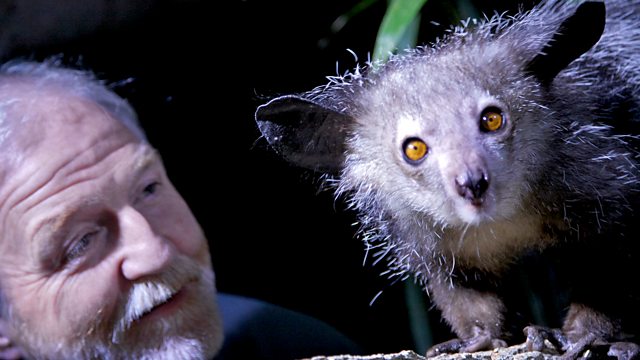
This is about the strangest animal I've ever seen. | 0:36:34 | 0:36:37 | |
If you didn't know what it was and had to describe it, | 0:36:37 | 0:36:40 | |
you'd say it had the ears of a bat, the teeth of a rodent, | 0:36:40 | 0:36:43 | |
the hands of an alien. | 0:36:43 | 0:36:46 | |
It's got a bushy, squirrel-like tail, and yet it's in the same group | 0:36:46 | 0:36:50 | |
of animals as you and I, it's almost hard to believe. | 0:36:50 | 0:36:53 | |
This almost mythical creature is from Madagascar. | 0:36:55 | 0:36:59 | |
MAKES SHORT LIP-SMACKING SOUNDS | 0:36:59 | 0:37:01 | |
She's an aye-aye called Ardrey. | 0:37:01 | 0:37:03 | |
That is so cute. | 0:37:05 | 0:37:07 | |
I hate to use the word cute, but they are cute. | 0:37:08 | 0:37:11 | |
I think I'm in love with this animal. | 0:37:14 | 0:37:16 | |
Aye-ayes spend the night hunting for grubs that live | 0:37:22 | 0:37:25 | |
deep inside decaying branches. | 0:37:25 | 0:37:27 | |
To work out where the grubs are hidden, | 0:37:32 | 0:37:34 | |
they use that strange looking hand. | 0:37:34 | 0:37:37 | |
Tapping the wood at up to 10 times a second. | 0:37:39 | 0:37:43 | |
There she goes, she's tapping now. | 0:37:43 | 0:37:45 | |
I can hear it. | 0:37:49 | 0:37:50 | |
That's the most specialised primate hand in the whole world. | 0:37:54 | 0:37:58 | |
Like sonar, the sound penetrates the depths of the branch, | 0:38:00 | 0:38:04 | |
and a coded message is echoed back to those super-sensitive ears. | 0:38:04 | 0:38:09 | |
When she finds a hollow spot, she starts to dig. | 0:38:12 | 0:38:17 | |
These incredibly sharp front teeth, the incisors, which unusually | 0:38:17 | 0:38:21 | |
for primates continue to grow, | 0:38:21 | 0:38:23 | |
and they rip the wood apart to get access to the cavity | 0:38:23 | 0:38:27 | |
which might contain an insect larvae. | 0:38:27 | 0:38:30 | |
The hearing is very acute so they can hear the larva inside. | 0:38:30 | 0:38:35 | |
But it's her probe-like middle finger that has | 0:38:42 | 0:38:45 | |
to find the grub. | 0:38:45 | 0:38:46 | |
And the latest science is now revealing just how incredible | 0:38:48 | 0:38:52 | |
this unique digit is. | 0:38:52 | 0:38:54 | |
AYE-AYE SNUFFLES | 0:38:59 | 0:39:01 | |
This camera is so sensitive, it picks up | 0:39:01 | 0:39:04 | |
on tiny changes in temperature, like the breath on my moustache. | 0:39:04 | 0:39:08 | |
And it highlights something rather unexpected. | 0:39:16 | 0:39:19 | |
Unlike her other fingers, Ardrey's feeding finger is stone cold. | 0:39:20 | 0:39:25 | |
It has virtually no blood flow to it at all. | 0:39:26 | 0:39:30 | |
But as she starts foraging, | 0:39:41 | 0:39:43 | |
blood rushes to thousands of nerve endings in her fingertip, | 0:39:43 | 0:39:47 | |
making it incredibly sensitive. | 0:39:47 | 0:39:49 | |
And in a specially constructed log, | 0:39:55 | 0:39:57 | |
we can get a look at that ET-like finger at work. | 0:39:57 | 0:40:01 | |
A unique knuckle, much like our shoulder joint, | 0:40:04 | 0:40:07 | |
means her finger can move in any direction. | 0:40:07 | 0:40:11 | |
And it's now so sensitive that like a blind person reads brail, | 0:40:12 | 0:40:17 | |
she can detect the slightest movement. | 0:40:17 | 0:40:20 | |
That is one of the most remarkable tools in the whole animal kingdom | 0:40:30 | 0:40:34 | |
and it allows the aye-aye to carve out a niche | 0:40:34 | 0:40:37 | |
so specific that in terms of finding food, it's in a league of its own. | 0:40:37 | 0:40:42 | |
The aye-aye is the ultimate specialist. | 0:40:49 | 0:40:51 | |
But when it comes to finding food, the world is | 0:40:57 | 0:41:00 | |
full of possibilities. | 0:41:00 | 0:41:01 | |
You just need to spot an opportunity... | 0:41:07 | 0:41:09 | |
..and make the most of it. | 0:41:13 | 0:41:14 | |
Primate ingenuity means there are no | 0:41:20 | 0:41:23 | |
bounds to their gastronomic ambition. | 0:41:23 | 0:41:25 | |
For olive baboons, | 0:41:35 | 0:41:37 | |
the savannahs around Lake Bogoria in Kenya are a land of plenty. | 0:41:37 | 0:41:42 | |
Insect grubs hidden in flamingo dung provide a welcome protein boost. | 0:41:53 | 0:41:59 | |
Some, however, are far more ambitious. | 0:42:04 | 0:42:07 | |
Timing is everything. | 0:42:22 | 0:42:24 | |
Once one baboon has worked it out, the whole troop soon catches on. | 0:42:52 | 0:42:57 | |
Hunting live prey requires ambition... | 0:43:20 | 0:43:23 | |
..speed... | 0:43:25 | 0:43:26 | |
..and coordination. | 0:43:28 | 0:43:29 | |
For a hungry primate, meat is the ultimate food of all. | 0:43:49 | 0:43:53 | |
Primate diversity is shaped by home and diet. | 0:44:04 | 0:44:07 | |
And, I think, by one more thing. | 0:44:10 | 0:44:12 | |
They're social animals, they live in families, | 0:44:17 | 0:44:20 | |
and as we all know, good communication skills | 0:44:20 | 0:44:23 | |
are essential for a harmonious family life. | 0:44:23 | 0:44:26 | |
And this need to communicate has also | 0:44:31 | 0:44:33 | |
influenced how they look and behave. | 0:44:33 | 0:44:36 | |
It's hard to believe that these chilled out monkeys | 0:44:43 | 0:44:47 | |
are the loudest on the planet. | 0:44:47 | 0:44:49 | |
But there is one way to spur them into action. | 0:44:53 | 0:44:55 | |
Right, the whole monkey troop is right here in this tree. | 0:45:07 | 0:45:10 | |
There's females, there's young ones, | 0:45:10 | 0:45:12 | |
but the one I want you to watch is the alpha male right here. | 0:45:12 | 0:45:15 | |
Watch what happens. | 0:45:15 | 0:45:17 | |
HE MAKES MONKEY NOISES | 0:45:18 | 0:45:20 | |
MONKEY ROARS | 0:45:28 | 0:45:31 | |
ROARING CONTINUES | 0:45:35 | 0:45:38 | |
That is very impressive. | 0:45:39 | 0:45:41 | |
That monkey can produce 90 decibels, which is enough to... | 0:45:41 | 0:45:45 | |
MONKEY ROARS | 0:45:45 | 0:45:47 | |
..well, drown me out. | 0:45:47 | 0:45:48 | |
MONKEY ROARS | 0:45:51 | 0:45:54 | |
The howler monkey's roar is a call to arms. | 0:46:00 | 0:46:04 | |
MONKEY ROARS | 0:46:04 | 0:46:06 | |
A reply to my rather poor impersonation of a rival. | 0:46:09 | 0:46:12 | |
MONKEY ROARS | 0:46:16 | 0:46:18 | |
The male's calls soon sets off the entire troop. | 0:46:20 | 0:46:23 | |
MONKEYS ROAR | 0:46:23 | 0:46:26 | |
The clever thing is that by calling together, | 0:46:27 | 0:46:30 | |
they make their group seem much bigger than it actually is | 0:46:30 | 0:46:34 | |
and the bigger the call, the louder the noise, | 0:46:34 | 0:46:38 | |
the more terrifying it is. | 0:46:38 | 0:46:40 | |
The secret to the sheer volume of a howler's roar | 0:46:41 | 0:46:44 | |
is in the design of its unusual throat. | 0:46:44 | 0:46:47 | |
When a howler monkey calls, | 0:46:48 | 0:46:50 | |
it flares out its lips like a natural loud-hailer | 0:46:50 | 0:46:53 | |
and it drops its jaw. | 0:46:53 | 0:46:55 | |
The throat contains an enormous hollow bone that reverberates | 0:46:55 | 0:47:00 | |
like a gong, giving the voice an amazing amount of extra clout. | 0:47:00 | 0:47:04 | |
MONKEYS ROAR | 0:47:04 | 0:47:07 | |
All this noise sends a message to neighbouring troops - | 0:47:10 | 0:47:13 | |
keep off our patch or there'll be trouble. | 0:47:13 | 0:47:15 | |
MONKEYS ROAR | 0:47:17 | 0:47:19 | |
The pitch of their voice is as important as the volume. | 0:47:26 | 0:47:29 | |
Higher frequencies are easily scattered, | 0:47:33 | 0:47:35 | |
but low roars punch through the forest for up to a mile. | 0:47:35 | 0:47:39 | |
ECHOING ROARS SPREAD | 0:47:42 | 0:47:44 | |
It's this mosaic of sound that sets clear-cut home ranges | 0:47:49 | 0:47:53 | |
across the entire forest. | 0:47:53 | 0:47:55 | |
Shouting at your neighbours may seem like a waste of energy, | 0:48:01 | 0:48:05 | |
but by howling every day, | 0:48:05 | 0:48:06 | |
families can avoid coming into | 0:48:06 | 0:48:08 | |
contact with each other, and when they do, disagreements are easily | 0:48:08 | 0:48:12 | |
settled at arm's length, and that is a great way to keep the peace. | 0:48:12 | 0:48:18 | |
While a howler monkey's world is shaped by sound, | 0:48:26 | 0:48:29 | |
other primates communicate in a much more visual way. | 0:48:29 | 0:48:33 | |
Mandrills live in the dark and impenetrable | 0:48:49 | 0:48:52 | |
forests of Gabon in West Africa. | 0:48:52 | 0:48:55 | |
And here, vision plays a key role in finding a mate. | 0:48:58 | 0:49:02 | |
It's thought that female mandrills spend | 0:49:14 | 0:49:17 | |
most of the year in large all-girl groups. | 0:49:17 | 0:49:20 | |
But in the breeding season, their peace is shattered. | 0:49:25 | 0:49:28 | |
Male mandrills are a very different animal. | 0:49:40 | 0:49:43 | |
These huge beasts dwarf the females, three times their size. | 0:49:54 | 0:50:00 | |
They're the largest monkeys on the planet, and the most colourful. | 0:50:07 | 0:50:11 | |
Those vibrant hues are a display of strength and power. | 0:50:16 | 0:50:21 | |
The big brutes pitch up to fight for the girls. | 0:50:42 | 0:50:45 | |
When two males catch each other's eye, it's a standoff. | 0:50:59 | 0:51:04 | |
MONKEYS CHATTER | 0:51:04 | 0:51:07 | |
An actual fight is a high-risk strategy - | 0:51:21 | 0:51:24 | |
it could mean injury or death. | 0:51:24 | 0:51:26 | |
Every single muscle twitch has a meaning. | 0:51:35 | 0:51:38 | |
It's all over. | 0:51:53 | 0:51:54 | |
A grimace is a sign of submission. | 0:51:54 | 0:51:57 | |
The battle has been avoided. | 0:52:01 | 0:52:04 | |
And the loser lives to fight another day. | 0:52:07 | 0:52:10 | |
The victor is one step closer to becoming king. | 0:52:15 | 0:52:18 | |
And after a bout like this, | 0:52:21 | 0:52:22 | |
a surge in testosterone will make a male's colours even more vivid. | 0:52:22 | 0:52:27 | |
After weeks of posturing, | 0:52:45 | 0:52:46 | |
the healthiest male becomes the most colourful. | 0:52:46 | 0:52:50 | |
And the object of all the females' desire. | 0:52:53 | 0:52:57 | |
The single most colourful male will mate with over three | 0:53:01 | 0:53:04 | |
quarters of the group. | 0:53:04 | 0:53:05 | |
He'll have their undivided attention for at least a couple of months. | 0:53:11 | 0:53:15 | |
Proof if ever you need it that in the mandrill mating game, | 0:53:21 | 0:53:26 | |
looks really matter. | 0:53:26 | 0:53:28 | |
The challenges of where we live, what we eat and | 0:53:41 | 0:53:47 | |
how we live together have shaped our incredible animal family. | 0:53:47 | 0:53:52 | |
But the world is changing. | 0:53:59 | 0:54:00 | |
In the 21st century, the ultimate challenge | 0:54:07 | 0:54:10 | |
to any monkey is living alongside the most | 0:54:10 | 0:54:13 | |
successful primate of all... | 0:54:13 | 0:54:15 | |
..humans. | 0:54:17 | 0:54:18 | |
But even the urban jungle is a land of opportunity | 0:54:24 | 0:54:27 | |
for those who are smart enough to exploit it. | 0:54:27 | 0:54:30 | |
For the resident rhesus macaques, a market-side pitch like this is what | 0:54:48 | 0:54:53 | |
life's all about. | 0:54:53 | 0:54:55 | |
They may not be the prettiest, or look the most remarkable, | 0:55:09 | 0:55:13 | |
but macaques are the most successful monkeys on the planet. | 0:55:13 | 0:55:17 | |
They're adaptable, devious and they work together as a team. | 0:55:23 | 0:55:28 | |
In their search for food, hungry macaques have swapped jungle vines | 0:55:36 | 0:55:40 | |
for power lines. | 0:55:40 | 0:55:42 | |
Gangs leave a trail of destruction in their wake. | 0:55:55 | 0:55:58 | |
They're smart enough to spot the tiniest of opportunities. | 0:56:10 | 0:56:13 | |
First up, the brave ones scope out the joint. | 0:56:30 | 0:56:33 | |
Lookouts are posted to watch for trouble... | 0:56:43 | 0:56:46 | |
and once the coast is clear, it's a free-for-all. | 0:56:47 | 0:56:50 | |
These opportunistic criminals | 0:57:02 | 0:57:04 | |
ransack a house in a matter of minutes. | 0:57:04 | 0:57:06 | |
And at the slightest hint of trouble... | 0:57:14 | 0:57:16 | |
..they make their escape. | 0:57:18 | 0:57:19 | |
Thanks to their agile bodies, and adaptable minds, | 0:57:31 | 0:57:35 | |
macaques can beat us humans at our own game. | 0:57:35 | 0:57:38 | |
To these incredible monkeys, | 0:57:44 | 0:57:45 | |
the urban jungle is just one big playground. | 0:57:45 | 0:57:48 | |
We primates are truly remarkable. | 0:57:54 | 0:57:56 | |
Not only are we physically adaptable, | 0:57:56 | 0:57:58 | |
we're also smart and can work as a team. | 0:57:58 | 0:58:02 | |
And that's a winning combination that allows us to survive, | 0:58:02 | 0:58:06 | |
even thrive in an ever-changing world. | 0:58:06 | 0:58:09 | |
Join me next time when we delve | 0:58:13 | 0:58:15 | |
into the sociable world of the primate family. | 0:58:15 | 0:58:18 | |
And it's not as harmonious as you might think. | 0:58:23 | 0:58:25 | |
You need to make friends. | 0:58:27 | 0:58:29 | |
Avoid your enemies. | 0:58:31 | 0:58:33 | |
Look at that! | 0:58:33 | 0:58:35 | |
And find your place on the social ladder. | 0:58:35 | 0:58:37 |