Reproduction Dara O Briain's Science Club
Similar Content
Browse content similar to Reproduction. Check below for episodes and series from the same categories and more!
Transcript
| Line | From | To | |
|---|---|---|---|
DNA, sexual attraction, inheritance. Bicycles. Polish vodka. | 0:00:02 | 0:00:05 | |
Tonight, we talk about how we make new life. Tonight we talk about | 0:00:05 | 0:00:08 | |
how YOU were made. | 0:00:08 | 0:00:09 | |
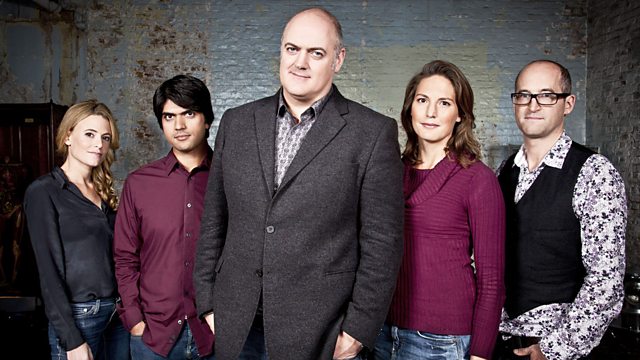
My name is Dara O Briain. Welcome to Science Club. | 0:00:09 | 0:00:12 | |
CHEERING AND APPLAUSE | 0:00:12 | 0:00:13 | |
CHEERING AND APPLAUSE | 0:00:33 | 0:00:35 | |
Welcome and good evening. | 0:00:35 | 0:00:37 | |
In our audience, curious people are here. Some fine minds. | 0:00:37 | 0:00:39 | |
Professor Steve Jones, thank you for joining us. | 0:00:39 | 0:00:43 | |
We'll discuss genetics later. | 0:00:43 | 0:00:44 | |
We'll have reports from Alok Jha and Tali Sharot. Ed Byrne will join us. | 0:00:44 | 0:00:49 | |
-You've got something for us? -I'll toss something into your gene pool. | 0:00:49 | 0:00:52 | |
Lovely. Very appetising. | 0:00:52 | 0:00:55 | |
We'll do an experiment with Mark Miodownik | 0:00:55 | 0:00:57 | |
that you can repeat at home. | 0:00:57 | 0:00:59 | |
But so to sex. As a method of passing on our DNA, | 0:00:59 | 0:01:02 | |
it is more fun than spitting into a cup. | 0:01:02 | 0:01:05 | |
Once that moment has passed, is it the best way to move | 0:01:05 | 0:01:08 | |
this species along? | 0:01:08 | 0:01:09 | |
We put sex and inheritance under the microscope. | 0:01:09 | 0:01:13 | |
Here at my new science club, we'll probe the topic | 0:01:13 | 0:01:17 | |
in all sorts of different ways | 0:01:17 | 0:01:19 | |
while neuro-scientist Tali Sharot asks can we pass on traits | 0:01:19 | 0:01:23 | |
that aren't in our genes? | 0:01:23 | 0:01:25 | |
This is a new frontier of medicine. | 0:01:25 | 0:01:27 | |
Science journalist Alok Jha questions if the Genome Project | 0:01:27 | 0:01:30 | |
was all it was cracked up to be. | 0:01:30 | 0:01:33 | |
We did not overstate the case. We said this would be key to medicine. | 0:01:33 | 0:01:37 | |
That's absolutely right. | 0:01:37 | 0:01:39 | |
Comedian Ed Byrne gets to grips with his Neanderthal family history. | 0:01:39 | 0:01:42 | |
I don't mean to disrespect her but would our breeding with Neanderthal | 0:01:43 | 0:01:48 | |
have coincided at all with the invention of alcohol? | 0:01:48 | 0:01:51 | |
Professor Mark Miodownik takes the technological view | 0:01:52 | 0:01:54 | |
by pulling a bike apart and showing how they've influenced | 0:01:54 | 0:01:59 | |
our sexual selection. | 0:01:59 | 0:02:00 | |
All this and more in this week's Science Club. | 0:02:00 | 0:02:03 | |
APPLAUSE | 0:02:03 | 0:02:06 | |
While you're watching, you can get facts and doodles by following... | 0:02:06 | 0:02:11 | |
or going to our website. | 0:02:11 | 0:02:13 | |
When it comes to passing on genes from one generation to the next, | 0:02:13 | 0:02:16 | |
it's only been the last 100 years | 0:02:16 | 0:02:18 | |
that we've understood what goes on. | 0:02:18 | 0:02:20 | |
One of life's great mysteries and this is what we used to think. | 0:02:20 | 0:02:23 | |
The story of inheritance begins, like many things, | 0:02:25 | 0:02:28 | |
with the ancient Greeks. | 0:02:28 | 0:02:30 | |
Aristotle, fresh from inventing logic itself, | 0:02:30 | 0:02:34 | |
noted that children often looked like their parents. | 0:02:34 | 0:02:36 | |
Aristotle decided that the man determined the form of the child, | 0:02:36 | 0:02:40 | |
whilst the woman provided the material. | 0:02:40 | 0:02:43 | |
He planted the seed, she provided the soil that fed it. | 0:02:43 | 0:02:47 | |
For hundreds of years, this was as far as people got. | 0:02:47 | 0:02:51 | |
The first clues to what goes on inside women, | 0:02:51 | 0:02:54 | |
came in the 1600s. | 0:02:54 | 0:02:56 | |
Two Dutch medics announced that women produced eggs, like birds. | 0:02:56 | 0:03:00 | |
A few years later, another Dutchman, a fabric merchant, | 0:03:02 | 0:03:06 | |
made a startling discovery by examining | 0:03:06 | 0:03:08 | |
the contents of his trousers with a primitive microscope. | 0:03:08 | 0:03:12 | |
Semen seemed to be full of tiny creatures | 0:03:12 | 0:03:15 | |
that thrashed around like a snake. | 0:03:15 | 0:03:16 | |
He had discovered sperm. | 0:03:16 | 0:03:19 | |
Most people thought babies must start off as perfect miniatures, | 0:03:20 | 0:03:24 | |
inside either egg or sperm. | 0:03:24 | 0:03:26 | |
But no-one knew which. | 0:03:26 | 0:03:29 | |
By the 1800s, the inheritance question | 0:03:29 | 0:03:32 | |
took another leap forward, thanks to some farmers. | 0:03:32 | 0:03:36 | |
Men like Robert Bakewell were a new breed, | 0:03:36 | 0:03:39 | |
who saw sheep as machines, | 0:03:39 | 0:03:40 | |
for turning grass into money. | 0:03:40 | 0:03:43 | |
He bred his best males with his best females. | 0:03:43 | 0:03:46 | |
The resulting super sheep suggested offspring were a mixture | 0:03:46 | 0:03:51 | |
of their parents. | 0:03:51 | 0:03:52 | |
Naturally, it wasn't quite that simple. | 0:03:52 | 0:03:55 | |
In Austria, a monk called Gregor Mendel, | 0:03:58 | 0:04:00 | |
had spent years breeding pea plants - | 0:04:00 | 0:04:03 | |
tall with short, yellow with green. | 0:04:03 | 0:04:06 | |
His results suggested that instead of a simple blend, | 0:04:06 | 0:04:09 | |
each offspring received one element for height or colour | 0:04:09 | 0:04:14 | |
from each of its parents but that one could override the other. | 0:04:14 | 0:04:18 | |
By 1909, Mendel's elements had been renamed genes. | 0:04:18 | 0:04:24 | |
A year later, whilst breeding flies, | 0:04:24 | 0:04:26 | |
Thomas Morgan showed these genes lived on tiny structures | 0:04:26 | 0:04:31 | |
inside the cell - the chromosomes. | 0:04:31 | 0:04:34 | |
The science of genetics has been born. | 0:04:34 | 0:04:37 | |
Scientists delved deeper until Watson and Crick finally revealed | 0:04:38 | 0:04:41 | |
the double helix of DNA. | 0:04:41 | 0:04:43 | |
So how does inheritance work? | 0:04:43 | 0:04:46 | |
Put simply, we receive half our dad's chromosomes | 0:04:46 | 0:04:49 | |
from the sperm and half of our mum's from the egg. | 0:04:49 | 0:04:53 | |
On these chromosomes are genes, pieces of DNA containing | 0:04:53 | 0:04:57 | |
the instructions to make our bodies. | 0:04:57 | 0:04:58 | |
They are the basic units of inheritance | 0:04:58 | 0:05:01 | |
and affect whether we, our children and our children's children | 0:05:01 | 0:05:04 | |
end up short, tall, blue-eyed, curly-haired or bald. | 0:05:04 | 0:05:09 | |
APPLAUSE | 0:05:10 | 0:05:12 | |
Those are the basics. To explain more, | 0:05:14 | 0:05:16 | |
let me welcome our guest tonight. | 0:05:16 | 0:05:18 | |
A genetics expert, a broadcaster and a man who's furthered our knowledge | 0:05:18 | 0:05:23 | |
of natural selection. | 0:05:23 | 0:05:25 | |
He is Emeritus Professor of Genetics at University of London | 0:05:25 | 0:05:27 | |
and one of the world's greatest experts in the love life of snails. | 0:05:27 | 0:05:31 | |
Professor Steve Jones. | 0:05:31 | 0:05:32 | |
CHEERING AND APPLAUSE | 0:05:32 | 0:05:34 | |
It's difficult to know where to start on a subject | 0:05:40 | 0:05:43 | |
as massive as this. | 0:05:43 | 0:05:44 | |
We said it would be about sex. Does sex work? | 0:05:44 | 0:05:47 | |
Is it efficient? Is it the best we could have done? | 0:05:47 | 0:05:50 | |
It's messy but it works. | 0:05:50 | 0:05:52 | |
I start my genetics course by saying, | 0:05:52 | 0:05:55 | |
"I'm a geneticist | 0:05:55 | 0:05:56 | |
"and my job is to make sex boring." | 0:05:56 | 0:05:59 | |
It's an inefficient mechanism because what it means is | 0:05:59 | 0:06:03 | |
that women waste their time copying someone else's genes. | 0:06:03 | 0:06:07 | |
Why they should do that is the biggest mystery in biology. | 0:06:07 | 0:06:10 | |
Why do women allow men to get away with it? | 0:06:10 | 0:06:13 | |
I've no idea. | 0:06:13 | 0:06:15 | |
It's a mystery. | 0:06:15 | 0:06:17 | |
Because we're so charming! | 0:06:17 | 0:06:18 | |
Is it almost over-engineered? | 0:06:18 | 0:06:21 | |
The competition for attention, all these mechanisms | 0:06:21 | 0:06:25 | |
that have come around sex? | 0:06:25 | 0:06:26 | |
If life had been designed, if there had been a creator, | 0:06:26 | 0:06:29 | |
we wouldn't have sex. | 0:06:29 | 0:06:30 | |
Anybody who designed that wouldn't deserve a job. | 0:06:30 | 0:06:33 | |
People who like creators dislike sex anyway. | 0:06:33 | 0:06:35 | |
There was a scientist called Lazzaro Spallanzani, | 0:06:38 | 0:06:42 | |
are you familiar with his work? | 0:06:42 | 0:06:44 | |
He was one of the first ones who said sperm was important, | 0:06:44 | 0:06:48 | |
in a series of exciting experiments | 0:06:48 | 0:06:50 | |
in which in order to remove the sperm from the equation. | 0:06:50 | 0:06:53 | |
While frogs mated, he created, | 0:06:53 | 0:06:56 | |
from male frogs, tight-fitting trousers | 0:06:56 | 0:06:59 | |
that he stretched around their legs | 0:06:59 | 0:07:01 | |
so that the sperm would not escape and let them mate, | 0:07:01 | 0:07:04 | |
-let them rub off each other but not mate. -That's right. | 0:07:04 | 0:07:06 | |
That was a proper experiment with a hypothesis of theory | 0:07:06 | 0:07:11 | |
that this stuff called sperm, which nobody knew what it did. | 0:07:11 | 0:07:14 | |
Many people thought it was the only thing that mattered. | 0:07:14 | 0:07:17 | |
They thought that the female was just an incubator, | 0:07:17 | 0:07:20 | |
in which the baby grew up. | 0:07:20 | 0:07:22 | |
All the information came from the sperm. | 0:07:22 | 0:07:24 | |
That was a proper, clean experiment. | 0:07:24 | 0:07:26 | |
Hurrah for Spallanzani, in spite of the trousers. | 0:07:26 | 0:07:28 | |
Let me ask you about the ways we've dispersed - | 0:07:28 | 0:07:31 | |
as we have moved, we have mixed our genes more, | 0:07:31 | 0:07:36 | |
even on a town-to-town basis. | 0:07:36 | 0:07:38 | |
You have a theory about bicycles. | 0:07:38 | 0:07:39 | |
I once said - and it's haunted me ever since - | 0:07:39 | 0:07:41 | |
the most important event in human evolution | 0:07:41 | 0:07:44 | |
was the invention of the bicycle. | 0:07:44 | 0:07:46 | |
There is some reason behind that. | 0:07:46 | 0:07:50 | |
What the bicycle did, you no longer had to have | 0:07:50 | 0:07:53 | |
sex with the boy or girl next door because you had no choice, | 0:07:53 | 0:07:57 | |
you were in a little village, you couldn't move. | 0:07:57 | 0:08:00 | |
You could get on your bicycle and have sex with | 0:08:00 | 0:08:02 | |
the boy or girl in the next village. | 0:08:02 | 0:08:04 | |
Now, you can get on your 747 and have sex with the boy or girl | 0:08:04 | 0:08:08 | |
in the next continent. | 0:08:08 | 0:08:09 | |
What that's done, it's turned, very rapidly | 0:08:09 | 0:08:11 | |
turning the human race into a kind of soup. | 0:08:11 | 0:08:15 | |
We're rapidly becoming much less different from each other | 0:08:15 | 0:08:18 | |
across the world than we were even 100 years ago. | 0:08:18 | 0:08:21 | |
Arguably, that's the most important event in the last 100,000 years | 0:08:21 | 0:08:25 | |
of human evolution. | 0:08:25 | 0:08:27 | |
We knew about Steve's bicycle theory. | 0:08:27 | 0:08:29 | |
When we realised the bicycle played such a pivotal role in history, | 0:08:29 | 0:08:33 | |
we thought sod the genetics, | 0:08:33 | 0:08:34 | |
let's understand why it's such a brilliant invention. | 0:08:34 | 0:08:36 | |
Here's Mark Miodownik. | 0:08:36 | 0:08:38 | |
You may think the bike is a relic of the past. | 0:08:44 | 0:08:46 | |
But it's one of the most beautiful pieces of machinery we've created. | 0:08:46 | 0:08:50 | |
It shaped society in surprising ways. | 0:08:50 | 0:08:52 | |
That's because it's affordable and extremely efficient. | 0:08:52 | 0:08:57 | |
It had a huge impact because for the first time, | 0:08:59 | 0:09:03 | |
it facilitated travel for the masses. | 0:09:03 | 0:09:05 | |
Unlike horses and trains, | 0:09:05 | 0:09:08 | |
it didn't need feeding or stabling. | 0:09:08 | 0:09:09 | |
You didn't need to buy a ticket or run to a timetable. | 0:09:11 | 0:09:13 | |
It's simple and incredibly efficient. | 0:09:16 | 0:09:18 | |
That's down to how the wheels, pedals and chain | 0:09:20 | 0:09:22 | |
all combine together. | 0:09:22 | 0:09:24 | |
Two key features are responsible for the bike's efficiency - | 0:09:26 | 0:09:29 | |
the chain drive and the wheels. | 0:09:29 | 0:09:32 | |
Although the wheel is one of humankind's best inventions, | 0:09:34 | 0:09:38 | |
early versions were a bit clunky. | 0:09:38 | 0:09:40 | |
The stone wheels much too heavy. | 0:09:40 | 0:09:42 | |
The wooden wheel much too unreliable. | 0:09:42 | 0:09:44 | |
But this, the bicycle wheel, | 0:09:44 | 0:09:47 | |
this is one of our best yet. | 0:09:47 | 0:09:51 | |
Elegant, light and extremely strong. | 0:09:51 | 0:09:54 | |
Original spokes are thick because they work under compression. | 0:09:55 | 0:09:59 | |
Bicycle spokes are too thin for that | 0:09:59 | 0:10:01 | |
and can easily buckle. | 0:10:01 | 0:10:02 | |
Instead, they have been engineered to work under tension. | 0:10:02 | 0:10:06 | |
Although none of the spokes are capable of holding | 0:10:06 | 0:10:08 | |
your weight individually, they are quite weak. | 0:10:08 | 0:10:11 | |
Because there are lots of spokes, | 0:10:11 | 0:10:12 | |
they are held in tension so this suspends the axle | 0:10:12 | 0:10:17 | |
in all directions so they are all taking their turn | 0:10:17 | 0:10:21 | |
to hold a bit of you up in the air. | 0:10:21 | 0:10:23 | |
This continues as the wheel rotates. | 0:10:23 | 0:10:26 | |
The lightweight spoked wheel transformed the bike | 0:10:26 | 0:10:30 | |
from a mere curiosity into a viable means of transport. | 0:10:30 | 0:10:36 | |
For wheels to move, they need power | 0:10:36 | 0:10:37 | |
and that's where the pedals come in. | 0:10:37 | 0:10:40 | |
Early bicycles like this penny-farthing | 0:10:40 | 0:10:42 | |
had the pedals attached to the hub. | 0:10:42 | 0:10:44 | |
This meant that larger wheels were a primitive form of gearing | 0:10:44 | 0:10:48 | |
because the larger the wheel, the further you went | 0:10:48 | 0:10:51 | |
for one turn of the pedals. | 0:10:51 | 0:10:53 | |
This had the downside that you were further from the ground, | 0:10:53 | 0:10:56 | |
which was precarious at best | 0:10:56 | 0:10:57 | |
but mostly downright dangerous. | 0:10:57 | 0:11:00 | |
The ordinary bicycle, as it was then known, | 0:11:00 | 0:11:03 | |
was pretty much for men only. | 0:11:03 | 0:11:05 | |
But one simple addition made bikes suitable for everybody to ride. | 0:11:05 | 0:11:09 | |
This is the ladies' safety bike. | 0:11:09 | 0:11:12 | |
It's over 100 years old. | 0:11:12 | 0:11:14 | |
It's characteristic feature is a chain, hidden beneath this guard. | 0:11:14 | 0:11:18 | |
It's the safety bike that allowed everyone - men and women - | 0:11:18 | 0:11:22 | |
to move more freely and further than ever before. | 0:11:22 | 0:11:25 | |
It's popularity was linked to falling church attendances, | 0:11:25 | 0:11:29 | |
to the decline of piano playing | 0:11:29 | 0:11:31 | |
and new courting standards amongst the young. | 0:11:31 | 0:11:34 | |
It was a sexual revolution, | 0:11:34 | 0:11:36 | |
albeit one aided by a piece of engineering. | 0:11:36 | 0:11:39 | |
The introduction of the chain drive | 0:11:43 | 0:11:45 | |
Created a different sort of gearing from the penny farthing | 0:11:45 | 0:11:48 | |
so now, one turn of the pedals | 0:11:48 | 0:11:51 | |
can turn the back wheel many times, | 0:11:51 | 0:11:53 | |
allowing you to go further for the same effort | 0:11:53 | 0:11:55 | |
and that meant you could have two wheels of the same size | 0:11:55 | 0:11:58 | |
and that made it much more comfortable, | 0:11:58 | 0:12:00 | |
much safer and more efficient | 0:12:00 | 0:12:02 | |
but they had one further trick up their sleeve - | 0:12:02 | 0:12:06 | |
the freewheel. | 0:12:06 | 0:12:07 | |
So you could stop peddling altogether and still get there. Genius. | 0:12:07 | 0:12:12 | |
APPLAUSE | 0:12:12 | 0:12:15 | |
Mark, thank you very much. | 0:12:15 | 0:12:17 | |
It's a bit of a miracle that we can even ride bikes, isn't it? | 0:12:17 | 0:12:20 | |
Well, I think the miracle is that we created this machine | 0:12:20 | 0:12:24 | |
that's stabilised and can ride itself. | 0:12:24 | 0:12:27 | |
You can actually throw a bike in a direction without a rider | 0:12:27 | 0:12:31 | |
and it will self-balance for 100 yards, and it's extraordinary. | 0:12:31 | 0:12:34 | |
We didn't realise, and we still don't really understand why that is. | 0:12:34 | 0:12:37 | |
With regard to your theory, by the way, | 0:12:37 | 0:12:39 | |
that these opened up genetic diversity, | 0:12:39 | 0:12:42 | |
why is genetic diversity important? | 0:12:42 | 0:12:44 | |
Well, genetic diversity is the raw material of evolution. | 0:12:44 | 0:12:47 | |
If there was no genetic diversity, we'd all still be... | 0:12:47 | 0:12:49 | |
We would all still BE the primeval slime. | 0:12:49 | 0:12:51 | |
Evolution is inherited differences in the ability to reproduce. | 0:12:51 | 0:12:56 | |
That's natural selection and the word is differences. | 0:12:56 | 0:12:59 | |
Without differences, you can't have genetics or evolution. | 0:12:59 | 0:13:02 | |
OK, so the last 150 years of mass migrations | 0:13:02 | 0:13:05 | |
will have had a huge effect in terms of...an evolutionary effect? | 0:13:05 | 0:13:09 | |
Sure. If you walk through the streets of London today, | 0:13:09 | 0:13:12 | |
you will see a genetically different population | 0:13:12 | 0:13:14 | |
from what you would have seen a century ago, | 0:13:14 | 0:13:16 | |
even when I was a kid, almost a century ago. | 0:13:16 | 0:13:18 | |
One of the ways you can see the effect of this moving business, | 0:13:18 | 0:13:22 | |
and maybe everybody in this room can ask themselves the question - | 0:13:22 | 0:13:25 | |
how far apart... And everybody watching the show. | 0:13:25 | 0:13:27 | |
How far apart were you born from your partner, if you have one, | 0:13:27 | 0:13:31 | |
compared to how far apart your mother and father were born, | 0:13:31 | 0:13:33 | |
compared to how far apart your mother's mother | 0:13:33 | 0:13:35 | |
and your mother's father was born, and so on. | 0:13:35 | 0:13:38 | |
What you'll find generally speaking, that figure, the marital distance, | 0:13:38 | 0:13:41 | |
get enormously bigger over the last three or four generations. | 0:13:41 | 0:13:44 | |
-Miodownik, by the way, not a London name. -No. | 0:13:44 | 0:13:46 | |
-How many generations back? -Polish to two generations. | 0:13:46 | 0:13:49 | |
As a matter of interest, just because | 0:13:49 | 0:13:51 | |
we have a spread of predominantly young London people here, | 0:13:51 | 0:13:54 | |
who would win that prize, by the way, | 0:13:54 | 0:13:56 | |
in terms of how far apart their parents were from? | 0:13:56 | 0:13:59 | |
What's the most racially diverse, ethnically... Yourself at the back? | 0:13:59 | 0:14:03 | |
Mongolia and Ireland. | 0:14:03 | 0:14:05 | |
How did they meet? | 0:14:05 | 0:14:08 | |
What weird social gathering...? Where did they meet? Here? | 0:14:08 | 0:14:11 | |
In Mongolia. | 0:14:11 | 0:14:12 | |
At the airport, actually. | 0:14:12 | 0:14:15 | |
-They met at the airport? -Yeah. | 0:14:15 | 0:14:16 | |
-No, they were both working at the airport. -Oh, right, | 0:14:16 | 0:14:19 | |
it just seemed like your dad from Ireland just swept into Mongolia... | 0:14:19 | 0:14:23 | |
-No, no! -But that's what? 8,000 miles of a difference, | 0:14:23 | 0:14:26 | |
Mongolian and Irish, any rarer? Yourself there at the back? | 0:14:26 | 0:14:29 | |
Yep, so Austrian, Lebanese and a little bit of Spanish. | 0:14:29 | 0:14:32 | |
Austria, Lebanon and a bit of Spain? | 0:14:32 | 0:14:35 | |
It's the bit of Spain I'm intrigued by. Why was that guy there? | 0:14:35 | 0:14:40 | |
Was he just a guy on a guitar at the night in question? OK, fantastic. | 0:14:40 | 0:14:44 | |
Any more diverse than that? And yourself there? | 0:14:44 | 0:14:47 | |
UK and Vietnam. | 0:14:47 | 0:14:49 | |
UK and Vietnam, OK, grand. So this has become more and more the case, | 0:14:49 | 0:14:52 | |
so genetically, when we're talking about, at the very fundamentals, | 0:14:52 | 0:14:56 | |
you take genes that have come from very, very far apart, | 0:14:56 | 0:14:59 | |
you're removing the danger of mutations? | 0:14:59 | 0:15:01 | |
Well, no, it's not quite like that. | 0:15:01 | 0:15:04 | |
I mean, there are some inherited genetic diseases, | 0:15:04 | 0:15:07 | |
which are simple diseases, which most genetic diseases are not, | 0:15:07 | 0:15:11 | |
most of them are very complicated, | 0:15:11 | 0:15:13 | |
which just demand two copies of the same damaged gene, OK? | 0:15:13 | 0:15:16 | |
Many people will have heard of a famous one called cystic fibrosis. | 0:15:16 | 0:15:20 | |
About one birth in 2,500 in Britain, | 0:15:20 | 0:15:23 | |
about one person in 25 in Britain carries a single copy. | 0:15:23 | 0:15:28 | |
Now, if you happen to think | 0:15:28 | 0:15:29 | |
that you might carry a single copy of this gene, | 0:15:29 | 0:15:32 | |
and now you can be tested very easily, but that's new, | 0:15:32 | 0:15:35 | |
and you were very, very worried | 0:15:35 | 0:15:36 | |
that perhaps your partner might have a single copy | 0:15:36 | 0:15:39 | |
and you might have an affected child | 0:15:39 | 0:15:41 | |
a geneticist's advice would be, marry a Nigerian | 0:15:41 | 0:15:44 | |
because there's no cystic fibrosis in Nigeria | 0:15:44 | 0:15:46 | |
and it might be that with all this amazing mixing across the globe, | 0:15:46 | 0:15:50 | |
we've actually entered somewhat of an era of genetic health. | 0:15:50 | 0:15:54 | |
The idea that mixing is bad is probably wrong. | 0:15:54 | 0:15:56 | |
Mixing is probably good. | 0:15:56 | 0:15:58 | |
The world does seem to be our oyster | 0:15:58 | 0:15:59 | |
as far as the genetic pool is concerned | 0:15:59 | 0:16:01 | |
but attraction is a strange and mysterious thing | 0:16:01 | 0:16:04 | |
and a burning question we have to ask is, | 0:16:04 | 0:16:06 | |
taken as a random sample, how attractive is our studio audience? | 0:16:06 | 0:16:10 | |
As the audience came in tonight, one of our researchers took a photo. | 0:16:10 | 0:16:14 | |
There's a few of them popping up behind me here. | 0:16:14 | 0:16:16 | |
Well, that's me, obviously. | 0:16:16 | 0:16:18 | |
That may drag down the average. What we're going to do | 0:16:18 | 0:16:21 | |
is that there are various theories about attractiveness | 0:16:21 | 0:16:24 | |
involving symmetry, whether symmetry reflects a genetic strength, | 0:16:24 | 0:16:28 | |
whether if we average across all of the faces, | 0:16:28 | 0:16:31 | |
that we will remove some of those asymmetries and whether if we get an average face, | 0:16:31 | 0:16:35 | |
it will be more attractive then on average. | 0:16:35 | 0:16:37 | |
We'll work that out and show you a face at the end of the show. | 0:16:37 | 0:16:40 | |
In case you think we're being brutal and impersonal here, | 0:16:40 | 0:16:43 | |
reducing you all down to one thing, it's worth reminding yourselves, | 0:16:43 | 0:16:46 | |
even though we say we're all different, | 0:16:46 | 0:16:48 | |
there's only a part of us, which is unique. | 0:16:48 | 0:16:50 | |
We have some pretty close cousins. | 0:16:50 | 0:16:51 | |
It takes a very specific set of genes to make a human. | 0:16:51 | 0:16:55 | |
Compare two humans and you'll find | 0:16:55 | 0:16:57 | |
their DNA will be almost identical, | 0:16:57 | 0:16:59 | |
to 99.9%, in fact. | 0:16:59 | 0:17:02 | |
Much of our DNA is, as you might expect, | 0:17:02 | 0:17:05 | |
also similar to other primates. | 0:17:05 | 0:17:07 | |
It's up to 99% for a chimp, | 0:17:07 | 0:17:09 | |
97% for an orang-utan | 0:17:09 | 0:17:11 | |
and 95% for a macaque. | 0:17:11 | 0:17:14 | |
On average, 85% of compared human and mouse genes are identical. | 0:17:14 | 0:17:18 | |
In fact, it's also been said | 0:17:18 | 0:17:20 | |
that 50% of our DNA is shared with a banana | 0:17:20 | 0:17:22 | |
but how many genes do you reckon a banana has? | 0:17:22 | 0:17:25 | |
A simple bacteria has around 4,000 genes, | 0:17:25 | 0:17:28 | |
yeast, a fungus, has about 6,000, | 0:17:28 | 0:17:31 | |
the honey bee over 10,000, | 0:17:31 | 0:17:34 | |
a fruit fly has roughly 14,000 genes, | 0:17:34 | 0:17:38 | |
a sea sponge about 18,000, | 0:17:38 | 0:17:41 | |
this frog has around 21,000. | 0:17:41 | 0:17:43 | |
A mouse has about 23,000 | 0:17:43 | 0:17:47 | |
and so do we. | 0:17:47 | 0:17:49 | |
But a tomato has over 30,000 genes. | 0:17:49 | 0:17:53 | |
A water flea has nearly 31,000 | 0:17:53 | 0:17:56 | |
and that banana - over 36,000 genes, | 0:17:56 | 0:17:59 | |
which is half as much again as we do. | 0:17:59 | 0:18:02 | |
APPLAUSE | 0:18:04 | 0:18:07 | |
Steve, this was never my field of expertise. | 0:18:07 | 0:18:10 | |
Correct me if I'm wrong on any of those points. | 0:18:10 | 0:18:12 | |
Are we overestimating some of those comparisons? | 0:18:12 | 0:18:15 | |
Well, you're getting into deep water when you talk about genes | 0:18:15 | 0:18:18 | |
as the big surprise for all those creatures, including the banana, | 0:18:18 | 0:18:21 | |
is how few genes in the traditional sense there are - | 0:18:21 | 0:18:24 | |
24,000, which is far, far fewer than anybody thought | 0:18:24 | 0:18:27 | |
and when you talk about a 4% difference between us and the chimp, | 0:18:27 | 0:18:30 | |
it's still hundreds of thousands of differences in the DNA | 0:18:30 | 0:18:34 | |
and we know that a single change in one single DNA letter | 0:18:34 | 0:18:37 | |
can turn you, for example, into somebody who's very short | 0:18:37 | 0:18:40 | |
with achrondoplasia, a dwarf, | 0:18:40 | 0:18:41 | |
or a giant, or give you a terrible genetic disease | 0:18:41 | 0:18:44 | |
or change your skin colour, | 0:18:44 | 0:18:46 | |
so these are really quite big differences, actually. | 0:18:46 | 0:18:49 | |
We have a simple test here, | 0:18:49 | 0:18:51 | |
which apparently is the indicator of one particular gene. | 0:18:51 | 0:18:54 | |
Now, if you could just spread one of those samples sheets out. | 0:18:54 | 0:18:57 | |
Some people have a variant that allows them to pick up | 0:18:57 | 0:19:00 | |
this particular scent. We know where the gene is, and some people | 0:19:00 | 0:19:03 | |
have variants that mean they can't smell it. | 0:19:03 | 0:19:05 | |
It'd be interesting to test the population | 0:19:05 | 0:19:07 | |
-to see how many of the different kinds we have. -Take one, pass it on. | 0:19:07 | 0:19:10 | |
Some of you will be able to smell this and some won't. | 0:19:10 | 0:19:13 | |
Some of you will find it pleasant and some will find it unpleasant. | 0:19:13 | 0:19:16 | |
-No? Smell blind. -Nothing. | 0:19:16 | 0:19:18 | |
Nothing, nothing. Is anyone getting a smell off that? | 0:19:18 | 0:19:21 | |
Yeah? Are you? What kind of smell are you getting? | 0:19:21 | 0:19:23 | |
It's not very distinctive. | 0:19:23 | 0:19:24 | |
Sorry, excuse me. What kind of smell are you getting? | 0:19:24 | 0:19:27 | |
It's not that distinctive. It's not good or bad, kind of...I don't know. | 0:19:27 | 0:19:30 | |
Would you describe it as being like any other smell? | 0:19:30 | 0:19:33 | |
-Chemically? -It's chemically? OK, grand. Hmm. | 0:19:33 | 0:19:36 | |
Chemically is everything, really, isn't it? Bit difficult... | 0:19:36 | 0:19:39 | |
-I shouldn't say that as a scientist. -Yeah, I know! | 0:19:39 | 0:19:42 | |
Anyone else? Can anyone get a smell off it? | 0:19:42 | 0:19:44 | |
-You can. What sort of smell? -Really unpleasant. | 0:19:44 | 0:19:46 | |
You're finding it unpleasant? | 0:19:46 | 0:19:48 | |
-Yeah. I'd say sweat. -Sweat? -Yeah. | 0:19:48 | 0:19:50 | |
-Possibly urine, maybe? -Potentially. | 0:19:50 | 0:19:53 | |
Potentially, OK, grand. I'm not going to force your hand on that. | 0:19:53 | 0:19:56 | |
How many of you aren't getting this at all? | 0:19:56 | 0:19:58 | |
Majority. So we'll only get a couple who are seeing it | 0:19:59 | 0:20:02 | |
and how many of you are getting any smell at all? You are, you are. | 0:20:02 | 0:20:05 | |
-Quite a few. -A few over there, seven or eight, a few at the back. | 0:20:05 | 0:20:09 | |
-Shout out, what word would you use to describe it? -Wee. | 0:20:09 | 0:20:11 | |
Wee? Wee. | 0:20:11 | 0:20:13 | |
Anybody getting, is there anyone getting a sweeter smell? | 0:20:13 | 0:20:16 | |
You are? You're getting the sweet smell? OK. | 0:20:18 | 0:20:20 | |
See, these are all different reactions from the same gene. | 0:20:20 | 0:20:23 | |
-Yeah, they are. -By the way, to explain what it is, | 0:20:23 | 0:20:26 | |
this is Boarmate, the boar odour spray. | 0:20:26 | 0:20:29 | |
LAUGHTER | 0:20:29 | 0:20:31 | |
B-O-A-R, by the way. I'll let you get that. | 0:20:31 | 0:20:33 | |
If you're looking for a boar odour spray, | 0:20:33 | 0:20:35 | |
I can't recommend this one highly enough. | 0:20:35 | 0:20:37 | |
And the purpose of Boarmate, by the way, it's used to determine | 0:20:37 | 0:20:41 | |
whether or not a sow is at the correct stage of oestrus | 0:20:41 | 0:20:45 | |
for artificial insemination, | 0:20:45 | 0:20:47 | |
and by the way, in a test, | 0:20:47 | 0:20:49 | |
you don't ask the pig, "Do you get that? Are you getting that smell?" | 0:20:49 | 0:20:53 | |
For us, it means nothing. | 0:20:53 | 0:20:55 | |
I'm just reassuring those of you who raised your hand, | 0:20:55 | 0:20:57 | |
-it means nothing, other than... -As far as we know. | 0:20:57 | 0:21:00 | |
As far as we know. Thanks. | 0:21:00 | 0:21:02 | |
I'm trying to reassure the nice ladies who smelt it. | 0:21:02 | 0:21:04 | |
I'm thrilled to read on the back, | 0:21:04 | 0:21:06 | |
"Avoid spraying Boarmate on hands or clothing," | 0:21:06 | 0:21:08 | |
like I just have five times. | 0:21:08 | 0:21:09 | |
"Wash hands immediately after use and change affected clothing." | 0:21:09 | 0:21:13 | |
Great, well, if we hear the sound of little footsteps, | 0:21:13 | 0:21:15 | |
it'll be pigs racing towards me in a state of excitement. | 0:21:15 | 0:21:18 | |
Now, it was 12 years ago that the human genome was sequenced | 0:21:18 | 0:21:21 | |
and it was fanfared as one of the most significant events in science | 0:21:21 | 0:21:25 | |
or in human history at the time | 0:21:25 | 0:21:27 | |
but was it? What has decoding the human genome ever done for us? | 0:21:27 | 0:21:30 | |
Alok Jha investigates. | 0:21:30 | 0:21:32 | |
Here they are - | 0:21:37 | 0:21:39 | |
more than 100 volumes containing all the instructions you need | 0:21:39 | 0:21:43 | |
to make an average human being. | 0:21:43 | 0:21:46 | |
This is the most important, | 0:21:46 | 0:21:48 | |
most wondrous map ever produced by humankind. | 0:21:48 | 0:21:51 | |
A revolution in medical science | 0:21:57 | 0:22:00 | |
whose implications far surpass even the discovery of antibiotics. | 0:22:00 | 0:22:05 | |
But what now? | 0:22:20 | 0:22:22 | |
What use has all this information been out there in the real world? | 0:22:22 | 0:22:27 | |
Nobel prizewinner John Sulston | 0:22:30 | 0:22:33 | |
was instrumental in delivering the Human Genome Project, or HGP. | 0:22:33 | 0:22:36 | |
John, why have so few of the promises from the Human Genome Project | 0:22:39 | 0:22:43 | |
actually emerged? | 0:22:43 | 0:22:46 | |
Well, as far as I was concerned, | 0:22:46 | 0:22:47 | |
these promises, if you'd like to call them that, or predictions, | 0:22:47 | 0:22:51 | |
were very long-term. | 0:22:51 | 0:22:53 | |
But the point is that we had read the code of instructions | 0:22:53 | 0:22:56 | |
to make a human being | 0:22:56 | 0:22:57 | |
but I had no idea how long it would take to understand. | 0:22:57 | 0:23:00 | |
Indeed, we found that the whole thing | 0:23:00 | 0:23:01 | |
was a great deal more complex than we could have imagined. | 0:23:01 | 0:23:04 | |
Was there an element of scientists leading us along just a little bit, | 0:23:04 | 0:23:08 | |
just to justify the millions of pounds and dollars being spent? | 0:23:08 | 0:23:11 | |
Well, I'm arguing, Alok, | 0:23:11 | 0:23:13 | |
that we did not overstate the case. | 0:23:13 | 0:23:15 | |
We said it was important, we said this would be key to medicine. | 0:23:15 | 0:23:19 | |
I think that's absolutely right. | 0:23:19 | 0:23:20 | |
It's because we have the sequence, because we can now learn | 0:23:20 | 0:23:24 | |
how one sort of cancer is different from another, | 0:23:24 | 0:23:26 | |
how every single tumour probably turns out to be somewhat different, | 0:23:26 | 0:23:30 | |
but we have the means, the tools to analyse it, and indeed, | 0:23:30 | 0:23:33 | |
precisely because we've discovered | 0:23:33 | 0:23:36 | |
it's so much more complex than anybody could have imagined, | 0:23:36 | 0:23:39 | |
with different classes of genes, | 0:23:39 | 0:23:41 | |
which have only been made accessible as a result of the work. | 0:23:41 | 0:23:44 | |
I think it's justified more than ever. | 0:23:44 | 0:23:46 | |
There's no doubt that the human genome project has been great | 0:23:46 | 0:23:49 | |
for fundamental science, | 0:23:49 | 0:23:51 | |
but, so far, its direct contribution to medicine is far from clear. | 0:23:51 | 0:23:56 | |
Should we believe scientists' promises? | 0:23:56 | 0:23:59 | |
I mean, they don't take things on faith, so why should we? | 0:23:59 | 0:24:03 | |
Why is it that we've not seen any treatments so far? | 0:24:04 | 0:24:08 | |
Because the genetics turned out to be a great deal more complicated | 0:24:08 | 0:24:12 | |
than the simple-minded molecular geneticists thought at the beginning, | 0:24:12 | 0:24:16 | |
because you cannot read off the whole of human life | 0:24:16 | 0:24:20 | |
from 20,000 genes. | 0:24:20 | 0:24:21 | |
After all, we're 98% identical genetically, | 0:24:21 | 0:24:24 | |
in terms of genes, to chimpanzees, | 0:24:24 | 0:24:26 | |
and no-one would mistake either you or I for a chimpanzee | 0:24:26 | 0:24:29 | |
and so for any one human characteristic, | 0:24:29 | 0:24:32 | |
there may be tens, hundreds, thousands of genes involved | 0:24:32 | 0:24:35 | |
and if you are trying to get cures for diseases, | 0:24:35 | 0:24:39 | |
the idea that you can get one gene which will solve everything is clearly wrong. | 0:24:39 | 0:24:43 | |
We've discovered that the links between human genetics | 0:24:47 | 0:24:50 | |
and disease are far more subtle, far more complex, | 0:24:50 | 0:24:54 | |
than perhaps people realised amid the hubris of the human genome launch. | 0:24:54 | 0:24:58 | |
So how do we steer this juggernaut that the Human Genome Project has created | 0:24:58 | 0:25:03 | |
and can we ever hope to turn all that data | 0:25:03 | 0:25:06 | |
into useful medical knowledge? | 0:25:06 | 0:25:08 | |
In 2010, the Wellcome Trust announced new plans | 0:25:08 | 0:25:11 | |
to sequence even more genomes - | 0:25:11 | 0:25:14 | |
10,000 over three years - in the hope of delivering new therapies. | 0:25:14 | 0:25:18 | |
Mike, the Human Genome Project was completed more than a decade ago. | 0:25:20 | 0:25:23 | |
Why do you create ever more sequences? | 0:25:23 | 0:25:26 | |
What we got in the year 2000 was what we call | 0:25:26 | 0:25:29 | |
the reference human genome. So it's like an average human genome. | 0:25:29 | 0:25:32 | |
One of the most important things to study is, | 0:25:32 | 0:25:35 | |
what are the differences between individual human genomes? | 0:25:35 | 0:25:39 | |
And so by sequencing the genomes of many tens, | 0:25:39 | 0:25:43 | |
hundreds, thousands, tens of thousands of individuals, | 0:25:43 | 0:25:47 | |
we'll find out all those differences between individual human beings. | 0:25:47 | 0:25:51 | |
The hope is that these differences can be linked to disease, | 0:25:51 | 0:25:56 | |
then perhaps new strategies will be found to treat, even cure, | 0:25:56 | 0:26:00 | |
some of the most common and life-threatening human diseases. | 0:26:00 | 0:26:04 | |
Give me some numbers. | 0:26:04 | 0:26:05 | |
What kind of timescales are we talking about for these treatments and medicines? | 0:26:05 | 0:26:10 | |
It's going to be happening drip, drip, every day, every year, | 0:26:10 | 0:26:15 | |
for the next several decades. | 0:26:15 | 0:26:17 | |
So today's message is far more measured than the fanfare | 0:26:18 | 0:26:22 | |
that rang out back in 2000. | 0:26:22 | 0:26:24 | |
Who was to blame for all of the hype, all the expectation we got? | 0:26:24 | 0:26:28 | |
The responsibility has to be divided between the scientists | 0:26:28 | 0:26:31 | |
who sold the project at the beginning, | 0:26:31 | 0:26:34 | |
the big pharmaceutical companies and industrialists | 0:26:34 | 0:26:38 | |
who saw there was a bonanza to be made from patenting genes, | 0:26:38 | 0:26:40 | |
and the selling to the politicians - | 0:26:40 | 0:26:42 | |
it was described as equivalent to putting a man on the moon | 0:26:42 | 0:26:47 | |
or even the equivalent of the discovery of the wheel. | 0:26:47 | 0:26:51 | |
These grandiose words simply were not justified by what came out. | 0:26:51 | 0:26:57 | |
And as for one of those involved, | 0:26:59 | 0:27:01 | |
John Sulston recalls being at Number 10 Downing Street, | 0:27:01 | 0:27:05 | |
preparing to announce the first draft of the Human Genome. | 0:27:05 | 0:27:08 | |
I was sitting there next to Max Perutz and Fred Sanger | 0:27:08 | 0:27:11 | |
and one of them turned to me and said, | 0:27:11 | 0:27:14 | |
"John, why did you publish now when it's not finished?" | 0:27:14 | 0:27:17 | |
I said, "I'm sorry. This is not about science, it's about politics." | 0:27:17 | 0:27:21 | |
Perhaps the most important lesson of the past decade | 0:27:24 | 0:27:27 | |
has been to show us that, when it comes to investing in science, | 0:27:27 | 0:27:31 | |
members of the public and politicians should think more long-term. | 0:27:31 | 0:27:34 | |
It's something we're not used to doing. | 0:27:34 | 0:27:37 | |
Back in 2000, it seemed as if we were writing the concluding chapter of biology. | 0:27:37 | 0:27:42 | |
Now it seems that was just the beginning. | 0:27:42 | 0:27:44 | |
Alok... | 0:27:54 | 0:27:56 | |
APPLAUSE | 0:27:56 | 0:27:57 | |
Could I just accuse you of impatience in this situation? | 0:27:57 | 0:28:01 | |
-Are we just being too quick to judge? -Absolutely. Let's be honest, | 0:28:01 | 0:28:05 | |
yes, we are being too quick to judge | 0:28:05 | 0:28:07 | |
but the whole point of the genome project was that it was going | 0:28:07 | 0:28:10 | |
to give us these things immediately. That's what they said to us. | 0:28:10 | 0:28:13 | |
That's exactly what John Sulston kind of admitted to saying. | 0:28:13 | 0:28:16 | |
They did what they had to do. They had to say these things to get that much money | 0:28:16 | 0:28:19 | |
to allow these things to happen because it was a massive project. | 0:28:19 | 0:28:22 | |
See it like an infrastructure project. | 0:28:22 | 0:28:24 | |
You just have to do it, you have to build roads for everyone to drive down, | 0:28:24 | 0:28:29 | |
you had to do this for the next generation of biology to happen. | 0:28:29 | 0:28:31 | |
You can't explain it to politicians in two minutes, unfortunately. | 0:28:31 | 0:28:34 | |
Shall we all just be slightly embarrassed about the claims that were made, | 0:28:34 | 0:28:38 | |
but glad they basically bluffed the politicians into paying for it? | 0:28:38 | 0:28:43 | |
Probably, yes. These guys are much cleverer than us, let's be honest. | 0:28:43 | 0:28:47 | |
They knew what they were doing | 0:28:47 | 0:28:48 | |
and let's just thank the Lord that they actually were able to understand | 0:28:48 | 0:28:53 | |
the politics to get this stuff done, | 0:28:53 | 0:28:55 | |
otherwise they would never have done it | 0:28:55 | 0:28:57 | |
and, actually, other people, private sector, would have done it | 0:28:57 | 0:29:00 | |
and we'd be in a very different place now | 0:29:00 | 0:29:03 | |
because the genome would have been patented, it would have been hard to use, | 0:29:03 | 0:29:06 | |
genetic medicine would have been even further away. | 0:29:06 | 0:29:08 | |
I think, first of all, it was a remarkable scientific breakthrough. | 0:29:08 | 0:29:11 | |
Secondly, it was an astonishing technological breakthrough. | 0:29:11 | 0:29:14 | |
The technology now is simply breathtaking, it's unthinkable what | 0:29:14 | 0:29:17 | |
we can do now that we couldn't three years ago so it's quite remarkable. | 0:29:17 | 0:29:22 | |
Let's also remember it's been very important to some people. | 0:29:22 | 0:29:25 | |
The place where it's been genuinely important is in cancer studies | 0:29:25 | 0:29:30 | |
because it turns out that some, but not all cancers, | 0:29:30 | 0:29:33 | |
have a strong inherited component. | 0:29:33 | 0:29:35 | |
And there's one particular kind of colon cancer | 0:29:35 | 0:29:38 | |
which, until a few years ago, five, six years ago, | 0:29:38 | 0:29:41 | |
the only way you could pick up whether somebody was at risk of inheriting the gene | 0:29:41 | 0:29:45 | |
which caused it, whether they had it or not, | 0:29:45 | 0:29:48 | |
was whether they had any signs of the cancer, by which time it was probably too late | 0:29:48 | 0:29:51 | |
to do much about it. Now you can look straight at the DNA and say | 0:29:51 | 0:29:54 | |
you inherited this damaging variant or you didn't. | 0:29:54 | 0:29:58 | |
And you can start treatment straight away. | 0:29:58 | 0:30:00 | |
There's a lot to keep across here and if you want to know more | 0:30:00 | 0:30:03 | |
or get involved with the show, this is how you do it. | 0:30:03 | 0:30:07 | |
You can find us at... | 0:30:07 | 0:30:09 | |
Or follow us on Twitter. | 0:30:12 | 0:30:15 | |
Or join the conversation. | 0:30:15 | 0:30:17 | |
Still to come - comedian Ed Byrne looks into his murky gene pool | 0:30:19 | 0:30:23 | |
and neuro-scientist Tali Sharot | 0:30:23 | 0:30:26 | |
reveals the latest startling genetic discoveries. | 0:30:26 | 0:30:28 | |
With all this talk of DNA, | 0:30:33 | 0:30:35 | |
we shouldn't act like it's a mysterious thing. | 0:30:35 | 0:30:37 | |
You can actually see the stuff. You can see some of your own DNA. | 0:30:37 | 0:30:41 | |
All our cells contain DNA but what you might not know is | 0:30:41 | 0:30:43 | |
you can extract it, should you want to, using simple household ingredients, | 0:30:43 | 0:30:47 | |
assuming your house has a ready supply of super strength vodka. | 0:30:47 | 0:30:49 | |
-What percentage is this, Mark? -88%. -88%. OK. | 0:30:49 | 0:30:53 | |
What's the recipe? How do we do this? | 0:30:53 | 0:30:55 | |
We need to make a cocktail and we'll try to get this DNA | 0:30:55 | 0:30:58 | |
that's in every one of our cells out so we can see it. | 0:30:58 | 0:31:01 | |
First thing to do is collect the cells | 0:31:01 | 0:31:05 | |
and we thought we'd have a couple of volunteers and try | 0:31:05 | 0:31:08 | |
and get people's cheek cells into a solution of their saliva. | 0:31:08 | 0:31:12 | |
We don't want you to bite off the inside of your cheek, | 0:31:12 | 0:31:15 | |
just rub it with your teeth. Two here, two there. | 0:31:15 | 0:31:18 | |
Essentially, chew the inside of your mouth and then spit into that. | 0:31:18 | 0:31:22 | |
What we're trying to do is get the dead cheek cells | 0:31:22 | 0:31:25 | |
from inside your mouth into your saliva and make a cocktail out of your saliva. | 0:31:25 | 0:31:28 | |
I think that's probably enough. In you go. | 0:31:28 | 0:31:32 | |
OK, grand. Temptation is obviously to judge these by how murky they are. | 0:31:32 | 0:31:36 | |
-Actually... I'm sorry! -Look at the difference! -I know, I know. | 0:31:36 | 0:31:41 | |
That is insane. That one actually is filthy! | 0:31:41 | 0:31:46 | |
That is... Yeah, can we exclude that on the grounds...? | 0:31:46 | 0:31:49 | |
-We may need to redo this experiment. -Yeah, that's just bits in that! | 0:31:49 | 0:31:54 | |
Moving one of them, I am not saying who it is. It was him! | 0:31:54 | 0:31:57 | |
Bung them all in together so that we're not revealing any information. | 0:31:57 | 0:32:02 | |
-For anonymity reasons. -No-one will be cloned from this. | 0:32:02 | 0:32:07 | |
Mixture of cells. There's a membrane on the outside. | 0:32:07 | 0:32:11 | |
-We need to get through that. -What's it made of? -Lipids, these are fats. | 0:32:11 | 0:32:15 | |
We need to get through the fats and to the cytoplasm, need to swim | 0:32:15 | 0:32:20 | |
through the cytoplasm, hit the nucleus, we need to drag the DNA out. | 0:32:20 | 0:32:23 | |
This is an enormously complicated thing to be doing. How do we get through the fats, firstly? | 0:32:23 | 0:32:27 | |
We do something quite simple, which is add | 0:32:27 | 0:32:30 | |
detergent, which you all know will nicely mop up fat. | 0:32:30 | 0:32:33 | |
-This is just common garden detergent. Whack it in there. -Washing-up liquid. | 0:32:33 | 0:32:37 | |
Hopefully we're tunnelling through some membranes. | 0:32:37 | 0:32:40 | |
-This is just pineapple juice. -What's in pineapple juice? | 0:32:40 | 0:32:43 | |
It's got this protease cold bromelain and it's amazing stuff. | 0:32:43 | 0:32:47 | |
It's used to tenderise meat | 0:32:47 | 0:32:49 | |
and if you put it on meat, it will essentially dissolve it, almost. | 0:32:49 | 0:32:52 | |
We just need to mash this up, there we go. | 0:32:52 | 0:32:55 | |
I think you can hear the cells screaming. | 0:32:55 | 0:32:58 | |
OK, there's too many bubbles and frothy stuff in there, | 0:32:58 | 0:33:02 | |
so the next thing is to strain it. | 0:33:02 | 0:33:04 | |
-I'll try to... -You have all the gear, don't you? | 0:33:04 | 0:33:07 | |
Try this at home with the old vodka martini. | 0:33:07 | 0:33:11 | |
The cocktail shaker you never use. | 0:33:11 | 0:33:14 | |
You got it as a wedding present or something. | 0:33:14 | 0:33:17 | |
OK, there we go. That's quite exciting. | 0:33:17 | 0:33:21 | |
We're going to get the DNA to come out of the solution by marrying it | 0:33:21 | 0:33:26 | |
with the alcohol. It's not such strong alcohol | 0:33:26 | 0:33:30 | |
that it doesn't dissolve... The DNA doesn't dissolve as strongly | 0:33:30 | 0:33:34 | |
and so it will precipitate out. | 0:33:34 | 0:33:37 | |
-What percentage is that? -It's 88%. -Go on. -Yeah, go on! | 0:33:37 | 0:33:42 | |
-That's probably enough. -Polish vodka? | 0:33:43 | 0:33:47 | |
-While you're doing that... -Generations of Poles. | 0:33:47 | 0:33:49 | |
We know how to drink that stuff. | 0:33:49 | 0:33:51 | |
LAUGHTER | 0:33:51 | 0:33:54 | |
-DARA GASPS -Oh, Jesus! | 0:33:54 | 0:33:56 | |
LAUGHTER | 0:33:56 | 0:33:58 | |
This was the real experiment, by the way. | 0:33:58 | 0:34:00 | |
It was worth it just for that. | 0:34:03 | 0:34:06 | |
-Oh, oh! -Down there, there. | 0:34:06 | 0:34:08 | |
Why is that your national drink? That is horrible! Oh, God! Wow! | 0:34:08 | 0:34:13 | |
-Bits of my throat and everything. -DNA? | 0:34:13 | 0:34:16 | |
I would say. Blood, actually! | 0:34:16 | 0:34:19 | |
We're going to get a layer of alcohol that will sit on top of the solution. | 0:34:19 | 0:34:25 | |
And when the DNA molecules hit that layer, | 0:34:25 | 0:34:30 | |
they can't dissolve as well in that and so they come out of solution. | 0:34:30 | 0:34:36 | |
They rise out of... | 0:34:36 | 0:34:38 | |
They hit it, it's a bit like sugar in tea, | 0:34:38 | 0:34:41 | |
when you cool it down it's not as soluble. | 0:34:41 | 0:34:43 | |
You can see it. There's a cloud of DNA. | 0:34:43 | 0:34:47 | |
-That is really, really good. -That's the joint DNA of the three of you. | 0:34:47 | 0:34:51 | |
Have we a shot that we can get from here? Because that's amazing. | 0:34:51 | 0:34:55 | |
It's really, really clear. John, can you come in here? | 0:34:55 | 0:34:58 | |
Now, that is very clearly... That's like a little web of DNA. | 0:35:00 | 0:35:06 | |
You should all be very proud of the strength and health. | 0:35:06 | 0:35:09 | |
-Now we can gather it up. There we go. -Wow. | 0:35:09 | 0:35:12 | |
That, although it looks very unimpressive, that goo, | 0:35:12 | 0:35:18 | |
that is the genius that is life. | 0:35:18 | 0:35:22 | |
Lovely stuff, well done, that's impressive. | 0:35:22 | 0:35:24 | |
Ladies and gentlemen, give it up for Mark. Thank you very much. | 0:35:24 | 0:35:27 | |
Well done, Mark. | 0:35:27 | 0:35:28 | |
Yes, extract your DNA | 0:35:32 | 0:35:33 | |
and you could become one of the most famous names in science. | 0:35:33 | 0:35:35 | |
We've all heard the famous names in science | 0:35:35 | 0:35:37 | |
but there are many scientists that have been doing amazing work | 0:35:37 | 0:35:39 | |
and you've never heard their names. | 0:35:39 | 0:35:41 | |
This is why we've instigated our hall of fame. | 0:35:41 | 0:35:44 | |
Obviously headed by the big five. | 0:35:44 | 0:35:45 | |
Darwin, Einstein, Newton, all that. | 0:35:45 | 0:35:47 | |
Who do you think has been overlooked? | 0:35:47 | 0:35:51 | |
Someone who has been overlooked is the guy who founded genetics | 0:35:51 | 0:35:56 | |
is this chap here. | 0:35:56 | 0:35:58 | |
He's called Francis Galton. He was this chap's cousin. | 0:35:58 | 0:36:02 | |
They were both pretty smart. He did many extraordinary things. | 0:36:02 | 0:36:05 | |
He was interested in human quality, which he measured in different ways. | 0:36:05 | 0:36:09 | |
He measured height, weight, looked at their parents. He did a lot... | 0:36:09 | 0:36:14 | |
More or less founded statistics. | 0:36:14 | 0:36:16 | |
He's the only person who has made a beauty map of the British Isles | 0:36:16 | 0:36:21 | |
and he went from city to city scoring the local | 0:36:21 | 0:36:24 | |
females on a five-point scale from attractive to repulsive. | 0:36:24 | 0:36:28 | |
The low point was in Aberdeen. | 0:36:28 | 0:36:30 | |
I once said that in Aberdeen - that was a mistake. | 0:36:30 | 0:36:33 | |
I had one. | 0:36:33 | 0:36:35 | |
Lazzaro Spallanzani. This man was knitting tiny trousers for frogs. | 0:36:35 | 0:36:41 | |
He's a good scientist. He should be here. I always put mine | 0:36:41 | 0:36:46 | |
over here cos he'll be remembered for the wrong things. | 0:36:46 | 0:36:50 | |
He'll always exist slightly sideways. | 0:36:50 | 0:36:53 | |
It was a big deal when we had our GMC quiz but recently, | 0:36:53 | 0:36:56 | |
our heavy-browed, knuckle-dragging evolutionary cousins | 0:36:56 | 0:36:59 | |
the Neanderthals have also had their genomes decoded. | 0:36:59 | 0:37:02 | |
It's thrown up some fascinating facts as Ed Byrne is finding out. | 0:37:02 | 0:37:06 | |
I'm on my way to the world-famous Natural History Museum. | 0:37:08 | 0:37:11 | |
Meet Chris Stringer, Britain's foremost expert on human origins. | 0:37:16 | 0:37:22 | |
Are we related to or descended from Neanderthals? | 0:37:22 | 0:37:25 | |
50 years ago, the opinion was we descended from them but with the new | 0:37:25 | 0:37:30 | |
evidence, the idea now is that we're two branches of the evolutionary tree. | 0:37:30 | 0:37:35 | |
So there was a split between homo sapiens and Neanderthal. | 0:37:35 | 0:37:41 | |
About half a million years ago, | 0:37:41 | 0:37:42 | |
there was a species called Homo heidelbergensis | 0:37:42 | 0:37:45 | |
and they went in different directions. | 0:37:45 | 0:37:49 | |
North of the Mediterranean, it became the Neanderthals | 0:37:49 | 0:37:53 | |
and south of the Mediterranean, it became us - Homo sapiens. | 0:37:53 | 0:37:57 | |
Why Homo sapiens flourished | 0:38:00 | 0:38:03 | |
when our Neanderthal cousins didn't is a bit of a mystery. | 0:38:03 | 0:38:06 | |
What's even more of a mystery is how it is that, despite them | 0:38:06 | 0:38:11 | |
being two different species, there was some interbreeding. | 0:38:11 | 0:38:16 | |
Some experts have always thought there was a bit of interbreeding. | 0:38:16 | 0:38:18 | |
People like me regard the Neanderthal as being a different species. | 0:38:18 | 0:38:23 | |
We know closely-related mammals can interbreed so lions and tigers, | 0:38:23 | 0:38:29 | |
African and Indian elephants. | 0:38:29 | 0:38:30 | |
There probably was a bit of interbreeding | 0:38:30 | 0:38:32 | |
when modern humans came out of Africa and the early DNA work on Neanderthals, | 0:38:32 | 0:38:36 | |
getting DNA from bones also supported that view. | 0:38:36 | 0:38:40 | |
In the last couple of years, | 0:38:40 | 0:38:42 | |
the latest DNA work shows that you and I have got some Neanderthal in us. | 0:38:42 | 0:38:48 | |
I take a liberal attitude to these things | 0:38:51 | 0:38:53 | |
but I'm feeling...don't fancy yours much. | 0:38:53 | 0:38:57 | |
If you know what I mean. | 0:38:57 | 0:38:59 | |
I don't mean to disrespect here, but would our breeding with | 0:38:59 | 0:39:03 | |
the Neanderthal coincide with the invention of alcohol? | 0:39:03 | 0:39:08 | |
No evidence of booze back there. | 0:39:08 | 0:39:10 | |
-It could have been magic mushrooms maybe. -That would do it. | 0:39:10 | 0:39:14 | |
How the interbreeding happened, we don't yet know. | 0:39:14 | 0:39:17 | |
On one extreme, it's the desperation scenario so modern humans ran | 0:39:17 | 0:39:22 | |
out of mates and they captured some from a Neanderthal group. | 0:39:22 | 0:39:27 | |
In a sort of Annie Hall as a goal spirit. | 0:39:27 | 0:39:29 | |
Maybe they had a big love-in. | 0:39:29 | 0:39:33 | |
I tend to think that's less likely. | 0:39:33 | 0:39:35 | |
I love the idea that there could have been one massive | 0:39:35 | 0:39:38 | |
love-in between the Neanderthals and humans. | 0:39:38 | 0:39:43 | |
Can you tell how Neanderthal someone is by looking at them? | 0:39:43 | 0:39:46 | |
Are there physical traits that signify Neanderthal? | 0:39:46 | 0:39:49 | |
Big brow ridges, big nose ridges. Not much of a chin. | 0:39:49 | 0:39:54 | |
You can look around and say, those people look a bit more Neanderthal. | 0:39:54 | 0:39:59 | |
The upper classes, they haven't got the chin going on. | 0:39:59 | 0:40:02 | |
Is there more Neanderthal there? | 0:40:02 | 0:40:04 | |
But just looking at people, we can't tell that now. | 0:40:04 | 0:40:06 | |
We'd have to look at their DNA. To tell how much Neanderthal they are. | 0:40:06 | 0:40:11 | |
There's actually a cool website here that tests your DNA to find | 0:40:13 | 0:40:17 | |
out exactly what percentage of you is Neanderthal | 0:40:17 | 0:40:21 | |
because as Chris was saying, the physical characteristics like broad | 0:40:21 | 0:40:25 | |
shoulders or a sloping forehead don't indicate how Neanderthal you are. | 0:40:25 | 0:40:31 | |
Just cos he looks like one, doesn't mean Dara is a Neanderthal. | 0:40:31 | 0:40:35 | |
There, I said it. It was out there. I said it. | 0:40:35 | 0:40:37 | |
I've got their testing kit here. | 0:40:37 | 0:40:40 | |
I was apprehensive about giving a sample of genetic | 0:40:40 | 0:40:45 | |
material on camera, but apparently saliva will suffice. | 0:40:45 | 0:40:51 | |
So... | 0:40:51 | 0:40:54 | |
Actually spitting camera is also a bit gross. | 0:40:54 | 0:40:57 | |
Maybe we should cut three. | 0:40:57 | 0:40:59 | |
Professor Mark Thomas is an evolutionary geneticist from UCM. | 0:41:07 | 0:41:11 | |
He specialises in looking into our ancient DNA. | 0:41:11 | 0:41:15 | |
Have you seen this? It's an app. It turns you into a Neanderthal. | 0:41:15 | 0:41:20 | |
Right. Go on, do it. | 0:41:20 | 0:41:23 | |
HE LAUGHS | 0:41:28 | 0:41:29 | |
-It's an improvement. -Not bad. You should consider a beard. | 0:41:29 | 0:41:32 | |
Yeah. | 0:41:32 | 0:41:34 | |
Some say Neanderthals were a different species. | 0:41:35 | 0:41:38 | |
Inter-species breeding is quite a rare thing. | 0:41:38 | 0:41:41 | |
Particularly to happen on the scale we're talking about. | 0:41:41 | 0:41:45 | |
How would that have come about? | 0:41:45 | 0:41:47 | |
The problem here is what do we mean by species. | 0:41:47 | 0:41:51 | |
Some people define it as you're a different species | 0:41:51 | 0:41:53 | |
if you can't interbreed. | 0:41:53 | 0:41:55 | |
Clearly we're not a different species from Neanderthals cos we did. | 0:41:55 | 0:41:59 | |
That shouldn't surprise us cos we only | 0:41:59 | 0:42:01 | |
separated from Neanderthals as a species about 300-400,000 years ago. | 0:42:01 | 0:42:08 | |
That's a blip in evolutionary terms | 0:42:08 | 0:42:10 | |
so we shouldn't be that different anyway. | 0:42:10 | 0:42:13 | |
There we have it. Despite our obvious differences. | 0:42:13 | 0:42:17 | |
We, homo sapiens, used to get it on with Neanderthals. | 0:42:17 | 0:42:20 | |
Although bit like a one-night stand. The details are hazy. | 0:42:20 | 0:42:23 | |
We're not sure how it happened, | 0:42:23 | 0:42:24 | |
when it happened or indeed who instigated it. | 0:42:24 | 0:42:27 | |
One thing I do know, if you've ever used the term Neanderthal to | 0:42:27 | 0:42:31 | |
describe someone who's a bit stupid, I for one am insulted. | 0:42:31 | 0:42:34 | |
That's my relative you're talking about so I take great offence. | 0:42:34 | 0:42:37 | |
I'm not sure how much offence I should take | 0:42:37 | 0:42:40 | |
until I see the results of the DNA test. | 0:42:40 | 0:42:42 | |
APPLAUSE | 0:42:42 | 0:42:46 | |
Ladies and gentlemen, Ed Byrne. | 0:42:46 | 0:42:49 | |
Did you learn anything on that? | 0:42:58 | 0:42:59 | |
I learned that no-one can agree on anything. | 0:42:59 | 0:43:02 | |
That's the fun part about science. | 0:43:02 | 0:43:05 | |
They can always be relied upon for a good dust-up between scientists. | 0:43:05 | 0:43:09 | |
How it came about that we ended up mating with Neanderthals | 0:43:09 | 0:43:12 | |
whether it was homo sapiens that did it out of necessity or | 0:43:12 | 0:43:17 | |
Neanderthals that did it to us out of superior strength is unknown. | 0:43:17 | 0:43:23 | |
It's jarring for people to think that they evolved in Europe | 0:43:23 | 0:43:27 | |
while we were evolving in Africa. | 0:43:27 | 0:43:30 | |
The odd thing about humans nowadays is that there's just us. | 0:43:30 | 0:43:34 | |
The species to which most of us claim to belong which is homo sapien. | 0:43:34 | 0:43:38 | |
It might be that the Neanderthals who had been in Europe for a long | 0:43:38 | 0:43:41 | |
time while we were evolving in Africa, we drove them out. | 0:43:41 | 0:43:44 | |
Because we're smart nasty and unpleasant. | 0:43:44 | 0:43:47 | |
There was a time before driving them out that we got kissy with them. | 0:43:47 | 0:43:51 | |
We gave you a test to see what percentage of Neanderthal you had. | 0:43:51 | 0:43:57 | |
Before you open that, can we introduce some competition here? | 0:43:57 | 0:44:01 | |
What percentage of Neanderthal...? | 0:44:01 | 0:44:02 | |
That's what we're asking cos they also did me. | 0:44:02 | 0:44:07 | |
We should not invest any significance in these figures. | 0:44:07 | 0:44:13 | |
I am not more stooped or powerful or have a larger brain. | 0:44:13 | 0:44:19 | |
-There's an easy way to find out. -Yes. We just wrestle, you mean? | 0:44:19 | 0:44:22 | |
This is how you want this to end? | 0:44:22 | 0:44:24 | |
-Ed, firstly, what percentage of you is Neanderthal? -I am 3.2%. | 0:44:24 | 0:44:29 | |
-That strikes me as quite high. -That is quite high. -Excuse me. | 0:44:29 | 0:44:34 | |
Well, well, well. You mixed, didn't you? Whereas I am 3.0%. | 0:44:34 | 0:44:42 | |
That could be why I prefer decorating my house with | 0:44:42 | 0:44:48 | |
animal bones more than you do. | 0:44:48 | 0:44:50 | |
I do. That's why you will die out earlier. | 0:44:50 | 0:44:54 | |
That app is great. Yvette first as a Neanderthal. | 0:44:55 | 0:45:00 | |
That's ED I presume. | 0:45:01 | 0:45:04 | |
Grand. And me, although this I am clearly less. | 0:45:05 | 0:45:09 | |
I get the way it works. | 0:45:09 | 0:45:12 | |
It's a picture of your eyes on the same Neanderthal. | 0:45:12 | 0:45:15 | |
What 69p did we waste on that? | 0:45:15 | 0:45:19 | |
In 2003, when the human genome was decoded, | 0:45:20 | 0:45:23 | |
we decided we had 22-23,000 genes. | 0:45:23 | 0:45:26 | |
This was about the same number of genes as a mouse. | 0:45:26 | 0:45:29 | |
For such a complex organism as us, it was disappointingly few. | 0:45:29 | 0:45:33 | |
We had massively underestimated how complex genetic expression is. | 0:45:33 | 0:45:37 | |
A rethink was needed and that rethink led us | 0:45:37 | 0:45:40 | |
into the world of the epigenome. | 0:45:40 | 0:45:42 | |
We sent Tali Sharot to find out more. | 0:45:42 | 0:45:45 | |
These mice are famous in the world of epigenetics. They're called the agouti mice | 0:45:52 | 0:45:56 | |
because they have the agouti gene which makes them yellow and very fat. | 0:45:56 | 0:46:02 | |
They're identical in terms of the genes and as you expect, | 0:46:02 | 0:46:05 | |
they look exactly the same. | 0:46:05 | 0:46:09 | |
This one looks very different. | 0:46:09 | 0:46:15 | |
It's brown, it's leaner and it's much healthier, | 0:46:15 | 0:46:18 | |
but it too is genetically identical to the other ones. | 0:46:18 | 0:46:22 | |
It has the agouti gene. | 0:46:22 | 0:46:26 | |
What's different is that it has a chemical tap on top of that | 0:46:26 | 0:46:29 | |
gene which suppresses it. | 0:46:29 | 0:46:32 | |
That is epigenetics at work. | 0:46:32 | 0:46:35 | |
We used to have a very simple model of genetic expression. | 0:46:37 | 0:46:41 | |
These mice are changing that. | 0:46:41 | 0:46:43 | |
They clearly show that one gene can be expressed to two quite different ways. | 0:46:43 | 0:46:50 | |
And as we're discovering, it's the epigenome that's | 0:46:50 | 0:46:53 | |
instrumental in mediating that expression. | 0:46:53 | 0:46:56 | |
This is a molecule of DNA. | 0:46:56 | 0:46:59 | |
The epigenetic markers sit here, on top of one of the base pairs. | 0:46:59 | 0:47:04 | |
What they are is a cluster of carbon and hydrogen atoms. | 0:47:04 | 0:47:09 | |
They don't change the underlying gene. | 0:47:09 | 0:47:13 | |
What they do is they suppress the gene expression. | 0:47:13 | 0:47:16 | |
You can think of the epigenome as software to the hardware of the DNA. | 0:47:17 | 0:47:23 | |
Now, what's really interesting is that, | 0:47:23 | 0:47:25 | |
unlike the DNA, which remain stable, | 0:47:25 | 0:47:27 | |
the epigenome is something that we can actually manipulate and control. | 0:47:27 | 0:47:31 | |
Dana Dolinoy is an epigeneticist | 0:47:38 | 0:47:40 | |
at the University of Michigan School of Public Health. | 0:47:40 | 0:47:44 | |
She's been changing the epigenetic markers | 0:47:44 | 0:47:46 | |
on the agouti mouse genome. | 0:47:46 | 0:47:49 | |
She does this by adding chemicals to the diet of the pregnant mothers | 0:47:49 | 0:47:53 | |
because the epigenome is most vulnerable to change | 0:47:53 | 0:47:56 | |
during development in the womb. | 0:47:56 | 0:47:59 | |
When we did this experiment, | 0:47:59 | 0:48:01 | |
we noticed there were a lot more yellow obese offspring. | 0:48:01 | 0:48:03 | |
So by introducing the chemical to the diet of the mother, | 0:48:03 | 0:48:06 | |
you were changing the epigenome of her offspring? | 0:48:06 | 0:48:09 | |
Exactly. | 0:48:09 | 0:48:10 | |
And it turns a gene on when it normally should be off | 0:48:10 | 0:48:14 | |
and it caused these mice to eat and become obese. | 0:48:14 | 0:48:16 | |
Once they figured out how to make the offspring fat, | 0:48:18 | 0:48:21 | |
they repeated the experiment with a second pregnancy | 0:48:21 | 0:48:24 | |
to see if they could make the new babies healthy. | 0:48:24 | 0:48:27 | |
They found out they could. | 0:48:27 | 0:48:30 | |
And this time we supplemented their diet | 0:48:30 | 0:48:32 | |
with a whole lot of nutritional factors like folic acid | 0:48:32 | 0:48:35 | |
so we showed by nutritional supplementation | 0:48:35 | 0:48:37 | |
we could counteract the effect of that chemical alone. | 0:48:37 | 0:48:40 | |
And that was truly amazing. | 0:48:40 | 0:48:42 | |
This time, the mother was able to produce lean brown mice pups, | 0:48:44 | 0:48:49 | |
all because nutrition had altered their epigenome. | 0:48:49 | 0:48:52 | |
It's an astonishing proof that environmental epigenetic changes | 0:48:52 | 0:48:56 | |
can override what's written in their DNA. | 0:48:56 | 0:48:59 | |
The big question is, could it be the same for humans? | 0:49:01 | 0:49:04 | |
Can we manipulate our own epigenome? | 0:49:04 | 0:49:07 | |
Here in Sweden, scientists are trying to find out by doing just that. | 0:49:09 | 0:49:14 | |
We used to think that our epigenome is set at birth, | 0:49:14 | 0:49:17 | |
but new research in humans now shows that, actually, | 0:49:17 | 0:49:20 | |
it can change throughout our life. That's really interesting | 0:49:20 | 0:49:24 | |
because it suggests we have much more control over our genetic destiny. | 0:49:24 | 0:49:28 | |
Many diseases, like cancer, type 2 diabetes | 0:49:31 | 0:49:34 | |
and cardiovascular disease, are thought to involve the epigenome, | 0:49:34 | 0:49:38 | |
with epigenetic markers altering the expression of our DNA. | 0:49:38 | 0:49:42 | |
If these markers are flexible, | 0:49:42 | 0:49:44 | |
this has huge implications for our future health. | 0:49:44 | 0:49:48 | |
Juleen Zierath studies diabetes at the Karolinska Institute in Stockholm. | 0:49:52 | 0:49:57 | |
She's been trying to find out | 0:49:57 | 0:50:00 | |
if exercise changes the epigenetic markers on our muscle tissue. | 0:50:00 | 0:50:04 | |
All right, so that's your first stage. | 0:50:04 | 0:50:06 | |
And her team have uncovered some surprising results. | 0:50:07 | 0:50:11 | |
This picture on top represents | 0:50:11 | 0:50:14 | |
a schematic diagram of a gene | 0:50:14 | 0:50:17 | |
that's really important for burning fat in muscle. | 0:50:17 | 0:50:20 | |
And this is before exercise. | 0:50:20 | 0:50:23 | |
And you can see that after exercise | 0:50:23 | 0:50:26 | |
the hill is smaller, | 0:50:26 | 0:50:28 | |
so that would suggest | 0:50:28 | 0:50:29 | |
that there is a disappearance of methyl groups from the DNA. | 0:50:29 | 0:50:33 | |
So these are changes to the epigenome that we're seeing here? | 0:50:33 | 0:50:36 | |
-And all these changes are positive in this case? -That's correct. | 0:50:36 | 0:50:39 | |
We didn't imagine that we would be able to see these kinds of changes | 0:50:39 | 0:50:43 | |
in response to exercise. | 0:50:43 | 0:50:45 | |
After intense exercise, | 0:50:45 | 0:50:47 | |
the epigenetic methyl tags disappeared from the DNA, | 0:50:47 | 0:50:49 | |
making the tissue healthier, | 0:50:49 | 0:50:51 | |
better at metabolising glucose and burning fat. | 0:50:51 | 0:50:54 | |
This change was completely unexpected. | 0:50:54 | 0:50:56 | |
We thought that this was fixed. | 0:50:56 | 0:50:57 | |
What this would suggest is that the epigenome is more flexible | 0:50:57 | 0:51:01 | |
than we could have imagined, so this was really surprising to us. | 0:51:01 | 0:51:05 | |
So a simple workout, a 20-minute workout, | 0:51:05 | 0:51:08 | |
can change our epigenome. | 0:51:08 | 0:51:10 | |
We used to think that if you were predisposed to a disease, | 0:51:10 | 0:51:14 | |
you couldn't do much about it. | 0:51:14 | 0:51:17 | |
Juleen's results suggest we may have more control | 0:51:17 | 0:51:20 | |
over our future health than we thought possible. | 0:51:20 | 0:51:24 | |
This is a whole new frontier of medicine. | 0:51:24 | 0:51:26 | |
Based on the studies, | 0:51:26 | 0:51:28 | |
something like exercise can reprogram the muscle to be more fit, | 0:51:28 | 0:51:32 | |
and to increase its capacity to burn fuels like glucose and fats... | 0:51:32 | 0:51:38 | |
..and possibly even prevent the development of type 2 diabetes, | 0:51:39 | 0:51:42 | |
because we can keep our sugar levels under control. | 0:51:42 | 0:51:45 | |
Until recently, we believed that genetics alone determined our inheritance. | 0:51:50 | 0:51:55 | |
But we now know that's not the case. | 0:51:55 | 0:51:58 | |
Far from being fixed at the moment of conception, | 0:51:58 | 0:52:02 | |
these new insights into our dynamic epigenome | 0:52:02 | 0:52:05 | |
suggest we may actually be able to take control | 0:52:05 | 0:52:08 | |
of our own genetic destinies is ways that we never imagined. | 0:52:08 | 0:52:13 | |
Tali, thank you very much for coming in. This is a big deal. | 0:52:17 | 0:52:21 | |
This is a major change, isn't it? | 0:52:21 | 0:52:23 | |
Yeah, it seems that things like nutrition and exercise | 0:52:23 | 0:52:27 | |
and all kinds of environmental factors | 0:52:27 | 0:52:30 | |
will change the epigenome, | 0:52:30 | 0:52:31 | |
and the epigenome changes the expression of the gene. | 0:52:31 | 0:52:34 | |
And the epigenome is a switch that sits on top of the base-pairs on the DNA | 0:52:34 | 0:52:40 | |
-and can either be functioning or not functioning? -Yeah. | 0:52:40 | 0:52:42 | |
And what it does, it can switch off the expression of the gene | 0:52:42 | 0:52:47 | |
and therefore totally change traits, like we saw with the agouti mice. | 0:52:47 | 0:52:50 | |
Yes, and we also saw the man on the bike was switching on or switching off... | 0:52:50 | 0:52:56 | |
was switching off certain genes because of the exercise he was doing at the time. | 0:52:56 | 0:53:00 | |
Yeah. So that's really interesting, | 0:53:00 | 0:53:02 | |
cos what happens there is that the epigenome is changing | 0:53:02 | 0:53:05 | |
for a very short amount of time. | 0:53:05 | 0:53:07 | |
So you exercise and the change only lasts for about an hour, | 0:53:07 | 0:53:10 | |
so it's acute. | 0:53:10 | 0:53:12 | |
And that's quite interesting. | 0:53:12 | 0:53:13 | |
The only thing about it is, | 0:53:13 | 0:53:14 | |
-we don't know whether it's a good effect or a bad effect? -In the case of exercise, | 0:53:14 | 0:53:18 | |
it seems like it was a positive effect, | 0:53:18 | 0:53:20 | |
cos it enhances metabolism, and that's good. | 0:53:20 | 0:53:22 | |
But we do know that... For example, in a famous study in Sweden, | 0:53:22 | 0:53:26 | |
they looked at a village - Overkalix - and they showed that | 0:53:26 | 0:53:31 | |
whether the grandparents had a lot to eat, | 0:53:31 | 0:53:33 | |
whether it was a good time for them, | 0:53:33 | 0:53:35 | |
or whether they were in famine, where they didn't have much to eat, | 0:53:35 | 0:53:39 | |
actually it affected two generations later | 0:53:39 | 0:53:42 | |
the longevity of their grandchildren. | 0:53:42 | 0:53:44 | |
-You pick an obscure Swedish village... We have shots of it. -Yeah, that's it. | 0:53:44 | 0:53:48 | |
..which is isolated, but well recorded, | 0:53:48 | 0:53:50 | |
and then you contract the relative health. | 0:53:50 | 0:53:53 | |
But two generations later? | 0:53:53 | 0:53:55 | |
-Possibly more. At least two now. -Yeah. They looked at two, but... | 0:53:55 | 0:53:59 | |
What's astonishing, genuinely astonishing, about the Swedish study | 0:53:59 | 0:54:02 | |
is it goes down through males. | 0:54:02 | 0:54:04 | |
So it's actually changing the DNA in the sperm. | 0:54:04 | 0:54:07 | |
-It's nothing to do with the woman's body. It's actually the DNA. -So I think there's two points here. | 0:54:07 | 0:54:12 | |
One is we can change our epigenome throughout our lifetime, | 0:54:12 | 0:54:15 | |
and the second is that changes to our epigenome can actually be inherited | 0:54:15 | 0:54:20 | |
and not only inherited by our kids but a second generation over. | 0:54:20 | 0:54:23 | |
It means we have a lot of responsibility. | 0:54:23 | 0:54:26 | |
So if I start smoking and drinking or not eating well, | 0:54:26 | 0:54:30 | |
it's not only going to affect me, it's going to affect my kids, | 0:54:30 | 0:54:33 | |
-possibly my grandkids, and so on and so on and so on. -The guy on the bike, by the way, | 0:54:33 | 0:54:36 | |
if the guy on the bike wanted to pass on those changes to the next generation, | 0:54:36 | 0:54:40 | |
would he have had to make a baby, basically, | 0:54:40 | 0:54:44 | |
an hour after he'd been on the exercise bike? | 0:54:44 | 0:54:47 | |
-Is that how long...? -On the bike. -On the bike is great. Fantastic. | 0:54:47 | 0:54:52 | |
I don't think we know and I don't think the experiment has been done... | 0:54:52 | 0:54:56 | |
Yes. You'd get funding for that! | 0:54:56 | 0:54:58 | |
We've talked about everything we wanted to know about sex but were afraid to ask. | 0:54:58 | 0:55:03 | |
If you have any other questions you want to add to this about genetics, | 0:55:03 | 0:55:06 | |
we have our after-hours science club which is starting now, | 0:55:06 | 0:55:09 | |
where Steve Jones will be waiting for your questions. | 0:55:09 | 0:55:12 | |
If you want to get involved with the show, this is how you do it. | 0:55:12 | 0:55:15 | |
APPLAUSE | 0:55:20 | 0:55:22 | |
Some last items of business, then. How attractive is this crowd? | 0:55:22 | 0:55:25 | |
Let's have a look. | 0:55:25 | 0:55:27 | |
We've been staring at you all day, | 0:55:27 | 0:55:29 | |
but let's have a look at the average of this. | 0:55:29 | 0:55:32 | |
The gist of this, basically, | 0:55:32 | 0:55:33 | |
the scientific principle was, we tend to favour more symmetric faces | 0:55:33 | 0:55:37 | |
because we believe they are healthier | 0:55:37 | 0:55:39 | |
and there is possibly an argument to say the more symmetric face is genetically stronger, | 0:55:39 | 0:55:43 | |
having weeded out imperfections and things that cause asymmetry. | 0:55:43 | 0:55:47 | |
So let's have a look. We've flashed you various faces. | 0:55:47 | 0:55:51 | |
Those are faces of the studio audience there. | 0:55:51 | 0:55:54 | |
We've got two composites, obviously, the male and the female composite, which I think we can do. | 0:55:54 | 0:55:58 | |
Do you have the male composite? | 0:55:58 | 0:56:00 | |
Not an enormous amount of raw lust coming out of the room at this stage for that. | 0:56:01 | 0:56:06 | |
-It's Michael McIntyre! -It genuinely is Michael McIntyre. | 0:56:06 | 0:56:11 | |
Michael McIntyre, it turns out, | 0:56:11 | 0:56:12 | |
is your image of the ideal beautiful person. | 0:56:12 | 0:56:16 | |
Let's have a look at the ladies. | 0:56:16 | 0:56:18 | |
You know, I can't see exactly who that is. | 0:56:18 | 0:56:21 | |
Let's put them together | 0:56:21 | 0:56:23 | |
and just see if you think they are more attractive than average. | 0:56:23 | 0:56:27 | |
Try not to think of Michael McIntyre when you're actually doing the vote. | 0:56:27 | 0:56:31 | |
More or less attractive than average? | 0:56:31 | 0:56:32 | |
No-one, no-one? Literally...one guy. | 0:56:32 | 0:56:36 | |
You don't have to throw in cos I need you to get involved. | 0:56:36 | 0:56:40 | |
OK, so that piece of science is clearly bunk. | 0:56:40 | 0:56:43 | |
We're going to lose that. | 0:56:43 | 0:56:45 | |
Can we bring in the rest of our contributors? | 0:56:45 | 0:56:49 | |
That's very, very kind. Thank you. | 0:56:49 | 0:56:51 | |
-By the way, if you average... -ED GROWLS | 0:56:51 | 0:56:53 | |
-Sit down. Sit down! Sit down, Caveman Ed. -ED GROWLS | 0:56:53 | 0:56:57 | |
This, by the way, is the average of the presenters. | 0:56:57 | 0:57:01 | |
LAUGHTER | 0:57:01 | 0:57:04 | |
-That's actually... -There's a lot of me in there. | 0:57:05 | 0:57:08 | |
It is predominantly... You can see me! | 0:57:08 | 0:57:10 | |
That actually isn't bad. | 0:57:10 | 0:57:12 | |
That actually is better than all of us combined, I think. | 0:57:12 | 0:57:14 | |
-Apart from the fringe. -At least we've got hair now, Dara. | 0:57:14 | 0:57:17 | |
I've got hair. You're right! It's me with hair! | 0:57:17 | 0:57:21 | |
That is just about it for tonight. | 0:57:21 | 0:57:22 | |
I would like to say thanks to all of our reporters, | 0:57:22 | 0:57:25 | |
to Alok and Tali. Thanks to Mark Miodownik, of course, | 0:57:25 | 0:57:27 | |
and to our special guest, Ed Byrne, and a big thanks to tonight's science guru Steve Jones. | 0:57:27 | 0:57:32 | |
CHEERING | 0:57:32 | 0:57:34 | |
But more than that, ladies and gentlemen, | 0:57:38 | 0:57:40 | |
we have to wrap up what we have learned tonight. | 0:57:40 | 0:57:43 | |
We've learned, many, many things in the Science Club. | 0:57:43 | 0:57:45 | |
We've discovered genes aren't everything, | 0:57:45 | 0:57:47 | |
that epigenetics is the emerging big new area of study. | 0:57:47 | 0:57:50 | |
We've learned scientists make pairs of shorts for frogs, | 0:57:50 | 0:57:53 | |
that Ed Byrne is more Neanderthal than me - that's quite a nice thing. | 0:57:53 | 0:57:57 | |
We found out also that if you drink really strong Polish vodka midway through a television show, | 0:57:57 | 0:58:03 | |
at the end, it still hurts. | 0:58:03 | 0:58:05 | |
That's something you may not have learned, but take it from me. | 0:58:05 | 0:58:08 | |
We found that our audience, if you add them all together, are moderately attractive | 0:58:08 | 0:58:11 | |
but less attractive than anyone in particular, but weirdly they look like Michael McIntyre. | 0:58:11 | 0:58:15 | |
But mainly we've learnt - if you take any advice at all - | 0:58:15 | 0:58:19 | |
if you want to make a baby, do it on an exercise bike. | 0:58:19 | 0:58:21 | |
That's what we've learnt tonight. It's been a pleasure to have you. | 0:58:21 | 0:58:24 | |
We'll see you for another Science Club soon. Good night. | 0:58:24 | 0:58:27 | |
Subtitles by Red Bee Media Ltd | 0:58:49 | 0:58:52 |