Extinction Dara O Briain's Science Club
Similar Content
Browse content similar to Extinction. Check below for episodes and series from the same categories and more!
Transcript
| Line | From | To | |
|---|---|---|---|
Let me tell you about the most unlucky animal in the world. | 0:00:02 | 0:00:04 | |
It's called the Pyrenean ibex. | 0:00:04 | 0:00:06 | |
Due to over-hunting in 1973 it got put on the endangered species list. | 0:00:06 | 0:00:10 | |
But the last one didn't die until the year 2000, | 0:00:10 | 0:00:13 | |
when a tree fell on it. | 0:00:13 | 0:00:15 | |
But luckily they'd extracted some DNA and they were able to clone it. | 0:00:15 | 0:00:18 | |
And then the clone died. | 0:00:18 | 0:00:20 | |
The Pyrenean ibex is the only animal in history | 0:00:20 | 0:00:23 | |
that's gone extinct twice. | 0:00:23 | 0:00:25 | |
Tonight we're talking about extinction. | 0:00:25 | 0:00:27 | |
I'm Dara O Briain, welcome to Science Club. | 0:00:27 | 0:00:31 | |
APPLAUSE | 0:00:31 | 0:00:33 | |
Good evening, everyone. Great to have you here. | 0:00:55 | 0:00:58 | |
This is the show that takes apart all kinds of subjects | 0:00:58 | 0:01:00 | |
and looks at them from many different angles. | 0:01:00 | 0:01:03 | |
To help us do that we've got our curious sciencey audience | 0:01:03 | 0:01:06 | |
and some fantastic guests. | 0:01:06 | 0:01:07 | |
Palaeontologist, Richard Fortey, | 0:01:07 | 0:01:08 | |
zoologist, Lucy Cooke, | 0:01:08 | 0:01:10 | |
our resident supporters Dr Helen Czerski and Dr Tali Sharot, | 0:01:10 | 0:01:13 | |
science supporter, Alok Jha, | 0:01:13 | 0:01:14 | |
and special guest, Mark Steel. How are you, Mark? Are you well? | 0:01:14 | 0:01:17 | |
-Very well. -Lovely to have you here. | 0:01:17 | 0:01:19 | |
Of course, we also have Professor Mark Miodownik | 0:01:19 | 0:01:21 | |
who'll be conducting some exciting experiments, ladies and gentlemen, | 0:01:21 | 0:01:25 | |
featuring, as ever, strong Eastern European vodka. | 0:01:25 | 0:01:27 | |
Tonight on the show we'll be looking at extinction | 0:01:27 | 0:01:30 | |
and asking how species come and go from our planet, | 0:01:30 | 0:01:32 | |
what we should do about it, | 0:01:32 | 0:01:33 | |
and if indeed we should do something about it at all. | 0:01:33 | 0:01:35 | |
But don't be depressed, | 0:01:35 | 0:01:36 | |
it won't all be tearful goodbyes and guilt trips for humanity. | 0:01:36 | 0:01:39 | |
This being Science Club, | 0:01:39 | 0:01:42 | |
Dr Tali Sharot explores the ultimate fast food | 0:01:42 | 0:01:45 | |
and visits the first-ever taste test of man-made beef. | 0:01:45 | 0:01:48 | |
Are you anxious? | 0:01:48 | 0:01:49 | |
Oh yes, I am, definitely. | 0:01:49 | 0:01:51 | |
Comedian Mark Steel attempts to save the planet and goes on a quest | 0:01:51 | 0:01:55 | |
to find out how we should deal with any incoming asteroid. | 0:01:55 | 0:01:58 | |
One that has been discovered is a thing called Apophis. | 0:01:58 | 0:02:01 | |
Great names, by the way. | 0:02:01 | 0:02:03 | |
Is it people who were put out of work when Star Trek was finished? | 0:02:03 | 0:02:06 | |
And science journalist Alok Jha asks the unaskable, | 0:02:06 | 0:02:09 | |
should we just let the pandas die out? | 0:02:09 | 0:02:11 | |
For extra info while the show is on, you can follow us on Twitter | 0:02:12 | 0:02:15 | |
or visit the website. | 0:02:15 | 0:02:16 | |
Details at the bottom of your screen. | 0:02:16 | 0:02:18 | |
CHEERING AND APPLAUSE | 0:02:20 | 0:02:23 | |
Right, tonight we have the pleasure of two esteemed science gurus on our sofa, | 0:02:23 | 0:02:27 | |
palaeontologist, fellow of the Royal Society, | 0:02:27 | 0:02:30 | |
doyen of the Natural History Museum in London, Richard Fortey, | 0:02:30 | 0:02:33 | |
and zoologist, TV presenter and amphibian expert, Lucy Cooke. | 0:02:33 | 0:02:37 | |
APPLAUSE | 0:02:37 | 0:02:39 | |
How are you, Richard, Lucy? Pleasure to have you both here. | 0:02:43 | 0:02:45 | |
Welcome to Science Club. | 0:02:45 | 0:02:47 | |
We don't normally expect people to arrive in with | 0:02:47 | 0:02:50 | |
a show-and-tell type gift, what have you brought us in? | 0:02:50 | 0:02:53 | |
I've brought you in a trilobite. | 0:02:53 | 0:02:55 | |
A proper...how old? | 0:02:55 | 0:02:57 | |
This is a 400 million-year-old animal, | 0:02:57 | 0:02:58 | |
and if we're talking about extinction, these are extinct. | 0:02:58 | 0:03:01 | |
But they had a good innings. How long were they around? | 0:03:01 | 0:03:04 | |
They were around for 250 million years, | 0:03:04 | 0:03:07 | |
that's a great deal longer than we've been around. | 0:03:07 | 0:03:09 | |
Lucy, speaking of presents, | 0:03:09 | 0:03:11 | |
at the moment you are dealing with amphibians, frogs, predominantly. | 0:03:11 | 0:03:14 | |
I love frogs, yes. | 0:03:14 | 0:03:15 | |
LAUGHTER | 0:03:15 | 0:03:17 | |
Why is that funny?! | 0:03:17 | 0:03:18 | |
Frogs just are funny. | 0:03:18 | 0:03:20 | |
I don't see why it is funny. I think they are amazing creatures, | 0:03:20 | 0:03:23 | |
and I think they should get more attention. | 0:03:23 | 0:03:25 | |
-Yay, frogs. -Yay frogs, exactly, that's what I'll be doing all through the show, | 0:03:25 | 0:03:29 | |
repeatedly, until you all agree with me. | 0:03:29 | 0:03:31 | |
Tell me about this thing. | 0:03:31 | 0:03:32 | |
We tend to presume this is a model of extinction, | 0:03:32 | 0:03:36 | |
which is the dodo, the mortal enemy of the Portuguese sailor. | 0:03:36 | 0:03:41 | |
But this is a perfectly natural process, | 0:03:41 | 0:03:45 | |
it's not just us dabbling or asteroids crashing, | 0:03:45 | 0:03:47 | |
it is what has been going on on this planet. | 0:03:47 | 0:03:50 | |
That's a very important point. Extinction is a natural process. | 0:03:50 | 0:03:54 | |
It happens at a regular, slow pace. | 0:03:54 | 0:03:56 | |
If it didn't, we wouldn't be here. | 0:03:56 | 0:03:59 | |
We're going to cover a number of these things, | 0:03:59 | 0:04:02 | |
including what kind of catastrophes there are, | 0:04:02 | 0:04:04 | |
the manner in which man-made disasters can occur. | 0:04:04 | 0:04:06 | |
Just a quick historical view. | 0:04:06 | 0:04:08 | |
It is only relatively recently that we've actually understood the idea of extinction at all. | 0:04:08 | 0:04:12 | |
Even a couple of hundred years ago | 0:04:12 | 0:04:14 | |
we had no idea that species emerged and disappeared. | 0:04:14 | 0:04:16 | |
So let's have a look at how previous generations have thought about species loss. | 0:04:16 | 0:04:20 | |
Although the dodo is THE poster boy of extinction, | 0:04:23 | 0:04:26 | |
it took 100 years before anyone realised | 0:04:26 | 0:04:30 | |
that the dodo had in fact gone extinct. | 0:04:30 | 0:04:32 | |
Extinction as a concept made no sense to anyone. The reasons are twofold. | 0:04:32 | 0:04:37 | |
First, it didn't make sense that | 0:04:37 | 0:04:39 | |
God would let all his hard work go to waste and let creatures die out, | 0:04:39 | 0:04:43 | |
and second, nobody imagined the earth was very old. | 0:04:43 | 0:04:47 | |
In the 1650s an Irish bishop, James Ussher, | 0:04:48 | 0:04:52 | |
looked at who begat whom in the Bible. | 0:04:52 | 0:04:55 | |
Using this he announced that the earth was less than 6,000 years old. | 0:04:55 | 0:05:00 | |
Even more precisely, it was created on Sunday, 23 October, 4004 BC, | 0:05:00 | 0:05:06 | |
even though, technically, Sunday should have been his day off. | 0:05:06 | 0:05:10 | |
The first clue maybe this was a tiny bit out came from fossils. | 0:05:12 | 0:05:16 | |
For years people thought fossils had simply fallen from the sky, | 0:05:19 | 0:05:23 | |
or were left by the devil. | 0:05:23 | 0:05:24 | |
By the end of the 1700s | 0:05:27 | 0:05:28 | |
fossils had become something of an elephant in the room. | 0:05:28 | 0:05:32 | |
Quite literally when French naturalist Georges Cuvier | 0:05:32 | 0:05:35 | |
presented a paper on fossilised elephant bones in the 1790s. | 0:05:35 | 0:05:39 | |
He made the controversial claim that one was the jaw of a creature | 0:05:39 | 0:05:44 | |
that no longer existed, an animal that was extinct. | 0:05:44 | 0:05:49 | |
It turned out to be a mammoth. | 0:05:49 | 0:05:51 | |
While many scientists argued that the animals were still around, | 0:05:51 | 0:05:55 | |
just they hadn't been found alive yet, | 0:05:55 | 0:05:57 | |
but Cuvier was adamant | 0:05:57 | 0:05:59 | |
suggesting this and other extinctions were caused by catastrophic events. | 0:05:59 | 0:06:03 | |
By the early 19th century, although extinction had been established, | 0:06:07 | 0:06:11 | |
the Bible still held sway. | 0:06:11 | 0:06:14 | |
And Noah's Flood | 0:06:14 | 0:06:15 | |
was deemed responsible for both extinction and fossils. | 0:06:15 | 0:06:19 | |
But again, the earth suggested otherwise. | 0:06:19 | 0:06:22 | |
A Scottish physician, James Hutton, | 0:06:22 | 0:06:25 | |
developed the concept of deep time and geology. | 0:06:25 | 0:06:29 | |
Now, using the power of geology, the estimated age of the earth | 0:06:29 | 0:06:33 | |
spread from thousands to millions, | 0:06:33 | 0:06:35 | |
and finally, thanks to the advent of radioactive dating, | 0:06:35 | 0:06:40 | |
we now know that the earth is about 4.5 billion years old. | 0:06:40 | 0:06:45 | |
Then, towards the end of the 20th century, | 0:06:46 | 0:06:49 | |
as geologists looked more closely, | 0:06:49 | 0:06:51 | |
periods of mass extinction were identified, | 0:06:51 | 0:06:54 | |
times when species were dying out at quite frankly an alarming rate. | 0:06:54 | 0:07:00 | |
It was one of these, however, that gave mammals their big break, | 0:07:00 | 0:07:03 | |
and consigned dinosaurs | 0:07:03 | 0:07:05 | |
to the entrance halls of natural history museums. | 0:07:05 | 0:07:08 | |
Ultimately, this paved the way for we humans | 0:07:08 | 0:07:11 | |
to become the dominant animal on earth. | 0:07:11 | 0:07:14 | |
In the course of our ascendency, | 0:07:14 | 0:07:16 | |
we have been responsible for quite a few extinctions ourselves. | 0:07:16 | 0:07:20 | |
Of course, there is the dodo, | 0:07:20 | 0:07:22 | |
but there is also the Steller's sea cow, | 0:07:22 | 0:07:24 | |
extinct within a mere 27 years of its discovery. | 0:07:24 | 0:07:28 | |
And the Tasmanian wolf, listed as an endangered species | 0:07:28 | 0:07:32 | |
three years after the last one was seen in the wild. | 0:07:32 | 0:07:37 | |
Indeed, we are so good at killing animals | 0:07:37 | 0:07:39 | |
it's been suggested we're actually in the middle of | 0:07:39 | 0:07:42 | |
a great period of extinction right now. | 0:07:42 | 0:07:45 | |
All of our own making. | 0:07:45 | 0:07:46 | |
APPLAUSE | 0:07:49 | 0:07:52 | |
So... | 0:07:52 | 0:07:54 | |
if the number of animal species dying out could be graphed, | 0:07:54 | 0:07:59 | |
it would be a steady level of noise but with spikes for massive events. | 0:07:59 | 0:08:04 | |
What kind of events are we talking? | 0:08:04 | 0:08:06 | |
Well, the great dying was about 250 million years ago, | 0:08:06 | 0:08:10 | |
at the end of the so-called Permian Period, | 0:08:10 | 0:08:12 | |
where 90%...90% of all species are supposed to have died out. | 0:08:12 | 0:08:17 | |
That's the biggest one in the history of life that we know. | 0:08:17 | 0:08:20 | |
The ones where dinosaurs died out, the K-T Event, | 0:08:20 | 0:08:23 | |
the figure's about 60% there, | 0:08:23 | 0:08:25 | |
so it is very, very serious | 0:08:25 | 0:08:27 | |
and a lot of people think we are now in a man-made one, | 0:08:27 | 0:08:31 | |
just at the moment. | 0:08:31 | 0:08:32 | |
99.9% of all species that have ever lived on the planet are now gone. | 0:08:32 | 0:08:37 | |
Yes. | 0:08:37 | 0:08:39 | |
The thing about extinction is it is a natural process, | 0:08:39 | 0:08:41 | |
but it is happening at an unnatural rate at the moment. | 0:08:41 | 0:08:44 | |
For instance, the amphibians, | 0:08:44 | 0:08:46 | |
my best friends, they are one of the most threatened class of animals | 0:08:46 | 0:08:49 | |
and their rate of extinction is something like 25,000 to 45,000 times the normal base rate. | 0:08:49 | 0:08:54 | |
There is the passenger pigeon, the passenger pigeon was hunted | 0:08:54 | 0:08:56 | |
because they use to flock in mass, | 0:08:56 | 0:08:58 | |
there was a point at which you could shoot them, | 0:08:58 | 0:09:01 | |
you could shoot 50 in one go. | 0:09:01 | 0:09:02 | |
The sky was dark with them. | 0:09:02 | 0:09:03 | |
Yes, people thought you couldn't over-hunt them. | 0:09:03 | 0:09:06 | |
And there was a small 14-year-old boy in Ohio who killed the last one. | 0:09:06 | 0:09:10 | |
It takes a fair amount of guts to be the last person to go, | 0:09:10 | 0:09:14 | |
this is the one, photograph with the very last one. | 0:09:14 | 0:09:16 | |
The sad thing is, something you can eat, for example, | 0:09:16 | 0:09:19 | |
the fewer there are, the more the price goes up, | 0:09:19 | 0:09:23 | |
the supplies of some of the rarer species of tuna, | 0:09:23 | 0:09:25 | |
so the more the hunters go after them. | 0:09:25 | 0:09:27 | |
Many factors cause extinction | 0:09:27 | 0:09:29 | |
and the last couple of hundred years we've added some of our own. | 0:09:29 | 0:09:32 | |
In honour of the passenger pigeon and the dodo, | 0:09:32 | 0:09:34 | |
which was also a type of pigeon, by the way, | 0:09:34 | 0:09:36 | |
Prof Mark Miodownik presents a guide to the humble shotgun. | 0:09:36 | 0:09:39 | |
Technology turned the human hunter into a killing machine. | 0:09:40 | 0:09:45 | |
The shotgun is the perfect piece of kit | 0:09:45 | 0:09:48 | |
to solve the problem | 0:09:48 | 0:09:50 | |
of how to get a bird from the sky onto your dinner plate. | 0:09:50 | 0:09:54 | |
But with a shotgun, you can kill more than you could ever eat. | 0:09:54 | 0:09:59 | |
It may seem obvious, | 0:09:59 | 0:10:01 | |
but what's so special about the shotgun is the shot. | 0:10:01 | 0:10:04 | |
So unlike other guns which fire one bullet at a time, | 0:10:06 | 0:10:09 | |
shotguns fire many little projectiles. | 0:10:09 | 0:10:11 | |
Let me show you what it looks like | 0:10:11 | 0:10:13 | |
if you fire a shotgun at a target from about 40 yards. | 0:10:13 | 0:10:16 | |
You can see all these tiny little impacts. | 0:10:16 | 0:10:19 | |
That makes it ideal for trying to hunt or shoot fast-moving objects, | 0:10:19 | 0:10:23 | |
because you don't have to be entirely accurate to hit something. | 0:10:23 | 0:10:27 | |
As long as you hit something in here you are very likely to kill it. | 0:10:27 | 0:10:31 | |
Shot means that even unskilled hunters | 0:10:32 | 0:10:34 | |
can bring down huge flocks of birds, all too easily. | 0:10:34 | 0:10:38 | |
This is a flintlock shotgun. | 0:10:40 | 0:10:42 | |
It consists of three parts, a lock, a stock and a barrel. | 0:10:42 | 0:10:48 | |
In this type of shotgun | 0:10:48 | 0:10:50 | |
the shot goes down the barrel here, | 0:10:50 | 0:10:52 | |
but before it goes down we need to add a propellant | 0:10:52 | 0:10:55 | |
and that's gunpowder. | 0:10:55 | 0:10:57 | |
Saltpetre, sulphur and charcoal. | 0:10:58 | 0:11:01 | |
And then we just need to add the final ingredient, fire. | 0:11:01 | 0:11:06 | |
Mind out. | 0:11:06 | 0:11:08 | |
The Chinese invented gunpowder and they used it for fireworks, | 0:11:14 | 0:11:18 | |
and you can see why. | 0:11:18 | 0:11:19 | |
But what you can't see is | 0:11:19 | 0:11:21 | |
the huge amount of carbon dioxide that is given off, | 0:11:21 | 0:11:23 | |
and it's that that's useful for guns. | 0:11:23 | 0:11:26 | |
The carbon dioxide creates a huge pressure inside the barrel, | 0:11:26 | 0:11:31 | |
which propels the shot out. | 0:11:31 | 0:11:33 | |
But muzzle-loading guns are slow to reload. | 0:11:34 | 0:11:39 | |
However, one simple invention | 0:11:39 | 0:11:41 | |
drastically improved the rate of firing, | 0:11:41 | 0:11:43 | |
and turned the shotgun into something that can kill on an industrial scale. | 0:11:43 | 0:11:48 | |
The cartridge encapsulates all the stages of loading a gun, | 0:11:48 | 0:11:52 | |
in one container. | 0:11:52 | 0:11:54 | |
It makes it easier, quicker and more reliable. | 0:11:54 | 0:11:56 | |
It has the top cap, the shot, | 0:11:58 | 0:12:00 | |
the wad, the gunpowder, the cartridge, | 0:12:00 | 0:12:03 | |
and one extra ingredient, | 0:12:03 | 0:12:05 | |
the primer. | 0:12:05 | 0:12:06 | |
And this contains a pressure-sensitive chemical | 0:12:06 | 0:12:09 | |
that explodes on impact. | 0:12:09 | 0:12:10 | |
The cartridge meant that the design of the shotgun's lock mechanism, | 0:12:10 | 0:12:15 | |
which is activated when you pull the trigger, had to change. | 0:12:15 | 0:12:18 | |
Here is the side lock. This is the mainspring. | 0:12:21 | 0:12:24 | |
When the trigger is pulled | 0:12:24 | 0:12:26 | |
it throws the hammer forward | 0:12:26 | 0:12:28 | |
and that hammer | 0:12:28 | 0:12:30 | |
impacts the firing pin here. | 0:12:30 | 0:12:32 | |
And that pushes through and detonates the cartridge. | 0:12:33 | 0:12:37 | |
Then the rest follows, the gunpowder ignites, | 0:12:37 | 0:12:40 | |
the carbon dioxide is produced, | 0:12:40 | 0:12:43 | |
pressure builds up, | 0:12:43 | 0:12:44 | |
the shot is propelled out, | 0:12:44 | 0:12:47 | |
and that all happens in a split second. | 0:12:47 | 0:12:49 | |
The dramatic increase in the speed of reloading | 0:12:52 | 0:12:56 | |
meant that within 50 years of the invention of the shotgun cartridge | 0:12:56 | 0:13:00 | |
the passenger pigeon, | 0:13:00 | 0:13:01 | |
once one of the most numerous birds on the planet, | 0:13:01 | 0:13:05 | |
was wiped out completely. | 0:13:05 | 0:13:07 | |
APPLAUSE | 0:13:09 | 0:13:10 | |
But extinction...extinction isn't necessarily | 0:13:15 | 0:13:19 | |
always as obvious as shotguns and changed habitats. | 0:13:19 | 0:13:22 | |
-It moves in mysterious ways, sometimes. -Very mysterious. | 0:13:22 | 0:13:25 | |
Who are these? | 0:13:25 | 0:13:26 | |
This is Xenopus, the African clawed toad. | 0:13:26 | 0:13:29 | |
He is very likely responsible | 0:13:29 | 0:13:32 | |
for one of the biggest extinction crises | 0:13:32 | 0:13:35 | |
since the dinosaurs were wiped of the planet. | 0:13:35 | 0:13:38 | |
And that's happening right now. | 0:13:38 | 0:13:39 | |
It's happening right now. | 0:13:39 | 0:13:41 | |
His fellow amphibians are being wiped out in massive numbers. | 0:13:41 | 0:13:45 | |
How massive? Compare it to the dinosaurs being wiped out, | 0:13:45 | 0:13:48 | |
how many frogs, species of frogs? | 0:13:48 | 0:13:51 | |
There's 40% hurtling towards extinction. | 0:13:51 | 0:13:54 | |
It's more than any other vertebrate. | 0:13:54 | 0:13:56 | |
And there's about... over 120 that have gone extinct in the last 20-odd years. | 0:13:56 | 0:14:02 | |
Why is this frog at fault and why is this frog not extinct? | 0:14:02 | 0:14:06 | |
Well, so this amphibian here | 0:14:06 | 0:14:08 | |
is the sort of Typhoid Mary of the amphibian extinction. | 0:14:08 | 0:14:14 | |
And asymptomatic carrier of something. | 0:14:14 | 0:14:17 | |
So amphibians are being killed off globally by fungus, | 0:14:17 | 0:14:22 | |
the question was, where is this coming from? | 0:14:22 | 0:14:24 | |
They have figured out the likely suspect is this frog. | 0:14:24 | 0:14:29 | |
It carries this particular fungus and spreads it. | 0:14:29 | 0:14:32 | |
This is the frog which is very popular in the scientific community. | 0:14:32 | 0:14:35 | |
It's your standard default frog for experiments. | 0:14:35 | 0:14:38 | |
Exactly, he is a scientific superstar, | 0:14:38 | 0:14:41 | |
the first vertebrate to be cloned and he's even been into space. | 0:14:41 | 0:14:44 | |
Wow, hell of a frog! | 0:14:44 | 0:14:46 | |
There is actually very funny footage, the frog doing that. | 0:14:46 | 0:14:49 | |
Can we get it out? Is it likely to get out? | 0:14:49 | 0:14:52 | |
Yes, he's a very slippery customer, I'm going to try to get him out. | 0:14:52 | 0:14:56 | |
This is an African clawed toad, and he evolved and lived in Africa | 0:14:56 | 0:15:00 | |
until a chap called Lancelot Hogben, | 0:15:00 | 0:15:04 | |
who was studying the effects of hormones on amphibians, | 0:15:04 | 0:15:08 | |
was also working in South Africa, | 0:15:08 | 0:15:10 | |
and he stumbled upon this frog and started using it in his experiments. | 0:15:10 | 0:15:13 | |
What he discovered was that this frog makes a great pregnancy test. | 0:15:13 | 0:15:20 | |
This is not... When are we talking about, 1920s? | 0:15:20 | 0:15:24 | |
This frog was the number one pregnancy test in the world. | 0:15:24 | 0:15:28 | |
For almost 20 years. | 0:15:28 | 0:15:29 | |
If you go into family planning clinics in London, | 0:15:29 | 0:15:31 | |
they'd have a basement full of frogs who would be | 0:15:31 | 0:15:33 | |
consulted as to whether you were pregnant or not. | 0:15:33 | 0:15:36 | |
Just to confirm, it did not mean you needed to wee on the frog. | 0:15:36 | 0:15:39 | |
If you wee on it, it does not turn blue. That's not how it works. | 0:15:39 | 0:15:44 | |
What did you have to do? | 0:15:44 | 0:15:46 | |
You inject its lymph gland with a woman's urine, | 0:15:46 | 0:15:50 | |
and if she's pregnant, the frog will lay eggs within 8 to 10 hours. | 0:15:50 | 0:15:54 | |
It got exported out of Africa into labs all over the world | 0:15:54 | 0:15:57 | |
so that lots of ladies could find out if they were pregnant. | 0:15:57 | 0:16:00 | |
It's a young, healthy, virile crowd in the peak | 0:16:00 | 0:16:04 | |
of their reproductive years, does anyone who's not sure if they may | 0:16:04 | 0:16:07 | |
be pregnant... No judgements will be passed, we're not that kind of show. | 0:16:07 | 0:16:12 | |
This is merely science. Nobody is stepping forward. | 0:16:12 | 0:16:14 | |
It's really unfair that you're not taking part in this experiment. | 0:16:14 | 0:16:19 | |
Is this very common? | 0:16:19 | 0:16:22 | |
Basically, what happened was it got exported to laboratories | 0:16:22 | 0:16:24 | |
all over the world, and when the little blue strip replaced the toad, | 0:16:24 | 0:16:29 | |
people were like, "What are we going to do with all these toads?" | 0:16:29 | 0:16:33 | |
They just released them. | 0:16:33 | 0:16:34 | |
What they didn't know was that it carries a fungus on its skin. | 0:16:34 | 0:16:39 | |
Is it just a case of plunging your hand in? | 0:16:39 | 0:16:41 | |
Yes, plunge your hand in, they are slippery, | 0:16:41 | 0:16:44 | |
so try to catch them in a scoop. | 0:16:44 | 0:16:47 | |
Am I in danger of breaking them? Thank you very much. | 0:16:48 | 0:16:52 | |
APPLAUSE | 0:16:52 | 0:16:53 | |
No, no. Really patronising round of applause, | 0:16:53 | 0:16:57 | |
given I hadn't actually caught the frog. | 0:16:57 | 0:17:00 | |
Stop, stop. You're there. You're a bad frog. You're a bad, evil frog. | 0:17:00 | 0:17:06 | |
I'm going to drop you from a great height and it'll teach you a lesson. | 0:17:06 | 0:17:09 | |
His little face! Look at that. Oh no! | 0:17:09 | 0:17:12 | |
-Hang on, they're very slippery. -That's fine, nobody saw that. | 0:17:14 | 0:17:19 | |
APPLAUSE | 0:17:19 | 0:17:22 | |
OK. | 0:17:24 | 0:17:26 | |
There are many factors that influence extinction, | 0:17:26 | 0:17:29 | |
one of the key reasons for current extinction is us, | 0:17:29 | 0:17:33 | |
our meat-eating habits, we like steaks. | 0:17:33 | 0:17:35 | |
But they devastate other animals' habitats. Let's look at the numbers. | 0:17:35 | 0:17:41 | |
Lots of land is taken up with producing meat. | 0:17:41 | 0:17:44 | |
Each person in the United States consumes | 0:17:44 | 0:17:46 | |
an average of 120 kilograms a year, that's 1,060 quarter pounders. | 0:17:46 | 0:17:51 | |
Brits get by on 84.2 kilograms. | 0:17:51 | 0:17:55 | |
Since 1961, the UK has increased its total meat consumption by a fifth, | 0:17:55 | 0:18:01 | |
to 84.2 kilograms per person. | 0:18:01 | 0:18:06 | |
America by a third, and China is now eating 15 times as much. | 0:18:06 | 0:18:10 | |
To feed these mouths, | 0:18:10 | 0:18:12 | |
America's meat production has more than doubled in less than 50 years. | 0:18:12 | 0:18:16 | |
India's has more than tripled, | 0:18:16 | 0:18:18 | |
and China in the same period has increased production by 30 times. | 0:18:18 | 0:18:22 | |
There are now at least 1.4 billion cows on planet Earth | 0:18:22 | 0:18:27 | |
with a total mass of 550 million tonnes. | 0:18:27 | 0:18:31 | |
If you put them on a scale with every wild mammal, | 0:18:31 | 0:18:34 | |
cows would outweigh them 10 to 1. | 0:18:34 | 0:18:36 | |
APPLAUSE | 0:18:36 | 0:18:39 | |
Yes, yes. | 0:18:39 | 0:18:40 | |
We are obviously applauding the making of that film rather | 0:18:41 | 0:18:44 | |
than the sentiments involved, because we just love burgers. | 0:18:44 | 0:18:49 | |
-It's not just burgers, either. -It's frogs' legs as well. -Really? | 0:18:49 | 0:18:53 | |
You think of the French eating frogs' legs, | 0:18:53 | 0:18:55 | |
but actually there is a billion frogs imported into America every year. | 0:18:55 | 0:18:59 | |
-There is no eating in the middle part of a frog. -I've never tried it. | 0:18:59 | 0:19:03 | |
I'm just saying, clearly there is a billion frog middles waiting | 0:19:03 | 0:19:08 | |
to be eaten at the moment. | 0:19:08 | 0:19:10 | |
Yes, we are diluting the planet in the search of making burgers, | 0:19:10 | 0:19:14 | |
but just in time, science comes riding into the rescue. | 0:19:14 | 0:19:17 | |
Do you want to see the future of food? | 0:19:17 | 0:19:19 | |
In a Science Club exclusive, Tali Sharot | 0:19:19 | 0:19:21 | |
has been to Maastricht in Holland to bear witness to a historic event. | 0:19:21 | 0:19:26 | |
This Petri dish could provide a solution to reducing | 0:19:32 | 0:19:35 | |
the impact we are having on species extinction. | 0:19:35 | 0:19:38 | |
These are bovine muscle cells. | 0:19:38 | 0:19:41 | |
They will be turned into a piece of beef steak, | 0:19:41 | 0:19:43 | |
but one that has been grown in the lab. | 0:19:43 | 0:19:46 | |
At the University of Maastricht, for the last five years | 0:19:49 | 0:19:53 | |
Professor Mark Post has been perfecting a way to create lab-cultured meat. | 0:19:53 | 0:19:57 | |
The idea is very old, in 1932, | 0:20:00 | 0:20:04 | |
Winston Churchill put forward this idea that you could grow pieces | 0:20:04 | 0:20:09 | |
of meat without the entire animal, because it seemed inefficient | 0:20:09 | 0:20:12 | |
to grow an entire animal if you're only eating the wings or the legs. | 0:20:12 | 0:20:17 | |
The process begins by taking a biopsy of muscle from a cow. | 0:20:19 | 0:20:23 | |
From this bovine muscle, stem cells are isolated. | 0:20:23 | 0:20:27 | |
These are the undifferentiated cells that go on to grow into muscle fibres. | 0:20:27 | 0:20:32 | |
These individual stem cells are then suspended in Petri dishes | 0:20:35 | 0:20:38 | |
and nutrients and placed in an incubator to grow. | 0:20:38 | 0:20:42 | |
At the moment, | 0:20:42 | 0:20:44 | |
there's not enough meat here to make even one single dinner, it is | 0:20:44 | 0:20:47 | |
running at a very small scale, more proof of concept. | 0:20:47 | 0:20:51 | |
But it's thought that when the process is scaled up, | 0:20:51 | 0:20:54 | |
cells from one single biopsy of muscle, from one single cow, | 0:20:54 | 0:20:58 | |
would be able to produce over 20,000 tonnes of lab-grown beef. | 0:20:58 | 0:21:04 | |
As they multiply, the muscle cells naturally fuse together to form fibres, | 0:21:06 | 0:21:09 | |
which are then encouraged to form these rings of muscle tissue. | 0:21:09 | 0:21:14 | |
After about six weeks, the rings of muscles are harvested | 0:21:19 | 0:21:22 | |
and cut into strips. | 0:21:22 | 0:21:24 | |
They might not look like traditional muscle tissue, | 0:21:24 | 0:21:27 | |
because there is no blood or fat or connected fibres, | 0:21:27 | 0:21:31 | |
but at the cellular level, | 0:21:31 | 0:21:32 | |
each strip is indistinguishable from regular beef. | 0:21:32 | 0:21:37 | |
It's one thing to grow muscle cells in the lab, | 0:21:40 | 0:21:43 | |
but at the moment this looks like tiny little worms. | 0:21:43 | 0:21:46 | |
It doesn't smell very appetising either. | 0:21:46 | 0:21:49 | |
Really, the key in passing man-made meat as a nice piece of beef | 0:21:49 | 0:21:53 | |
lies wholly in the taste. | 0:21:53 | 0:21:55 | |
-Have you tasted your lab-grown beef yet? -We haven't yet. | 0:21:57 | 0:22:00 | |
We're going to do that this afternoon. | 0:22:00 | 0:22:02 | |
I'm very excited about that. | 0:22:02 | 0:22:04 | |
This is actually the first time we have sufficient material | 0:22:04 | 0:22:07 | |
to make tasting a realistic thing to do. | 0:22:07 | 0:22:11 | |
To oversee this historic moment, | 0:22:14 | 0:22:16 | |
Mark has drafted in food technician Peter. | 0:22:16 | 0:22:19 | |
Looks a bit like noodles. | 0:22:30 | 0:22:32 | |
I agree, yeah. | 0:22:32 | 0:22:34 | |
'Peter's first task is to try to turn these strips of man-made meat | 0:22:36 | 0:22:39 | |
'into something like a miniature hamburger.' | 0:22:39 | 0:22:42 | |
-How many individual fibres do we have there? -Around 600. | 0:22:43 | 0:22:47 | |
And they are all individually grown. | 0:22:48 | 0:22:51 | |
'The muscle fibres are mixed with salt to bind them together, | 0:22:52 | 0:22:56 | |
'then, it's into the frying pan.' | 0:22:56 | 0:22:58 | |
-Are you anxious? -Yes, I am, definitely. -Very much so. | 0:23:00 | 0:23:05 | |
-OK, the first-ever frying of lab-grown meat. -Yes. | 0:23:07 | 0:23:10 | |
'It doesn't look like much, but this is a big moment in culinary science. | 0:23:11 | 0:23:17 | |
'Peter assesses if the tiny burger is behaving like a more traditional beef patty.' | 0:23:17 | 0:23:21 | |
A little bit of shrinkage. | 0:23:22 | 0:23:23 | |
-The water is coming out. -Yes, which is normal. It was quite wet. | 0:23:25 | 0:23:30 | |
-That's to be expected. -How does it smell? | 0:23:30 | 0:23:33 | |
-Neutral. -Neutral. -Yeah. | 0:23:36 | 0:23:39 | |
There you see a slight, brown, crispy brown coating appearing. | 0:23:39 | 0:23:46 | |
'Finally, the moment of truth. | 0:23:47 | 0:23:50 | |
'It may be one very small mouthful, | 0:23:50 | 0:23:53 | |
'but it's one giant leap for the future of lab-grown beef.' | 0:23:53 | 0:23:57 | |
-Go ahead. -Really? Well, here we go. | 0:24:01 | 0:24:04 | |
I don't need a big fork like this. | 0:24:04 | 0:24:06 | |
It's salty. | 0:24:13 | 0:24:15 | |
It has a very smooth texture. | 0:24:16 | 0:24:19 | |
You feel the individual fibres, still. | 0:24:23 | 0:24:26 | |
And it basically tastes like fried chicken. | 0:24:26 | 0:24:31 | |
It is fried chicken. Salty, fried chicken. | 0:24:31 | 0:24:34 | |
So in its most naked of forms, even beef tastes like chicken. | 0:24:35 | 0:24:39 | |
It's going to take around 3,000 strips of lab-grown muscle fibres | 0:24:41 | 0:24:45 | |
just to make one average-sized hamburger. | 0:24:45 | 0:24:48 | |
But Mark has already started cultivation. | 0:24:49 | 0:24:52 | |
Admittedly, I was a little bit sceptical this morning, | 0:24:52 | 0:24:56 | |
but after seeing it cooked now, I'm much more convinced. | 0:24:56 | 0:24:59 | |
Although I wasn't allowed to taste the actual meat, it did smell | 0:24:59 | 0:25:04 | |
and look like proper meat. | 0:25:04 | 0:25:06 | |
Maybe in the future, we're all going to make burgers from this lab-grown beef. | 0:25:06 | 0:25:10 | |
APPLAUSE | 0:25:10 | 0:25:13 | |
You could go either way, you could mock them for the ridiculousness | 0:25:16 | 0:25:21 | |
of making a tiny white hamburger, and poring over it, | 0:25:21 | 0:25:23 | |
or you could say that was history being made to a certain extent. | 0:25:23 | 0:25:27 | |
Do you think it was history? | 0:25:27 | 0:25:28 | |
Yes, it took them 15 years to get there, | 0:25:28 | 0:25:32 | |
so it's a lot of work just making that tiny little piece of beef, | 0:25:32 | 0:25:36 | |
but as we said, it's a proof of concept. | 0:25:36 | 0:25:40 | |
Are there any vegetarians in the room? | 0:25:40 | 0:25:42 | |
As a vegetarian, are you vegan? | 0:25:42 | 0:25:46 | |
I'm vegetarian, and I think I would eat fake meat like that. | 0:25:46 | 0:25:49 | |
It would be quite interesting to try. | 0:25:49 | 0:25:51 | |
You could put yourself aside... | 0:25:51 | 0:25:53 | |
It wouldn't be a grey area, the fact that it is taken from stem cells? | 0:25:53 | 0:25:56 | |
I'd have to try it and think about how I felt about it after trying it. | 0:25:56 | 0:26:00 | |
I'm loving the journey. | 0:26:00 | 0:26:02 | |
"I'd think about how I felt, aw, I like the cow." | 0:26:02 | 0:26:07 | |
Is there anyone who just wouldn't take it at all, | 0:26:07 | 0:26:11 | |
who finds the idea of it quite disgusting? Anyone with that objection to it? | 0:26:11 | 0:26:14 | |
That's quite interesting, nobody thought that small, white... | 0:26:14 | 0:26:19 | |
No disgust kicked in. | 0:26:19 | 0:26:21 | |
The other thing, our fear about beef is the amount of resources it takes | 0:26:21 | 0:26:25 | |
to create a single hamburger. | 0:26:25 | 0:26:27 | |
It's an insane amount of effort. Grain and water... | 0:26:27 | 0:26:31 | |
That doesn't look like it's particularly efficient. | 0:26:31 | 0:26:35 | |
At the moment it isn't. | 0:26:35 | 0:26:36 | |
At the moment they have vast resources that you have to put in | 0:26:36 | 0:26:40 | |
to make that tiny little piece. | 0:26:40 | 0:26:42 | |
It's not helpful at the moment. | 0:26:42 | 0:26:44 | |
It's a good avenue to try, at this point I don't think we know... | 0:26:44 | 0:26:49 | |
-OK. -..if it will be something that will be fruitful. | 0:26:49 | 0:26:52 | |
The goal is that sometime in the future, | 0:26:52 | 0:26:56 | |
you can take one biopsy from one cow, and make hundreds of burgers. | 0:26:56 | 0:27:01 | |
Presumably if we can do it for cows, we can do it for pigs, we can do it for chickens. | 0:27:01 | 0:27:05 | |
If we can make a chicken taste more like chicken... | 0:27:05 | 0:27:08 | |
-A chicken that tastes like fish, maybe. -That would be fantastic. | 0:27:08 | 0:27:11 | |
OK, we have a lot in tonight's show, as ever. | 0:27:11 | 0:27:14 | |
If you'd like to know more, there are a number of ways you can get involved. | 0:27:14 | 0:27:17 | |
You can go to the website, you can follow us on Twitter, | 0:27:17 | 0:27:22 | |
for extra science like surprising facts and helpful doodles, | 0:27:22 | 0:27:26 | |
and you can join the conversation at hashtag scienceclub. | 0:27:26 | 0:27:30 | |
Still to come, Dr Helen Czerski goes in search of the secrets | 0:27:31 | 0:27:34 | |
of resurrection, visiting a lab in New Orleans in the US | 0:27:34 | 0:27:38 | |
where they're working on bringing extinct species back to life. | 0:27:38 | 0:27:42 | |
Comedian Mark Steel attempts to save the planet and goes on a quest | 0:27:42 | 0:27:47 | |
to find out how we should deal with any incoming asteroids. | 0:27:47 | 0:27:50 | |
There is now a whole industry working on trying to save | 0:27:50 | 0:27:53 | |
species around the world, but isn't it all being done in a piecemeal way? | 0:27:53 | 0:27:58 | |
Are we putting our efforts into the right animals? | 0:27:58 | 0:28:01 | |
Science journalist Alok Jha dares to ask the question, | 0:28:01 | 0:28:04 | |
should we just let the pandas die? | 0:28:04 | 0:28:07 | |
Humans have increased the level to which things are going extinct. | 0:28:09 | 0:28:12 | |
We've increased the speed. | 0:28:12 | 0:28:14 | |
So some of us might think that we've got a responsibility | 0:28:14 | 0:28:18 | |
to try and save as much as possible. | 0:28:18 | 0:28:20 | |
But we don't have infinite resources, so in that finite world, | 0:28:20 | 0:28:24 | |
what do we choose to save? | 0:28:24 | 0:28:26 | |
I think the world would be a far worse-off place | 0:28:56 | 0:28:58 | |
if it didn't have giant pandas. | 0:28:58 | 0:29:01 | |
This is a species that has been on the planet in one shape or form | 0:29:01 | 0:29:04 | |
for about 8 million years. | 0:29:04 | 0:29:06 | |
That means it's been on the planet a lot longer than we have. | 0:29:06 | 0:29:10 | |
Habitat loss is the greatest man-made threat to wild pandas, | 0:29:10 | 0:29:15 | |
yet it's a habitat they don't seem entirely suited to. | 0:29:15 | 0:29:19 | |
They evolved as carnivores, yet gave up meat in favour of just bamboo. | 0:29:19 | 0:29:24 | |
They also have a very dull sex life. | 0:29:25 | 0:29:28 | |
These animals are a bit weird, they don't really help themselves. | 0:29:30 | 0:29:33 | |
They're only on heat for three days a year, | 0:29:33 | 0:29:35 | |
and they are really fussy eaters. | 0:29:35 | 0:29:37 | |
So you have to really ask yourself the conservation question, | 0:29:37 | 0:29:42 | |
are they cost-effective? Basically, are pandas worth the effort? | 0:29:42 | 0:29:47 | |
At the Zoological Society of London, they are running a project | 0:29:53 | 0:29:57 | |
that is helping decide how limited conservation funds are best spent. | 0:29:57 | 0:30:00 | |
So, what they are trying to do here is find the most important species, | 0:30:02 | 0:30:06 | |
work out how important they are to their environments, | 0:30:06 | 0:30:09 | |
and then prioritise their conservation. | 0:30:09 | 0:30:12 | |
They are looking for evolutionarily distinct | 0:30:16 | 0:30:18 | |
and globally endangered species, or EDGE for short. | 0:30:18 | 0:30:22 | |
They hope that by giving EDGE species priority, | 0:30:22 | 0:30:27 | |
they can maintain as wide a gene pool as possible. | 0:30:27 | 0:30:30 | |
So, how do you go about selecting the animals for that programme? | 0:30:33 | 0:30:37 | |
They are not always the most pretty. They are the weird and wonderful, | 0:30:37 | 0:30:40 | |
the things that have really kind of developed on their own, in their | 0:30:40 | 0:30:43 | |
own lineage, that are really special, be that genetically | 0:30:43 | 0:30:46 | |
or the type of body shape they have, the type of things they do in the wild. | 0:30:46 | 0:30:51 | |
In terms of genetics and evolution, they are really important | 0:30:51 | 0:30:54 | |
-and interesting and different? -Yeah, that's right. | 0:30:54 | 0:30:57 | |
If I was going to force you to choose, EDGE species or pandas... | 0:30:57 | 0:31:02 | |
-Which would I choose? -What are you going to choose? | 0:31:02 | 0:31:04 | |
I would choose the EDGE every day. | 0:31:04 | 0:31:06 | |
If we were to lose the EDGE species, we would be losing species which | 0:31:06 | 0:31:10 | |
provide key functions within those environments, | 0:31:10 | 0:31:12 | |
things that really engineer the ecosystems they live in. | 0:31:12 | 0:31:17 | |
Alongside the pure science value, | 0:31:18 | 0:31:21 | |
you can also factor in the value that species bring directly to us. | 0:31:21 | 0:31:26 | |
Like the many varieties of bees and other pollinating insects. | 0:31:26 | 0:31:29 | |
-So, Dave, what have bees ever done for us? -Bees have done lots for us. | 0:31:34 | 0:31:39 | |
As we can see here, they pollinate our crops. | 0:31:39 | 0:31:43 | |
Roughly a third of the food we eat is insect pollinated. | 0:31:43 | 0:31:47 | |
That third includes most of the really interesting, | 0:31:47 | 0:31:49 | |
nice, tasty stuff - raspberries, blueberries, runner beans, | 0:31:49 | 0:31:53 | |
courgettes and so on. | 0:31:53 | 0:31:55 | |
Without the insect pollinators, no fruit or veg. | 0:31:55 | 0:31:58 | |
Sadly, due to increased pesticide use and loss of habitat, | 0:31:59 | 0:32:03 | |
many bees species are now in decline across the globe. | 0:32:03 | 0:32:06 | |
But compared to other wildlife, | 0:32:08 | 0:32:10 | |
losing bees would have much more far reaching effects. | 0:32:10 | 0:32:13 | |
If we lose our bees, we're going to lose our wildflowers, which means | 0:32:15 | 0:32:19 | |
that entire ecological communities would collapse and all the other | 0:32:19 | 0:32:22 | |
species that are dependent on those flowers will also disappear. | 0:32:22 | 0:32:26 | |
So it is not just bad for our diets if we lose bees, | 0:32:26 | 0:32:30 | |
we are talking about a kind of ecological armageddon. | 0:32:30 | 0:32:33 | |
Does it bother you that millions and millions of pounds are spent | 0:32:33 | 0:32:36 | |
on other charismatic mega-fauna, pandas, for example? | 0:32:36 | 0:32:40 | |
Everyone likes pandas. They are big and cute and furry. | 0:32:40 | 0:32:43 | |
But actually, ecologically, those creatures are nowhere near | 0:32:43 | 0:32:47 | |
as important as the little furry things | 0:32:47 | 0:32:49 | |
flying around our heads at the moment. | 0:32:49 | 0:32:51 | |
So, are the panda's days numbered? Maybe. | 0:32:54 | 0:32:59 | |
But it is possible that this is a species | 0:32:59 | 0:33:01 | |
that transcends pure scientific reasoning. | 0:33:01 | 0:33:04 | |
Perhaps being a conservation pin-up is enough. | 0:33:04 | 0:33:06 | |
The animals are here to help us | 0:33:10 | 0:33:13 | |
highlight the issues of giant pandas in the wild, through our visitors. | 0:33:13 | 0:33:18 | |
They are there to help us generate cash for ourselves, | 0:33:18 | 0:33:22 | |
which we then reinvest back into conservation research and education. | 0:33:22 | 0:33:26 | |
So it is self-sustaining. | 0:33:26 | 0:33:27 | |
APPLAUSE | 0:33:34 | 0:33:37 | |
Alok, look into the giant, doey eyes of the panda and tell me | 0:33:37 | 0:33:41 | |
you would let the pandas die. | 0:33:41 | 0:33:43 | |
I'm not suggesting we take a shotgun and shoot all these things in the wild. | 0:33:43 | 0:33:47 | |
They are not helping themselves. | 0:33:47 | 0:33:49 | |
Why don't we just take a sense of perspective? | 0:33:49 | 0:33:51 | |
The hundreds and hundreds | 0:33:51 | 0:33:52 | |
of millions of pounds we spend on this animal, | 0:33:52 | 0:33:54 | |
as cute as it is, honestly, | 0:33:54 | 0:33:55 | |
really cute, I saw one up close, we could spend them | 0:33:55 | 0:33:59 | |
on so many other things, great apes, for example, | 0:33:59 | 0:34:01 | |
they are also endangered. | 0:34:01 | 0:34:03 | |
Orang-utans and gorillas, a few thousand left. | 0:34:03 | 0:34:06 | |
Why not just shift some of that money into those things? | 0:34:06 | 0:34:09 | |
Are we running at a net loss on pandas? | 0:34:09 | 0:34:12 | |
Do they not bring so many people into a zoo...? | 0:34:12 | 0:34:14 | |
The zoo says, we bring these people in, it gives us visitor numbers, | 0:34:14 | 0:34:17 | |
we get money and then put that into other conservation programmes. | 0:34:17 | 0:34:21 | |
I am not sure I believe that actually works, | 0:34:21 | 0:34:24 | |
because they will spend £20 million over the course of a decade | 0:34:24 | 0:34:28 | |
on looking after these pandas | 0:34:28 | 0:34:29 | |
because of the amount they eat, the stuff they are housed in, | 0:34:29 | 0:34:31 | |
I am not sure they will get | 0:34:31 | 0:34:33 | |
£20 million worth of visitors in that time. | 0:34:33 | 0:34:35 | |
Not to get bogged down in the numbers, but we do rent pandas. | 0:34:35 | 0:34:38 | |
Anyone who has a panda outside China is paying a yearly lease to China. | 0:34:38 | 0:34:42 | |
£1 million a year per panda. | 0:34:42 | 0:34:44 | |
And it costs about several hundred thousand pounds | 0:34:44 | 0:34:47 | |
a year for maintenance, and every panda baby that is born, | 0:34:47 | 0:34:49 | |
and they will try and have babies, belongs to China immediately. | 0:34:49 | 0:34:52 | |
Richard, how do you feel on this? | 0:34:52 | 0:34:54 | |
Well, you know, who can resist a panda? | 0:34:54 | 0:34:57 | |
But I do think the important thing is, | 0:34:57 | 0:35:00 | |
if you conserve a species, it is too focused. | 0:35:00 | 0:35:05 | |
What you need to do is conserve the species which also conserves | 0:35:05 | 0:35:08 | |
the whole habitat in which it lives. | 0:35:08 | 0:35:10 | |
So I am not saying don't save the panda, but rather, | 0:35:10 | 0:35:15 | |
if you save the panda, save the whole environment in which it lives. | 0:35:15 | 0:35:19 | |
We all know that tremendous environmental degradation | 0:35:19 | 0:35:22 | |
is going on in China right now. | 0:35:22 | 0:35:23 | |
And if we can save a flagship species | 0:35:23 | 0:35:27 | |
and a whole habitat as a result, that has to be a good thing. | 0:35:27 | 0:35:30 | |
Lucy, what kind of monster would prioritise away from the panda? | 0:35:30 | 0:35:36 | |
-Where are you on this? -I say, stuff the panda, save the salamander! | 0:35:36 | 0:35:39 | |
-Really? -Yeah. | 0:35:39 | 0:35:41 | |
APPLAUSE | 0:35:41 | 0:35:44 | |
Why... Firstly, why the salamander? | 0:35:44 | 0:35:46 | |
Because the giant Chinese salamander | 0:35:46 | 0:35:49 | |
shares a mountain home with the panda, | 0:35:49 | 0:35:51 | |
and the albino version in particular may look | 0:35:51 | 0:35:55 | |
like a six-foot penis and be slightly less cute and cuddly, | 0:35:55 | 0:35:59 | |
but it is the world's largest amphibian, | 0:35:59 | 0:36:02 | |
it is an incredible creature, it has been around for millennia. | 0:36:02 | 0:36:05 | |
And it gets almost no conservation funding. | 0:36:05 | 0:36:07 | |
In fact, there was a study about three years ago that showed | 0:36:07 | 0:36:10 | |
the charismatic mega-fauna get 500 times more funding | 0:36:10 | 0:36:14 | |
for conservation and research than, say, endangered amphibians. | 0:36:14 | 0:36:18 | |
Can I just throw it to the audience, just a show of hands? | 0:36:18 | 0:36:21 | |
I want to put this in a way | 0:36:21 | 0:36:22 | |
which doesn't lead the questions too much. | 0:36:22 | 0:36:24 | |
But would you let the pandas die... That's emotive, isn't it? | 0:36:24 | 0:36:28 | |
Do you think we place too much emphasis on pandas, let's say, | 0:36:28 | 0:36:33 | |
and that kind of enormously charismatic... | 0:36:33 | 0:36:36 | |
Mega-fauna is the word of the day, I believe! | 0:36:36 | 0:36:39 | |
How many of you would let the pandas die in this situation? | 0:36:39 | 0:36:43 | |
-The majority... -Not bad! -The majority, | 0:36:43 | 0:36:46 | |
when the argument is made a certain way, can see other priorities. | 0:36:46 | 0:36:50 | |
If tonight's programme has given you | 0:36:50 | 0:36:51 | |
some burning questions about extinction, | 0:36:51 | 0:36:53 | |
we have our after-hours science club starting when we finish, | 0:36:53 | 0:36:56 | |
when an extinction expert is waiting to answer your questions. | 0:36:56 | 0:36:59 | |
Just go to the website to please get involved. | 0:36:59 | 0:37:01 | |
Let's assuage our species guilt here. | 0:37:05 | 0:37:07 | |
It's not all about the damage we are doing. | 0:37:07 | 0:37:09 | |
We ourselves could be the victims of extinction. | 0:37:09 | 0:37:12 | |
I mean, we have had major events occur. | 0:37:12 | 0:37:14 | |
How many major extinctions do we now think there have been? | 0:37:14 | 0:37:18 | |
Everybody is agreed on five. | 0:37:18 | 0:37:21 | |
And the one we are doing now is sometimes | 0:37:21 | 0:37:23 | |
-regarded as the sixth extinction. -The one previous to that, | 0:37:23 | 0:37:26 | |
-was that the dinosaurs one? -The big KT event, yes. -But even now, | 0:37:26 | 0:37:30 | |
it's one of these things we've always known, | 0:37:30 | 0:37:32 | |
that asteroids killed the dinosaurs, that's relatively recent, isn't it? | 0:37:32 | 0:37:36 | |
Yes, the evidence for the arrival of the meteorite was gleaned | 0:37:36 | 0:37:40 | |
from a little layer in the rocks, | 0:37:40 | 0:37:42 | |
that was enriched in the element iridium. | 0:37:42 | 0:37:44 | |
And this was brought in and engendered by the arrival of this massive impact. | 0:37:44 | 0:37:51 | |
Although we talk about the dinosaurs dying out, | 0:37:51 | 0:37:53 | |
and they did, the ancestor of the birds was a small dinosaur. | 0:37:53 | 0:37:58 | |
-So the ancestor of the dodo was in fact a dinosaur? -Exactly. | 0:37:58 | 0:38:01 | |
That's cruel irony for you, if you're a dodo in all this. | 0:38:01 | 0:38:04 | |
For all we know, one of those asteroids, meteorites, | 0:38:04 | 0:38:07 | |
comets, could be winging its way to us right now. | 0:38:07 | 0:38:10 | |
And there is no way we wouldn't have come up with a way of dealing with it, right? Course not. | 0:38:10 | 0:38:13 | |
Mark Steel has been to Berlin to meet the man with the plan. | 0:38:13 | 0:38:16 | |
The human race seems to love the idea of armageddon. | 0:38:16 | 0:38:21 | |
We are fascinated with the notion of being wiped out by ice ages | 0:38:21 | 0:38:26 | |
and alien invasions. | 0:38:26 | 0:38:27 | |
I had to keep a shovel by the front door for a year | 0:38:27 | 0:38:30 | |
because my son insisted it was the best way | 0:38:30 | 0:38:32 | |
of fighting off the inevitable zombie apocalypse. | 0:38:32 | 0:38:36 | |
But an impact between Earth and an asteroid does seem to be | 0:38:36 | 0:38:42 | |
the most credible of all these potential cataclysmic events. | 0:38:42 | 0:38:45 | |
So I have come to Berlin | 0:38:49 | 0:38:51 | |
to find out how we can avoid this death by asteroid. | 0:38:51 | 0:38:54 | |
I'm going to meet the leader of a multinational group | 0:38:57 | 0:38:59 | |
of scientists who hope to save us from impending armageddon. | 0:38:59 | 0:39:03 | |
'Professor Alan Harris is from the German Institute of Planetary Research.' | 0:39:05 | 0:39:09 | |
So, how do we detect these things, how do we come across them? | 0:39:11 | 0:39:14 | |
If you take a series of pictures like this | 0:39:14 | 0:39:17 | |
and track the object through | 0:39:17 | 0:39:18 | |
one night, and you come back the following night | 0:39:18 | 0:39:22 | |
and find it again, you can join the dots, as it were. | 0:39:22 | 0:39:25 | |
And that will tell you | 0:39:25 | 0:39:26 | |
if this asteroid is potentially hazardous or not. | 0:39:26 | 0:39:29 | |
In other words, could it one day hit the Earth? | 0:39:29 | 0:39:32 | |
So how likely is it that a dangerous extraterrestrial object | 0:39:33 | 0:39:37 | |
will hit Earth in, say, the next hundred years? | 0:39:37 | 0:39:39 | |
One that has been discovered is, I think, called Apophis, | 0:39:42 | 0:39:45 | |
-which is a near-Earth asteroid... -Great names, by the way! | 0:39:45 | 0:39:49 | |
Is it people who were put out of work when Star Trek was finished, | 0:39:49 | 0:39:54 | |
and they had to come up with names? | 0:39:54 | 0:39:56 | |
Let me tell you that Apophis | 0:39:56 | 0:39:58 | |
will come very close to the Earth in the year 2029. | 0:39:58 | 0:40:01 | |
And it will pass by the Earth's surface at a distance | 0:40:03 | 0:40:06 | |
of about 30,000 kilometres. | 0:40:06 | 0:40:08 | |
Now, that is beneath the altitude of TV satellites, for instance. | 0:40:10 | 0:40:15 | |
So this is really coming into our back garden. It is a wake-up call. | 0:40:15 | 0:40:19 | |
But if it passes by the Earth at a particular distance | 0:40:21 | 0:40:23 | |
from a particular small region of space, | 0:40:23 | 0:40:27 | |
it could be deflected by the Earth's gravitational pull to exactly | 0:40:27 | 0:40:31 | |
the right extent that it might come back in 2036 and hit the Earth. | 0:40:31 | 0:40:36 | |
But the chances of this happening, I have to say, | 0:40:40 | 0:40:43 | |
are currently about one in 250,000, so don't lose sleep over it. | 0:40:43 | 0:40:49 | |
-Oh, right, it's better than winning the Lottery. -Um, you're right! | 0:40:49 | 0:40:53 | |
'So apparently, there is a danger from space that could strike | 0:40:57 | 0:41:01 | |
'within our lifetimes. But if this is true, | 0:41:01 | 0:41:03 | |
'is there anything we can do about it? | 0:41:03 | 0:41:06 | |
'Well, this is where my new friend Alan comes in again. | 0:41:10 | 0:41:13 | |
'He is the project leader of the Near Earth Object Shield, | 0:41:13 | 0:41:18 | |
'or NEOShield for short. | 0:41:18 | 0:41:20 | |
'With a 5.8 million euro budget, | 0:41:20 | 0:41:23 | |
'they are investigating what methods could be used to avert armageddon, | 0:41:23 | 0:41:26 | |
'based on current technology.' | 0:41:26 | 0:41:29 | |
So, have you come up with | 0:41:30 | 0:41:32 | |
a favourite solution to the asteroid conundrum? | 0:41:32 | 0:41:35 | |
One is simply taking a massive spacecraft | 0:41:35 | 0:41:39 | |
and throwing it at the asteroid. | 0:41:39 | 0:41:41 | |
Here we have a very nasty, dangerous asteroid | 0:41:43 | 0:41:46 | |
that is on course for the Earth. | 0:41:46 | 0:41:49 | |
That blue ball there is the Earth. | 0:41:49 | 0:41:52 | |
And you are going to try | 0:41:52 | 0:41:53 | |
and deflect the asteroid with a kinetic impacter. | 0:41:53 | 0:41:56 | |
Try with this much lighter ball - that represents the spacecraft. | 0:41:56 | 0:42:02 | |
It didn't quite work, | 0:42:04 | 0:42:05 | |
and that is a very realistic scenario in which you could deflect | 0:42:05 | 0:42:10 | |
the asteroid slightly, but it could still end up hitting the Earth. | 0:42:10 | 0:42:13 | |
A different bit of the Earth. | 0:42:13 | 0:42:14 | |
Yes, and that is the problem, | 0:42:14 | 0:42:16 | |
because then you have a terrible political situation. | 0:42:16 | 0:42:19 | |
-It was about to hit Chicago, and you've deflected it to Peking. -Yeah. | 0:42:19 | 0:42:22 | |
-Go on! -Very good. | 0:42:25 | 0:42:27 | |
Another method we are considering in the NEOShield project | 0:42:27 | 0:42:31 | |
is something we call blast deflection. | 0:42:31 | 0:42:32 | |
And this is basically throwing a bomb at the asteroid. | 0:42:32 | 0:42:37 | |
This is going to be your bomb. | 0:42:37 | 0:42:39 | |
It is actually a blast of air, but it will do to try | 0:42:39 | 0:42:42 | |
and demonstrate the idea of blast deflection. | 0:42:42 | 0:42:45 | |
Oh, dear, it looks like you have failed. | 0:42:48 | 0:42:50 | |
I think we ought to try again. | 0:42:50 | 0:42:51 | |
We are going to try and make it more realistic by reducing | 0:42:51 | 0:42:54 | |
the size of the asteroid, making it much less massive than the Earth. | 0:42:54 | 0:43:00 | |
-That is, I think, the thing that stops it being realistic. -Exactly. | 0:43:00 | 0:43:03 | |
Other than that, it's as if we're in space. | 0:43:03 | 0:43:05 | |
Ooh! You've just caught the outside of Turkey. | 0:43:10 | 0:43:12 | |
It skimmed through the atmosphere, | 0:43:12 | 0:43:14 | |
but you just saved millions of lives. | 0:43:14 | 0:43:16 | |
Hmm. | 0:43:16 | 0:43:18 | |
APPLAUSE | 0:43:20 | 0:43:23 | |
You all right, Mark? Let us hope that day never comes. | 0:43:24 | 0:43:28 | |
Were you impressed with the science of this? | 0:43:28 | 0:43:30 | |
Well, I don't know, I started out not particularly fretful, | 0:43:30 | 0:43:35 | |
to be honest, that we were going to be hit by an asteroid. | 0:43:35 | 0:43:39 | |
By the end of it, I thought, well, we're still not going to be | 0:43:39 | 0:43:42 | |
-hit by an asteroid, but if we are, then we're stuffed. -Yeah, we are. | 0:43:42 | 0:43:47 | |
Apophis is the interesting one, | 0:43:47 | 0:43:49 | |
the one that is going to pass us in 2029. | 0:43:49 | 0:43:53 | |
Yes, well, there is one that is going to pass | 0:43:53 | 0:43:56 | |
and then possibly loop back, so that will be | 0:43:56 | 0:43:59 | |
an interesting eight-year period, | 0:43:59 | 0:44:01 | |
when we've just waited for an asteroid to come and destroy us. | 0:44:01 | 0:44:05 | |
I think we should point out, as has to be done intermittently | 0:44:05 | 0:44:08 | |
and repeatedly, the difference between the terms meteorite, | 0:44:08 | 0:44:11 | |
meteor, asteroid, comet... | 0:44:11 | 0:44:12 | |
It is quite hard, isn't it? I always forget. | 0:44:12 | 0:44:14 | |
Basically, anything which intrudes into our atmosphere from outer space | 0:44:14 | 0:44:18 | |
is an meteorite if it hits the ground | 0:44:18 | 0:44:21 | |
or a meteor if it is just a falling star? | 0:44:21 | 0:44:23 | |
So that can be either asteroid or comet. What is the difference between an asteroid and comet? | 0:44:23 | 0:44:27 | |
And asteroid is a rocky metal thing. It is really heavy. | 0:44:27 | 0:44:31 | |
This is a meteorite, but it could have come from an asteroid | 0:44:31 | 0:44:35 | |
and burnt up and hit the ground. | 0:44:35 | 0:44:37 | |
This hit the ground in Arizona in 1891. | 0:44:37 | 0:44:40 | |
It is really worth holding in your hand because it is enormously heavy. | 0:44:40 | 0:44:46 | |
The main thing of holding it in your hand is that this has been in space! | 0:44:46 | 0:44:51 | |
-It feeds the six-year-old in you. -It does. | 0:44:51 | 0:44:54 | |
Although it really would damage the six-year-old in you | 0:44:54 | 0:44:58 | |
if you happen to be standing underneath it when it hit. | 0:44:58 | 0:45:01 | |
We have comets here. This is our favourite, Halley's Comet. | 0:45:01 | 0:45:03 | |
We sent Giotto up to have a look. We have the photographs. | 0:45:03 | 0:45:06 | |
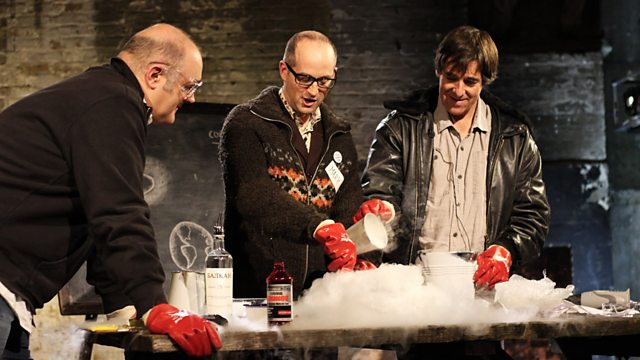
You are going to make a comet for us. | 0:45:06 | 0:45:09 | |
To get your head round what a comet is... The best way is to make one. | 0:45:09 | 0:45:13 | |
Here we go. We're going to make a comet | 0:45:13 | 0:45:15 | |
The early European space mission Giotto to Halley's Comet | 0:45:15 | 0:45:21 | |
discovered something great about them which is that they have a lot of water in them. | 0:45:21 | 0:45:24 | |
First of all, we will mix up some water. Also carbon. | 0:45:24 | 0:45:28 | |
That is a common element in the solar system and there is loads. | 0:45:28 | 0:45:33 | |
We have the image of a dirty snowball. | 0:45:33 | 0:45:37 | |
These things are icy, but they don't look like a snowball. | 0:45:37 | 0:45:41 | |
There is some mineral content - silica, aluminium and a few other things. | 0:45:41 | 0:45:45 | |
Which you are representing with sand here. | 0:45:45 | 0:45:48 | |
The incredible thing is that the NASA Stardust mission, to Wild 2, | 0:45:48 | 0:45:52 | |
they found they had amino acids in them. | 0:45:52 | 0:45:55 | |
That was really startling and amazing | 0:45:55 | 0:45:57 | |
-cos that means.... -We got these from bodybuilders. | 0:45:57 | 0:46:01 | |
It's incredible because that might suggest that comets cannot just be | 0:46:01 | 0:46:06 | |
harbingers of doom, but they carry the components of life. | 0:46:06 | 0:46:10 | |
Amino acids are the building blocks of all our protein. | 0:46:10 | 0:46:12 | |
Is there any justification for using Eastern European vodka? | 0:46:12 | 0:46:17 | |
It's not vodka. It's ethanol, alcohol. | 0:46:17 | 0:46:21 | |
Not only did these comets deliver water, but booze. | 0:46:21 | 0:46:27 | |
So there is volatiles, there is organics in there, | 0:46:27 | 0:46:29 | |
and of course, there is carbon dioxide. | 0:46:29 | 0:46:32 | |
I wonder if you can help me. Mark, can you put on these gloves? | 0:46:32 | 0:46:35 | |
We should all put on gloves and safety glasses. | 0:46:35 | 0:46:38 | |
Although this is solid carbon dioxide, it is -78C. | 0:46:38 | 0:46:43 | |
It's not terribly dangerous, but it will give you frostbite. | 0:46:43 | 0:46:46 | |
What we do next means that it might spit. | 0:46:46 | 0:46:51 | |
Whack that in here. | 0:46:51 | 0:46:54 | |
-How much of this goes in there? -About three cups. | 0:46:54 | 0:46:58 | |
That will cool this down and create this icy black snowball. | 0:46:58 | 0:47:02 | |
-Cheap special effects. -This is brilliant. | 0:47:02 | 0:47:05 | |
-I shouldn't put my hand in there. -Don't put your hand in. | 0:47:05 | 0:47:09 | |
If a comet landed, all the rock bands in the world would have | 0:47:09 | 0:47:12 | |
to rush out really quickly. | 0:47:12 | 0:47:16 | |
This looks like some cheap trick. | 0:47:16 | 0:47:20 | |
But it will create something that is uncannily like a comet. | 0:47:20 | 0:47:25 | |
I'm trying to solidify that water we put in there | 0:47:25 | 0:47:30 | |
and all the carbon and the vodka is being squeezed together. | 0:47:30 | 0:47:36 | |
I think we have a comet. OK. | 0:47:36 | 0:47:39 | |
If you have just tuned in, | 0:47:39 | 0:47:41 | |
this isn't the Great British Bake Off. | 0:47:41 | 0:47:44 | |
-Look. -Oh, wow! | 0:47:44 | 0:47:47 | |
Look at the jets. The jets coming across. | 0:47:47 | 0:47:49 | |
These are the carbon dioxide subliming and creating... | 0:47:49 | 0:47:54 | |
And cooling the water and the water in the air is creating this steam. | 0:47:54 | 0:47:59 | |
There would be jets on an actual comet? | 0:47:59 | 0:48:02 | |
As it comes near the sun, this starts to happen. | 0:48:02 | 0:48:05 | |
As it comes near to Mark, the warmth of his charisma, | 0:48:05 | 0:48:08 | |
his personality starts to warm the side of it. | 0:48:08 | 0:48:11 | |
And that is the coma you see around a comet. | 0:48:11 | 0:48:14 | |
It's amazing how much you've created a comet | 0:48:14 | 0:48:18 | |
-that looks like a human brain. -Yeah. | 0:48:18 | 0:48:21 | |
Wow, that's fantastic. That's exactly as it would appear in space. | 0:48:21 | 0:48:25 | |
Ladies and gentlemen, this is Mark Miodownik's comet. | 0:48:25 | 0:48:29 | |
APPLAUSE | 0:48:29 | 0:48:31 | |
If tonight's programme has given you | 0:48:31 | 0:48:33 | |
some burning questions about extinction, | 0:48:33 | 0:48:35 | |
we have our after-hours science club starting when we finish. | 0:48:35 | 0:48:38 | |
Go to the website and get involved. | 0:48:38 | 0:48:40 | |
APPLAUSE | 0:48:40 | 0:48:43 | |
Loads more sources of information for you there. | 0:48:43 | 0:48:47 | |
Now we have our unsung scientist Hall of Fame. | 0:48:47 | 0:48:50 | |
This is where we big up scientists | 0:48:50 | 0:48:52 | |
who don't get enough credit for their achievements. | 0:48:52 | 0:48:54 | |
Richard, who would you like to add to the Hall of Fame? | 0:48:54 | 0:48:57 | |
We have heard about the influence of guns on life. | 0:48:57 | 0:49:02 | |
One wonderful species that almost died out, | 0:49:02 | 0:49:06 | |
almost became extinct, was the North American buffalo, the bison. | 0:49:06 | 0:49:11 | |
It was only thanks to a few people who conserved them, | 0:49:11 | 0:49:15 | |
who valued then, that this species survives now. | 0:49:15 | 0:49:18 | |
My unsung hero is a farmer or farmer's wife, Molly Goodnight... | 0:49:18 | 0:49:24 | |
who kept a small herd | 0:49:24 | 0:49:28 | |
and now there are healthy populations once again | 0:49:28 | 0:49:31 | |
of this magnificent animal. | 0:49:31 | 0:49:33 | |
Who are you going to add? | 0:49:33 | 0:49:34 | |
Alfred Russel Wallace who discovered my favourite frog | 0:49:34 | 0:49:39 | |
which is... LAUGHTER | 0:49:39 | 0:49:41 | |
You're noticing a theme here. | 0:49:41 | 0:49:43 | |
He discovered Wallace's flying frog which is a frog that flies | 0:49:43 | 0:49:47 | |
which is amazing. But that's not why he's going on. | 0:49:47 | 0:49:50 | |
He's going on because he thought of the theory of evolution | 0:49:50 | 0:49:53 | |
by natural selection, | 0:49:53 | 0:49:54 | |
possibly even before Darwin or definitely around the same time. | 0:49:54 | 0:49:59 | |
The co-presented. You never hear about Arthur Russell Wallace. | 0:49:59 | 0:50:02 | |
You always hear about Charles Darwin. | 0:50:02 | 0:50:04 | |
Do you want to take Darwin out of the...? | 0:50:04 | 0:50:06 | |
-And put Alfred Russel Wallace in. -That's not going down well in the room. | 0:50:06 | 0:50:10 | |
Genuinely spontaneous booing for that. | 0:50:10 | 0:50:12 | |
The one I'm going to bring in is our old friend Lancelot Hogben | 0:50:12 | 0:50:18 | |
who invented the frog-based pregnancy test that you'll be delighted to know | 0:50:18 | 0:50:23 | |
isn't the way you'll be pacing | 0:50:23 | 0:50:25 | |
nervously in a bathroom in 10 years' time. | 0:50:25 | 0:50:27 | |
-He was the one who popularised that frog? -Absolutely. | 0:50:27 | 0:50:31 | |
It was because he turned it into a scientific superstar. | 0:50:31 | 0:50:35 | |
That's the reason it became a model organism. He has a lot to answer for. | 0:50:35 | 0:50:40 | |
He goes on to the side. Thank you very much. | 0:50:40 | 0:50:44 | |
I told you at the start of the show this wouldn't be a big depressing | 0:50:44 | 0:50:47 | |
guilt trip about how bad we are to little animals and pandas crying. | 0:50:47 | 0:50:52 | |
Yes, resources and species are disappearing at an alarming rate and | 0:50:52 | 0:50:55 | |
it may be all our fault, but we, as humans, have ingenuity on our side. | 0:50:55 | 0:50:59 | |
What if we could bring these defunct species back? | 0:50:59 | 0:51:03 | |
Dr Helen Czerski has been to New Orleans | 0:51:03 | 0:51:05 | |
to uncover some astonishing experiments. | 0:51:05 | 0:51:08 | |
Keeping endangered animals behind bars is one way to preserve them | 0:51:11 | 0:51:15 | |
for future generations. | 0:51:15 | 0:51:18 | |
The idea of rescuing a few specimens in the hope that they'll breed | 0:51:18 | 0:51:22 | |
is as old as Noah's Ark. | 0:51:22 | 0:51:25 | |
Creating Noah's Ark in a zoo isn't practical because, even if | 0:51:25 | 0:51:29 | |
you had several of every species, | 0:51:29 | 0:51:32 | |
you have then the enormous problem of finding habitats and food for them. | 0:51:32 | 0:51:37 | |
At the Audubon Nature Institute in New Orleans, they have a solution. | 0:51:37 | 0:51:42 | |
A way of keeping animals that doesn't have those problems. | 0:51:42 | 0:51:46 | |
They're building a genetic ark. | 0:51:46 | 0:51:48 | |
For over 10 years, Martha Gomez and her team have been collecting | 0:51:53 | 0:51:57 | |
the next generation of endangered animals | 0:51:57 | 0:51:59 | |
by storing their DNA in liquid nitrogen. | 0:51:59 | 0:52:03 | |
Basically, we have here the frozen soup. | 0:52:03 | 0:52:07 | |
We have cells from lions, antelopes, gorilla and elephants. | 0:52:07 | 0:52:13 | |
What Martha's team have is effectively a biological hard drive | 0:52:15 | 0:52:18 | |
to recreate endangered species from around the world. | 0:52:18 | 0:52:23 | |
After defrosting genetic material like these wildcats sperm and eggs, | 0:52:23 | 0:52:28 | |
they use IVF procedures to create new embryos in the lab. | 0:52:28 | 0:52:33 | |
These eggs, there is a cell membrane round the outside | 0:52:33 | 0:52:38 | |
-and the genetic material from the mother is in there. -Exactly. | 0:52:38 | 0:52:42 | |
Then swimming around out here, | 0:52:42 | 0:52:45 | |
these are all the sperm with the genetic material from the father. | 0:52:45 | 0:52:48 | |
-Mm-hmm. -They are combining here. -It is in-vitro fertilisation. | 0:52:48 | 0:52:54 | |
-Is this better magnification? -Yes. -Look at that! | 0:52:54 | 0:52:58 | |
You can see how many sperm you have around. And just one... | 0:52:58 | 0:53:03 | |
-One more cat in the world, here we go. -Here we go. | 0:53:03 | 0:53:08 | |
By freezing the embryos, too, | 0:53:09 | 0:53:12 | |
Martha's team are experimenting with starting life | 0:53:12 | 0:53:16 | |
then pausing it at will. | 0:53:16 | 0:53:18 | |
Defrosting the embryos of endangered species years down the line is | 0:53:19 | 0:53:23 | |
all very well, but they need mothers to bring them into the world. | 0:53:23 | 0:53:26 | |
So what do you do if the mothers are dying out? | 0:53:26 | 0:53:31 | |
This African black-footed wildcat is the first of her kind to be | 0:53:31 | 0:53:35 | |
born through interspecies surrogacy. | 0:53:35 | 0:53:39 | |
This is Crystal. | 0:53:40 | 0:53:41 | |
She might be the most astonishing animal I have ever seen. | 0:53:41 | 0:53:46 | |
The sperm that make up half of her DNA were frozen for a year | 0:53:46 | 0:53:51 | |
then they joined the egg to make an embryo | 0:53:51 | 0:53:55 | |
and that embryo was frozen for eight more years. | 0:53:55 | 0:54:00 | |
And at the end of that, | 0:54:00 | 0:54:02 | |
that embryo was implanted not in the same species as Crystal, | 0:54:02 | 0:54:07 | |
but in a domestic cat. | 0:54:07 | 0:54:11 | |
So that little cat over there was carried to term | 0:54:11 | 0:54:15 | |
by a mother of a whole separate species. | 0:54:15 | 0:54:20 | |
So, even if an animal becomes extinct, | 0:54:23 | 0:54:26 | |
the frozen zoo could use a common relative to resurrect the species. | 0:54:26 | 0:54:30 | |
But in their latest research, | 0:54:32 | 0:54:33 | |
Martha's team don't even need frozen sperm and eggs. | 0:54:33 | 0:54:37 | |
They can now create an embryo from a skin cell using cloning. | 0:54:38 | 0:54:42 | |
A normal domestic cat donates unfertilised eggs or oocytes. | 0:54:44 | 0:54:49 | |
Under the microscope, Martha adds fluorescent dye to make | 0:54:51 | 0:54:55 | |
the mother's DNA visible for extraction from the oocyte. | 0:54:55 | 0:54:58 | |
What she's doing is going in with another pipette | 0:54:58 | 0:55:01 | |
and removing the DNA that is already in this egg cell. | 0:55:01 | 0:55:05 | |
The DNA is now here and there is nothing... | 0:55:05 | 0:55:09 | |
Nothing. Can you see that this is the DNA? | 0:55:09 | 0:55:12 | |
Now that there is an empty egg cell, | 0:55:15 | 0:55:18 | |
a blank, the next stage is to take one of these cells that has come from | 0:55:18 | 0:55:22 | |
the skin tissue of a different species of cat | 0:55:22 | 0:55:25 | |
and put that into the oocyte. | 0:55:25 | 0:55:28 | |
That's the complete genetic package effectively going into the egg cell. | 0:55:28 | 0:55:33 | |
So the domestic cat DNA inside the egg | 0:55:35 | 0:55:38 | |
has been replaced with wildcat DNA. | 0:55:38 | 0:55:41 | |
Martha will apply an electric pulse across the cell | 0:55:44 | 0:55:48 | |
so that the new DNA will fuse with the egg cell. | 0:55:48 | 0:55:53 | |
This is the spark of life. | 0:55:53 | 0:55:56 | |
I'm going to pass it. 3, 2, 1. | 0:55:56 | 0:55:59 | |
What I do there is helping. | 0:56:04 | 0:56:06 | |
You can clearly see how the cell got attached. | 0:56:06 | 0:56:09 | |
Cloning is nothing new, but using separate species to provide eggs | 0:56:11 | 0:56:14 | |
and surrogate mothers is groundbreaking. | 0:56:14 | 0:56:16 | |
Martha's team hope to eventually clone tigers | 0:56:18 | 0:56:23 | |
using the more common lion as a surrogate. | 0:56:23 | 0:56:26 | |
This technology opens up tantalising possibilities for long extinct animals. | 0:56:26 | 0:56:30 | |
APPLAUSE | 0:56:30 | 0:56:32 | |
That is astonishing. It's nothing short of miraculous. | 0:56:39 | 0:56:42 | |
Even watching the video again, shivers are going down my spine. | 0:56:42 | 0:56:46 | |
We spent two days there and they have honed this procedure. | 0:56:46 | 0:56:49 | |
It's very clever. They're using the natural machinery of the cells. | 0:56:49 | 0:56:53 | |
So there is little artificial about it. | 0:56:53 | 0:56:55 | |
They are switching things in the cell the right way, | 0:56:55 | 0:56:59 | |
so they can put whole skin cells into this egg. | 0:56:59 | 0:57:02 | |
-The technology is astonishing. It makes me shiver. -Dinosaurs? | 0:57:02 | 0:57:07 | |
Is that a stupid question? This is Jurassic Park. | 0:57:07 | 0:57:11 | |
It's all about the integrity of the DNA. | 0:57:11 | 0:57:13 | |
To reproduce an entire animal, | 0:57:13 | 0:57:15 | |
you need a lot of things to be exactly right. | 0:57:15 | 0:57:18 | |
In the depths of mammoth DNA that have been found so far, | 0:57:18 | 0:57:21 | |
no-one's got an intact sequence. | 0:57:21 | 0:57:23 | |
It's difficult to patch together sequences from different animals. | 0:57:23 | 0:57:27 | |
DNA does denature quite quickly. | 0:57:27 | 0:57:31 | |
No DNA has survived in any decent chunks from the age of the dinosaurs. | 0:57:31 | 0:57:36 | |
The mammoth is a more interesting possibility, | 0:57:36 | 0:57:39 | |
because deep frozen mammoths are found... | 0:57:39 | 0:57:41 | |
Wrangel Island, they lived until just a few thousand years ago. | 0:57:41 | 0:57:45 | |
It's just conceivable that somewhere, there would be a whole strand. | 0:57:45 | 0:57:51 | |
That is the passenger pigeon shot by a 14-year-old in Ohio | 0:57:51 | 0:57:56 | |
in the year 1900. Presumably, whose great-grandchildren are still alive. | 0:57:56 | 0:58:00 | |
So, if you could bring him back he could fly above and shit on him. | 0:58:00 | 0:58:04 | |
That would be a small piece of vengeance. | 0:58:04 | 0:58:07 | |
It's a miraculous film but it may be a far more confusing | 0:58:07 | 0:58:10 | |
and complex issue than that. | 0:58:10 | 0:58:12 | |
We are almost at the end. Mark, if you could come back in again. | 0:58:12 | 0:58:15 | |
We want to thank all our reporters. Helen, Tali, Alok and of course our own Mark. | 0:58:18 | 0:58:21 | |
Mainly our science gurus Richard Fortey | 0:58:21 | 0:58:23 | |
Lucy Cooke and of course our special guest Mark steel. | 0:58:23 | 0:58:26 | |
How do we tie a bow on this, ladies and gentlemen? | 0:58:34 | 0:58:36 | |
Given what we've done to the animals, we've shot them, | 0:58:36 | 0:58:39 | |
eaten them, knocked down their homes, introduced them to cats | 0:58:39 | 0:58:42 | |
and we've weed on them to find out if we're pregnant. | 0:58:42 | 0:58:45 | |
We probably deserve an asteroid strike, but before that happens, | 0:58:45 | 0:58:48 | |
we're coming after the pandas. | 0:58:48 | 0:58:50 | |
Ladies and gentlemen, that's all for this week. Good night. | 0:58:50 | 0:58:53 | |
APPLAUSE | 0:58:53 | 0:58:55 | |
Subtitles by Red Bee Media Ltd | 0:59:07 | 0:59:09 |