Episode 2 Wild Burma: Nature's Lost Kingdom
Similar Content
Browse content similar to Episode 2. Check below for episodes and series from the same categories and more!
Transcript
| Line | From | To | |
|---|---|---|---|
Burma. | 0:00:03 | 0:00:05 | |
Cut off from the world for 50 years. | 0:00:07 | 0:00:10 | |
A mysterious land. | 0:00:13 | 0:00:14 | |
A land of secrets. | 0:00:16 | 0:00:18 | |
Home to half of mainland Southeast Asia's remaining forests. | 0:00:21 | 0:00:25 | |
It's rumoured to be teeming with iconic animals. | 0:00:27 | 0:00:29 | |
This is one big question mark when it comes to scientific exploration. | 0:00:32 | 0:00:36 | |
These forests could be the last refuge | 0:00:36 | 0:00:38 | |
to some magnificent creatures that are being wiped out | 0:00:38 | 0:00:42 | |
across the world. | 0:00:42 | 0:00:43 | |
As it opens up to democracy, | 0:00:43 | 0:00:45 | |
Burma will have to choose the fate of its forests. | 0:00:45 | 0:00:48 | |
There, there, there, there! What is that? | 0:00:53 | 0:00:56 | |
Now, for the first time, a team of scientists | 0:00:57 | 0:01:00 | |
and wildlife film-makers are venturing | 0:01:00 | 0:01:02 | |
deep into Burma's jungles. | 0:01:02 | 0:01:03 | |
Did you see that? There they are. I'm shaking. | 0:01:05 | 0:01:08 | |
They will catalogue its forgotten wildlife... | 0:01:09 | 0:01:12 | |
..and give Burma's government a report | 0:01:13 | 0:01:15 | |
to help get these forests protected. | 0:01:15 | 0:01:17 | |
So very, very, very, very lucky. | 0:01:20 | 0:01:22 | |
It's a race against time, | 0:01:24 | 0:01:25 | |
as the world eyes up Burma's natural riches. | 0:01:25 | 0:01:29 | |
We've got fire in front of us and then fire here | 0:01:29 | 0:01:31 | |
and then fire behind us. | 0:01:31 | 0:01:32 | |
Oh, God, this isn't good! | 0:01:34 | 0:01:36 | |
What they discover | 0:01:36 | 0:01:37 | |
could change the future of Burma's wilds forever. | 0:01:37 | 0:01:42 | |
Watch this, watch this, watch this...whoa! | 0:01:42 | 0:01:46 | |
Burma's forests are not just important to Burma. | 0:01:47 | 0:01:50 | |
They're not just important to Asia. | 0:01:50 | 0:01:52 | |
Burma's forests are important for the world. | 0:01:52 | 0:01:55 | |
Burma's forests are largely unexplored and inaccessible. | 0:02:08 | 0:02:11 | |
Potentially a haven | 0:02:13 | 0:02:14 | |
for Asia's endangered animals. | 0:02:14 | 0:02:17 | |
Unlike its neighbours, nearly half the country is wilderness. | 0:02:17 | 0:02:21 | |
But only 3% is protected under law. | 0:02:21 | 0:02:23 | |
The survey team | 0:02:26 | 0:02:27 | |
hopes their report on the wildlife here | 0:02:27 | 0:02:29 | |
will persuade Burma to protect more. | 0:02:29 | 0:02:31 | |
Joining forces for the expedition | 0:02:37 | 0:02:38 | |
are two specialist wildlife filmmakers - | 0:02:38 | 0:02:40 | |
Gordon Buchanan.... | 0:02:40 | 0:02:42 | |
Oh, look down there. | 0:02:42 | 0:02:44 | |
..and Justine Evans. | 0:02:45 | 0:02:47 | |
See if I can get a viewpoint from up here. | 0:02:47 | 0:02:50 | |
They're joined by a team of scientists. | 0:02:52 | 0:02:54 | |
Entomologist Ross Piper... | 0:02:54 | 0:02:55 | |
That's a fantastic creature. | 0:02:57 | 0:02:59 | |
..mammal expert Darrin Lunde... | 0:03:00 | 0:03:02 | |
I don't know how fast these guys could dig, | 0:03:03 | 0:03:05 | |
but I'm going to try to keep up with them. | 0:03:05 | 0:03:08 | |
..and a group of Burmese biologists with vital local knowledge. | 0:03:08 | 0:03:12 | |
Yes, yes! | 0:03:16 | 0:03:18 | |
Against the odds, they've already discovered Asian elephants | 0:03:18 | 0:03:21 | |
thriving in the south. | 0:03:21 | 0:03:23 | |
Elsewhere in Asia, they are severely endangered. | 0:03:24 | 0:03:28 | |
The team aims to protect not just elephants, | 0:03:29 | 0:03:32 | |
but whole ecosystems. | 0:03:32 | 0:03:33 | |
Now they're pushing deeper into Burma's uncharted forests. | 0:03:38 | 0:03:42 | |
Their mission - | 0:03:45 | 0:03:46 | |
to find as many different species as possible. | 0:03:46 | 0:03:49 | |
Measuring the forest's diversity | 0:03:49 | 0:03:52 | |
will help make the case for its protection. | 0:03:52 | 0:03:54 | |
Top of their list are three animals that are rapidly disappearing | 0:03:56 | 0:04:00 | |
from the rest of Asia. | 0:04:00 | 0:04:01 | |
The endangered sun bear... | 0:04:03 | 0:04:05 | |
..and two rare cats - | 0:04:08 | 0:04:09 | |
the little-known Asian golden cat | 0:04:09 | 0:04:12 | |
and the clouded leopard. | 0:04:12 | 0:04:15 | |
The team is heading to an isolated mountain range. | 0:04:17 | 0:04:20 | |
A place so remote it has never been properly studied - | 0:04:20 | 0:04:23 | |
Salu. | 0:04:23 | 0:04:24 | |
They hope to find one of the most pristine | 0:04:25 | 0:04:28 | |
and intact forests in Burma. | 0:04:28 | 0:04:30 | |
The only way in is on foot. | 0:04:37 | 0:04:39 | |
Local Rakhine villagers will act as guides | 0:04:40 | 0:04:43 | |
and help carry the team's two tonnes of specialist equipment. | 0:04:43 | 0:04:47 | |
They know this forest intimately | 0:04:50 | 0:04:52 | |
and will help the team find Salu's rarest animals. | 0:04:52 | 0:04:55 | |
Entomologist Ross is confident | 0:04:59 | 0:05:01 | |
they'll make some spectacular discoveries. | 0:05:01 | 0:05:04 | |
No-one's really been here to document the wildlife, | 0:05:04 | 0:05:07 | |
so we're going to be the first to do that | 0:05:07 | 0:05:09 | |
and there's a real sense of anticipation | 0:05:09 | 0:05:11 | |
amongst the scientists here about what we're going to find. | 0:05:11 | 0:05:13 | |
For the Rakhine people, the expedition's arrival | 0:05:16 | 0:05:18 | |
is a sure sign that Burma is changing. | 0:05:18 | 0:05:21 | |
Their once isolated world is becoming more accessible. | 0:05:21 | 0:05:24 | |
Burma, also known as Myanmar, | 0:05:28 | 0:05:31 | |
began its exile in 1962 | 0:05:31 | 0:05:33 | |
when General Ne Win staged a coup. | 0:05:33 | 0:05:35 | |
He locked down the country with brute force. | 0:05:39 | 0:05:42 | |
Decades of military rule followed. | 0:05:42 | 0:05:44 | |
Despite years of protests, Burma was shut away from the developed world. | 0:05:47 | 0:05:51 | |
Now that's changed. | 0:05:54 | 0:05:56 | |
Democracy has brought new hope. | 0:05:57 | 0:05:59 | |
But freedom comes at a cost. | 0:06:05 | 0:06:07 | |
There are fears that hunters | 0:06:08 | 0:06:09 | |
are already targeting Burma's unprotected forests. | 0:06:09 | 0:06:13 | |
Base camp is on the banks of the Salu river, | 0:06:18 | 0:06:21 | |
in the heart of the forest. | 0:06:21 | 0:06:23 | |
This place is a fantastic choice for a base camp. | 0:06:27 | 0:06:29 | |
What you want to do is heighten your chance of seeing | 0:06:29 | 0:06:32 | |
as many different animals as possible, and this place is great. | 0:06:32 | 0:06:35 | |
You've got a range of different habitats. | 0:06:35 | 0:06:37 | |
You've got the river, riverine forest, forested mountain slopes | 0:06:37 | 0:06:40 | |
and right even up on the ridge, entirely covered in trees. | 0:06:40 | 0:06:43 | |
The team's goal is to prove this forest is so unique, | 0:06:45 | 0:06:49 | |
it's worth protecting. | 0:06:49 | 0:06:50 | |
They must find as many species as possible, | 0:06:51 | 0:06:55 | |
ideally some that are new to science. | 0:06:55 | 0:06:57 | |
In this remote forest, the team expects diversity to be high. | 0:06:59 | 0:07:03 | |
As well as searching for insects, Ross will oversee the survey. | 0:07:07 | 0:07:10 | |
The team will feed information back to me. | 0:07:13 | 0:07:16 | |
I can collate it all | 0:07:16 | 0:07:17 | |
and we can build up a picture of what animals are living here. | 0:07:17 | 0:07:20 | |
This survey, once it's completed, | 0:07:20 | 0:07:22 | |
will give the Burmese government the information they need | 0:07:22 | 0:07:25 | |
to protect these forests. | 0:07:25 | 0:07:26 | |
The forest covers 650 square miles, | 0:07:28 | 0:07:32 | |
with different animals in different areas. | 0:07:32 | 0:07:35 | |
The team splits up. | 0:07:35 | 0:07:36 | |
Gordon and his guides are searching for the extremely rare sun bear. | 0:07:50 | 0:07:54 | |
They hope to pick up their trail on these thickly forested ridges. | 0:07:57 | 0:08:00 | |
It already feels quite different, | 0:08:03 | 0:08:05 | |
even just being on the hill above camp. | 0:08:05 | 0:08:08 | |
Camp is down there - | 0:08:09 | 0:08:11 | |
a little row of tents. | 0:08:11 | 0:08:14 | |
This habitat is separated vertically. | 0:08:15 | 0:08:17 | |
The higher we climb in elevation, there's all these subtle changes, | 0:08:17 | 0:08:21 | |
so there's change in different plants, | 0:08:21 | 0:08:23 | |
change in different trees, | 0:08:23 | 0:08:25 | |
and as you would expect, there's a change in animals. | 0:08:25 | 0:08:27 | |
And that's the whole reason we're climbing up onto this ridge, | 0:08:27 | 0:08:30 | |
because animals we'd expect to find up here | 0:08:30 | 0:08:32 | |
are going to be different from the animals | 0:08:32 | 0:08:34 | |
that the rest of the team are going to find down there. | 0:08:34 | 0:08:36 | |
These peaks offer rich pickings for sun bears, | 0:08:40 | 0:08:43 | |
with plenty of insects and fruiting trees. | 0:08:43 | 0:08:46 | |
Across the rest of Asia, | 0:08:51 | 0:08:53 | |
sun bears are victims of deforestation. | 0:08:53 | 0:08:56 | |
Their population has dropped 30% in the last three decades. | 0:08:57 | 0:09:00 | |
Salu could be a vital refuge, | 0:09:02 | 0:09:03 | |
but to prove it, Gordon must find evidence of a breeding population. | 0:09:03 | 0:09:07 | |
Up there is a tangle of branches, | 0:09:12 | 0:09:15 | |
and what that is... | 0:09:15 | 0:09:17 | |
It's a sun bear nest. | 0:09:18 | 0:09:21 | |
Sun bears will go up into the trees, | 0:09:21 | 0:09:23 | |
and like chimpanzees do, | 0:09:23 | 0:09:24 | |
they'll break the branches | 0:09:24 | 0:09:26 | |
and form a little platform. | 0:09:26 | 0:09:27 | |
And you can sleep up there. | 0:09:27 | 0:09:29 | |
So, this is a place where a sun bear has been | 0:09:29 | 0:09:32 | |
and there's always a chance that they could come back. | 0:09:32 | 0:09:36 | |
See here, there's some scratch marks here where the bear | 0:09:36 | 0:09:39 | |
has climbed up, well, actually, even higher. | 0:09:39 | 0:09:42 | |
Sleeping up in a nest like this for a sun bear | 0:09:43 | 0:09:46 | |
is quite a wise place to go | 0:09:46 | 0:09:47 | |
because there's probably going to be leopards up around here. | 0:09:47 | 0:09:50 | |
There's Asiatic black bear, which is a much bigger bear species, | 0:09:50 | 0:09:53 | |
so a sun bear would want to keep off a path like this, | 0:09:53 | 0:09:58 | |
up nice and high, so anything, | 0:09:58 | 0:10:00 | |
any threat, could pass below him and not even know he was here. | 0:10:00 | 0:10:02 | |
Locals believe sun bears use these paths to move around. | 0:10:06 | 0:10:10 | |
So Gordon's first job is to set up motion-triggered cameras. | 0:10:10 | 0:10:14 | |
For the next two weeks, he will check them every day. | 0:10:18 | 0:10:21 | |
Down in the valleys, Justine is also setting camera traps. | 0:10:25 | 0:10:29 | |
Her mission is to film Salu's wild cats. | 0:10:29 | 0:10:32 | |
She's after two of Asia's rarest and most beautiful cats - | 0:10:34 | 0:10:38 | |
the golden cat | 0:10:38 | 0:10:40 | |
and the clouded leopard. | 0:10:40 | 0:10:42 | |
Both feed on the forest's smaller creatures. | 0:10:43 | 0:10:46 | |
So if the cats are thriving, the whole forest is. | 0:10:46 | 0:10:49 | |
Catching them on camera won't be easy. | 0:10:51 | 0:10:53 | |
Now, this is looking pretty good. | 0:10:55 | 0:10:57 | |
I'm seeing here there's a bit of bamboo that's fallen down | 0:10:57 | 0:11:00 | |
and then there's lots of scrub here and low-lying branches, | 0:11:00 | 0:11:04 | |
so if I was an animal and I was walking down there, | 0:11:04 | 0:11:07 | |
I wouldn't try and pick my way through all of that. | 0:11:07 | 0:11:10 | |
I'd probably just prefer to come through here. | 0:11:10 | 0:11:12 | |
Most animals will take the path of least resistance, | 0:11:12 | 0:11:14 | |
especially cats. | 0:11:14 | 0:11:16 | |
Cats do like it easy. They like a good path. | 0:11:16 | 0:11:20 | |
You know, in many parts of the world where you get big cats, | 0:11:20 | 0:11:22 | |
you often see them on drivable tracks, | 0:11:22 | 0:11:25 | |
so I think this just looks like a really good bet. | 0:11:25 | 0:11:27 | |
Gordon and Justine's remote cameras will be on 24/7. | 0:11:29 | 0:11:32 | |
They're the team's best chance of recording these elusive creatures. | 0:11:34 | 0:11:37 | |
Meanwhile, the scientists begin their search for smaller animals. | 0:11:43 | 0:11:47 | |
Smithsonian mammal expert Darrin Lunde | 0:11:49 | 0:11:52 | |
plans to catch as many species as possible | 0:11:52 | 0:11:54 | |
in the short time they have. | 0:11:54 | 0:11:56 | |
I'm looking to put a pitfall trap line in here | 0:11:56 | 0:11:59 | |
and I'm just going to cut a swathe through | 0:11:59 | 0:12:02 | |
and then we're going to dig holes | 0:12:02 | 0:12:04 | |
and we're going to sink buckets down into the holes | 0:12:04 | 0:12:07 | |
and we're going to run a plastic fence through the centre of them | 0:12:07 | 0:12:10 | |
and what that does is, animals that are moving | 0:12:10 | 0:12:13 | |
from one side of the forest, or just moving through this forest, | 0:12:13 | 0:12:17 | |
they're going to encounter that fence, | 0:12:17 | 0:12:19 | |
they're going to run along it, trying to get around it, | 0:12:19 | 0:12:22 | |
and many of them are going to fall into these pitfall buckets. | 0:12:22 | 0:12:26 | |
And we may very well find something that's new. We'll see. | 0:12:26 | 0:12:30 | |
Finding species new to science will help the team prove | 0:12:32 | 0:12:36 | |
how valuable this forest is. | 0:12:36 | 0:12:38 | |
The pitfall traps could be their best hope. | 0:12:38 | 0:12:41 | |
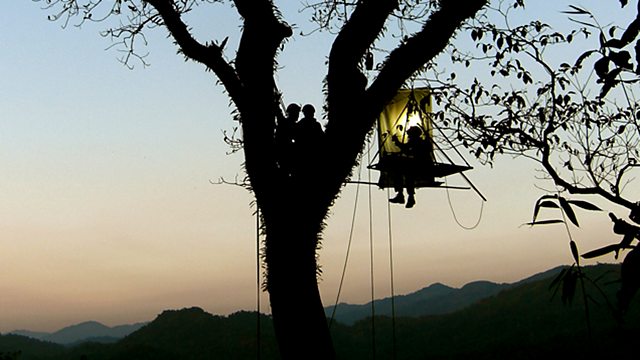
The team also needs to catalogue the canopy. | 0:12:47 | 0:12:49 | |
And Ross is heading into the treetops. | 0:12:52 | 0:12:53 | |
This is fantastic, to be so high above this forest | 0:12:56 | 0:12:59 | |
and seeing so far as I can now. | 0:12:59 | 0:13:00 | |
It gives you an unparalleled view | 0:13:00 | 0:13:02 | |
of where we are at the moment. | 0:13:02 | 0:13:04 | |
You just see | 0:13:04 | 0:13:05 | |
ridge after ridge of forest. | 0:13:05 | 0:13:07 | |
Insects are drawn to bright lights. | 0:13:10 | 0:13:12 | |
This white sheet will lure them in. | 0:13:12 | 0:13:14 | |
Ross can survey the insect population without moving at all. | 0:13:17 | 0:13:20 | |
All he has to do is wait. | 0:13:20 | 0:13:23 | |
At night, the remote cameras switch to infrared. | 0:13:29 | 0:13:32 | |
INTENSE BUZZING AND CHIRPING | 0:13:32 | 0:13:35 | |
The forest is alive with sound. | 0:13:41 | 0:13:43 | |
Ross gets his first results. | 0:13:44 | 0:13:46 | |
There's lots of species. | 0:13:50 | 0:13:52 | |
Down here is crawling with all sorts of beetle species. | 0:13:52 | 0:13:55 | |
The thing is, I'm also attracting | 0:13:55 | 0:13:57 | |
these big bees and a few wasps as well. | 0:13:57 | 0:13:59 | |
I'm also starting to get some cicadas now. | 0:14:00 | 0:14:03 | |
And listen to that. | 0:14:03 | 0:14:04 | |
CLICKING AND BUZZING | 0:14:04 | 0:14:07 | |
That sounds positively electronic. | 0:14:09 | 0:14:11 | |
Cicadas are amongst the loudest animals there are. | 0:14:12 | 0:14:16 | |
Some of them can be about 120 decibels. | 0:14:16 | 0:14:19 | |
It's all about trying to find a mate. | 0:14:19 | 0:14:21 | |
So they'll just sit up high up in the trees, | 0:14:21 | 0:14:23 | |
making these really peculiar sounds, | 0:14:23 | 0:14:26 | |
in the hope of trying to find a female. | 0:14:26 | 0:14:28 | |
Cicadas produce their intense noises... | 0:14:29 | 0:14:31 | |
..with a pair of plates on the bottom of their abdomen. | 0:14:33 | 0:14:36 | |
Now, they vibrate these really quickly | 0:14:36 | 0:14:39 | |
to produce the intense sounds. | 0:14:39 | 0:14:41 | |
Insects are a vital part of the forest food chain. | 0:14:46 | 0:14:49 | |
Small animals like these are prey for larger predators. | 0:14:50 | 0:14:53 | |
Urgh! | 0:14:56 | 0:14:57 | |
This...this is a burying beetle. | 0:14:59 | 0:15:01 | |
These really stink. They stink like a decomposing corpse, | 0:15:01 | 0:15:05 | |
but they have a really important function. | 0:15:05 | 0:15:08 | |
So any small animal that dies on the ground down there, | 0:15:09 | 0:15:12 | |
these find the body and bury it | 0:15:12 | 0:15:14 | |
and their larvae live on it and that's what they eat. | 0:15:14 | 0:15:18 | |
So the thing is, if it weren't for creatures like this, | 0:15:18 | 0:15:20 | |
we'd be ankle-deep in all sorts of corpses. | 0:15:20 | 0:15:22 | |
INSECTS CHIRP AND BUZZ | 0:15:22 | 0:15:25 | |
In just one hour, Ross has recorded 50 species. | 0:15:26 | 0:15:29 | |
And more are coming in every second. | 0:15:29 | 0:15:31 | |
There are some incredible mimics on this sheet. | 0:15:33 | 0:15:36 | |
This moth, for example, is mimicking a wasp. | 0:15:36 | 0:15:39 | |
It does this because all other animals know | 0:15:39 | 0:15:41 | |
that wasps are dangerous, they have a sting. | 0:15:41 | 0:15:43 | |
So this strategy keeps this moth safe from its own predators. | 0:15:44 | 0:15:48 | |
You see that again and again with some of the animals on here. | 0:15:48 | 0:15:52 | |
And look at this longhorn beetle. | 0:15:54 | 0:15:55 | |
It will blend in completely. | 0:15:56 | 0:15:58 | |
You wouldn't see it if it was on the bark of a tree. | 0:15:58 | 0:16:00 | |
You see, also the weird thing about this one | 0:16:00 | 0:16:02 | |
are these big pompoms on the antenna. | 0:16:02 | 0:16:04 | |
Now, this is probably used in courtship. | 0:16:06 | 0:16:08 | |
Ross's insect survey is the team's first evidence | 0:16:10 | 0:16:13 | |
of a rich and diverse forest. | 0:16:13 | 0:16:15 | |
Back in base camp, | 0:16:23 | 0:16:25 | |
Justine is keen to find out what the locals know about Salu's wild cats. | 0:16:25 | 0:16:29 | |
Any of these cats... | 0:16:32 | 0:16:34 | |
We have a golden cat here, this one? | 0:16:35 | 0:16:37 | |
Any of the other ones? | 0:16:38 | 0:16:40 | |
TRANSLATION: | 0:16:40 | 0:16:42 | |
Is it possible, do you think, to film them, though? | 0:16:45 | 0:16:47 | |
The locals doubt she'll film cats. | 0:17:03 | 0:17:06 | |
And they also have distressing news about sun bears. | 0:17:06 | 0:17:09 | |
I'm surprised that things like sun bear are being taken for trade. | 0:17:39 | 0:17:44 | |
And somewhere quite remote like this, you know, it feels like, | 0:17:44 | 0:17:49 | |
you know, that this international trade | 0:17:49 | 0:17:51 | |
is just permeating everywhere globally. | 0:17:51 | 0:17:54 | |
You know, it's a disease that you just can't escape. | 0:17:54 | 0:17:56 | |
The team's survey may be too little, too late. | 0:17:58 | 0:18:02 | |
ANIMALS WHOOP AND CHIRP | 0:18:15 | 0:18:17 | |
Next morning, the team sets out with a new sense of urgency. | 0:18:30 | 0:18:34 | |
The forest is already under threat. | 0:18:34 | 0:18:37 | |
The more species they can find, the better their chance | 0:18:37 | 0:18:40 | |
of getting it protected. | 0:18:40 | 0:18:42 | |
If poachers ARE hunting sun bears here, | 0:18:55 | 0:18:58 | |
Gordon's search may be doomed. | 0:18:58 | 0:19:00 | |
These shy and persecuted creatures could already be gone. | 0:19:00 | 0:19:03 | |
Only the camera traps will tell. | 0:19:05 | 0:19:06 | |
Look at this hog badger here. | 0:19:09 | 0:19:11 | |
He's a generalist | 0:19:11 | 0:19:12 | |
rather than a specialist. | 0:19:12 | 0:19:14 | |
He will eat practically anything. | 0:19:14 | 0:19:16 | |
He'll be eating insects, he'll be eating reptiles and amphibians | 0:19:16 | 0:19:20 | |
if he can find them. | 0:19:20 | 0:19:22 | |
He'll eat small mammals if he can get hold of them. | 0:19:22 | 0:19:24 | |
Very strange-looking animal. | 0:19:24 | 0:19:26 | |
It's a kind of tropical slant on a very familiar-looking creature. | 0:19:27 | 0:19:30 | |
What's that? | 0:19:32 | 0:19:33 | |
Oh, look! | 0:19:33 | 0:19:35 | |
A sun bear! | 0:19:35 | 0:19:36 | |
That...is...amazing! | 0:19:36 | 0:19:40 | |
There is still at least one bear here. | 0:19:48 | 0:19:51 | |
Gordon is on the right track. | 0:19:52 | 0:19:53 | |
This animal spends its entire waking life looking for insects, | 0:20:01 | 0:20:06 | |
looking for honey, looking for fruit. And you only get that fruit | 0:20:06 | 0:20:10 | |
and that honey and those insects in places that are intact. | 0:20:10 | 0:20:14 | |
I've actually looked for these bears many times before | 0:20:16 | 0:20:19 | |
and I've never ever seen one. | 0:20:19 | 0:20:22 | |
The sun bear | 0:20:24 | 0:20:26 | |
has this cryptic character that has never really properly | 0:20:26 | 0:20:30 | |
been caught on film. | 0:20:30 | 0:20:31 | |
Much of their life is still a mystery. | 0:20:31 | 0:20:35 | |
So to catch a brief glimpse of a sun bear | 0:20:36 | 0:20:38 | |
is really very, very special indeed. | 0:20:38 | 0:20:41 | |
Sun bears are rapidly disappearing from Asia. | 0:20:43 | 0:20:46 | |
Their forest habitat is vanishing. | 0:20:46 | 0:20:49 | |
Poachers are hunting them. | 0:20:49 | 0:20:51 | |
This bear is Gordon's first success, | 0:20:57 | 0:21:00 | |
but he still has work to do. | 0:21:00 | 0:21:02 | |
He needs to find evidence that there's a population of bears here. | 0:21:05 | 0:21:09 | |
While Gordon continues his search on the ridge, | 0:21:14 | 0:21:17 | |
two miles south, Justine scours the valley. | 0:21:17 | 0:21:20 | |
This thing's very funny. It just explodes. | 0:21:22 | 0:21:26 | |
Justine is still looking for wild cats. | 0:21:34 | 0:21:37 | |
Lots of animals come to drink at the river. | 0:21:37 | 0:21:40 | |
The cats come here to hunt them. | 0:21:40 | 0:21:41 | |
If she waits long enough, she may catch them on film. | 0:21:41 | 0:21:46 | |
The good thing is, it's the dry season, | 0:21:47 | 0:21:50 | |
so this river will attract a lot of animals | 0:21:50 | 0:21:53 | |
coming off the hills, especially at night when it's cooler, | 0:21:53 | 0:21:57 | |
or first thing in the morning, last thing at night. | 0:21:57 | 0:22:00 | |
Now she must wait. She'll stay here for four days. | 0:22:01 | 0:22:05 | |
You do need quite a long time in the hide, | 0:22:06 | 0:22:08 | |
because everything has to settle down. | 0:22:08 | 0:22:11 | |
You've got to get quiet | 0:22:11 | 0:22:12 | |
and then everything that I may have disturbed coming in here | 0:22:12 | 0:22:17 | |
has to sort of calm down and want to come back. | 0:22:17 | 0:22:20 | |
With all of you lot leaving, that will be really helpful, | 0:22:20 | 0:22:23 | |
because things might get the idea that the human commotion | 0:22:23 | 0:22:27 | |
has all gone, left back downriver. | 0:22:27 | 0:22:30 | |
Cats are nocturnal. | 0:22:32 | 0:22:34 | |
Justine must switch her body clock | 0:22:34 | 0:22:37 | |
and be primed for nightfall. | 0:22:37 | 0:22:38 | |
At the moment, it's really quiet out there. I could hear a pin drop. | 0:22:49 | 0:22:53 | |
Justine knows she must stay alert night after night. | 0:22:56 | 0:22:59 | |
And be prepared for her mind to play tricks on her. | 0:23:01 | 0:23:04 | |
WATER GURGLES | 0:23:04 | 0:23:06 | |
The sound of the river makes an ever-changing sound | 0:23:06 | 0:23:10 | |
and sometimes it sounds like something completely different, | 0:23:10 | 0:23:14 | |
like voices or somebody creeping up to the hide. | 0:23:14 | 0:23:19 | |
It can get quite spooky. | 0:23:19 | 0:23:21 | |
Justine settles in for a long wait. | 0:23:24 | 0:23:25 | |
Back in base camp, | 0:23:36 | 0:23:38 | |
the science team is making progress. | 0:23:38 | 0:23:40 | |
They're cataloguing several species an hour. | 0:23:40 | 0:23:43 | |
For Darrin, that means regularly checking his pitfall trap line. | 0:23:47 | 0:23:50 | |
Big spider. | 0:23:55 | 0:23:57 | |
And it's big and I don't want to mess with that! | 0:23:59 | 0:24:02 | |
Urgh! There. | 0:24:02 | 0:24:04 | |
Look at that. | 0:24:05 | 0:24:07 | |
I've got a nice centipede. Wow, they're fast! Whoo-oh-oh! | 0:24:07 | 0:24:11 | |
OK, look at this. | 0:24:15 | 0:24:17 | |
Wow. | 0:24:17 | 0:24:18 | |
I think what we've got here is a snake. | 0:24:18 | 0:24:22 | |
In fact, I know it's a snake, | 0:24:22 | 0:24:23 | |
but it looks like | 0:24:23 | 0:24:25 | |
a very rare kind of snake called a blind snake | 0:24:25 | 0:24:29 | |
and they're usually underground | 0:24:29 | 0:24:31 | |
and I think because we did a lot of digging here, | 0:24:31 | 0:24:34 | |
we may have disturbed its burrow and chased it | 0:24:34 | 0:24:36 | |
up on the ground and caught it in this pitfall trap. | 0:24:36 | 0:24:40 | |
I am pretty excited about this, because although I study mammals | 0:24:40 | 0:24:44 | |
and small mammals in particular, | 0:24:44 | 0:24:46 | |
I happen to know that this is a spectacular find. | 0:24:46 | 0:24:49 | |
Blind snakes, burrowing snakes, you just don't find them | 0:24:49 | 0:24:52 | |
unless you really do a lot of digging. | 0:24:52 | 0:24:54 | |
And we got very lucky, I think. | 0:24:54 | 0:24:56 | |
Um... | 0:24:56 | 0:24:58 | |
I can't remember if these guys are venomous or not, | 0:24:58 | 0:25:03 | |
so I want to put my glove on | 0:25:03 | 0:25:06 | |
and I'm going to collect it and show it to Ross. | 0:25:06 | 0:25:10 | |
Wow, look at that thing! All right, here we go. | 0:25:10 | 0:25:13 | |
In it goes. | 0:25:13 | 0:25:14 | |
I don't want to lose it. | 0:25:14 | 0:25:16 | |
Got it in and I got it covered. Pow! | 0:25:16 | 0:25:18 | |
Hey, Ross, I got something for you! | 0:25:20 | 0:25:22 | |
-What is it? In a tin? -Wait till you see this. | 0:25:22 | 0:25:26 | |
That looks foreboding. | 0:25:26 | 0:25:27 | |
Hang on. | 0:25:31 | 0:25:32 | |
Do you want something to open it with? | 0:25:32 | 0:25:35 | |
Uh, yeah, here. | 0:25:35 | 0:25:37 | |
Oh, my word! Oh, it's one of the blind snakes! | 0:25:37 | 0:25:39 | |
-Yep. -Oh, my word, that's fantastic! | 0:25:39 | 0:25:41 | |
-Isn't it incredible? -Yeah, yeah, I've never seen one. -No. | 0:25:41 | 0:25:44 | |
-Are these venomous? -No, no, no, no. -Look at that, right? | 0:25:44 | 0:25:47 | |
-These are really difficult to find. -I know. They're underground. | 0:25:47 | 0:25:50 | |
-Yeah, yeah. -Are they blind? -Yeah, almost completely blind. | 0:25:50 | 0:25:53 | |
Almost completely blind. | 0:25:53 | 0:25:55 | |
So I think they just rely on just touch, really, | 0:25:55 | 0:25:57 | |
and maybe vibrations in the soil. | 0:25:57 | 0:26:00 | |
These things are very similar to the ancestors | 0:26:03 | 0:26:06 | |
of all the living snakes. | 0:26:06 | 0:26:08 | |
You'd see that... You'd think that was an earthworm, wouldn't you? | 0:26:08 | 0:26:11 | |
-Right, it looks very worm-like. -Yeah, yeah. | 0:26:11 | 0:26:13 | |
Look at the way this is moving here. I mean, it's difficult | 0:26:13 | 0:26:16 | |
to make out which is the head and which is the tail. | 0:26:16 | 0:26:18 | |
You know, I think this to me looks like some form of defence. | 0:26:18 | 0:26:22 | |
I know this is an amazing find, | 0:26:22 | 0:26:23 | |
but just how amazing is it? I mean how...? | 0:26:23 | 0:26:26 | |
So little is known about these reptiles. | 0:26:26 | 0:26:29 | |
I mean, you could find individual species that are restricted | 0:26:29 | 0:26:33 | |
to individual valley systems like we are in at the moment, | 0:26:33 | 0:26:36 | |
so there's every possibility this could be unknown to science. | 0:26:36 | 0:26:39 | |
-That's a brilliant find. -I know, it's great. -Awesome, yeah. | 0:26:39 | 0:26:42 | |
Yeah, that's the best. | 0:26:42 | 0:26:43 | |
Yeah, that's the best thing I've seen so far. | 0:26:43 | 0:26:46 | |
Unique creatures like this snake can only survive | 0:26:47 | 0:26:50 | |
if Burma chooses to save its forests. | 0:26:50 | 0:26:53 | |
Finding species new to science | 0:27:02 | 0:27:04 | |
is a key part of the team's mission. | 0:27:04 | 0:27:06 | |
And after four days, the list is already looking strong. | 0:27:09 | 0:27:13 | |
I don't like using the word "cute", but that is cute! | 0:27:15 | 0:27:18 | |
Up on the ridge, Gordon is still searching for proof | 0:27:27 | 0:27:31 | |
there's a breeding population of sun bears here. | 0:27:31 | 0:27:34 | |
Rather worryingly, there's a fire that's sprung up | 0:27:43 | 0:27:47 | |
just off this side of the ridge. | 0:27:47 | 0:27:48 | |
CRACKLING AND POPPING | 0:27:48 | 0:27:51 | |
You can hear it crackling away. | 0:27:51 | 0:27:52 | |
That's all the bamboo burning and popping. | 0:27:52 | 0:27:55 | |
That's not good. | 0:27:57 | 0:27:58 | |
The wildlife will be able to hear that popping, | 0:27:58 | 0:28:01 | |
they'll be able to smell the smoke that's drifting through | 0:28:01 | 0:28:04 | |
and they may well have headed out of this area, | 0:28:04 | 0:28:07 | |
but I think... | 0:28:07 | 0:28:08 | |
I don't know. I think it's worth taking the risk | 0:28:08 | 0:28:11 | |
and just hoping that the fire skirts round this side | 0:28:11 | 0:28:14 | |
and that there are still some animals up here. | 0:28:14 | 0:28:16 | |
That is not good. OK. | 0:28:26 | 0:28:29 | |
Whoa! | 0:28:29 | 0:28:31 | |
That's going to cut us off. | 0:28:32 | 0:28:34 | |
Right, quite seriously, we're going to have to move pretty sharpish. | 0:28:34 | 0:28:37 | |
We're heading back to base camp | 0:28:47 | 0:28:49 | |
and the fire seems to be blocking our way. | 0:28:49 | 0:28:52 | |
It's to the right, ahead of us and to the left of us, | 0:28:52 | 0:28:55 | |
so I just want to move | 0:28:55 | 0:28:57 | |
at least so I can see the flames and see if we can get past. | 0:28:57 | 0:29:00 | |
Oh, look at this. This is all completely gone. | 0:29:02 | 0:29:05 | |
Jeez! | 0:29:05 | 0:29:07 | |
OK, it's right here. Let's move off the path. | 0:29:11 | 0:29:14 | |
We're kind of blocked in here. Um... | 0:29:14 | 0:29:17 | |
BLEEP | 0:29:17 | 0:29:19 | |
We've got fire in front of us | 0:29:22 | 0:29:23 | |
and then fire here and then fire behind us. | 0:29:23 | 0:29:25 | |
BLEEP | 0:29:29 | 0:29:30 | |
This way, this way. | 0:29:30 | 0:29:32 | |
Actually, this is... this is a safe zone. | 0:29:38 | 0:29:43 | |
It's already been torched, | 0:29:44 | 0:29:47 | |
so the fire's not going to come through here | 0:29:47 | 0:29:49 | |
and I think it's... I think it's behind us. | 0:29:49 | 0:29:52 | |
It's just clouds of smoke and burnt bamboo floating up through the air. | 0:29:53 | 0:29:56 | |
And that's the big danger... Some of those bits of bamboo | 0:29:59 | 0:30:03 | |
will be alight and they drop somewhere | 0:30:03 | 0:30:06 | |
and ignite a whole other part of the forest. | 0:30:06 | 0:30:09 | |
That's why it's so dangerous. That's why we've got to get off here. | 0:30:09 | 0:30:12 | |
The fire will drive all the animals off the ridge. | 0:30:15 | 0:30:17 | |
In many parts of Asia, | 0:30:25 | 0:30:26 | |
hunters set fires to catch rare species | 0:30:26 | 0:30:29 | |
for the illegal wildlife trade. | 0:30:29 | 0:30:31 | |
This fire could have started naturally. | 0:30:36 | 0:30:39 | |
It could have been started by poachers. | 0:30:39 | 0:30:41 | |
On this side, you can hear the fire burning away, | 0:30:43 | 0:30:46 | |
wood cracking and popping. | 0:30:46 | 0:30:48 | |
On this side, you can hear | 0:30:51 | 0:30:53 | |
all the noises of the jungle - insects and birds. | 0:30:53 | 0:30:56 | |
CHIRPING AND BUZZING | 0:30:56 | 0:30:58 | |
You look out over this landscape, it's all green and serene | 0:30:58 | 0:31:02 | |
and on this side, | 0:31:02 | 0:31:03 | |
you've got a fire that is hungry and consuming the forest. | 0:31:03 | 0:31:07 | |
And this is kind of where Burma stands at the moment. | 0:31:07 | 0:31:10 | |
This is Burma as it is at the moment, | 0:31:10 | 0:31:13 | |
and this is the rest of the world, | 0:31:13 | 0:31:14 | |
hungry and consuming, wanting to eat up these forests. | 0:31:14 | 0:31:18 | |
Less than a mile away, down in the valley, life goes on undisturbed. | 0:31:30 | 0:31:35 | |
Another day is over. The science team takes stock of their progress. | 0:31:41 | 0:31:45 | |
So far they have found 100 species, | 0:31:47 | 0:31:50 | |
and two that are potentially new to science. | 0:31:50 | 0:31:53 | |
-Is this from a dung beetle? -It is, yeah, yeah. | 0:31:56 | 0:31:58 | |
This is a... I think it's a dung ball | 0:31:59 | 0:32:01 | |
made by one of the elephant dung beetles. | 0:32:01 | 0:32:03 | |
Inside, though, I think there's either a larva or a pupa | 0:32:03 | 0:32:06 | |
of the dung beetle. | 0:32:06 | 0:32:08 | |
That's a beauty, isn't it? Fantastic little thing. | 0:32:09 | 0:32:11 | |
And what about these black tips here on the fingers? | 0:32:13 | 0:32:15 | |
I don't know. I've never seen it on a toad before, | 0:32:15 | 0:32:18 | |
but they feel almost a bit like claws, don't they? | 0:32:18 | 0:32:20 | |
Identifying animals in the field is hard, | 0:32:20 | 0:32:23 | |
so compiling the finished list will take time, | 0:32:23 | 0:32:25 | |
but the team's spirit is high. | 0:32:25 | 0:32:27 | |
Exciting. | 0:32:28 | 0:32:30 | |
So this is a false vampire bat? | 0:32:31 | 0:32:32 | |
Yeah, false vampire bat. | 0:32:32 | 0:32:34 | |
OK. | 0:32:34 | 0:32:35 | |
It feeds on small mammals, | 0:32:35 | 0:32:37 | |
fishes and large insects. | 0:32:37 | 0:32:41 | |
-Oh, really? -Yes. | 0:32:41 | 0:32:42 | |
Darrin also has a new mammal to add to the list. | 0:32:42 | 0:32:45 | |
-You know what that is? -No. Some manner of rat? | 0:32:47 | 0:32:51 | |
It's a bamboo rat. I've seen bamboo rats, | 0:32:51 | 0:32:53 | |
but this is the lesser bamboo rat | 0:32:53 | 0:32:56 | |
and it's about half the size of the ones that I've seen. | 0:32:56 | 0:32:59 | |
-Half the size? -Yeah, yeah. | 0:32:59 | 0:33:00 | |
This is a very small species of bamboo rat | 0:33:00 | 0:33:04 | |
and I've never seen these before | 0:33:04 | 0:33:06 | |
and I was hoping to find one here, and I have. | 0:33:06 | 0:33:08 | |
I don't know what he was doing. | 0:33:10 | 0:33:11 | |
Normally they're underground during the day. | 0:33:11 | 0:33:14 | |
They burrow under bamboo | 0:33:14 | 0:33:16 | |
and they feed on bamboo roots | 0:33:16 | 0:33:17 | |
and usually only come out at night. | 0:33:17 | 0:33:19 | |
It's quite chunky as well, isn't it? | 0:33:19 | 0:33:22 | |
They have massive heads and the reason why their head is so big is | 0:33:22 | 0:33:26 | |
it's almost all muscle, | 0:33:26 | 0:33:28 | |
which is used to power those jaws for digging. | 0:33:28 | 0:33:31 | |
They can close the skin behind their front teeth | 0:33:31 | 0:33:34 | |
and they can actually dig without ingesting any of the dirt. | 0:33:34 | 0:33:39 | |
You see they have small ears, which are almost completely buried, | 0:33:39 | 0:33:42 | |
buried in their fur. | 0:33:42 | 0:33:43 | |
They have very tiny, tiny eyes, | 0:33:43 | 0:33:45 | |
because they don't need them underground. | 0:33:45 | 0:33:47 | |
Looks like a massive hamster. | 0:33:47 | 0:33:49 | |
That's what it looks like! | 0:33:49 | 0:33:51 | |
Upriver, Justine is not having so much luck. | 0:33:59 | 0:34:03 | |
She's spent two days in her hide, | 0:34:03 | 0:34:05 | |
but seen no cats at all. | 0:34:05 | 0:34:07 | |
It's the middle of the night | 0:34:24 | 0:34:26 | |
and I'm finding it very hard to stay awake now. | 0:34:26 | 0:34:29 | |
Nothing has been going on. | 0:34:29 | 0:34:30 | |
I haven't seen anything. | 0:34:30 | 0:34:32 | |
And the chances of me seeing something just sitting here | 0:34:33 | 0:34:36 | |
is quite unlikely, | 0:34:36 | 0:34:38 | |
so maybe it's more of a job | 0:34:38 | 0:34:39 | |
for camera traps that can sit out there for 24 hours a day | 0:34:39 | 0:34:43 | |
without feeling tired like I am now. | 0:34:43 | 0:34:45 | |
The next day, | 0:34:58 | 0:35:00 | |
news of the ridge fire spreads. | 0:35:00 | 0:35:02 | |
Gordon calls an emergency meeting. | 0:35:03 | 0:35:05 | |
If the fire was started deliberately, | 0:35:07 | 0:35:09 | |
Salu's forests are in more danger than anyone thought. | 0:35:09 | 0:35:13 | |
Gordon wants to investigate. | 0:35:13 | 0:35:15 | |
Justine will take over Gordon's hunt for breeding sun bears | 0:35:19 | 0:35:23 | |
as well as searching for her cats. | 0:35:23 | 0:35:25 | |
That means setting more camera traps - | 0:35:25 | 0:35:28 | |
20 of them. | 0:35:28 | 0:35:30 | |
With just five days left, | 0:35:30 | 0:35:32 | |
the science team must work even harder | 0:35:32 | 0:35:35 | |
to make sure the survey is as complete as possible. | 0:35:35 | 0:35:38 | |
Gordon leaves base camp to visit the region's head monk. | 0:35:51 | 0:35:54 | |
SOFT CHANTING | 0:36:01 | 0:36:05 | |
Buddhist monks play a vital role in the community here. | 0:36:06 | 0:36:09 | |
Gordon is hoping for information on the fires and hunting in Salu. | 0:36:18 | 0:36:21 | |
How many years have you been living here? | 0:36:31 | 0:36:33 | |
SPEAKS IN DIALECT | 0:36:33 | 0:36:35 | |
Five years. So with your religion, | 0:36:35 | 0:36:37 | |
what's your attitude | 0:36:37 | 0:36:39 | |
towards the wild animals that are living in the forest? | 0:36:39 | 0:36:42 | |
TRANSLATION: | 0:36:42 | 0:36:45 | |
On some of the ridges, you can see the smoke and fire. | 0:37:00 | 0:37:04 | |
Do you know where those fires come from? | 0:37:04 | 0:37:06 | |
It seems almost certain the fire was started by hunters. | 0:37:32 | 0:37:35 | |
Gordon leaves with a new mission - | 0:37:37 | 0:37:39 | |
to find out how widespread the animal trade has become. | 0:37:39 | 0:37:42 | |
Back at base camp, the survey team has work to do. | 0:37:46 | 0:37:49 | |
Look at that. The colours on these are just amazing. | 0:37:52 | 0:37:55 | |
So far, they've recorded 150 bird species | 0:38:04 | 0:38:07 | |
within a few hundred yards of camp. | 0:38:07 | 0:38:09 | |
And they're still finding more. | 0:38:09 | 0:38:12 | |
Some, like the pied hornbill, | 0:38:23 | 0:38:25 | |
are a strong indicator of an intact forest. | 0:38:25 | 0:38:29 | |
It's a result that exceeds everyone's expectations. | 0:38:36 | 0:38:39 | |
Ross is targeting butterflies. | 0:38:45 | 0:38:48 | |
They're a good measure of the forest's diversity... | 0:38:48 | 0:38:52 | |
if he can catch them. | 0:38:52 | 0:38:53 | |
They're so quick! | 0:39:01 | 0:39:03 | |
Ohhhh! | 0:39:05 | 0:39:07 | |
See - look at that! That's fantastic. I've never seen this before. | 0:39:15 | 0:39:18 | |
This has got a crazy defence. | 0:39:19 | 0:39:21 | |
It's pushed these huge plumes out of its abdomen. | 0:39:21 | 0:39:25 | |
It looks like two big pompoms. | 0:39:25 | 0:39:27 | |
So these look like hugely specialised anal glands that are... | 0:39:27 | 0:39:30 | |
They must be emitting some really noxious odour. | 0:39:30 | 0:39:33 | |
So if anything tries to attack this, | 0:39:33 | 0:39:35 | |
it's going to get a nose full of whatever's being disseminated | 0:39:35 | 0:39:38 | |
by these plumes here. | 0:39:38 | 0:39:39 | |
And it's got these distinctive white spots on the thorax | 0:39:39 | 0:39:43 | |
and around the head. | 0:39:43 | 0:39:45 | |
These all suggest that this is going to be pretty noxious, | 0:39:45 | 0:39:47 | |
so if anything tries to eat these, it's going to be really distasteful | 0:39:47 | 0:39:50 | |
and perhaps even poisonous. | 0:39:50 | 0:39:51 | |
They're quite difficult to catch, | 0:39:51 | 0:39:53 | |
so I'm pleased to have actually snagged one at last. | 0:39:53 | 0:39:55 | |
Ross is finding a wide diversity of butterflies. | 0:39:59 | 0:40:01 | |
There is a huge population of them here. | 0:40:01 | 0:40:04 | |
Now these ones... This is interesting. | 0:40:08 | 0:40:10 | |
When it's resting on the ground, it mimics a dead leaf. | 0:40:10 | 0:40:13 | |
That's fantastic camouflage. | 0:40:13 | 0:40:16 | |
You can even see on the hind wings here | 0:40:16 | 0:40:18 | |
what looks like the stalk of a dead leaf. | 0:40:18 | 0:40:21 | |
Just the patterning all over the leaf. | 0:40:21 | 0:40:24 | |
You even get spots, what look like fungal spots, on these. | 0:40:24 | 0:40:27 | |
That's fantastic mimicry. | 0:40:27 | 0:40:29 | |
Look at that. | 0:40:36 | 0:40:38 | |
Now this one, believe it or not, | 0:40:39 | 0:40:41 | |
makes its predators think that its tail is actually its head, | 0:40:41 | 0:40:47 | |
because it's got false eye spots | 0:40:47 | 0:40:49 | |
and an also false antenna here. | 0:40:49 | 0:40:51 | |
Now, a predator sees these | 0:40:53 | 0:40:54 | |
and if it does attack, | 0:40:54 | 0:40:56 | |
it might go for the tail, | 0:40:56 | 0:40:57 | |
which can be sacrificed, | 0:40:57 | 0:40:59 | |
instead of the head. | 0:40:59 | 0:41:00 | |
This is a really good little find. | 0:41:00 | 0:41:02 | |
In just 10 days, | 0:41:03 | 0:41:05 | |
Ross has recorded over 300 insect species. | 0:41:05 | 0:41:08 | |
Proof that this forest supports a rich web of life. | 0:41:13 | 0:41:16 | |
But one vital element of the survey is still missing. | 0:41:31 | 0:41:34 | |
The wild cats. | 0:41:35 | 0:41:37 | |
Justine has made no progress. | 0:41:47 | 0:41:49 | |
It's possible the cats have already been hunted out of the forest. | 0:41:49 | 0:41:52 | |
All their hopes are pinned on the camera traps. | 0:41:55 | 0:41:58 | |
All right, and what have we got here? Wow, look at that! | 0:42:01 | 0:42:04 | |
That's a water monitor, isn't it? That's huge. | 0:42:04 | 0:42:07 | |
It looks like at least... | 0:42:07 | 0:42:09 | |
These roots here. | 0:42:09 | 0:42:11 | |
-..six foot? -Yeah. | 0:42:11 | 0:42:13 | |
Could be, to the tip of its tail. | 0:42:13 | 0:42:15 | |
Five. Yeah. All right, a civet. | 0:42:15 | 0:42:18 | |
He's lovely. | 0:42:18 | 0:42:19 | |
It's a large, large Indian. | 0:42:19 | 0:42:20 | |
It's got very distinct markings on the neck and the tail. | 0:42:20 | 0:42:23 | |
So would they be eating rodents and that sort of thing? | 0:42:23 | 0:42:26 | |
-It'd be eating whatever they... whatever they can eat. -Yeah. | 0:42:26 | 0:42:30 | |
The cameras reveal a rich food chain. | 0:42:31 | 0:42:33 | |
There's plenty of prey for cats, | 0:42:35 | 0:42:37 | |
but so far, there's no evidence they're here. | 0:42:37 | 0:42:40 | |
We haven't seen any cats on the camera traps yet, | 0:42:44 | 0:42:47 | |
-but they must be out there. -Yeah, yeah, I agree. | 0:42:47 | 0:42:50 | |
Cats are top predators. | 0:42:58 | 0:43:00 | |
They perform an important role | 0:43:00 | 0:43:02 | |
in the forest ecosystem. | 0:43:02 | 0:43:03 | |
Without them, the balance of life here will be affected. | 0:43:03 | 0:43:07 | |
If hunters have already wiped out some of Salu's rarest animals, | 0:43:14 | 0:43:17 | |
the forest's future is uncertain. | 0:43:17 | 0:43:20 | |
Following his conversation with the monk, | 0:43:28 | 0:43:30 | |
Gordon wants to find out how badly Burma's forests | 0:43:30 | 0:43:34 | |
are being hit by illegal hunting. | 0:43:34 | 0:43:36 | |
He's come to a notorious border town to investigate. | 0:43:36 | 0:43:39 | |
I do feel really nervous about coming here. | 0:43:42 | 0:43:45 | |
This is called Special Region 4. | 0:43:45 | 0:43:49 | |
It's a five-square-mile patch | 0:43:49 | 0:43:51 | |
that is run by militia army, Chinese gangs, | 0:43:51 | 0:43:55 | |
and it's a place without Burmese law | 0:43:55 | 0:43:58 | |
and no international law here. | 0:43:58 | 0:44:01 | |
Gordon is in Mong La, | 0:44:03 | 0:44:04 | |
near the borders with Laos, Thailand and China. | 0:44:04 | 0:44:07 | |
It's thought to be one of the major centres of wildlife trade in Asia. | 0:44:07 | 0:44:11 | |
And Burma's forests provide its main supplies. | 0:44:15 | 0:44:18 | |
The demand for illegal wildlife | 0:44:21 | 0:44:23 | |
is very much a black hole when it comes to all sorts of animals. | 0:44:23 | 0:44:27 | |
Animals that are used in traditional medicines. | 0:44:27 | 0:44:30 | |
There's lots of beliefs about the properties that tiger bones, | 0:44:30 | 0:44:34 | |
tiger skins, lots of other wildlife have | 0:44:34 | 0:44:36 | |
in Chinese traditional medicine... | 0:44:36 | 0:44:40 | |
and most of it's absolutely bogus. | 0:44:40 | 0:44:43 | |
What I really want to find is just evidence | 0:44:44 | 0:44:46 | |
of protected species being traded in the market down here. | 0:44:46 | 0:44:50 | |
It wouldn't be safe to film openly, | 0:44:52 | 0:44:55 | |
so Gordon and the producer wear hidden cameras. | 0:44:55 | 0:44:57 | |
You can buy almost anything in this market. | 0:45:01 | 0:45:04 | |
Stalls of fruit and vegetables | 0:45:04 | 0:45:06 | |
sit next to live forest animals being sold as food. | 0:45:06 | 0:45:09 | |
Are they leopard? | 0:45:17 | 0:45:19 | |
What is it - leopard? | 0:45:21 | 0:45:22 | |
Hmm. Wow. | 0:45:25 | 0:45:28 | |
How much is it? | 0:45:32 | 0:45:33 | |
What's that? | 0:45:37 | 0:45:39 | |
Oh, elephant. Oh, that's a trunk. | 0:45:43 | 0:45:46 | |
Jeez. | 0:45:49 | 0:45:50 | |
That's really shocking to see carved-up bits of elephant. | 0:45:52 | 0:45:56 | |
Really shocking. I mean, it's shocking to see all of it, | 0:45:56 | 0:45:59 | |
but I think maybe just something... | 0:45:59 | 0:46:00 | |
Yeah, you don't expect to see an elephant hacked to pieces | 0:46:00 | 0:46:06 | |
and showing up in the market, sold off in...little slabs. | 0:46:06 | 0:46:10 | |
Now, a lot of these sort of bones, | 0:46:10 | 0:46:12 | |
the skulls of cats here, | 0:46:12 | 0:46:14 | |
bear skulls in there... | 0:46:14 | 0:46:16 | |
There's all these little skeletons. | 0:46:16 | 0:46:18 | |
God knows what they are. | 0:46:18 | 0:46:19 | |
When you think of this kind of illegal trade in endangered animals, | 0:46:19 | 0:46:23 | |
you think it's all kind of completely undercover, | 0:46:23 | 0:46:25 | |
but it's not - it's completely out in the open here. | 0:46:25 | 0:46:28 | |
It's as usual to see tiger parts | 0:46:28 | 0:46:30 | |
as it is to see fruit and vegetables being bought and sold. | 0:46:30 | 0:46:34 | |
These things are bear... | 0:46:34 | 0:46:36 | |
bear gall bladder. | 0:46:36 | 0:46:37 | |
Oh, it's like these things can cure some... | 0:46:37 | 0:46:40 | |
..some kind of ailment. | 0:46:41 | 0:46:43 | |
A lot of it, it's just about you taking on the power | 0:46:43 | 0:46:46 | |
of the animal you're consuming. | 0:46:46 | 0:46:49 | |
It's just an absolute orgy of animal parts. | 0:46:52 | 0:46:56 | |
You know, this is like every single... | 0:46:58 | 0:47:00 | |
every single living thing | 0:47:00 | 0:47:01 | |
that we see in the forest can show up here...dead. | 0:47:01 | 0:47:05 | |
And there's everything, absolutely... | 0:47:05 | 0:47:07 | |
You know, there's not a single species | 0:47:07 | 0:47:10 | |
that isn't represented here in some way, shape or form. | 0:47:10 | 0:47:14 | |
It just really is so depressing. | 0:47:15 | 0:47:17 | |
Further undercover filming reveals an Asiatic black bear factory. | 0:47:23 | 0:47:26 | |
The owners siphon bile from their gall bladders twice every day. | 0:47:28 | 0:47:32 | |
A kilo of bile can sell for over 2,500 dollars, | 0:47:34 | 0:47:37 | |
for use in Chinese medicine. | 0:47:37 | 0:47:39 | |
It's a booming business. | 0:47:40 | 0:47:42 | |
To supply this demand, they've got to actually search a vast area. | 0:47:57 | 0:48:01 | |
So pretty much, I'd say all of Burma is suffering because of this market. | 0:48:01 | 0:48:07 | |
It's not like growing vegetables, | 0:48:07 | 0:48:08 | |
it's not manufacturing cakes and sweets. | 0:48:08 | 0:48:10 | |
This is a kind of limited resource | 0:48:10 | 0:48:12 | |
and many of these animals are on the very edge of extinction. | 0:48:12 | 0:48:15 | |
There's absolutely no way... | 0:48:15 | 0:48:17 | |
It's so depressing, because there's no way | 0:48:17 | 0:48:19 | |
that some of these animals will sustain that. | 0:48:19 | 0:48:21 | |
But it just seems... | 0:48:21 | 0:48:22 | |
such a kind of monumental waste of... of life. | 0:48:22 | 0:48:28 | |
Demand for animal products in Asia is increasing | 0:48:31 | 0:48:33 | |
and the rarer the animal, the more valuable it becomes. | 0:48:33 | 0:48:37 | |
Burma's forests will need rigorous protection | 0:48:38 | 0:48:41 | |
if their wildlife is to survive. | 0:48:41 | 0:48:43 | |
But the forests of Salu | 0:48:53 | 0:48:55 | |
are isolated and hard to reach. | 0:48:55 | 0:48:58 | |
Here, there's still hope. | 0:48:58 | 0:49:00 | |
The survey has already revealed a dazzling array of species. | 0:49:12 | 0:49:15 | |
But now, with only one day left, | 0:49:17 | 0:49:19 | |
Justine's mission is still in doubt. | 0:49:19 | 0:49:21 | |
She needs proof that Gordon's sun bears are breeding. | 0:49:22 | 0:49:25 | |
-Justine. -What have you got? | 0:49:31 | 0:49:33 | |
Yeah, here are some footprints of sun bear. | 0:49:33 | 0:49:35 | |
Ah, these are sun bear? | 0:49:35 | 0:49:37 | |
Here is the hind leg. | 0:49:37 | 0:49:39 | |
You can see the pad there, | 0:49:39 | 0:49:41 | |
the length and the toes. | 0:49:41 | 0:49:44 | |
-And there's a left and there's a right. -Mm-hm. -Yeah. | 0:49:44 | 0:49:47 | |
It's a promising sign, but she's no closer to proving | 0:49:49 | 0:49:52 | |
there's a population of sun bears here. | 0:49:52 | 0:49:54 | |
And she still hasn't found her wild cats. | 0:49:58 | 0:50:00 | |
She heads out to make one final round of the cameras. | 0:50:04 | 0:50:08 | |
In the forest near base camp, | 0:50:10 | 0:50:12 | |
Darrin is checking his pitfall traps for the last time. | 0:50:12 | 0:50:15 | |
OK. | 0:50:25 | 0:50:26 | |
Oh, whoa, look at that! | 0:50:29 | 0:50:31 | |
Right under the leaf! There's a shrew. | 0:50:31 | 0:50:33 | |
And this is one of the bigger shrews. | 0:50:33 | 0:50:36 | |
They could get half that size, | 0:50:36 | 0:50:38 | |
less than half that size. This one's fairly big. | 0:50:38 | 0:50:41 | |
They're not rodents. They're not mice. | 0:50:41 | 0:50:43 | |
They have lots of teeth, | 0:50:43 | 0:50:45 | |
but they're a tiny little predator that's hunting insects. | 0:50:45 | 0:50:49 | |
They have such a high metabolism | 0:50:49 | 0:50:51 | |
that they really need to eat every few hours. | 0:50:51 | 0:50:53 | |
They need to eat constantly. They wake up in the night, | 0:50:53 | 0:50:56 | |
they wake up during the day. | 0:50:56 | 0:50:58 | |
They're going where the insects are. | 0:50:58 | 0:51:00 | |
It's not a species Darrin has encountered before. | 0:51:02 | 0:51:05 | |
It could even be new to science. | 0:51:05 | 0:51:07 | |
It's impossible to know what species it is. | 0:51:08 | 0:51:11 | |
Very easily, it could be something new. | 0:51:11 | 0:51:13 | |
And actually, of all of the mammals that I've seen here, | 0:51:13 | 0:51:16 | |
this is the most likely to be something completely unknown. | 0:51:16 | 0:51:20 | |
I just want to get a little close to this bucket | 0:51:21 | 0:51:23 | |
and I just want to take this all in. I just want to watch this guy. | 0:51:23 | 0:51:27 | |
This is worth all of the effort of putting these pitfall traps in. | 0:51:27 | 0:51:30 | |
Finding a potential new mammal species | 0:51:34 | 0:51:36 | |
is very rare in the modern world. | 0:51:36 | 0:51:38 | |
It highlights how important these forests could be. | 0:51:45 | 0:51:47 | |
When we first came here, all we had was a blank page. | 0:51:51 | 0:51:54 | |
We didn't have an idea of what wildlife was going to be found. | 0:51:54 | 0:51:56 | |
But look at this now - this massive list of different animals. | 0:51:56 | 0:51:59 | |
Mammals alone, we've seen just over 30 species. | 0:51:59 | 0:52:02 | |
Birds, just over 150. | 0:52:02 | 0:52:04 | |
Then a huge number of different arthropods - | 0:52:04 | 0:52:07 | |
you know, insects and spiders, that sort of thing. | 0:52:07 | 0:52:10 | |
It's a really good diversity of things. | 0:52:10 | 0:52:11 | |
And I just think, you know, there's so much more to find out here. | 0:52:11 | 0:52:15 | |
You could spend months or even years in places like this, | 0:52:15 | 0:52:17 | |
just documenting the wildlife. | 0:52:17 | 0:52:19 | |
The team has proof the forest is diverse. | 0:52:20 | 0:52:23 | |
But, without evidence of breeding sun bears, | 0:52:23 | 0:52:26 | |
clouded leopards and golden cats, | 0:52:26 | 0:52:29 | |
their survey may not make a strong enough impact | 0:52:29 | 0:52:32 | |
with Burma's policy makers. | 0:52:32 | 0:52:34 | |
It's the team's final night in Salu. | 0:52:51 | 0:52:53 | |
Justine gathers the locals | 0:52:54 | 0:52:56 | |
to watch the last of the remote camera footage. | 0:52:56 | 0:52:58 | |
It's a rare opportunity for them | 0:53:03 | 0:53:05 | |
to see the animals they share the forest with. | 0:53:05 | 0:53:07 | |
Look! | 0:53:11 | 0:53:13 | |
One, two, three, four, five, six, seven, eight... | 0:53:13 | 0:53:17 | |
nine... | 0:53:17 | 0:53:18 | |
ten, 11... | 0:53:18 | 0:53:21 | |
Another one! | 0:53:21 | 0:53:22 | |
12. | 0:53:22 | 0:53:24 | |
Ah, look! | 0:53:24 | 0:53:25 | |
See? | 0:53:27 | 0:53:29 | |
EXCITED CHAT AND LAUGHTER | 0:53:29 | 0:53:32 | |
Macaques. | 0:53:37 | 0:53:39 | |
They just love the macaques! They just think they're the funniest. | 0:53:40 | 0:53:43 | |
Oh, wild dog. | 0:53:43 | 0:53:45 | |
Dhole, dhole. | 0:53:45 | 0:53:47 | |
I mean, we've got the dhole here and one's just lying on the path. | 0:53:47 | 0:53:50 | |
The other one's trying to bite the camera trap! | 0:53:50 | 0:53:52 | |
And it's... | 0:53:52 | 0:53:54 | |
You're just seeing a pack at work. | 0:53:56 | 0:53:58 | |
Like the cats, dholes are top predators. | 0:54:01 | 0:54:04 | |
If they can live here, perhaps the cats can too. | 0:54:04 | 0:54:09 | |
Oh, it's having a good go! | 0:54:09 | 0:54:10 | |
-And it's... -SHE GROWLS | 0:54:10 | 0:54:12 | |
..biting it. | 0:54:12 | 0:54:14 | |
They're incredibly inquisitive, aren't they? | 0:54:16 | 0:54:18 | |
LAUGHTER | 0:54:18 | 0:54:20 | |
Oh! Oh, look! | 0:54:23 | 0:54:25 | |
Golden cat. | 0:54:26 | 0:54:28 | |
He's beautiful. | 0:54:29 | 0:54:31 | |
At last, the moment Justine has been hoping for. | 0:54:31 | 0:54:35 | |
An endangered Asian golden cat. | 0:54:35 | 0:54:37 | |
Do they think...? Do you think it's a tiger? | 0:54:42 | 0:54:44 | |
No, no. Golden cat, yeah. | 0:54:44 | 0:54:48 | |
Also known as the fire tiger, | 0:54:49 | 0:54:52 | |
many revere it as the protector of the forest. | 0:54:52 | 0:54:55 | |
Yeah, they're beautiful. The white tip on its tail. | 0:55:04 | 0:55:07 | |
Isn't it pretty? | 0:55:07 | 0:55:08 | |
Oh! | 0:55:11 | 0:55:13 | |
Ooh! Clouded leopard. | 0:55:13 | 0:55:15 | |
Mmm. | 0:55:19 | 0:55:20 | |
Aaah! | 0:55:29 | 0:55:30 | |
Clouded leopards are rarely seen, | 0:55:41 | 0:55:43 | |
let alone filmed. | 0:55:43 | 0:55:45 | |
They are fast vanishing from the rest of Asia. | 0:55:45 | 0:55:48 | |
Has anyone seen one before? | 0:55:56 | 0:55:58 | |
No, they've never seen it. | 0:55:58 | 0:56:00 | |
No? | 0:56:00 | 0:56:02 | |
Two of Asia's rarest cats, | 0:56:05 | 0:56:07 | |
caught on film in a single forest. | 0:56:07 | 0:56:10 | |
Animals in desperate need of protection. | 0:56:15 | 0:56:18 | |
It's a powerful addition to the survey. | 0:56:24 | 0:56:26 | |
But the camera traps | 0:56:29 | 0:56:31 | |
have another surprise in store. | 0:56:31 | 0:56:32 | |
Oh! | 0:56:34 | 0:56:35 | |
Two sun bear! | 0:56:35 | 0:56:36 | |
Two together. | 0:56:36 | 0:56:39 | |
Is that a male and a female? | 0:56:39 | 0:56:43 | |
He's turned around to look at the camera. | 0:56:43 | 0:56:44 | |
Finding a pair of sun bears is crucial evidence | 0:56:47 | 0:56:50 | |
that they're breeding. | 0:56:50 | 0:56:52 | |
Perhaps in these forests, there is hope. | 0:56:52 | 0:56:55 | |
The team has documented some of Asia's rarest animals. | 0:57:03 | 0:57:06 | |
They have proved that Salu's forests are rich, | 0:57:09 | 0:57:12 | |
diverse, | 0:57:12 | 0:57:13 | |
and in need of protection. | 0:57:13 | 0:57:15 | |
And they have seen first-hand the dangers | 0:57:19 | 0:57:21 | |
the forests face. | 0:57:21 | 0:57:23 | |
The most important thing about this place is that it is intact, | 0:57:23 | 0:57:27 | |
it's special, it is so very precious | 0:57:27 | 0:57:31 | |
and it needs to be protected. | 0:57:31 | 0:57:33 | |
Elsewhere in Asia, habitats are shrinking, | 0:57:33 | 0:57:36 | |
species are being lost at an alarming rate. | 0:57:36 | 0:57:39 | |
If we want those species to survive into the future, | 0:57:39 | 0:57:42 | |
we need to provide them a home. | 0:57:42 | 0:57:44 | |
The richness of Salu is no longer in question. | 0:57:48 | 0:57:50 | |
Its future is. | 0:57:51 | 0:57:53 | |
Next time, the team embarks on its final mission - | 0:58:00 | 0:58:03 | |
the search for the most iconic animal of them all... | 0:58:03 | 0:58:06 | |
the tiger. | 0:58:06 | 0:58:08 | |
HE SPEAKS IN DIALECT | 0:58:10 | 0:58:12 | |
Is he saying that he saw it? | 0:58:12 | 0:58:14 | |
These guys have seen a tiger walking through their camp last night. | 0:58:14 | 0:58:18 | |
That is...that's amazing! | 0:58:18 | 0:58:20 | |
Subtitles by Red Bee Media Ltd | 0:58:31 | 0:58:33 |